

It’s early MS4. Your ERAS account is open in one browser tab, your school’s scheduling portal is in another, and your stomach drops.
You changed your mind on specialty. Maybe halfway through third year. Maybe last week. But your fourth-year schedule? Built for the old plan.
You’ve got an away rotation in a field you’re no longer pursuing, a sub-I in the wrong specialty, your “audition” months are in December–January, and the one letter writer you absolutely need has never even met you. You’re hearing things like “you really want 2 home sub-Is before September” and thinking: I have…zero.
You are not the first person to be in this mess. But you do not have time to pretend it’ll sort itself out.
Here’s how to handle a misaligned MS4 schedule when your interests change—step by step, with actual tactics, not vibes.
Step 1: Get brutally clear on your new target
Before touching your schedule, you need one decision: What are you really applying in?
No hedging like “I might do EM or anesthesia or maybe IM prelim and then who knows.” That mindset will wreck your schedule and dilute your application.
You need:
- Primary specialty you’re applying to
- Backup plan (if needed)
- Level of competitiveness for you in this field
Not “Is derm competitive?” but “Is derm competitive for me with my CV?”
Do a quick competitiveness reality check
Pull your most relevant data:
- Step 1: Pass/Fail. If fail, huge factor.
- Step 2 CK score
- Class percentile or rank (if available)
- Research in the new field: none / minimal / solid
- Home program in that specialty: yes / no
Now compare that to something realistic for the field.
| Specialty | Typical Competitiveness | Needs Early Sub-I? |
|---|---|---|
| Internal Med (categorical) | Moderate | Helpful, not critical |
| Family Med | Lower | Rarely critical |
| Pediatrics | Moderate | Helpful |
| General Surgery | High | Very important |
| EM | High | Critical |
| Ortho | Very high | Absolutely critical |
If you’re switching from a competitive field to something more forgiving (e.g., ortho → IM), schedule problems are annoying but usually fixable.
If you’re switching into a more competitive field (e.g., IM → EM, Peds → Ortho) late? Different story. You’ll need to be a lot more aggressive and maybe consider delaying graduation or doing a research year. I’ve seen people force a late switch to EM in August with no SLOEs—almost all of them regretted it.
For now, assume you’re committed. You’ve picked the new field. Good. Move.
Step 2: Map your current schedule against application reality
You can’t fix what you don’t see. So lay it out clearly.
Open a blank sheet and write out months from June – March. Then fill in what you actually have scheduled, not what you wish you had.
| Category | Value |
|---|---|
| Jun | 1 |
| Jul | 1 |
| Aug | 1 |
| Sep | 1 |
| Oct | 1 |
| Nov | 1 |
| Dec | 1 |
Replace the “1” in your head with specific rotations. Example:
- June: Required Neuro
- July: Away in Ortho (no longer your field)
- August: Research elective
- September: Vacation
- October: EM (new interest)
- November: Required ICU
- December: Home Sub-I in Ortho
- January: Interview month
- February: Required Ambulatory
- March: Elective (random)
Now overlay what your new field expects from a strong applicant by ERAS submission (September).
You care about three things by mid-September:
- Signal rotations / sub-Is in your new specialty completed or in progress
- Letters from the right people in that specialty
- Evidence in your file that you seriously want this specialty (not “decided last week in a panic”)
Let’s reality-check that with a simple structure.
| Item | Ideal by ERAS | Your Current Situation |
|---|---|---|
| Sub-I / Acting Internship in new field | 1–2 completed | 0 |
| Letters in new specialty | 2–3 | Maybe 1 generic? |
| Away rotations in new field | 0–2 (specialty-dependent) | 0 |
| Dedicated elective time in new field | 1+ month | 0–1, late in year |
If your September status line is basically “no sub-I, no letters, one elective in October,” you have a problem. But it’s fixable if you move now.
Step 3: Identify what must change (non-negotiables)
You cannot and should not try to rip up your whole MS4 schedule. Some things aren’t moving—graduation requirements, certain core rotations, school-level policies.
But some pieces are non-negotiable for your match, not for your school’s convenience:
- At least one solid rotation in your new specialty before ERAS
- At least two specialty-relevant letters (ideally three) ready or in-progress by September
- If the field is competitive, at least one home sub-I in that field, preferably before or during August
Let me be blunt:
If you’re applying surgery without a single surgery sub-I by September, programs will assume you’re not serious or you had issues getting one. Same story with EM and SLOEs, or with Ortho and ortho sub-Is.
So for the new field, ask:
- Does this specialty expect/strongly prefer a sub-I before ERAS?
- Are away rotations actually important here, or just optional fluff?
- What kind of letters matter most (chair, PD, sub-I attendings, etc.)?
If you don’t know, ask residents/fellows actually in that field or your school’s specialty advisor. Not random Reddit takes.
Step 4: Triage your current schedule: what to keep, move, or kill
Time to act like a surgeon with your calendar.
You’re going to categorize each block as:
- Critical to keep as is (required rotations you truly can’t move)
- Can move to later in the year (ideally after October)
- Can swap with someone / trade
- Can convert to something more relevant
Look at your early blocks (June–October) first. Early months are prime real estate. Those are what need reshaping.
Patterns I see a lot
Old specialty away in July/August
If you’re not applying in that field, this is almost always a waste of prime months. You want that time shifted to a home sub-I or new specialty elective if at all possible.Vacation before ERAS is in
If your vacation month is July or August and you’re behind on specialty exposure, that’s a luxury you might not be able to afford. Push vacation to later if your school allows.Research elective early year in a field you’re abandoning
You can usually convert this to something else—either research in new field, or a clinical elective that gives you a letter.New specialty rotations scheduled for October–December
That’s too late to help your initial ERAS, though they still matter for updates and mid-season letters. You want at least one moved earlier.
Step 5: Use the levers you actually have
Most students underestimate how much they can change if they approach it properly and early.
Lever 1: The Registrar / Scheduling Office
They’re not your enemy, but they’re also not psychics. You need a precise ask, not a vague sob story.
Wrong:
“I changed my mind about specialties, is there anything I can do about my schedule?”
Better:
“I’m now applying to internal medicine instead of ortho. I need at least one medicine sub-I before September to have an appropriate letter. I’m currently scheduled for Medicine Sub-I in November and Orthopedics Sub-I in July. Is there any way to swap those months or move the Ortho block later in the year?”
You’re giving them a clean, specific swap. Much easier to say yes to.
Lever 2: Course Directors / Clerkship Leaders
If the registrar says, “We’d need approval from [X],” do not just shrug and give up.
Email that person with something short and professional:
Dr. Smith,
I’m a rising MS4 originally scheduled for the July Ortho Sub-I. I’ve recently switched my residency plans to Internal Medicine after careful consideration and discussion with mentors. I’m hoping to move a Medicine Sub-I earlier in the year so I can obtain appropriate letters before ERAS submission.
Would you be open to me either:
- Swapping my July Ortho Sub-I with a later month, or
- Converting that July spot into an IM sub-I slot if any capacity exists?
I’m happy to be flexible and take a less popular month for another rotation to make this possible.
Thank you for considering this,
[Name]
Show that you understand this is an ask, not a demand. Offer flexibility. Many course directors will work with you if you’re organized and early.
Lever 3: Classmates
Your classmates are sitting on golden tickets you might need—like that August sub-I spot.
Do not fire off a mass GroupMe guilt-tripping everyone. Instead:
- Identify 2–3 people on that rotation you might be able to swap with
- Offer a specific, fair trade (e.g., your November EM elective for their August EM)
- Explain briefly why it matters
People are more likely to swap if:
- They have family/wedding/travel plans in a certain month
- They don’t care when they do that particular sub-I
- You make it administratively easy (you’ve already checked with the coordinator that swaps are allowed)
Lever 4: Advising / Dean’s Office
If you’re hitting barriers, you sometimes need an advocate with institutional weight.
Spell it out in one page:
- Old plan (specialty, original schedule highlights)
- New plan
- What your schedule currently looks like by month
- What you need to be a viable applicant
- What you’ve already tried (so you don’t look helpless)
Then ask your advisor or dean: “Can you help me structure this in a way that gives me a realistic shot at matching in [specialty]?”
I’ve watched deans overturn “not possible” decisions from course directors within a week when they see that a student’s match likelihood is at stake.
Step 6: Fix your letters problem on a tight runway
Your schedule is only half the issue. The other half is letters.
Changing interests late usually means your strongest evaluators are in the wrong field. You can still use one or two if they’re outstanding and speak to general clinical excellence. But you must add specialty-specific letters.
Think in three layers:
- Core letters that every program expects
- Specialty-specific letters
- Wild card letter
What you should aim for (minimum set)
For most fields:
- 1–2 letters from attendings in the new specialty (ideally from sub-I / acting internship or strong elective)
- 1 letter from a core clerkship director or someone who can speak to your overall clinical performance
- Optional 4th letter: research PI, previous specialty mentor if very strong, or another attending who knows you well
If you’re late to the specialty, you may need to compress this process.
Concrete tactics:
- On your first day of the new specialty rotation, act as if you’re auditioning. Because you are.
- Identify 1–2 attendings you’re working closely with. Tell them early in the block:
“I’m applying to [specialty] this year and this is one of my key rotations. I’d really value feedback during the month so I can be sure I’m working at the level needed for a strong letter.”
You’re flagging your intention without directly asking for a letter on day one.
- By week 3, if things have gone well, ask explicitly:
“Dr. X, I’ve really appreciated working with you this month. I’m applying to [specialty] and will need letters from people who’ve seen me clinically. Would you feel comfortable writing me a STRONG letter for residency?”
That word “strong” matters. If they hesitate, you still have time to shift focus on that rotation or line up another writer.
Step 7: Decide if you need an away rotation in the new field
People overuse away rotations like they’re magic. For some specialties, they’re almost mandatory. For others, they’re optional or even unnecessary.
If you’re changing late and already had away rotations booked in your old specialty, you have questions to answer:
- Can you cancel or convert the old away?
- Do you actually need an away in the new specialty this cycle, or will a strong home performance suffice?
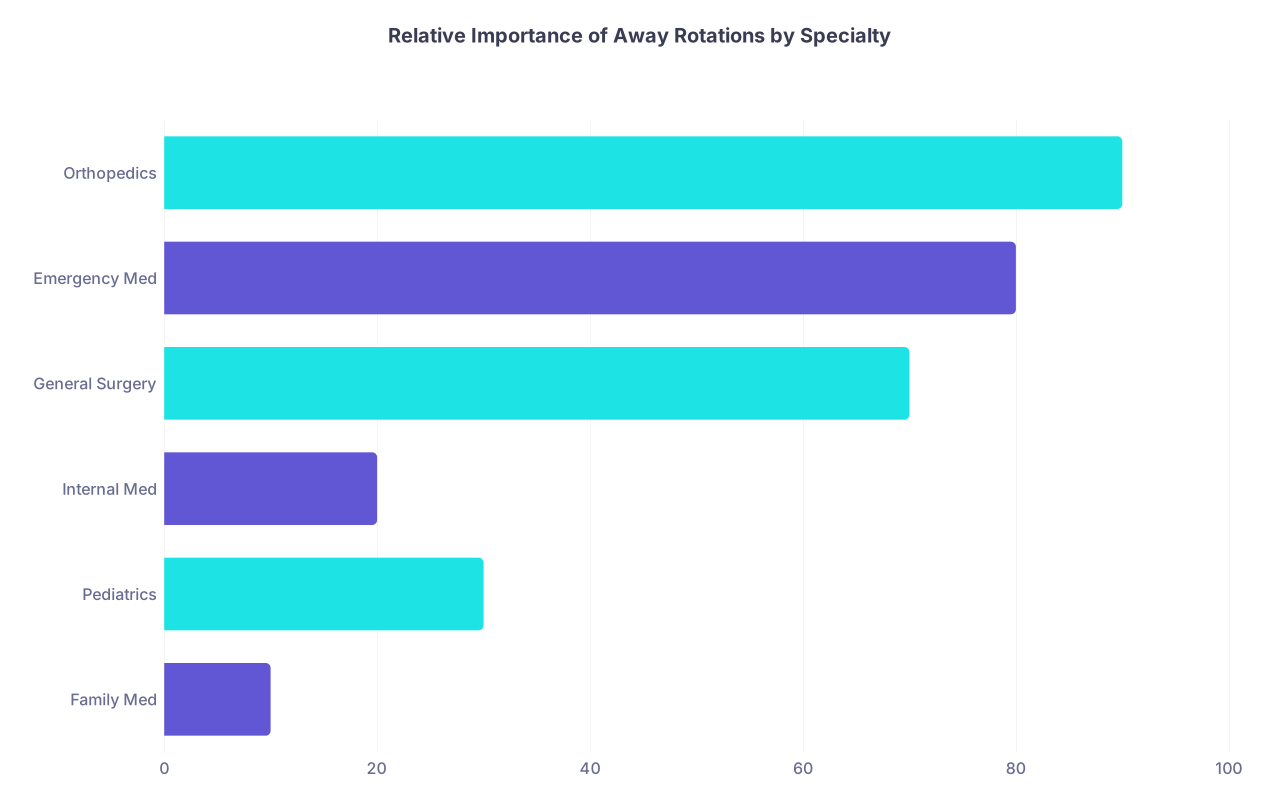
Quick reality check with aways
| Category | Value |
|---|---|
| Family Med | 10 |
| Pediatrics | 30 |
| Internal Med | 20 |
| General Surgery | 70 |
| Emergency Med | 80 |
| Orthopedics | 90 |
If you’re switching into something like EM or Ortho late, and you hadn’t planned aways, you may be in “do I push back graduation?” territory. For IM, Peds, FM, aways are often helpful but not essential unless you’re targeting an elite or geographic-specific program.
Tactically:
- Reach out to the away coordinator where you’re scheduled in the old field. Ask if they host students in the new specialty and if there’s any last‑minute flexibility to change departments.
- If not, decide quickly: cancel and try to book a late emergency away in the new field, or keep it and accept that this away is now just general experience, not match-critical.
Candidly: trying to scramble a new away in a competitive specialty in August for a September ERAS is usually a mess. One decent home sub-I + clinical elective + strong letters will often do more for you than a last-minute away that barely gets you a letter in time.
Step 8: Work with what you cannot change
Some things will not move. A required ICU month in August. A neuro rotation that’s locked. An away you can’t cancel.
So instead of brooding, think: how do I extract value for my new specialty from those blocks?
Examples:
Future IM applicant stuck on ICU in August:
Introduce yourself to the intensivists and hospitalists as someone applying IM. Ask to take on more primary responsibility, present on rounds, and get feedback. Then use that attending as a letter writer—they’re highly credible for IM.Future EM applicant on Neuro:
Focus on ED consults, acute stroke codes, and any overlap with emergency care. Ask your attending to comment specifically on your performance with undifferentiated acute patients.Future Peds applicant on required Ob/Gyn:
Ask to spend time on L&D with the pediatric team if available. Build relationships there.
Letters do not have to be from the exact same specialty to be useful. They have to demonstrate you’re a strong, reliable, teachable clinician.
Step 9: Decide if your change is a minor pivot or a major reset
Some schedule misalignments are annoying but survivable. Others are a sign that you may need to strongly consider delaying graduation or adjusting your application strategy.
Rough rule of thumb:
If by September you can realistically have:
- 1 sub-I or equivalent in the new field
- 2 solid letters in the new field (or 1 in-field + 1 very strong adjacent)
- A personal statement that isn’t obviously panicked and shows some thought
- A Step 2 CK that’s not catastrophic for that specialty
…then you can usually proceed with this cycle without doing anything drastic.
If instead, your truth is:
- No rotations in the new field before ERAS
- Only letters from your old specialty and some random preclinical faculty
- Scores on the weaker side for a competitive new field
Then you’re in “be honest with yourself” territory.
That may mean:
- Applying more broadly and more conservatively than your classmates
- Building a strong backup plan (e.g., prelim year, or a less competitive but acceptable specialty)
- Or, yes, choosing to delay graduation, do a research year, or push your real application to next cycle with a fixed schedule and stronger profile
I’ve watched students stubbornly apply this cycle “because I just want to be done” and then end up unmatched, burned out, and a year behind anyway. Sometimes slowing down once is better than losing bigger later.
Step 10: Control your narrative, not just your calendar
Programs will see your story. Old research, old away rotations, random scattered experiences. If it’s not coherent, they’ll write the story for you: “indecisive, couldn’t get a sub-I, maybe had issues.”
So you need to own the narrative head-on in:
- Your personal statement
- Your MSPE (where you can suggest framing to your dean if they’re open to student input)
- Interviews
You do not have to confess every twist and doubt. But you should be able to say something like:
“I initially explored [old specialty] in depth, including a sub-I and research, because I was drawn to [X aspect]. During my core third-year rotations, I realized that what consistently energized me day to day was [core element of new field]. I sought additional exposure in [specific rotations/electives] and found that the work, team dynamic, and patient population in [new specialty] aligned much more closely with how I want to practice.
Once I recognized that, I worked with my school to move a sub-I and elective earlier in fourth year so I could commit fully to this field and seek appropriate mentorship and letters. I’m glad I did—that experience confirmed that [new specialty] is where I fit best.”
That sounds intentional and mature, not chaotic.
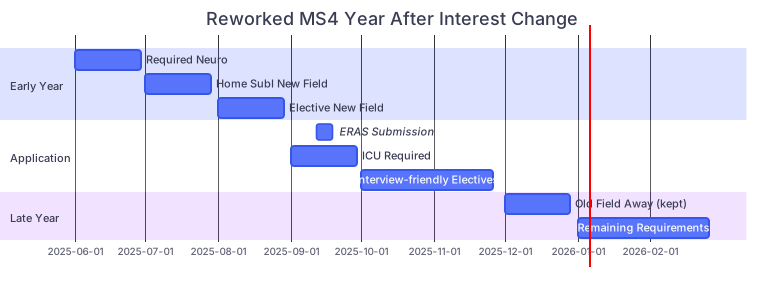
A quick visual: how your reworked year might look
| Task | Details |
|---|---|
| Early Year: Required Neuro | a1, 2025-06, 4w |
| Early Year: Home SubI New Field | a2, 2025-07, 4w |
| Early Year: Elective New Field | a3, 2025-08, 4w |
| Application: ERAS Submission | milestone, 2025-09-15, 1d |
| Application: ICU Required | a4, 2025-09, 4w |
| Application: Interview-friendly Electives | a5, 2025-10, 8w |
| Late Year: Old Field Away (kept) | a6, 2025-12, 4w |
| Late Year: Remaining Requirements | a7, 2026-01, 8w |
The key difference from your original mess: July–August are now working for your new specialty, not against it.
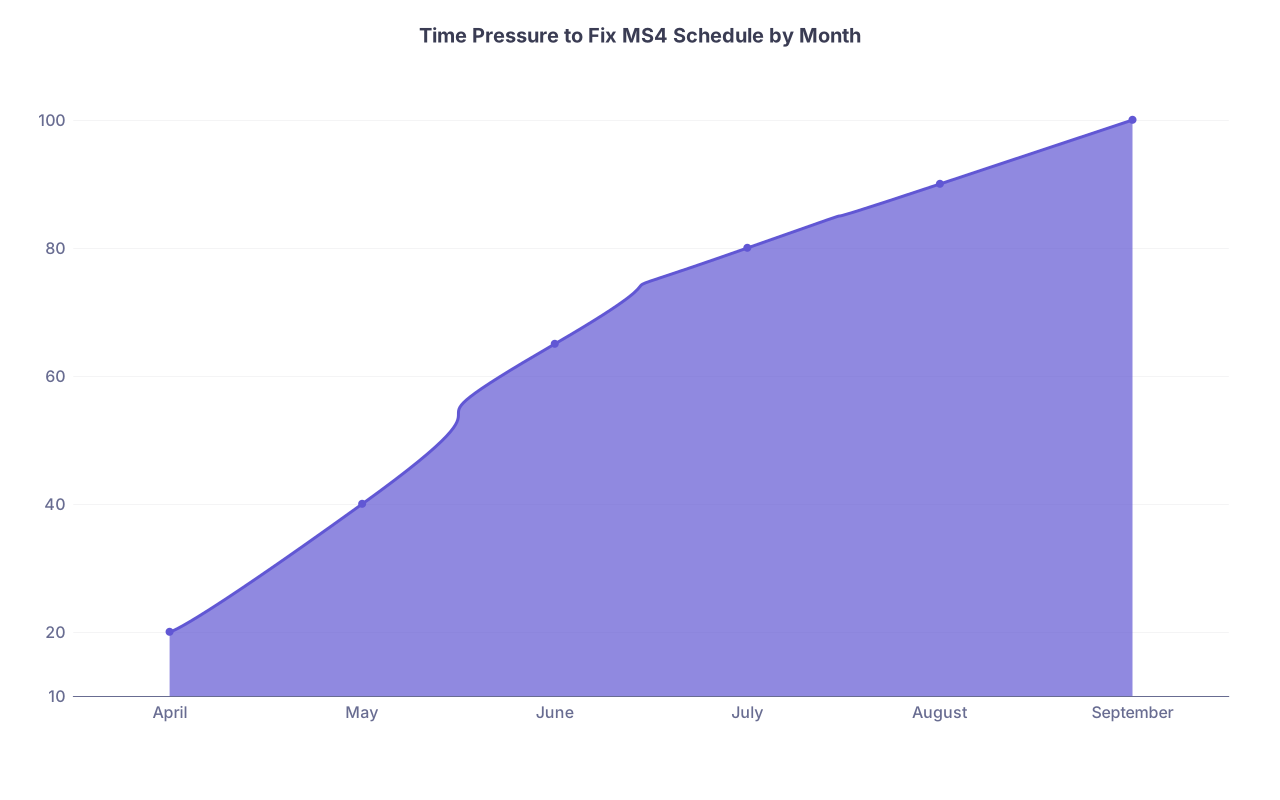
What to do this week (not “sometime soon”)
To keep this from becoming abstract “advice” you never use, here’s a tight checklist.
| Category | Value |
|---|---|
| April | 20 |
| May | 40 |
| June | 65 |
| July | 80 |
| August | 90 |
| September | 100 |
Higher value = more pain if you wait.
In the next 7 days:
- Write out your MS4 schedule month by month on one page.
- Write down your new specialty, your Step 2 score, and your honest competitiveness level.
- Mark which months before September are currently useless for your new field.
- Draft a specific ask to your registrar/scheduler (one actual swap you want).
- Email or meet your specialty advisor with that sheet and ask: “Is this enough for a realistic match in [specialty]? What would you change first?”
- Contact at least one course director to explore a concrete block swap.
- If you have an upcoming rotation in the new field, identify one or two attendings you’ll target for letters, and plan how you’ll approach them.
This is all manageable if you stop hand‑wringing and move.
Key points to walk away with
- A misaligned MS4 schedule after a specialty change isn’t fatal, but you must aggressively restructure June–September around your new field: at least one sub-I and 2 specialty-appropriate letters.
- Use the levers you actually have—registrar, course directors, classmates, deans—with specific asks, not vague complaints. Early, concrete, and flexible requests get the most yeses.
- Control the story: your old experiences aren’t wasted; they become evidence that you made a thoughtful, informed decision. But only if your new schedule and letters clearly back that up.


