
You’re three weeks into a low-volume, low-drama rotation. No codes. No big cases. The PD hasn’t once appeared on your floor. Meanwhile, your classmates on the ICU and trauma are collecting “great to work with” emails from attendings who have lunch with the PD twice a week. You start doing the math—and it feels like you’re losing.
If that’s where you are, this is for you. You got assigned a low‑visibility service, but you still want a real shot at face time with program leadership and a strong residency application out of this place. Here’s exactly what to do.
Step 1: Get Clear On What “Visibility” Actually Means
Low‑visibility services can be any of the following:
- Quiet consult services (endocrine, ID when census is low, rheum)
- Rehab, pre-op clinic, wound care, hospice
- Off‑site community hospital affiliates where leadership rarely rounds
- Night float with limited staff presence
- Electives where you mostly shadow and rarely present
You’re probably thinking: “If nobody important sees me, this rotation does nothing for my application.”
Not quite.
In reality, “visibility” breaks down into three buckets:
People who can write about you
Attendings, fellows, senior residents, site directors. They don’t have to be the PD. They just need to be credible and specific.People who can vouch for you
Folks the PD actually trusts—chiefs, long‑time faculty, APDs, site liaisons. They can mention your name in rooms you’ll never enter.People who can put you in the same room as the PD
Clerkship directors, coordinators, chiefs, faculty with regular leadership meetings.
On a low‑visibility service, you may not naturally run into #2 and #3. So you engineer it.
Step 2: Map Your Specific Situation in Week 1
You can’t fix what you haven’t mapped. Take one evening and answer these concretely:
- Who is my site director or rotation director?
- Who are the most connected people on this service? (Often the mid‑career attending who is on a bunch of committees, or the fellow who came from this program.)
- How often do our attendings interact with the PD or APDs? Daily? Monthly? Almost never?
- What standing meetings exist that I might access? Morning report, noon conference, grand rounds, morbidity & mortality, didactics.
- Who here has a reputation for good letters? Ask residents quietly: “Whose letter actually moves the needle for our PD?”
You’re not just trying to be “seen” generically. You’re trying to plug into the shortest path between you and the PD’s mental list of “people we want.”
Create a tiny mental org chart:
You → Attending / Fellow / Chief → Clerkship Director / APD → PD
Your whole rotation strategy is about strengthening each link.
Step 3: Stop Waiting for Traffic; Go Where the Traffic Is
If your service lives in a quiet corner of the hospital, you cannot just stay there and hope leadership magically appears. You need structured, legitimate reasons to be where they are.
Three high-yield moves:
- Commit to core conferences where PDs actually show up.
PDs and APDs reliably show up to:
- Morning report
- Noon conference (especially when catered)
- Grand rounds
- Program-wide didactics
Show up early. Do not sit in the back scroll‑scroll‑scrolling your phone. Sit near residents from that program, ideally within the first few rows.
During Q&A, ask one smart, concise question every couple of sessions. Not performative. Just engaged. Residents notice. Faculty notice. Sometimes the PD will look over and think, “Who is that student who keeps showing up and asking reasonable questions?”
- Use post-conference minutes intelligently.
You do not ambush PDs. But you can do this:
- After conference where the PD spoke or was clearly in the room
- You walk up, wait for a small gap in conversation
- You say:
“Hi Dr. Patel, I’m [Name], one of the [MS3/MS4]s on the [X] service right now. I’ve really liked working with your residents. I’m very interested in [specialty] and was hoping to learn what you look for in applicants who are rotating here, especially those of us on the quieter services.”
Then stop. Let them talk.
You just:
- Introduced yourself
- Signaled interest
- Linked yourself to “your residents” (always a good phrase)
- Framed yourself as thoughtful, not needy
If you can do this 2–3 times over a month, your name and face start to lodge in their memory.
- Show up consistently to the same events.
Hit morning report or noon conference consistently instead of randomly. Familiarity compounds. The PD may not know your whole story, but they start thinking, “That student is always here and engaged.”
Step 4: Turn Low‑Visibility Into High‑Signal Performance
You’re stuck on a sleepy endocrine consult service? Fine. Then you become the best endocrine consult student they’ve had all year. That matters more than you think.
Here’s how you turn a “nothing” rotation into a “who is this student?” effect:
Own something concrete:
Be the one who pre‑writes consult notes, follows up labs obsessively, or always brings a succinct one‑liner on every patient.Be visibly prepared:
When you present, have a short assessment that sounds like a resident, not a student:
“This is a 64‑year‑old with poorly controlled type 2 diabetes, admitted for cellulitis, now with steroid‑induced hyperglycemia. I think her basal insulin needs to increase to X, and here’s why…”Do the annoying follow‑through:
Check evening labs, call primary teams when plans change, update handoffs. Residents love this. Attendings notice when residents suddenly have fewer loose ends.
Why does this matter for a PD?
Because the attending or fellow eventually emails someone: “We have a student, [Your Name], who is outstanding. Please keep them on your radar for residency.” That email goes way further than you hovering awkardly around a PD for 30 seconds on rounds.
Step 5: Make Your Attending Your Advocate—Deliberately
You want at least one person from this “low visibility” month who is willing to:
- Write you a real letter
- Email the PD/APD about you
- Mention you in ranking discussions or recruitment meetings
You do not get that by being generically “solid.” You get it by being deliberate and direct.
Here’s a script that works, used in the last week of the rotation:
“Dr. Lee, I really appreciate working with you this month. I’m planning to apply in [specialty], and I’m particularly interested in [this program/this institution]. Do you feel you know my work well enough to write me a strong letter of recommendation, and potentially mention me to the program leadership if you think I’ve earned it?”
Two key words there: “strong” and “if you think I’ve earned it.”
If they hesitate, you move on.
If they say yes, you just secured:
- A potentially meaningful letter
- An implied permission to ask later: “If it isn’t too much trouble, would you be comfortable letting Dr. [PD/APD] know I’m applying? I’d be very grateful for any support.”
That kind of quiet advocacy is exactly how lower‑profile rotators move up in the stack.
Step 6: Use Chiefs and Residents as Your Doorway to Leadership
Often the PD won’t know you directly, but they will absolutely know which students their residents keep talking about.
Your residents are not just there to teach you; they’re your entry point.
Concrete plays:
- Ask a senior resident for feedback mid‑rotation:
“I’m hoping to be competitive for [X specialty] and would love to know what I could do this month to be the kind of student people here want as a resident.”
They now know your goal. If you back it up with performance, a good senior will eventually say to the PD, “We had a really good student on [obscure service]. They’d do well here.”
- Ask chiefs for tactical advice:
Chiefs live in the space between residents and leadership. Catch a chief after conference:
“I’m on [low‑profile service] this month and really interested in your program. Any suggestions on how to make sure I’m on the radar, given where I’m rotating?”
Sometimes they’ll straight-up say, “Email [APD X] and tell them I suggested you set up a meeting.”
That’s gold.
Step 7: Schedule One Focused Meeting With Leadership (Not 10)
You probably get one shot to sit down with the PD or APD without being annoying. Use it intelligently.
How to set it up:
- Ask your rotation director, clerkship director, or a supportive attending:
“Would it be appropriate for me to email Dr. [PD/APD] to ask for a brief meeting to learn more about the program? I want to be respectful of their time.”
If they say yes, then you send something like:
“Dear Dr. [Name],
My name is [Name], I’m a [MS3/MS4] from [Home Institution], currently rotating on [Service] here. I’ve really enjoyed working with your residents and am strongly considering applying to [Program] for residency this cycle. If you have 10–15 minutes sometime this month, I’d be very grateful for the chance to ask a few questions about what you value in applicants and how I can best position myself.
Thank you for your time,
[Name]”
Then prepare. This is not a chat about “work‑life balance.” Ask things that show you’re serious:
- “When you think about residents who really thrive here, what do they have in common before they arrive?”
- “For students who rotate here on lower‑visibility services, what are the most effective ways you’ve seen them stand out?”
- “Are there particular letters or faculty whose input you especially trust when it comes to applicants from away rotations?”
You’re gathering intel and letting them see you as thoughtful, self‑aware, and already functioning like a junior resident.
Step 8: Use Low‑Visibility Time to Build Output
One upside of a slower service: you have more mental bandwidth. If you just use it to scroll, yeah, it’s a waste. Or you can convert it into things that directly help your application and give you reasons to interact with faculty.
Examples:
Quick case report or short communication:
“Could we write this unusual [X] case up? I’d be happy to do the first draft.”
Even if it never gets published, you spend more time with your attending and they see your work ethic.Quality improvement idea:
Spot a systems issue, draft a tiny proposal, and ask, “Is this something the department cares about?” That often gets circulated to people above your attending.Teaching material:
Offer to prepare a 5–10 minute chalk talk for the team on something relevant. It shows initiative and can be mentioned in letters: “Gave an excellent mini‑presentation on [X].”
The point is this: your rotation might not be loud, but your footprint on it can be.
Step 9: Track Where PDs and APDs Actually Spend Time
Every program has a pattern. Some PDs basically live at morning report. Some are always in the ICU. Some are clinic‑heavy and only visible at journal club.
You’re trying to answer: “Where can I intersect with them again without being weird?”
Here’s a simple comparison of typical leadership “hotspots”:
| Setting | PD Presence Likelihood | How You Use It |
|---|---|---|
| Morning report | High | Sit front, ask rare concise question |
| Noon conference | Medium-High | Consistent attendance, brief intro |
| Grand rounds | Medium | Post‑talk intro or follow‑up email |
| ICU/ED rounds | Variable | If you rotate there later, excel |
| Clinic | Low-Moderate | Only if you’re assigned there |
Watch for patterns over the first week or two, then commit to the one or two settings that reliably put you in the same room.
Step 10: Do Damage Control if You’re Deep Into the Rotation Already
If you’re on week 3 of 4 and just now realizing, “I’ve basically been invisible,” don’t spiral. You still have time, but you can’t be passive anymore.
Do this immediately:
- Ask your main attending for mid‑course feedback—now.
“Dr. [Name], I know we’re getting close to the end of the rotation. I want to make sure I’m ending strongly. Could you share one or two specific things I can improve in this last week?”
Then fix those things aggressively. People remember the trajectory, not the starting point.
- Explicitly link your interest to this program.
If you actually want to match here, you need to say those words out loud to at least one faculty member: “This is a program I would be very excited to train at.”
People do not read minds. Once they know that, they’re more likely to mention you.
- Hit conferences hard for the remaining time.
For whatever days are left, you go to the high-yield gatherings. You listen, you ask one or two questions, you introduce yourself once. This is late, but late is better than never.
Step 11: Know What Not to Do
There are several ways students shoot themselves in the foot trying to “get face time.” Avoid these:
- Chasing the PD like a shadow in the hallway
- Cornering leadership with long personal stories when they’re clearly trying to leave
- Dropping, “I really need this program, I’ll do anything to match here” during a first introduction
- Repeatedly emailing PDs when they don’t respond the first time
- Asking residents to “put in a good word” when you have not actually worked with them closely
You want to project: competent, self‑aware, serious about this place, not desperate.
Step 12: Connect the Dots Across Rotations
Low‑visibility this month does not mean low‑visibility forever. You can use future rotations at the same institution to reinforce what you started here.
Strategic sequence:
- Quiet consult service now → ICU or wards here later
- Research month with faculty from this department → Away rotation or sub‑I next block
- Community affiliate now → Main campus sub‑I near interview season
And you always link back:
“Dr. [ICU Attending], I actually worked with Dr. [Consult Attending] on endocrine in June and really enjoyed seeing the other side of these admissions.”
Now your name starts popping up in multiple settings. That’s how you transform “random student” into “familiar, well‑regarded applicant.”
To visualize it:

| Step | Description |
|---|---|
| Step 1 | Low visibility rotation |
| Step 2 | Strong work with attending |
| Step 3 | Attending advocates to leadership |
| Step 4 | Attend conferences |
| Step 5 | Brief PD intro |
| Step 6 | Future high visibility rotation |
| Step 7 | PD remembers name and reputation |
Step 13: Use Metrics To Keep Yourself Honest
If you like structure, set simple targets for a 4‑week low‑visibility block:
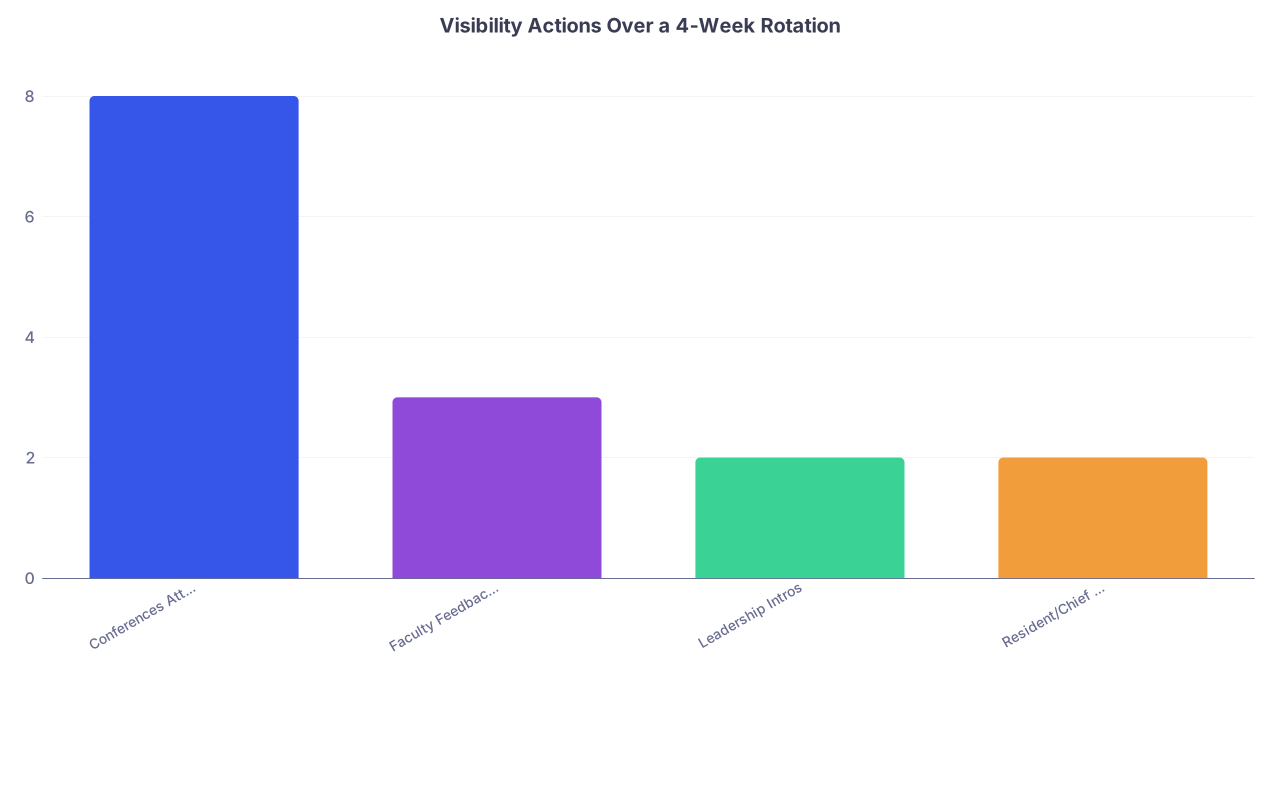
| Category | Value |
|---|---|
| Conferences Attended | 8 |
| Faculty Feedback Conversations | 3 |
| Leadership Intros | 2 |
| Resident/Chief Mentors | 2 |
That might look like:
- 8 meaningful conference attendances (2 per week)
- 3 explicit feedback conversations with faculty/residents
- 2 short PD/APD introductions or one short meeting + one hallway interaction
- 2 residents or chiefs who now know your name and goals
If you hit those numbers, you did not waste the month, no matter how quiet the service felt.
You didn’t choose a low‑visibility service, but you’re not stuck with a low‑impact month. You can turn a quiet consult block into a strong letter, a personal meeting with leadership, and a reputation that follows you into interview season.
The students who match well out of these situations aren’t lucky. They’re deliberate. They map who has power, they perform where they are, they show up where leaders are, and they ask directly for support when they’ve earned it.
Do that for this block, then do it again on your next one. By the time applications open and interview invites start rolling out, you won’t be the anonymous student from the quiet service—you’ll be the name multiple people already recognize when your file hits the PD’s desk. And that recognition starts tilting the match odds your way, one rotation at a time.