
Program directors absolutely do not only care about medicine. That myth survives because students repeat it to each other, not because any data supports it.
Let me be blunt: if you treat every clerkship that is not medicine as a disposable side quest, it will show up in your MSPE, on your transcript, in your narrative comments, and in your letters. And program directors actually read those. All of them.
You cannot “game” your third year by only turning on your brain for IM and your chosen specialty. The data, the surveys, and the actual behavior of PDs say otherwise.
Where This Myth Comes From (And Why It’s Wrong)
The myth usually comes packaged like this:
- “IM is the only rotation PDs really look at.”
- “As long as you crush medicine and your home specialty, you’re fine.”
- “Nobody cares about psych/OB/peds for an IM or surgery match.”
I’ve heard that exact phrasing from anxious MS3s standing in workrooms at 10 pm, trying to decide whether it’s worth reading on a psych patient because “it doesn’t matter for residency.”
Here’s what actually shapes that false belief:
- Medicine is often your longest, most heavily weighted clerkship.
- Many schools use IM as the “anchor” grade that influences class rank.
- Students see medicine and their target specialty mentioned in MSPE summaries, so they overgeneralize.
But go read NRMP and specialty-specific program director survey data. Over and over, you see phrases like:
- “Overall clerkship performance”
- “Evidence of reliability across rotations”
- “Professionalism concerns mentioned in MSPE”
Not “internal medicine grade in isolation.”
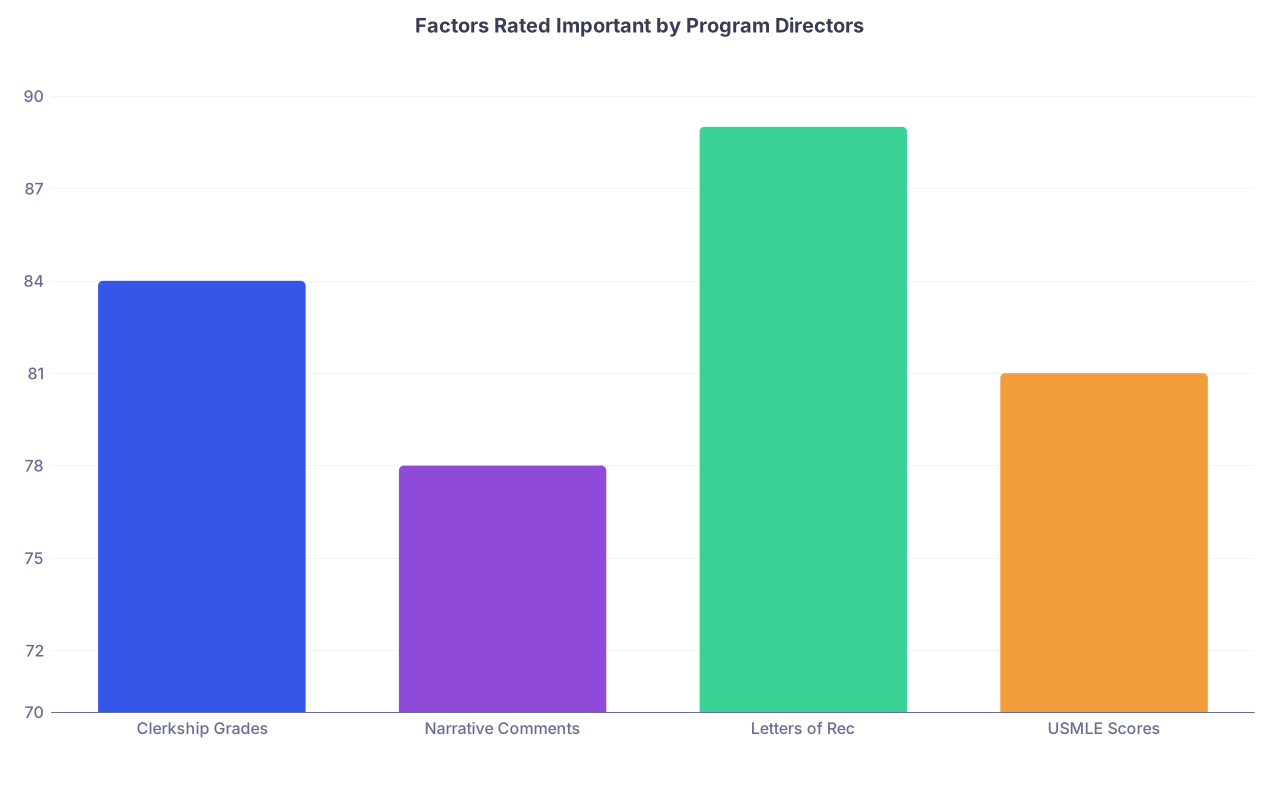
| Category | Value |
|---|---|
| Clerkship Grades | 84 |
| Narrative Comments | 78 |
| Letters of Rec | 89 |
| USMLE Scores | 81 |
Those numbers bounce around a bit by year and specialty, but the pattern is stable: clerkships as a whole, narratives, and letters matter at least as much as one star rotation.
You are not applying to internal medicine clerkship residency. You are applying as a physician-in-training whose behavior pattern across many environments will predict how you act as a resident. PDs know that. They train doctors, not “medicine-rotation specialists.”
What PDs Actually See: The Whole Pattern, Not One Number
Program directors don’t just see a line that says “Internal Medicine: Honors.” They get:
- A full transcript with all core clerkships.
- Your MSPE (Dean’s letter) that usually:
- Summarizes all core clerkship grades.
- Extracts key narrative comments from multiple rotations.
- Flags any concerns (professionalism, remediation, leave).
- Letters from different specialties that describe how you function in different environments.
So imagine two applicants for internal medicine:
Applicant A
- IM: Honors
- Surgery: High Pass
- Peds: High Pass
- OB/GYN: High Pass
- Psych: Pass with note about “frequent lateness, needed reminders to complete notes”
Applicant B
- IM: High Pass
- Surgery: Honors
- Peds: Honors
- OB/GYN: High Pass
- Psych: Honors, comments about “independent learner, excellent team communication”
Who’s more attractive to a competitive IM program?
If you think PDs blindly pick Applicant A “because IM grade,” you’re kidding yourself. Repeated high performance and strong narratives across multiple settings are a better predictor of a reliable intern than one shining clerkship surrounded by mediocrity and red flags.
Programs routinely rank B over A in that scenario. I’ve watched that conversation happen: “Yeah A honored IM, but those professionalism comments and just-OK other rotations worry me. B looks solid everywhere.”
That’s the part nobody tells the MS3s.
The Real Role of Each Core Clerkship in Your Application
Different clerkships send different signals. PDs absolutely care about them—just not all for the same reason.
Internal Medicine: Yes, It Matters. But Not Alone.
Internal medicine is still a big one for many specialties, because it tests:
- Bread-and-butter inpatient care
- Note writing, presentations, basic clinical reasoning
- Reliability over several weeks with a continuous team
If you’re going into IM, EM, anesthesia, neurology, or many subspecialties, a poor medicine performance hurts. But an Honors in IM doesn’t buy you immunity from everything else.
Surgery: Work Ethic and Grit Signal
Surgery rotations—especially at busy academic centers—are notorious for long hours and high expectations. PDs know that if you:
- Showed up on time at 4:30–5:00 a.m.
- Took feedback without melting down.
- Stayed engaged despite fatigue.
…then you probably have at least baseline stamina and professionalism.
I’ve sat in meetings where non-surgical PDs said some version of: “Their surgery evals are great. That tells me they can handle a hard month without falling apart.”
So if you’re going into IM, EM, or even psych and you treat surgery as “who cares,” that short-sightedness is visible. That “Pass, seemed disengaged and often disappeared from the floor” on surgery? That’s a giant red flag for any program.
Pediatrics and OB/GYN: Communication and Flexibility
Peds and OB/GYN are stress tests for:
- Communication with families.
- Handling high-emotion situations.
- Working in chaotic inpatient/outpatient hybrids.
Programs like IM, EM, FM, and peds itself pay attention to these. OB/GYN comments about you calmly explaining preeclampsia to an anxious patient say more about your maturity than one extra medicine shelf percentile.
If you trash your OB rotation because “I’m going into radiology,” do not be surprised when your MSPE pulls a quote about you seeming uninterested or disengaged in patient care. Radiology PDs read that too.
Psychiatry: Emotional Intelligence and Team Behavior
Psych rotations highlight:
- How you handle difficult conversations.
- Your ability to work with nursing and social work.
- Your insight into your own biases and reactions.
Those narrative comments about “excellent listener,” “respectful with challenging patients,” “contributes thoughtfully to team discussions”—those land very well with PDs in almost every specialty. Residents are not just test-score machines. They are colleagues interacting with vulnerable people (including staff and co-residents).
A weak psych rotation with comments about poor boundaries, insensitivity, or dismissiveness? That is a fatal wound in certain programs.
Family Medicine, EM, or Other Required Rotations
These often show:
- Breadth of knowledge.
- Ability to manage undifferentiated complaints.
- Time management in high-volume settings.
Again, not optional. A solid FM or EM rotation with strong comments can partially offset a single weaker clerkship, because it suggests your “average behavior” is still strong.
The Data: PDs Care About Global Performance
The NRMP Program Director Surveys (for IM, surgery, EM, peds, psych, OB/GYN, etc.) consistently rank some version of “grades in required clerkships” and “MSPE narrative” near the top of decision factors.
Not “medicine only.” Required clerkships. Plural.
| Aspect | Why PDs Care |
|---|---|
| All core clerkship grades | Global reliability and consistency |
| Narrative comments | Real behavior, not just numbers |
| Professionalism notes | Predictor of major residency problems |
| Outlier weak rotations | Potential blind spots or attitude issues |
PDs are trying to answer three questions:
- Will this person show up, consistently, on time?
- Will they get along with nurses, residents, attendings, and patients?
- When things are hard and they’re tired, do they still function?
You do not answer those questions with “Honors in IM, whatever elsewhere.” You answer them with a pattern across the entire third year.
The Silent Killer: MSPE Narratives and Red Flags
Everyone obsesses over grades and forgets that the words under them matter more. Program directors actually read those little comment snippets like:
- “Needed multiple reminders to complete notes on time.”
- “At times seemed disinterested on less acute patients.”
- “Frequently left the floor without communicating with team.”
Those can come from any rotation. OB. Psych. Surgery. FM.
I’ve seen otherwise strong applications sink because of:
- A professionalism remediation that started on a “non-essential” clerkship.
- A pattern of “quietly disengaged” comments from multiple non-medicine rotations.
- One spectacular “concern regarding honesty” from a short specialty rotation.
You do not control which rotations end up having power in your story. The faculty who actually write detailed comments are often the ones on the smaller or “less prestigious” services that had time to observe you. Ironically, those are the ones students blow off.
Terrible strategy.
Specialty-Specific Reality: Who Cares About What?
Let’s kill some specialty-specific myths.
Applying to Internal Medicine
No, they don’t only care about IM and neurology.
Good IM programs look at:
- IM, sure. But also:
- Surgery: work ethic and responsiveness.
- Psych: how you handle complexity and communication.
- OB/Peds/FM: whether you treat non-adult-medicine patients and families with respect.
A transcript of IM Honors with repeated “Pass, minimally engaged” elsewhere is less attractive than consistent High Pass/Honors across the board with strong comments.
Applying to Surgery
Surgery PDs are not blind to everything non-surgical.
They absolutely scan:
- Medicine: can you manage pre-op/post-op intern-level tasks?
- OB/GYN: your OR etiquette and operative stamina often show up here, especially for Gyn-Onc or heavy surgical OB programs.
- EM/ICU rotations (often 4th year) for acute management and crisis behavior.
And psych/peds/others matter for the same thing: do you treat others well? If your psych eval says you were dismissive of staff or rolled your eyes in family meetings—you think that doesn’t worry someone who’s about to put you in a high-stress OR?
Applying to “Lifestyle” or Cognitive Specialties (Rads, Path, Derm, etc.)
Students sometimes treat non-specialty clerkships as basically irrelevant. That’s how you get:
- “Brilliant but difficult to work with” themes.
- Comments about poor teamwork or entitlement.
Those matter a lot in small departments where everyone works closely. Derm PDs, for example, are very aware of interpersonal dynamics—they’re building tiny teams. A bad psych or OB narrative can absolutely kill you.
How To Actually Use Clerkships To Help Your Match
No, you do not need to Honor every rotation. That is unrealistic for most people. But you must stop treating non-medicine clerkships as “fluff.”
Here’s the smart strategy:
Decide a floor, not just a ceiling.
You want as few weak spots as possible. Especially avoid:- Failing or needing remediation in any clerkship.
- Professionalism comments or patterns of disengagement.
Treat each new service as a fresh audience, not a vacation.
That psych attending might write the best narrative in your entire file. Same for that OB hospitalist who actually noticed how you handled a screaming L&D patient at 3 a.m.Collect letters from where you actually shined, not just your target specialty.
A glowing letter from peds or psych that describes you as dependable and thoughtful can reinforce your overall story nicely. EM or IM PDs love those.If you bomb one rotation, overperform on the rest.
One off month happens. Two or three? That’s a pattern. After a bad rotation, you don’t get to “coast” on an easier one. You have to prove the earlier performance was the exception.

| Step | Description |
|---|---|
| Step 1 | Start Core Clerkships |
| Step 2 | Strong IM Performance |
| Step 3 | Strong Non IM Rotations |
| Step 4 | Consistent Positive MSPE |
| Step 5 | Stronger Application Signal |
| Step 6 | Weak Non IM Rotation |
| Step 7 | Negative Narrative Comment |
| Step 8 | PD Concern About Reliability |
The point of third year is not to become an “IM person” or a “surgery person.” It’s to show that in multiple environments you show up, do the work, and do not cause damage.
FAQs
1. If I know I’m going into IM, can I relax on OB or surgery as long as I pass?
No. “Just passing” with lukewarm or negative comments can hurt you more than you think. IM PDs care about professionalism and consistency. A Pass with vague or negative narratives on another core clerkship can drag down your MSPE and raise concerns about how you’ll behave when the work is unglamorous—which a lot of intern year is.
2. Will one bad clerkship ruin my match chances?
Usually not, if it’s truly one outlier and not tied to professionalism or honesty concerns. PDs understand people have off months, bad fits, or life events. What worries them is a pattern: two or three weak or disengaged rotations, or repeated similar negative comments. Your job after one bad month is to overperform on subsequent rotations and make the narrative clearly “one-off,” not “this is who they are.”
3. Do PDs actually read all the narrative comments, or just look at grades and scores?
Yes, they read them. Especially at the interview-invite and rank list stages. Grades and scores screen you in; narratives are often what distinguish you from the pack. Short comments like “always early, great with nursing staff, sought feedback and improved” stick in PDs’ minds far more than whether your shelf was at the 72nd vs 79th percentile.
4. If I honored IM but only got Pass in psych and OB, should I address that in my application?
If there’s a clear, explainable, and truthful reason (illness, mis-scheduled exams, clear context) that doesn’t sound like excuse-making, a brief mention in your Dean’s letter addendum or personal statement can help. But the main fix is forward-looking: secure strong letters from rotations where you excelled, maintain excellent performance in fourth-year sub-Is and electives, and let PDs see a strong overall upward or consistent trend rather than dwelling on old Passes.
Key points:
- Program directors care about your global clerkship pattern, not just internal medicine.
- Narrative comments and professionalism signals from any rotation can help or seriously hurt you.
- Smart students treat every core clerkship as a chance to prove they’re a dependable future colleague—not as background noise to the “important” one.