
Prestige of your clerkship site is wildly overrated as a predictor of residency interviews. Your performance signal and what gets documented on paper matter far more than the hospital logo on your badge.
Let’s kill this myth properly.
You’ve probably heard some version of: “You have to rotate at Big Name Academic Center or you’ll never match X specialty.” Or, “Community rotations won’t impress programs.” That sounds intuitive. It’s also not how program directors actually behave once they’re sitting in front of a spreadsheet sorting 800 applications in ERAS.
They don’t see “prestige.” They see: grades, narrative comments, standardized assessments, letters, Step/COMLEX, and your story. The rest is mostly noise.
What Program Directors Actually Look At
We don’t have to guess here. The NRMP’s Program Director Survey has been asking the same questions for years: what factors influence who gets an interview?
The answers are boringly consistent.
| Factor | Approx. % PDs Citing as Important* |
|---|---|
| Step 2 CK / COMLEX score | 75–85% |
| Clerkship grades in core specialty | 70–80% |
| Letters of recommendation | 70–80% |
| MSPE (Dean’s Letter) narrative | 60–70% |
| Class ranking / honors (AOA, etc.) | 40–60% |
*Ranges across recent survey years and specialties, but the ranking order is stable.
Notice what’s missing: “Prestige of third-year clerkship site.”
It’s not that program directors are blind to institutional reputation. They’re not. But for the average applicant, the brand name of the ward where you rounded in third year is a faint, unreliable signal. Compared with a clear “Honors – Outstanding performance; resident-level responsibility; excellent fund of knowledge” in your evaluation? No contest.
The Prestige Myth: Why It’s So Sticky
The prestige myth survives because it’s emotionally satisfying. It gives a simple story: “If I get into Famous Academic Medical Center for my clerkship, I’m safe.”
Students and even some faculty repeat this narrative:
- “If you want derm, you have to be at [Elite Hospital] for that rotation.”
- “Programs won’t respect grades from community sites.”
- “Program X only interviews people who rotated at big-name places.”
I’ve watched MS3s fight to switch out of a very well-run community medicine service into a chaotic “top” university service that barely knew their name. Why? Prestige tax. They were willing to sacrifice meaningful evaluation for a logo.
Here’s the problem: letters and narratives are written by people who actually worked with you. If the “prestigious” service is so busy or resident-driven that you’re functionally invisible, you lose your strongest signal: documented performance.
A quiet, unflashy community site where the attending knows exactly how you think, how you work, and how quickly you improved? That can generate a lethal (in the good way) letter.
What Predicts Interviews: Performance, Measurably Documented
We need to separate three things:
- True clinical growth – how much better you actually get.
- Documented performance – what ends up in evaluations, grades, MSPE.
- Perceived prestige – the halo effect of big names.
Residency interviews are driven almost entirely by #2. #1 is morally and professionally important, but programs don’t directly see it. #3 only matters when #2 is strong enough to be noticed.
How your clerkship performance actually shows up
Concrete things that get used:
- Shelf exam scores (sometimes explicitly, often folded into grades).
- Clerkship grades (Pass / High Pass / Honors, or equivalents).
- Narrative comments in the MSPE (“consistently read ahead,” “functioned at intern level,” “required close supervision”).
- Letters of recommendation (particularly from the specialty you’re applying to).
- Any standardized forms (SLOEs in EM, specialty-specific checklists, etc.).
None of those automatically improve because the hospital is “fancy.” They improve when:
- You get enough face time and responsibility to stand out.
- You’re assessed by people who actually write strong, specific letters.
- The grading system at that site gives you a realistic shot at Honors/High Pass.
That’s performance yield. And prestige often works against you there.
Where Prestige Helps (And Where It Doesn’t)
I’m not going to pretend prestige never matters. It does. Just not in the simplistic way people think.
Where clerkship prestige can help a bit
Letter-writer recognition.
A letter signed by a nationally known chair or fellowship director can carry more weight if:- It’s detailed.
- It clearly states, with examples, that you’re in the top X% of students they’ve worked with. A vague letter from a big name is worse than a specific, enthusiastic letter from a well-respected but less famous attending.
Signal of comparable rigor.
For some hyper-competitive specialties, coming from a known academic environment can signal you’ve seen complex pathology, worked in resident-heavy teams, and tolerated academic pressure. But again, they still look at what your evaluations actually say.Name recognition bias.
Human brains are lazy. A PD glancing at “Clerkship in Cardiology – Big Name University Hospital” may pay a bit more attention than “Community General Hospital.” But if the comments are tepid or the grade is mediocre, that halo vanishes fast.
Where prestige absolutely does not save you
- A weak narrative in the MSPE. “Performed at expected level for training” is PD code for: perfectly average, do not recruit on this alone.
- Low Step 2 or COMLEX scores. No hospital logo compensates for being 1+ SD below their usual interview range.
- Generic letters. “Pleasure to work with, strong clinical skills, good team player” without any rankings or specifics? Might as well be a template.
- Known “easy-Honors” sites. Some programs explicitly discount certain schools or sites they know hand out top marks like candy. Prestige can backfire here.
The Big Trade-off: Status vs Signal
Let me give you the real decision you’re often making when you chase “prestige” for third-year core rotations or fourth-year sub-Is:
Prestige-heavy option:
Big academic center. Famous name. Lots of residents. Busy service.
You may:- See complex cases.
- Present less.
- Have fewer direct interactions with attendings.
- Struggle to stand out among many students.
Performance-heavy option:
Solid but less glamorous site. More direct attending contact.
You may:- Have primary responsibility for more patients.
- Get direct feedback.
- Get noticed.
- Get specific, memorable comments and stronger grades.
When it comes to interview invites, the second scenario usually wins.
I’ve seen two near-identical applicants in internal medicine:
- Student A: Rotated at an elite academic center, got High Pass, letter said “performed at expected level, bright and enthusiastic.”
- Student B: Community-heavy core IM rotations, did a sub-I at a regional academic affiliate, got Honors, letter said “top 5% of students in the last five years, independent management of complex patients, would be my first choice for intern.”
Guess who pulled more interviews from university programs? B. Easily.
Away Rotations: Where Prestige Actually Bites
The single scenario where “prestige of clerkship” genuinely intersects with interview decisions is away/audition rotations. But even there, the myth gets it half-wrong.
Programs do tend to interview:
- Most students who rotate with them and do well.
- Some students who rotate with them and are borderline but likable.
- A minority of students who rotate with them and do poorly (mainly as courtesy, sometimes not at all).
So the prestige effect here isn’t “big name hospital → more interviews everywhere.” It’s “rotating at the specific program you want → much higher chance of an interview at that program if you don’t tank.”
Away rotation ≠ generic prestige bump. It’s basically an in-person month-long interview. And the same rule applies: performance, not just presence.
If you’re choosing between:
- An away at a “top 5” name where you’ll be one of ten students, or
- An away at a strong but mid-tier academic program where you can be one of two students and actually shine
It’s not obvious that the “bigger name” is the better interview strategy, especially if your goal is to maximize actual interview offers instead of flexing hospital logos on your CV.
Data Reality Check: What Correlates With Match Odds
Let’s simplify things a bit and look at what consistently moves match outcomes in the literature and PD surveys:
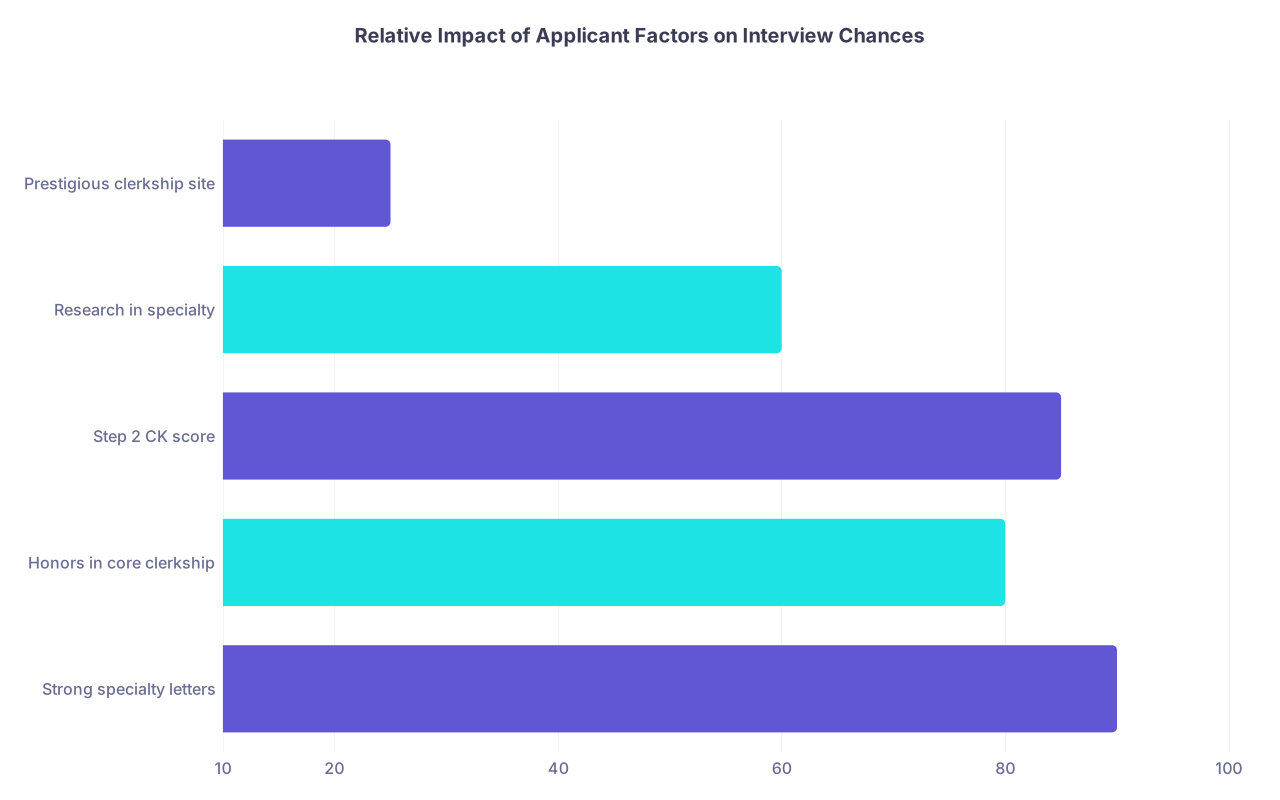
| Category | Value |
|---|---|
| Strong specialty letters | 90 |
| Honors in core clerkship | 80 |
| Step 2 CK score | 85 |
| Research in specialty | 60 |
| Prestigious clerkship site | 25 |
No, these numbers are not from a single randomized trial (we do not randomize students to “prestigious” vs “non-prestigious” ward teams). They’re a realistic representation of how PDs rank importance in survey after survey.
Program directors themselves are telling you: they care about your documented performance in their specialty, your exam scores, and the quality of your letters. “You rotated at Hospital X” barely registers without that.
How to Actually Use Clerkships to Boost Interview Chances
Let’s get very practical and very specific.
1. Stop chasing prestige, start chasing responsibility
You want clerkships where:
- You’re writing real notes that matter.
- You’re presenting on rounds, not shadowing in the back.
- You’re seeing patients first, not just co-signing the intern’s work.
- You get consistent, direct feedback from attendings.
Those are the conditions that produce the phrases PDs love to see: “functioned at intern level,” “took ownership,” “independent learner,” “excellent clinical reasoning.”
2. Optimize your letters, not your zip code
Ask yourself:
- Who actually watched me manage patients over time?
- Who saw me improve?
- Who let me make real decisions (with supervision)?
That’s your letter writer. If that person is at a mid-tier or community site, so be it. A glowing, specific letter from “Dr. Unknown, MD – Community Affiliate” beats a bland letter from the famous department chair who barely remembers you.
3. Exploit your evaluation system
Every school has:
- “Killer” sites where almost nobody gets Honors.
- “Friendly” sites where strong students reliably do well.
- Known tough graders.
- Known advocates who push for good students.
You’re not “gaming the system” by choosing sites where your effort will be fairly recognized. You’re just refusing to handicap yourself for the illusion of prestige.
If your school data quietly shows that 40% of students Honor Medicine at Community Site A and 10% at University Site B with the same shelf score, do not martyr yourself to B in the name of image.
4. Use prestige surgically
There are a few targeted situations where prestige is worth the trade-off:
- You’re dead-set on one hyper-competitive specialty (derm, plastics, ENT, ortho, neurosurgery).
- You have already proven you can stand out on busy academic teams.
- You’re going there for a sub-I/away specifically to that program you want to match at.
- You know the service actually lets students shine (ask upperclassmen honestly).
Even then, you’re going there to perform, not to collect a logo. If you can’t get face time or responsibility, it’s a wasted opportunity.
The MSPE Trap: Where Weak Performance Gets Exposed
Many students underestimate how brutally transparent the MSPE can be. It often includes:
- Grade distribution graphs for your class.
- Where your clerkship grades fall within that distribution.
- Selected comments, both positive and negative.
A “Pass” in medicine at your home school that gives out 60% Honors is a red flag, no matter where you rotated. A “High Pass” at a site that hands out Honors to everyone is also telling.
Prestige does not hide this. If anything, it can highlight it, because PDs know the grading culture at big-name places and read context into it.
So What Actually Predicts Interviews?
Boil it down to this:
- Honors/High Pass in your core specialty clerkships, especially at your home institution, is a big predictor of getting your foot in the door.
- Clear, enthusiastic, specific letters from people who supervised you clinically are almost non-negotiable for competitive fields.
- Step 2 / COMLEX scores still heavily shape your initial screening chances, even in the “holistic” era.
- Evidence you can function like an intern (sub-I evaluations, strong narratives) is gold.
The hospital’s brand name? Minor tiebreaker. Maybe useful seasoning. Not the main ingredient.
If you’re about to choose clerkships, ask a more uncomfortable but far more predictive question: “Where will I be forced to show up, think hard, work, and be evaluated by people who will actually go to bat for me when it’s time to apply?”
That, not the shine of the logo on your ID badge, is what will quietly decide how many interviews hit your inbox.
Years from now, you won’t care whether your stethoscope once swung through a world-famous lobby; you’ll care whether you built the kind of performance record that made people fight to have you on their team.