Community hospital rotations do not tank your chances of matching at academic programs. The myth survives because people repeat anecdotes louder than they read data.
You’ve probably heard some version of this in the hallway:
“If you want academic internal medicine, you have to rotate at the big-name university hospital.”
“PDs don’t take community letters seriously.”
“If your core clerkships are at a community site, kiss top-tier programs goodbye.”
I’ve watched students quietly panic over this. Rearranging schedules, begging for any university spot, assuming every day at a community site was some sort of “downgrade.” It is not that simple. And a lot of what you’ve been told is flat wrong or at least wildly exaggerated.
Let’s separate myth from what actually shows up in match outcomes, program director (PD) surveys, and the way letters and evals are read.
What the Data and PDs Actually Care About
Programs do not rank you based on how many marble columns your hospital lobby has. They care whether:
- You performed strongly on clinical evaluations
- You worked with people they trust and got strong letters
- You demonstrated that you can function in a real clinical environment
- Your board scores / class rank / research line up with their usual pool
That’s true at big academic centers and at solid community programs.
If you want something concrete, look at the NRMP Program Director Survey (they update it regularly). For almost every specialty, the top factors are:
- Clinical grades in required clerkships
- Letters of recommendation in the specialty
- USMLE/COMLEX scores
- MSPE / class ranking
- Perceived commitment to the specialty
- Performance in away/audition electives
Notice what’s missing:
“Core clerkships must be at an academic medical center.”
“Community hospitals are devalued.”
“Only letters from big-name institutions matter.”
Not there. Because that’s not how most PDs think.
What does change with setting is the signal they get about you: how detailed letters are, what kind of autonomy you had, how directly you were observed. Those things can be better or worse at either site, depending entirely on local culture.
The Big Myth: “Community = Less Impressive”
Let me be blunt: a lot of the anti–community rotation noise comes from status anxiety, not outcomes.
Students assume:
- Academic hospital = top-tier, research-focused, “serious” medicine
- Community hospital = lower acuity, less complex, “easy” medicine, weaker teaching
Reality is messy.
I’ve seen:
- Community medicine wards with absolutely brutal patient loads, very high acuity, and zero hiding spots. You present. You write the notes. Your decisions matter.
- University services where the student barely gets to touch a patient because the chain of resident–fellow–attending is so long and cautious. You watch, you nod, you hope someone remembers your name long enough to fill in your evaluation form.
From a PD’s perspective, a strong evaluation from a busy, respected community hospital where you clearly worked hard and showed growth can be more informative than a generic “did fine” from a big-name academic behemoth.
This becomes very obvious when you see letters like:
“X functioned at the level of a strong intern. Took ownership of her patients, communicated well with families, and independently looked up management questions and presented them concisely on rounds.”
versus
“Y met expectations. Was present for rounds and got along well with the team.”
You probably know which letter is from which site. And you also know which one helps you match.
Where Community Rotations Help You
Community hospitals quietly give you some advantages that students underestimate.
1. You’re actually seen
At smaller or community sites, you’re more likely to:
- Work with the same attending for 2–4 weeks straight
- Rotate on a team with fewer learners (maybe just you and a resident, or you and the attending)
- Get direct observation of your H&Ps, notes, and patient interactions
That leads to:
- Detailed evaluations
- Strong, specific letters (“I watched her personally manage…” instead of “He was a student on my service…”)
- Concrete stories you can use in personal statements and interviews
PDs do not want “star of the universe.” They want: “I watched this person function on a real team, day after day, and they were reliable, kind, and smart.” Community settings are often better at producing that kind of evidence.
2. You get more reps
You know what’s not rare at community hospitals?
- Bread-and-butter IM and FM cases, over and over
- Real continuity encounters in clinic
- Procedures like paracentesis, joint injections, I&Ds, pap smears, laceration repairs
For many specialties — internal medicine, family, EM, general surgery, OB/GYN — repetition builds competence and confidence. You can talk in interviews about:
- Managing 15+ patients on a busy ward
- Calling consultants and handling cross-cover issues
- Educating patients in a primary-care setting where resources are limited
That resonates with PDs. It signals you will not fold the first time you cover a night float shift.
3. Letters from community attendings are not “discounted”
This one needs to die:
“Letters from community faculty don’t count.”
Programs care whether the writer:
- Explains how they know you
- Gives concrete examples of your performance
- Compares you to peers
- Mentions they’d love to have you as a resident
If your community attending is faculty for your med school or part of a residency program, they understand what a useful letter looks like. And they often have more time and emotional bandwidth to actually write one.
Is a letter from a nationally known researcher in your specialty useful? Of course — if they really know you. But a lukewarm letter from a big name is far weaker than a detailed, enthusiastic letter from a community clinician who worked with you for weeks.
When Rotating at Academic Sites Actually Matters
Here’s the nuance people ignore: community rotations do not hurt you, but there are cases where having some academic exposure helps. Especially for highly competitive or research-heavy specialties.
Think:
- Dermatology
- Plastic surgery
- Neurosurgery
- ENT
- Radiation oncology
- Ophthalmology
- Certain fellowships you’re already aiming toward
For those, academic programs like to see:
- Serious research experience (often at academic centers)
- At least one away/audition or sub-I at an academic program in the specialty
- Letters from people in that specialty who are known in the field
Note the pattern. The specialty needs academic exposure, not your entire third-year core.
You can absolutely:
- Do core IM, surgery, peds at community sites
- Then do sub-Is / electives in your target specialty at academic centers in 4th year
- Add research time at an academic lab if needed
The PD does not care whether your third-year OB/GYN was at Big City University or Suburban Regional Medical Center if you’re applying into neurosurgery. They care about your neurosurgery letters, research, and performance on neurosurgery rotations.
To make this clear:
| Scenario | Academic Exposure Needed? |
|---|---|
| Applying IM to mid-tier academic | Helpful but not mandatory |
| Applying FM (community programs) | Mostly not |
| Applying Derm / Plastics / Neurosurg | Strongly yes (for sub-I / aways) |
| Applying EM | One academic EM rotation recommended |
| Applying OB/GYN academic-heavy | Sub-I at academic center helpful |
The Real Risk: Weak Rotations Anywhere
The thing that truly hurts your match chances is not where you rotate. It’s how you show up and what ends up documented.
Students get obsessed with “Is community bad?” when the more honest categories should be:
- Strong community rotation
- Weak community rotation
- Strong academic rotation
- Weak academic rotation
You can absolutely torpedo your app at either site by:
- Being passive and forgettable
- Showing up barely on time, leaving early
- Not knowing your patients cold
- Acting like a tourist instead of a team member
On the flip side, you can shine in any setting by:
- Owning your patients
- Anticipating questions and next steps
- Being the person the intern trusts at 3 a.m. to organize data or call the lab
- Following up on teaching points and coming back the next day sharper
PDs don’t see “community vs academic” on your ERAS and automatically assign a score. They see narratives, patterns, letters, grades.
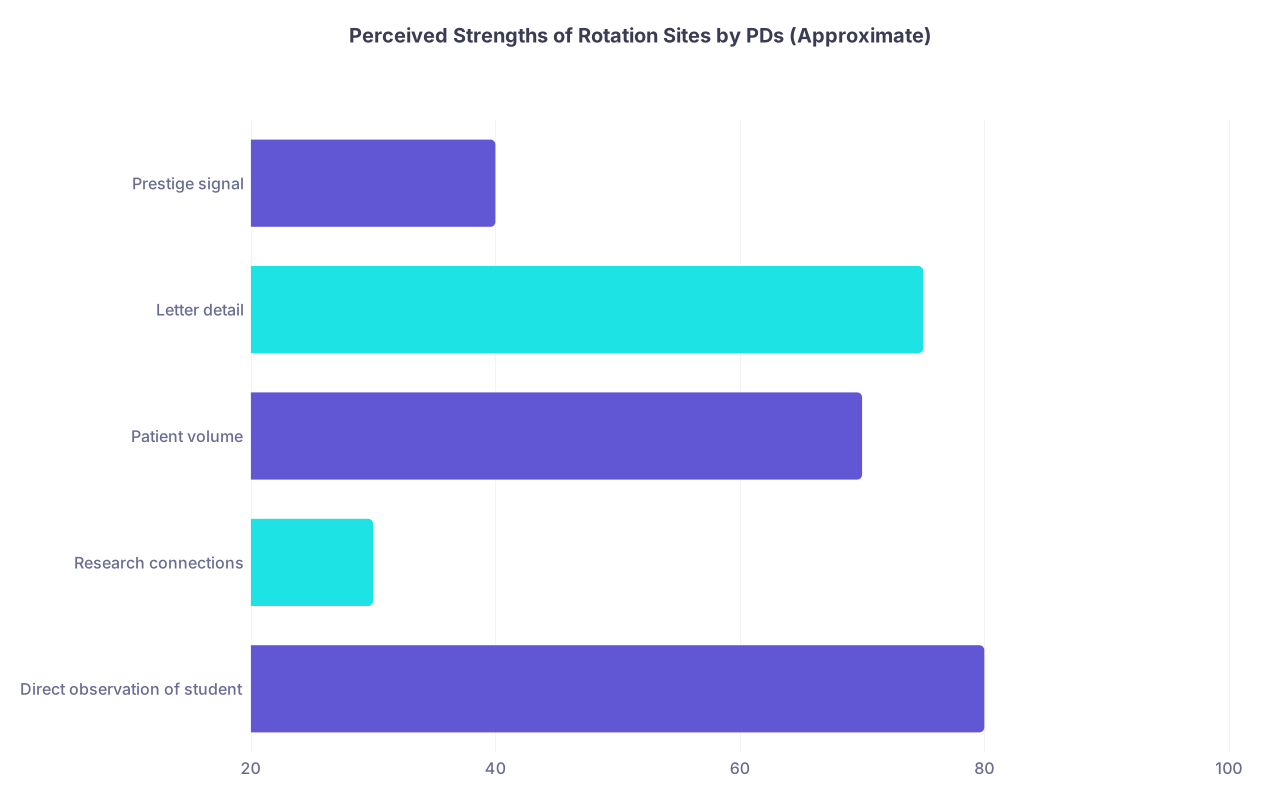
How Community vs Academic Rotations Actually Show Up on Your Application
Let’s map what each setting tends to generate, based on what I’ve repeatedly seen.
| Category | Value |
|---|---|
| Direct observation of student | 80 |
| Research connections | 30 |
| Patient volume | 70 |
| Letter detail | 75 |
| Prestige signal | 40 |
Rough rule of thumb (not rigid, but common):
Community sites often rate higher in:
- Direct observation
- Volume of bread-and-butter cases
- Detailed letters about your day-to-day function
Academic sites often rate higher in:
- Research and scholarly opportunities
- Name recognition / prestige signal
- Specialty depth and exposure for niche fields
Your job is not to worship one type over the other. It’s to exploit the strengths of where you’re placed and then plug gaps with targeted electives and sub-Is.
Strategic Use of Community Rotations for the Match
If you want to match well — academic or community — community rotations can be an asset if you’re smart about them.
Here’s how.
1. Treat community as your “performance lab”
Use community clerkships to:
- Prove you can function as an intern: notes, presentations, follow-through
- Work on clinical reasoning — not just test-answer recall
- Build habits of reliability: showing up early, closing the loop, calling family, chasing labs
Then, when you go to an academic sub-I or away rotation, you’re not figuring out how to be on the team. You’re already good. You can focus on fit and relationships, not basics.
2. Target your letters
If you know you want an academic IM residency, choose:
- 1–2 strong letter writers from your best rotations, even if they’re community-based
- 1 letter from an academic subspecialist or sub-I attending, especially in your chosen field
You’re not gaming the system; you’re giving PDs what they want: consistent performance across settings, plus at least one letter from someone who knows the academic landscape.
3. Use 4th year to show you belong in academics (if that’s your goal)
If your core year was mostly community-based and you’re worried, here’s the antidote:
- Do a sub-I at your home academic hospital in the specialty (or closely related)
- Do an away rotation at a realistic academic program where you’d be competitive
- Show up there as the polished, high-functioning student your community rotations helped build
If you perform, nobody’s going to say, “But wait, your third-year psych was at a community site, so we’re out.”
When Community Might Truly Be a Problem
There are some legitimate issues that can show up more often at community sites — and these can hurt you if you don’t intervene.
Watch for:
- No formal teaching or feedback structure
- Attendings who refuse to complete evaluations or write letters
- A culture where students are invisible and treated like scribes only
- No residents or academic affiliation, so nobody knows what to document for residency apps
If you’re stuck in one of these black holes:
- Be proactive about asking for feedback and an honest evaluation.
- Identify at least one attending who seems education-minded and work closely with them.
- Use other rotations (including academic or better-structured community ones) to generate your key letters.
This is not a “community vs academic” problem so much as a “bad educational environment” problem. And yes, those exist at “name brand” university hospitals too. Just with fancier signage.
The Bottom Line: What Actually Hurts or Helps Your Academic Match Chances
Let me strip this down to the uncomfortable truth people avoid.
What hurts your academic match chances:
- Mediocre clinical performance, documented across rotations
- Lukewarm, generic letters that say nothing specific about you
- An application that screams “wants academic prestige” but shows zero research or academic engagement
- Poor board scores relative to your target tier
- Weak performance on away/sub-I rotations at academic programs
What does not inherently hurt your chances:
- Doing most of your core clerkships at a well-run community hospital
- Having letters from community faculty who know you well
- Lacking a famous hospital name all over your transcript
What helps your chances:
- Strong evaluations — wherever they come from
- Detailed, enthusiastic letters that describe you as already near-intern level
- At least one or two targeted academic experiences (sub-I, away, research) for competitive or academic-focused specialties
- Actually being good with patients, teams, and clinical reasoning — which community sites are very good at exposing
Years from now, you won’t remember whether the hospital lobby had a glass atrium or beige tile; you’ll remember the days you actually became a clinician. Programs are looking for that person. Not the one who collected logos.