
Research electives do not beat clinical rotations for the Match. Not even close. For most applicants, flipping that priority is exactly backward.
The myth is seductive: disappear into a lab for a month, crank out a paper, and suddenly you are “more competitive” than the classmates still grinding on wards. I’ve heard students say, “Program directors care about PubMed, not whether I did another sub‑I.” That line is repeated often enough it sounds like wisdom.
It is not. It is half‑true in a few narrow situations and flat‑out wrong in most others.
Let’s pull apart what actually moves the needle for residency programs and where research electives sit in that hierarchy.
What Program Directors Actually Care About (Not What Reddit Tells You)
You do not have to guess. Program director surveys spell this out every couple of years.
The NRMP Program Director Survey (latest major iterations: 2020–2022 data) consistently shows the same pattern across most specialties: clinical performance and perceived fit beat research almost every time.
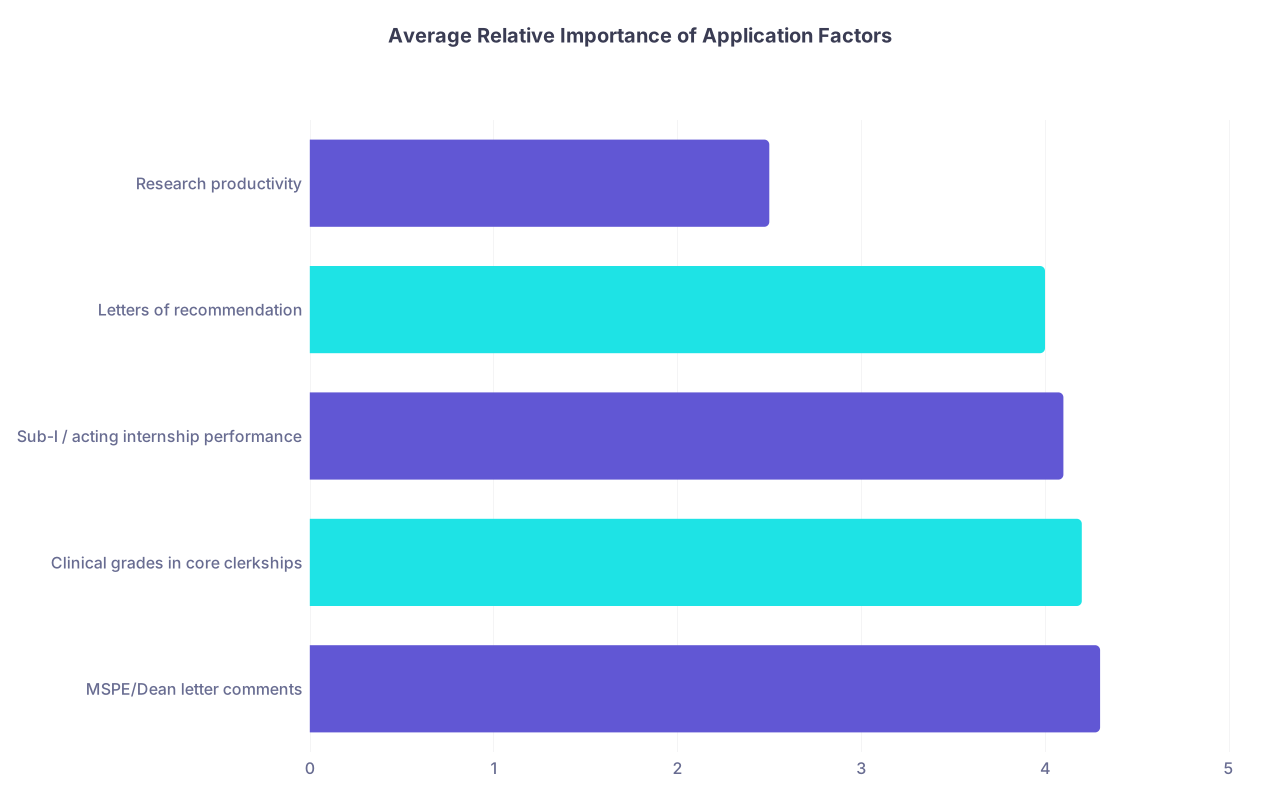
| Category | Value |
|---|---|
| MSPE/Dean letter comments | 4.3 |
| Clinical grades in core clerkships | 4.2 |
| Sub-I / acting internship performance | 4.1 |
| Letters of recommendation | 4 |
| Research productivity | 2.5 |
The exact numbers vary by specialty, but the stack‑rank is remarkably stable:
- Narrative clinical evaluations (MSPE, clerkship comments)
- Grades in core clerkships and sub‑internships
- Letters of recommendation from people who actually worked with you clinically
- Class ranking or honor society status (where used)
- Then—down the page—research experience, presentations, and publications
Yet students routinely act as if one more abstract will erase mediocre medicine or surgery evaluations. It will not.
Here is the blunt reality: for 90% of applicants, a strong clinical month that produces an “I would rank this student in my top 10%” letter is worth more than an extra line on your PubMed list.
When Research Actually Matters (And When It Really Does Not)
The myth exists because there are pockets where research is truly valuable. People over‑generalize those pockets to everyone.
Research matters a lot for:
- Physician‑scientist tracks (e.g., PSTP in IM, research‑heavy neurology or heme/onc pipelines)
- MSTP/MD‑PhD applicants continuing in a research-heavy environment
- Ultra‑competitive academic programs in certain fields (derm, rad onc, elite academic neurosurgery)
- Applicants with an otherwise excellent file competing at the margins for “trophy” programs
For these, meaningful, sustained research (often years, not a single elective) and strong letters from recognizable investigators can be decisive. But even for them, that does not mean research electives “beat” clinical work—just that research is part of the non‑negotiable package.
Research matters a little for:
- Most academic‑leaning programs in internal medicine, pediatrics, neurology, etc.
- Applicants in competitive specialties without eye‑popping Step or clerkship credentials who need every possible signal of “seriousness”
In these cases, having some research, ideally in the specialty, is better than none. It shows interest, persistence, and the ability to finish something. But a research elective that produces no output and no strong letter? That barely registers.
Research matters almost not at all for:
- Community‑focused programs whose main concern is: can you take care of patients on day one
- Applicants with weak clinical performance trying to cover it with a research month
- Students who stack “research electives” just to avoid service
Program directors are not stupid. They read schedules. If your fourth year is a graveyard of “research,” “independent study,” and one lonely sub‑I, they know exactly what happened: you dodged actual work.
And they will assume you will do the same in residency.
The Hidden Problem: What Research Electives Can’t Give You
The core problem with research electives is structural. They do not give you the currency programs value most: clear clinical performance data.
On a typical research elective you lack several things:
Direct observation of patient care
Nobody is watching you handle a sick patient at 3 a.m., or a difficult family, or a chaotic sign‑out. That’s what convinces attendings you’re ready for residency.Comparative context
Clinical attendings see dozens of students rotate each year. When they say “top 10%,” that means something. A PI saying “hard‑working in the lab” has no built‑in comparison set programs trust.High‑impact letters about how you function on a team
Residency is 90% being a reliable, reasonably pleasant, clinically competent teammate. The strong letters that move you up a rank list focus exactly on that.Evidence you can handle clinical volume
A month in the lab does not reassure anyone you can see 12–15 patients, place orders, staff efficiently, and write notes that are not disasters.
You may enjoy research more than wards. That is completely valid. But enjoying something does not mean programs prioritize it.
Clinical Rotations: Still the Kingmaker for the Match
There is a reason students still panic about their medicine clerkship and their sub‑Is: those months move rank lists.
When I look at applicants I’ve seen succeed in the Match—especially those who “punched above their weight”—there is a common pattern:
- They had one or two absolutely stellar clinical months in their chosen field.
- Those months produced powerful letters with specific stories.
- Those letters overrode slightly average stats or CVs.
Research, when present, was usually supporting evidence, not the lead actor.
Why sub‑Is and audition rotations usually beat research electives
Sub‑internships and audition rotations do four things research never will:
- Put you side‑by‑side with residents and attendings who write the strongest letters.
- Give programs a real‑time audition of how you work on their team.
- Provide narrative comments that fill your MSPE with gold.
- Let you show consistency: show up early, handle pages, own patients, ask for feedback, improve.
When a PD sits down with your file, they do not ask, “How many months did they pipette?” They ask, “Will this person make my residents’ lives easier or harder?” Clinical rotations answer that. Research does not.
“But I Need Publications to Even Be Looked At, Right?”
This is where anxiety distorts reality.
Yes, some specialties and programs have high research averages. Look at the NRMP “Charting Outcomes in the Match” reports and you’ll see big research numbers for matched applicants in derm, plastics, rad onc, ENT, neurosurgery.
What students miss is the denominator: those “research experiences” often include minor projects, posters, case reports, and non‑first‑author work. And the direction of causality is messy.

A few clarifications:
- High research counts in those specialties reflect who applies to them, not just what programs demand. People aiming for derm and rad onc often self‑select into years of research.
- A massive research CV can’t fully compensate for mediocre Step scores or poor clinical evaluations in those same specialties.
- Many solid, mid‑tier programs in competitive fields still care more about whether you’re a safe, functional intern than whether you have eight second‑author papers.
Programs want to see:
- Some evidence you are curious and capable of scholarship, if they’re academic.
- A track record of finishing something.
- Letters from faculty who can vouch that you’re not a liability.
All of that can be accomplished without sacrificing high‑yield clinical time for an extra research elective.
When a Research Elective Does Make Sense
Now the contrarian twist: there are situations where a research elective is exactly the right move. The key is that it’s targeted, not reflexive.
Think about a research elective if:
You are clearly aiming for a research‑heavy academic career or PS track
Planning for physician‑scientist pathways, serious academic onc, or transplant ID? Then yes, getting embedded with a major lab or outcomes group early and deeply makes sense.You already have strong clinical evaluations and at least one good sub‑I lined up
Research electives are far more defensible as an “extra” once the core clinical foundation is solid.You can convert the elective into something concrete in time:
A submission, abstract, or at least a truly detailed letter from a well‑known investigator saying you owned a project.You are switching fields late and need a quick signal of interest
For example, pivoting from surgery to rad onc late MS3, and snagging a rad onc research elective that gets you in front of the faculty who will later vouch for your seriousness.
In those cases, research electives are not beating clinical rotations; they’re complementing strategic clinical work you’ve already done.
When Choosing Research Over Clinical is a Red Flag
Programs can smell avoidance.
Here are the patterns that make reviewers skeptical:
- A schedule that’s oddly light on sub‑Is or audition electives in your chosen field, but packed with “research time”
- Research electives unrelated to your specialty, clearly used as generic time‑fillers
- No usable output from multiple research electives (no abstracts, no posters, no specific letter describing a real contribution)
That last one is more common than people admit. I’ve seen fourth‑years show up with two, three, even four “research months” and nothing tangible to show for them. When asked, they mumble something about “data collection” and “the paper is in progress.”
Programs read that as: passive, not proactive, did the minimum, did not own anything.
If you are going to “spend” a block of elective time on research, you’d better be able to get something meaningful out of it—either a strong letter or a credible product.
Smart Scheduling: Blending Clinical and Research the Right Way
The question is not “research or clinical.” It’s sequence and proportion.
For most students targeting a moderately competitive specialty at academic programs, a sensible high‑yield pattern looks like this:
| Priority | Elective Type | Goal |
|---|---|---|
| 1 | Home sub-I in specialty | Flagship letter and eval |
| 2 | Away/audition elective | Fit and visibility |
| 3 | Additional clinical month in field or ICU | Depth and confidence |
| 4 | Focused research elective with one mentor | Concrete output + letter |
Notice what is first. Always the clinical rotation that generates your flagship letter and evaluation. Clinical work sets the floor. Research, if pursued, pushes up the ceiling slightly.
You can absolutely thread in research. Just do not pretend it replaces—or “beats”—the core clinical pieces programs actually use to decide who to rank.
Specialty‑Specific Nuance (Because Blanket Rules Are Lazy)
Let’s zoom into a few specialties where myths are especially loud.
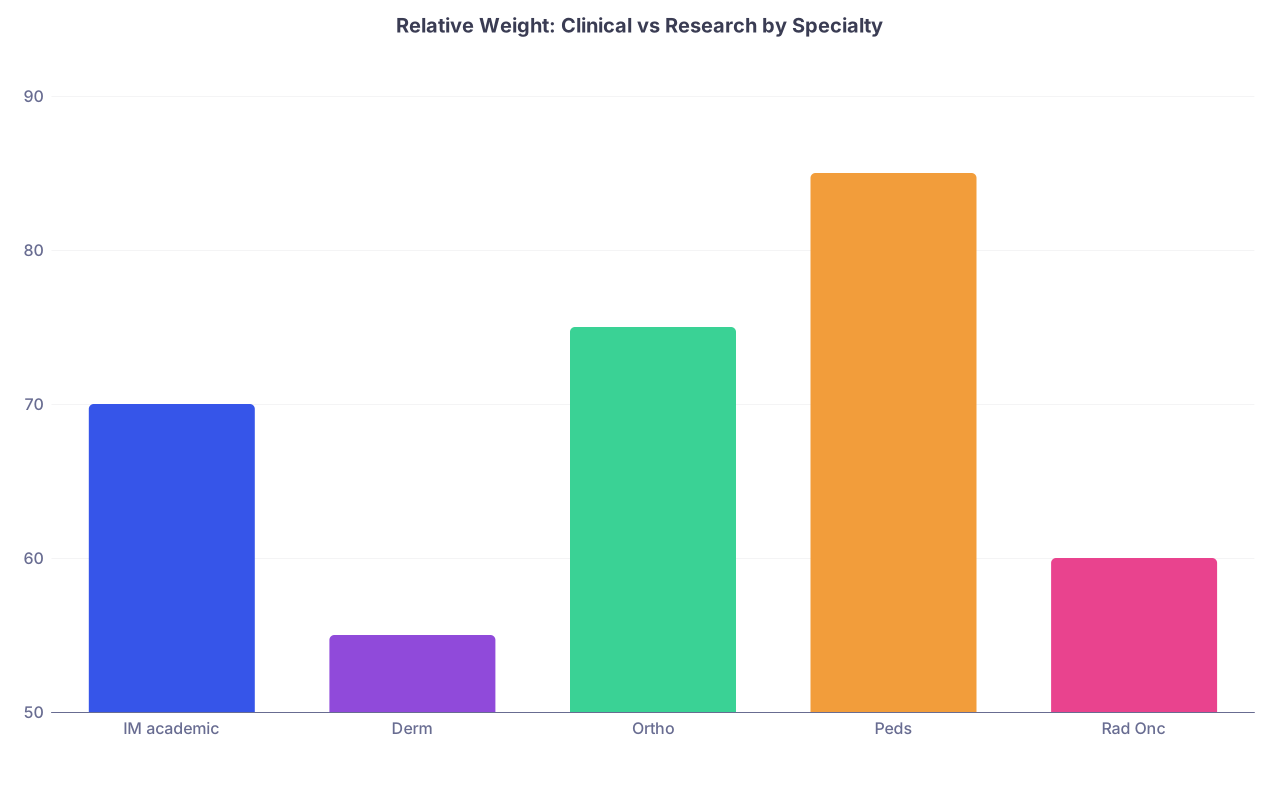
| Category | Value |
|---|---|
| IM academic | 70 |
| Derm | 55 |
| Ortho | 75 |
| Peds | 85 |
| Rad Onc | 60 |
Interpret that loosely as: approximate “clinical weight” out of 100, with the rest being research/other factors. Not exact numbers, but the pattern is real.
Dermatology – Research is heavily valued, especially at top programs. But try getting in with weak medicine and surgery evaluations. You will not. At least one absolutely stellar derm clinical month plus strong core clerkships is mandatory; research then stratifies the top of the pool.
Orthopedic surgery – Research helps, especially multi‑center studies or sports/biomechanics projects. Yet the real separator is how you perform on away rotations and your surgery sub‑I. Clinical impressions here are brutal and decisive.
Internal medicine (academic) – More flexible. A serious research background can open doors at MGH, UCSF, Hopkins, etc. But they still care deeply about whether you can function on the wards. A research‑only application without powerful clinical letters will not fly.
Pediatrics / Family medicine – Most programs emphasize your humanity and clinical reliability far more than your abstract count. A research elective can be nice window dressing. It’s almost never the reason someone matches—or does not.
Radiation oncology / Rad onc‑adjacent fields – Historically research‑heavy. Here, a targeted research elective with a rad onc group can matter quite a bit. But even then, the best‑positioned applicants usually balance that with real exposure in clinic.
The pattern: the more niche and academic the field, the more research can act as a pseudo‑entry ticket. But even then, weak clinical performance caps how far you go.
How Program Directors Actually Think About Trade‑Offs
I’ll spell out the internal monologue I’ve heard:
- “Would I rather see one more research month or a strong ICU/sub‑I where they clearly carried a load?” → ICU/sub‑I. Almost every time.
- “Would I rank higher the applicant with an extra low‑impact poster or the one whose letter says ‘hardest‑working student I’ve had in years’?” → The letter. Without hesitation.
- “Does this stack of research electives tell me they’re committed and scholarly, or that they’re avoiding clinical work?” → Depends on output and letters. No output? It screams avoidance.
Research is a tie‑breaker for many programs, not the main event. Clinical performance is the main event.
How to Decide: Your Simple Sanity Check
Here’s the practical test before you sign up for another research elective:

| Step | Description |
|---|---|
| Step 1 | Need elective choice |
| Step 2 | Choose clinical elective |
| Step 3 | Do sub I or audition elective |
| Step 4 | Clinical or mixed elective |
| Step 5 | High yield research elective with clear project |
| Step 6 | Strong core clinical evals? |
| Step 7 | At least one sub I in chosen field? |
| Step 8 | Targeting research heavy academic career? |
If you do not yet have at least:
- Strong core clerkship comments
- One sub‑I or audition month in your target field (or firmly scheduled)
then choosing research over clinical is almost always a mistake.
Only once the clinical floor is solid should you ask: “Is a research elective now the highest‑yield way to advance my goals?”
Sometimes the answer is yes. Many times, it is not.
The Verdict: Myth Busted
“Research electives beat clinical rotations for the Match” is lazy advice that confuses correlation with causation and over‑reads the experience of a narrow minority of applicants.
For most students, most of the time:
- Clinical performance is the currency programs care about.
- Sub‑Is and audition rotations are where careers are made or broken.
- Research electives are optional leverage, not a replacement for the hard clinical work.
Use research strategically. Do it when it aligns with your career path, when you have a realistic shot at real output, and when it comes after you have proved you can take care of patients.
Years from now, you will not remember exactly how many posters you listed on ERAS—but you will remember the rotations where you actually learned to be a doctor, and so will the people who decided to rank you.