
Away rotations are not golden tickets. They are expensive auditions with mixed returns, variable evidence, and a lot more mythology than data.
If you’re about to drop several thousand dollars and a month of your life assuming, “If I rotate there, I’ll at least get an interview,” you’re operating on faith, not facts.
Let’s pull this apart.
What Programs Actually Use Away Rotations For
Here’s the first uncomfortable truth: programs do not need away rotators to fill their interview slots. They already have a pipeline—home students, regional schools, “name brand” med schools, and people with strong scores or research.
Away rotations mostly serve three program needs:
- Extended audition – They get 4 weeks to see you work instead of 20 minutes on Zoom. Great for them, not always great for you.
- Cheap labor – You join the service, pre-round, call consults, and help keep the machine moving.
- Risk reduction – For borderline or non-traditional candidates, the away can either de-risk you (“oh, this person’s actually great”) or confirm concerns.
Notice what’s missing: “Guaranteed interview for everyone who rotates.”
Even in fields where aways are common—orthopedics, neurosurgery, EM, plastics—the more honest program directors will tell you straight: an away rotation gets you looked at closely. It does not immunize you against a “no.”
What the Data Actually Shows (Across Specialties)
Let me walk through what the literature and surveys actually say, stripped of the folklore.
1. Surgical Specialties
These are the rotations students most commonly view as “required aways.”
Orthopedic surgery, neurosurgery, plastics, ENT—multiple specialty-specific surveys show roughly the same pattern:
- Most applicants do 1–3 aways.
- A large fraction of matched applicants matched at a program where they did an away.
- Programs often say aways are “important” or “very important” in ranking decisions.
Students read that and translate: “I must do an away to match” and “If I rotate, I’ll get an interview.”
Wrong on both counts.
The nuance:
- In many of these studies, programs explicitly say they use aways to screen people out. Poor work ethic, bad team fit, unprofessional behavior. Those students don't get ranked, let alone interviewed again.
- Students who match at away programs often look strong on paper anyway—good Step 2 scores, home research, strong letters—so you cannot attribute the match solely to the away.
So yes, aways matter more in surgery than in psych or peds. But “more important” is not the same as “guaranteed interview.”
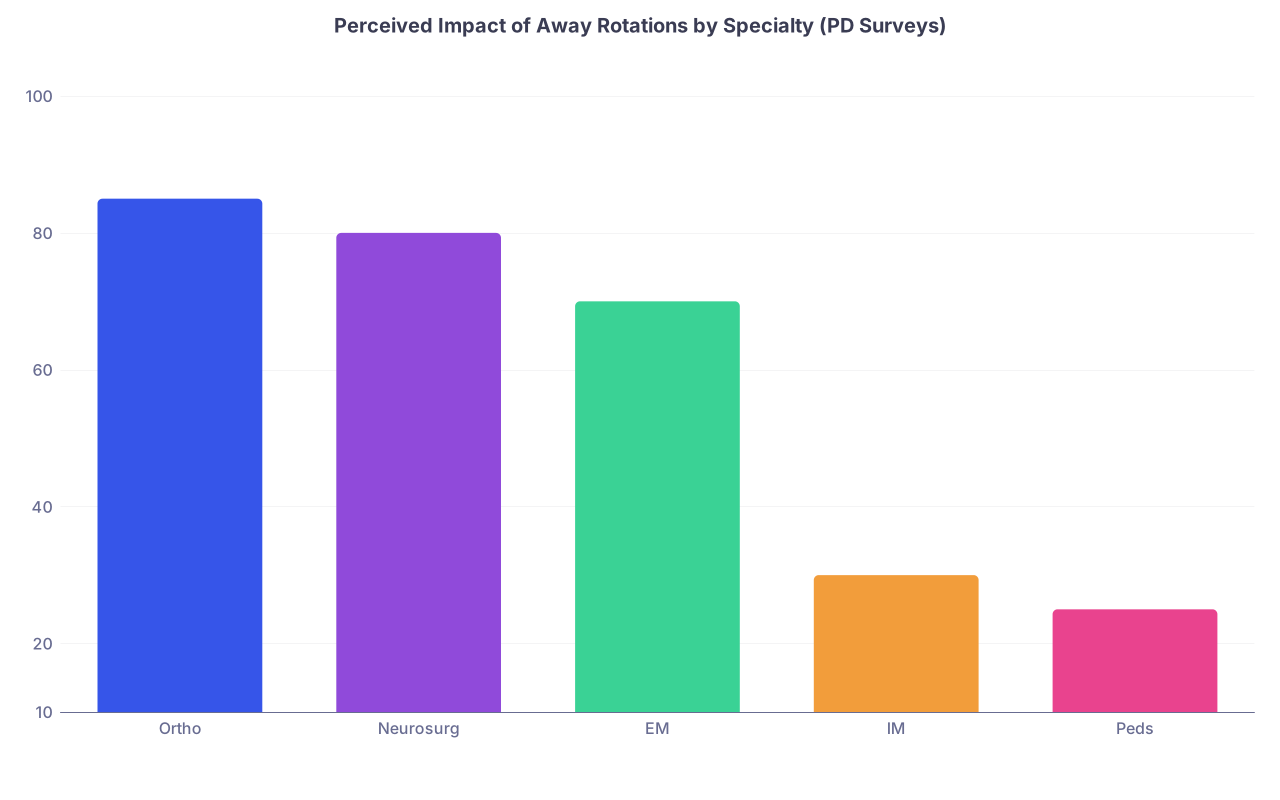
| Category | Value |
|---|---|
| Ortho | 85 |
| Neurosurg | 80 |
| EM | 70 |
| IM | 30 |
| Peds | 25 |
(Values = % of program directors rating aways as “important” or “very important” for ranking decisions in various published surveys. There is some variation by study, but the pattern holds: procedural fields care more.)
2. Emergency Medicine
EM is notorious for believing its own myths. For years, the story was:
- Two EM rotations.
- Two SLOEs.
- Then you’re safe.
Reality:
- Aways in EM strongly influence evaluations and SLOEs.
- EM program directors repeatedly report that SLOEs carry huge weight, often more than Step 2 scores.
- But there are lots of applicants each year who do an EM away and still get no interview at that same program.
I’ve seen it: A student at a mid-tier school rotates at a big-name academic EM program, works hard, gets a “solid” SLOE (not top 10%), and then never hears from them again. They end up matching at a different academic program that never met them in person.
The away gave them a usable letter. That’s it.
3. IM, Peds, Psych, FM
In these fields, aways are often:
- Not required.
- Less common outside of geographic or niche interest reasons.
- A mixed bag in terms of actual value.
Program directors in these specialties often say they value:
- Home performance (core clerkships).
- Letters from known faculty.
- Fit with mission (rural, academic, etc.).
- Research, in certain niches.
An away might help if:
- You’re trying to break into a highly competitive program (e.g., top 10 IM program from a lower-tier school).
- You’re switching geographic regions with no natural ties.
But for the average applicant? The evidence that an away meaningfully changes match odds in these fields is thin. Not zero. Thin.
The Biggest Myth: “If I Don’t Blow It, I’ll Get an Interview”
The unspoken assumption students carry is: “As long as I don’t screw up, the program will feel obligated to interview me.”
That’s not how this works.
Programs triage hundreds, sometimes thousands of applications. You are not a special category just because you rotated.
Here’s what actually happens at many places:
- They create an interview list from ERAS before fully integrating impressions from away rotators.
- They tag aways in their system, but still filter by Step 2, school type, perceived research potential, diversity priorities, etc.
- Only then do they reconcile: “Did we miss any aways we really liked? Did we accidentally include an away who was a problem?”
You are not the starting point. You’re a modifier.
So you end up in one of four buckets:
- Strong on paper + strong on away → Almost surely get an interview and strong rank.
- Strong on paper + mediocre away → Might get an interview based on file alone; away could actually hurt.
- Weak on paper + outstanding away → May rescue you into an interview you’d otherwise miss. This is the real upside.
- Weak on paper + mediocre away → No interview. The rotation just confirmed their initial hesitation.
Only one of those four scenarios resembles the fairy tale students are told.
When Aways Help—And When They Don’t
Let’s be concrete. Here’s where an away rotation actually has evidence-backed upside.
Scenarios where aways pull their weight
You’re from a lower-ranked or newer school applying to a competitive specialty.
Example: DO student aiming for ortho at a large academic center. Multiple ortho studies show aways can help these students showcase in person and overcome “school bias,” if they perform at or above the level of MD peers.You need a specialty-specific letter / SLOE that your home cannot provide.
This is classic EM, but also applies to places without home neurosurg, ENT, etc. Then the away isn’t just about an interview; it’s about a letter you literally cannot get otherwise.You are region-switching with zero natural ties.
New England to Pacific Northwest. Midwest to California. Programs like to see some plausible reason you want to be there. A well-reviewed away can serve as that tie.You have a red flag you need to overwrite.
Low Step 2, remediation, or late specialty switch. A sustained month of consistent, high-level performance can convince at least some programs you’re not your exam score.
Scenarios where aways are overhyped
You’re already strong and competitive for your target tier.
Example: 255+ Step 2, solid research, home ortho program, good letters. You may match just fine without 3 expensive aways. One targeted away? Reasonable. Three? Often overkill.You’re doing an away at a “reach” program because of its brand name, not realistic match odds.
I’ve watched students with marginal scores go to Harvard/MGH-level rotations hoping “face time” will override everything else. It rarely works. They get a polite month, decent eval, no interview.You’re choosing aways purely based on location (nice city, good nightlife) rather than realistic fit.
Programs notice when you’re not actually enthusiastic about their patient population or mission. You turn into anonymous labor, not a future colleague.
Why Rotating Can Actually Hurt You
Programs love aways because they expose students. That cuts both ways.
Here’s the part nobody likes to say out loud:
A mediocre or even slightly-below-average away performance can be worse than never showing up at all.
If you never rotate:
- You’re assessed on your ERAS file, letters, scores, and generic reputation.
- They may give you the benefit of the doubt.
If you rotate and:
- Look disinterested.
- Show up late a couple times.
- Seem fragile with feedback.
- Struggle with basic medical knowledge.
- Annoy the residents.
You get labeled. And that label spreads surprisingly fast.
I’ve heard the exact phrase in multiple program meetings: “We had them as an away. Hard pass.” That applicant’s file then goes into the “no interview” pile even if scores are fine.
The away took you from “unknown” to “known risk.”

| Step | Description |
|---|---|
| Step 1 | No Away Rotation |
| Step 2 | Moderate-High Interview Chance |
| Step 3 | Low Interview Chance |
| Step 4 | Away Rotation |
| Step 5 | Higher Interview Chance at That Program |
| Step 6 | Lower Interview Chance Than File Alone |
| Step 7 | Near-Zero Interview Chance, Potential Red Flag |
| Step 8 | File Strength |
| Step 9 | Performance |
That’s the actual dynamic. An away is a magnifier, not a safety net.
The Money and Time Problem Students Ignore
Let’s talk cost, because this myth persists partly because nobody forces students to do the math.
An away rotation typically costs:
- VSLO fees / institutional fees
- Travel (flight, gas)
- Housing (short-term sublet or overpriced student housing)
- Food in a new city
- Lost wages if you had a part-time job back home
| Expense Category | Approximate Cost (USD) |
|---|---|
| VSLO / Admin Fees | $100–$300 |
| Travel | $200–$600 |
| Housing | $800–$2,000 |
| Food / Local Transport | $400–$800 |
| Misc. (scrubs, parking, etc.) | $100–$300 |
So you’re usually in the $1,500–$3,500 range per rotation. Do three of those, and you’ve just spent what some people spend on their entire preclinical Step prep.
Now ask yourself: does each away give you a clear, evidence-backed bump in match probability? Or are you buying a lottery ticket plus a month of stress?
For some students—especially in ultra-competitive surgical fields—that cost is justifiable. For many others, it is self-inflicted financial harm justified by myths.
How to Decide If an Away Rotation Is Worth It (For You)
Let me give you a cleaner decision framework than “everyone does it.”
Ask yourself these questions, and be brutally honest:
Does my target specialty and tier actually value aways?
Not what the loud MS4 on Reddit said. What program director surveys and match data actually show for your field.Am I deficient on paper compared to the programs I want?
Lower Step 2, weaker home school prestige, limited research. If yes, an away might be a risk worth taking because your baseline odds are already low.Can I realistically shine in a new, high-pressure environment in 1–2 days?
Some students thrive under that pressure. Others shut down. You know which you are.Do I need something I cannot get at home (specialty-specific letter, niche interest, regional tie)?
If yes, that’s a practical, concrete reason. Not vibes.Will this away meaningfully change how multiple programs view me, or just one?
A strong letter that can be uploaded broadly = good leverage. A month for a program that might not even interview you = bad leverage.
You want at least two “yes” answers before you commit to the cost and risk.
How to Treat an Away Rotation if You Do One
If you decide to rotate, stop thinking “guaranteed interview” and start thinking “4-week job interview with no HR protection.”
A few evidence-based, non-fluffy points from what faculty actually care about:
- Reliability beats brilliance. Students who show up early, know the patients cold, and follow through on tasks are rated higher than the occasional gunner with random flashy answers.
- Residents drive a lot of the narrative. If they like working with you, your name comes up positively in ranking meetings. If you annoy them, it comes up there, too.
- Enthusiasm for that program matters. Ask specific questions about their patient population, teaching structure, fellowships, and culture. Generic “I love your program” lines are obvious and useless.
- One bad day is survivable. A pattern of disengagement is not. You don't need to be a superhero; you do need to be consistently present and teachable.
Stop thinking of it as an “away” and frame it in your head as a month-long working interview. Because that’s what it is.

Better Uses of Time If You Don’t Absolutely Need an Away
Here’s the contrarian piece students don’t like: sometimes the best move is doing fewer aways and shoring up other parts of your application.
For a lot of non-ortho/non-NSGY/non-EM applicants, you might get a bigger return from:
- Crushing core sub-internships at your home program and getting standout letters.
- Doing one very targeted away instead of three scattered ones.
- Spending time on a small but well-executed research or QI project with someone who will write a strong, detailed letter.
- Actually sleeping and functioning like a human so you can perform better on your home rotations and Step 2.
Rotating everywhere “just in case” is how you burn money, accumulate average evaluations, and end up more tired, not more competitive.
The Bottom Line: Aways Are High-Variance Bets, Not Guarantees
Away rotations do not guarantee interviews. They never did.
They’re powerful tools in certain contexts:
- Competitive surgical specialties.
- Applicants from less well-known schools.
- Students needing specialty-specific letters or regional ties.
- Red-flag candidates who truly can overperform in person.
They’re also liabilities:
- If you’re marginal on paper and average in person.
- If you’re chasing logos instead of realistic matches.
- If you mistake “increased visibility” for “automatic interview.”
Years from now, you won’t be bragging about how many aways you did or how many interviews each one produced. You’ll remember whether you made deliberate, evidence-based choices—or whether you followed myths and hoped they’d save you.