
The belief that you must do an away rotation to match outside your region is flat-out wrong. It is a half-true myth that wastes money, ramps up anxiety, and pushes students into bad decisions.
Away rotations can help. Sometimes a lot. But they are not the magic key to escaping your geographic “box,” and for many applicants they’re neutral or even harmful. The problem is almost no one will tell you that out loud—because the people giving advice are usually the ones who already played the game and survived, not the ones who got burned.
Let’s pull this apart using what actually exists: NRMP data, program director surveys, and what I’ve watched play out over multiple match cycles.
Where This Myth Comes From (And Why It Persists)
The story you hear on the wards goes like this:
- “If you want to leave the Midwest, you have to rotate on the coasts.”
- “You won’t match in California without an away.”
- “Programs won’t rank you high if they don’t know you.”
Sounds plausible. Also wrong in its absolutism.
Here’s the reality: this myth is mostly built from three things:
- Highly competitive specialties where aways do matter a lot.
- Survivorship bias—only hearing from the people who did aways and matched.
- A lazy explanation programs use for “fit” and “geography” when they don’t want to explain their real selection filters.
But for most applicants in most specialties, the data show something very different: aways are one tool, not a requirement, and not always your best tool.
What the Data Actually Show About Aways and Matching
Let’s zoom out from hallway folklore and look at actual trends.
The NRMP Program Director Survey (2018, 2020, 2022) consistently shows this:
- “Audition electives/away rotations” are important, but usually not the top factor.
- Step 2 scores, clerkship grades, personal knowledge of the applicant, and the MSPE consistently rank higher.
- In some specialties, aways are heavily weighted (ortho, neurosurgery, ENT, derm). In others, they’re secondary or optional (IM, peds, psych, neuro, FM).
Now here’s what people conveniently ignore: a huge number of applicants match outside their school’s region every year without ever spending a month living in that city first.
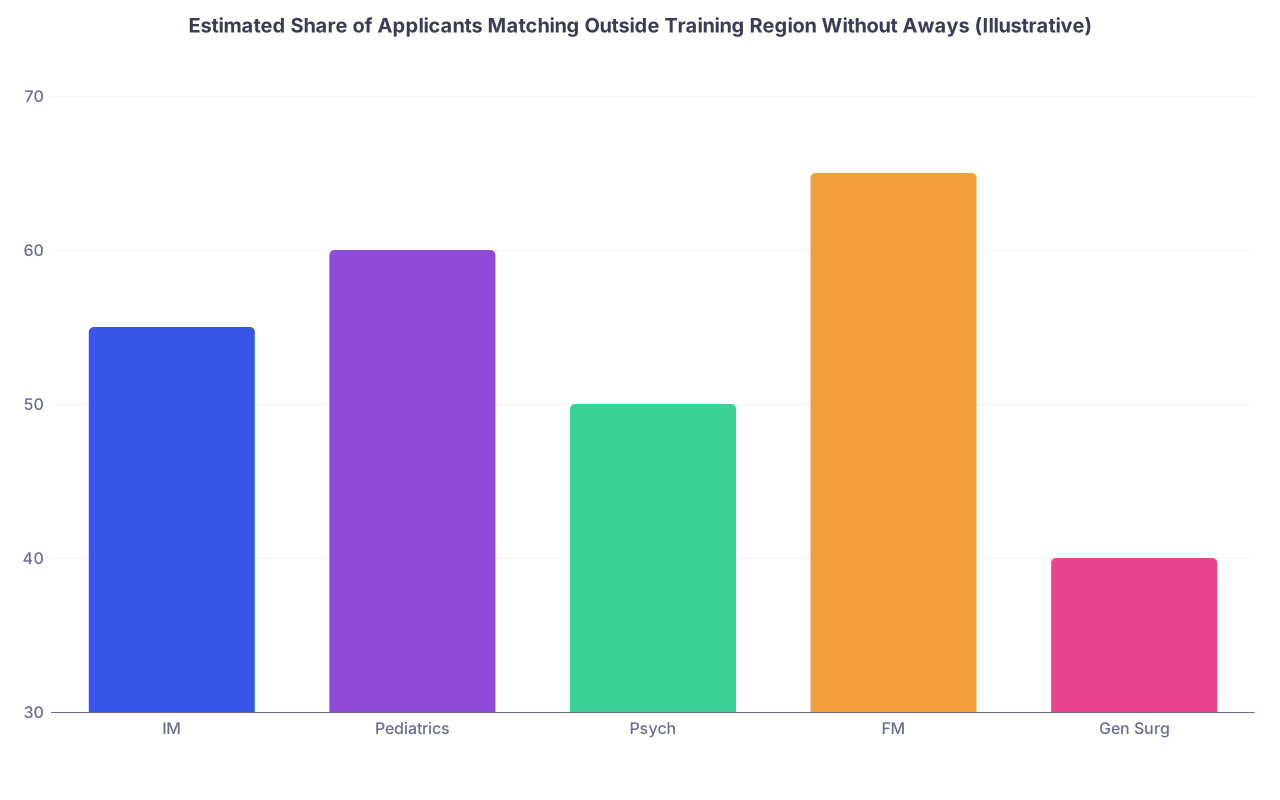
| Category | Value |
|---|---|
| IM | 55 |
| Pediatrics | 60 |
| Psych | 50 |
| FM | 65 |
| Gen Surg | 40 |
These numbers are illustrative, but the pattern is consistent with what you see if you actually read between the lines of NRMP data and institutional match lists: huge geographic movement with no requirement for aways.
So the blanket claim—“you must do an away to get out of your region”—is simply not supported by any large-scale evidence.
Does that mean aways are useless? No. It means they’re situationally powerful, and the context matters.
When An Away Rotation Actually Helps You Match Outside Your Region
Let me be clear: there are times when an away rotation is a high-yield move. But those are narrower and more specific than the myth suggests.
1. You’re Aiming at Highly Competitive Specialties
For fields like:
- Orthopedic surgery
- Neurosurgery
- Dermatology
- ENT
- Plastics
- Some competitive gen surg, IR, or radiation oncology programs
Aways can function as a month-long audition. In these specialties, a strong away can:
- Turn you from a random application into “that student we loved on service.”
- Generate the kind of personalized letter that actually moves your rank list position.
- Prove you can function on that service’s turf and fit their culture.
In these cases, aways can be very important if you’re trying to jump regions. If you want to go from a Southern med school to a West Coast ortho program, your chances are probably better with a targeted away or two.
But even here, the key word is “important,” not “absolute requirement.” Plenty of people still match without one when their home institution, research, and letters are strong.
2. You Have No Home Program in Your Desired Field
If your med school doesn’t have:
- Its own derm, ENT, neurosurg, or rad onc department, or
- A meaningful footprint in that specialty regionally
Then away rotations may be your main way to show two things:
- You actually understand the specialty’s day-to-day reality.
- You can get letters from people whose names program committees recognize.
In this scenario, an away isn’t about geography as much as credibility. That credibility can absolutely move you outside your local orbit.
3. You’re Pivoting Regions With a Weak Home Brand
If your school:
- Has little reputation in the region you want,
- And your metrics are good-but-not-elite,
- And you’re targeting moderately to very competitive programs
Then an away can serve as a “trust accelerator.” Program directors may not know your school well, but they do know their colleagues down the street. A strong performance on an away rotation can short-circuit their uncertainty.
But understand what’s really happening there: the away is substituting for institutional reputation and known quantity—not some mythical requirement to step foot in any new region.
When An Away Rotation Is Overrated, Unnecessary, or Dangerous
This is the part no one likes to say out loud, especially not “advisors” who reflexively tell everyone to do two or three aways “just in case.”
1. You’re Applying to Less Competitive Specialties
For internal medicine, pediatrics, family medicine, psychiatry, neurology, PM&R, and even a large chunk of general surgery programs, your match odds are driven much more by:
- Step 2 score (now that Step 1 is pass/fail)
- Clinical evals and core clerkship performance
- Quality of your letters (not where they’re from, but what they say)
- Fit with program needs (couples match, visa, specific interests)
If you’re a solid IM applicant at a mid-tier school in the Midwest and you want to go to the East Coast, you absolutely do not need to set your life on fire to do a Manhattan away rotation. You need:
- A believable geographic story (family, partner, long-term plans).
- A smart, regionally balanced list.
- Strong application materials.
In these fields, an away can be nice, but it’s rarely the difference between “stuck in your region forever” and “geographic freedom.”
2. Your Application Has Major Holes You’re Hoping an Away Will “Fix”
This one almost always backfires.
If you’re thinking:
- “My scores aren’t great, I’ll just crush an away in California and they’ll ignore them.”
- “I failed a rotation at home, but if I’m super friendly on my away, I’ll be fine.”
You’re gambling. Programs don’t erase objectively weak parts of your application because you were pleasant for four weeks. At best, they’ll say, “Nice student, but we have stronger choices.” At worst, a mediocre away gives them yet another data point against you.
I’ve watched students with marginal applications hurt themselves by doing aways where they were then judged against an even stronger peer group.
3. You Underestimate the Cost—Financial and Opportunity
Away rotations are expensive and time-consuming:
| Expense | Approximate Cost (USD) |
|---|---|
| VSLO/application fees | $100–$250 |
| Housing (1 month) | $800–$2000 |
| Travel | $200–$600 |
| Food/transportation | $300–$600 |
| Misc (scrubs, etc.) | $100–$300 |
Two aways can easily run over $4,000–$5,000, especially in high-cost cities. That’s before counting the opportunity cost: time you could have spent on:
- Home institution relationships
- Dedicated research or a strong sub-I
- Step 2 studying
For a lot of students, that trade is bad. They’re bleeding cash to chase a marginal gain in a specialty where geography is flexible if you just apply broadly and intelligently.
Programs Do Not Think About Geography the Way Students Do
Here’s the quiet part no one says out loud: most programs don’t obsess over your “region” the way you do.
They care about:
- Risk. Will you be a remediation problem? Will you pass boards?
- Fit. Are you vaguely normal, teachable, and not a disaster at 3 a.m.?
- Commitment. Are you likely to come if they rank you high?
Away rotations can demonstrate “commitment to region,” but they’re not the only or even best signal of that.
You can demonstrate genuine interest in a new region through:
- Having family or a partner there (and saying so clearly in your PS or interview).
- Having done undergrad there or grown up there and now wanting to return.
- Tailored personal statements or geographic preference signaling (in specialties that allow it).
- A rank list and application pattern that matches your supposed priorities (e.g., not saying “I love the West Coast” but only applying to 3 West Coast programs and 50 in your home state).
Programs see right through the student who does one away in, say, Seattle, then applies to 80 programs scattered across the whole country with no coherent pattern. That away doesn’t magically override everything else.
How to Match Outside Your Region Without an Away
Let’s get practical. If you don’t have the money, flexibility, or desire to do an away—but you want to move regions—here’s the non-myth-based strategy.

| Step | Description |
|---|---|
| Step 1 | Clarify Regions |
| Step 2 | Assess Competitiveness |
| Step 3 | Apply Broadly in New Region |
| Step 4 | Boost Scores and Letters |
| Step 5 | Explain Geography in Application |
| Step 6 | Use Signaling/PS Wisely |
| Step 7 | Interview and Rank Strategically |
| Step 8 | Target Specialty? |
1. Apply Broadly and Intelligently
If you’re trying to jump from, say, the Southeast to the Pacific Northwest in IM, don’t apply to 4 programs there and “see what happens.”
Apply in a way that suggests seriousness about that region:
- 10–20 programs in that region (depending on specialty competitiveness).
- A mix of academic and community programs, not just the top 3 brand names everybody knows.
Programs notice geographic clusters.
2. Explicitly Explain Your Geographic Interest
Do not hope they “intuit” your motives. Spell it out.
- Personal statement version: one short, specific paragraph about your connection or plans in that region.
- Secondary questions (if present for some specialties): clear, honest, non-fluffy reasoning.
- Interviews: a consistent story—partner job, family support, long-term life plans, or previous time spent there.
They aren’t mind readers. If you don’t explain, they’ll default to “this student will probably stay closer to home.”
3. Use Signaling Wisely (In Fields That Have It)
Some specialties now allow program signaling (e.g., using a small number of “tokens” to show interest). Use a signal or two on out-of-region programs you’re genuinely willing to attend. That’s far more powerful than a random away that doesn’t translate into a strong letter.
4. Get High-Quality Letters That Actually Say Something
A local letter that has substance beats a big-name away letter that’s generic.
“The student worked hard, got along with staff, and completed tasks” is worthless. No one on a committee cares.
“The student functioned at intern level, took ownership of complex patients, and was in the top 5% of students I have worked with in the last five years” carries weight even if it’s from some place no one outside your state has heard of.
When an Away Rotation Is Worth It for Geography
Let’s narrow it down to the specific situations where an away rotation might really move the needle for leaving your region:
- You’re aiming for a very competitive specialty and your home program has weak or no national footprint.
- You have no real regional connection but want to move to an especially competitive geographic area (e.g., West Coast, NYC, Boston) in a competitive field.
- You want to convert an interview into a top-3 rank at one or two specific programs where you know the culture strongly favors “known entities.”
In those narrow cases, a well-chosen away can significantly help. But that’s not the same as a blanket requirement.
The Bottom Line: Myth Busted
Let me strip this down to what actually matters.
You do not need an away rotation to match outside your region in most specialties. Geography is influenced far more by how broadly and coherently you apply, your scores, your letters, and whether your story about where you want to live makes sense.
Away rotations are power tools, not default tools. They’re high-yield in specific scenarios—highly competitive specialties, no home program, or targeted reach into a very competitive region—but often overrated or even harmful outside those cases.
If you’re going to spend thousands of dollars and four precious weeks of your life, do it because it fits a clear, evidence-based strategy for your specialty and profile—not because a stressed-out MS4 told you, “You have to.”