
Did Step 1 going pass/fail secretly make your third‑year rotations irrelevant… or did it just expose how much they always mattered?
Let me ruin the comforting myth first: third‑year rotations matter more, not less, in the Step 1 pass/fail era. The difference now is you can no longer hide behind a three‑digit score.
You’ll hear variations of this in the hallways:
“Programs only care about Step 2 and school reputation now.”
“Clerkship grades are random, everyone honors surgery if they’re loud enough.”
“Letters are all the same—‘hard‑working, a pleasure to work with.’”
Some of that has a kernel of truth. Most of it is lazy thinking from people who don’t look at actual match data or have never sat in front of a rank list trying to separate Applicant #37 from Applicant #38.
Let’s walk through what’s actually happening.
What Changed With Step 1 Going Pass/Fail?
Step 1 used to be the blunt instrument programs used to cut down massive applicant pools. I’ve watched real selection meetings where the screen was literally just an Excel sheet sorted by Step 1 score. That was the first pass.
Now that Step 1 is pass/fail, program directors needed a new set of quick filters. They didn’t suddenly become holistic, thoughtful philosophers. They just swapped tools.
Here’s what quietly moved up the priority list:
- Step 2 CK score
- Core clerkship grades
- Narrative comments from third‑year
- Class rank / quartile if your school still uses it
- School “type” (US MD vs DO vs IMG) and reputation
- Signals and away rotations (for some specialties)
The NRMP and specialty‑specific surveys back this up. When Step 1 went pass/fail, program directors predicted—and then confirmed—greater reliance on Step 2 CK and clinical performance.
So no, rotations didn’t get devalued. The scoreboard just changed.
What Programs Actually Use Third‑Year For
Think like a program director for a second.
You’re trying to answer three basic questions about an applicant:
- Are they smart enough not to hurt patients?
- Are they safe and reliable on a busy service at 2 a.m.?
- Would I (or my residents) hate working with this person?
Step scores mainly answer #1. Third‑year answers #2 and #3.
So programs mine clerkship data for very specific signals:
Patterns in core grades
Not “Did they honor everything?” but “Did they honor the stuff that counts for my specialty and not bomb anything important?”Narrative comments
Words like “independent,” “calm under pressure,” “respected by staff” versus “eager,” “interested,” and the death phrase: “will be a good resident with continued supervision.”Comparative language
“Among the top X% of students I’ve worked with” hits totally differently than “performed at the level expected of a medical student.”Consistency across services
Honors in medicine + surgery + OB, then pass in psych with comments about “time management” and “professionalism reminders”? That raises flags.
Even when your school plays games with grade distributions, the narratives and relative evaluations tell a story. Program directors know who grade‑inflates and who doesn’t. They read between lines. They talk to each other.
In other words, your third‑year is the only longitudinal, real‑world dataset they have on you actually being in a hospital.
Step 2 vs Rotations: Which One “Matters More”?
The internet loves fake either/or questions. “Just focus on Step 2, rotations are political.” That’s not how selection works.
Here’s how it actually looks when programs are sorting stacks of applications.
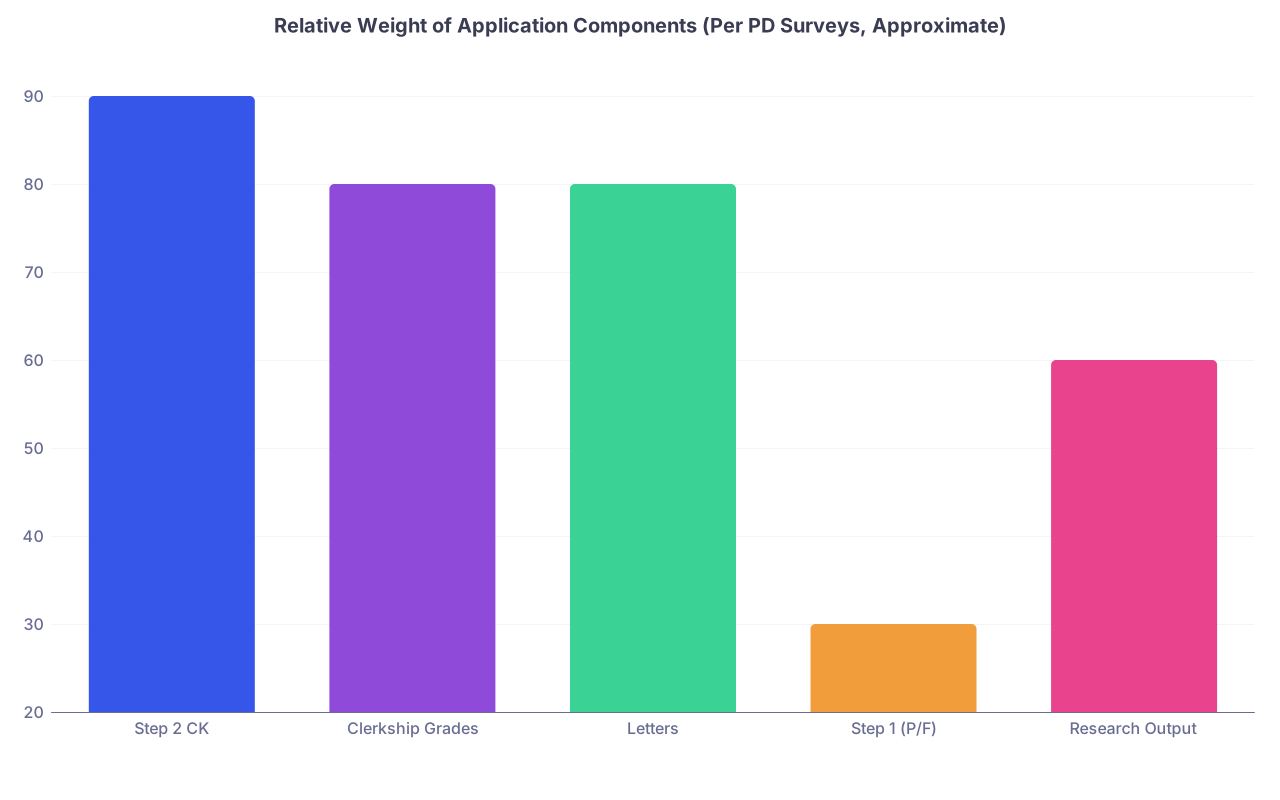
| Category | Value |
|---|---|
| Step 2 CK | 90 |
| Clerkship Grades | 80 |
| Letters | 80 |
| Step 1 (P/F) | 30 |
| Research Output | 60 |
Those “values” aren’t exact numbers from a single study, but they reflect the pattern from repeated NRMP Program Director Surveys and specialty‑specific data:
- Step 2 CK is now the primary objective screen.
- Clerkship performance and letters built on third‑year experiences sit right behind it, often tied.
- Step 1 pass/fail still matters as a hurdle, but not as a ranking tool.
- Research matters more in some fields (derm, neurosurg) but does not rescue awful clinical narratives.
The smarter way to think about it is this:
- Step 2 gets you read.
- Rotations get you ranked.
You can’t compensate for mediocre clerkship comments with a monster Step 2 in competitive fields. People try that strategy every year. It fails a lot more quietly than it’s advertised on Reddit.
Myth: “Clerkship Grades Are Random, So Why Bother?”
I’ve heard this line usually from two types of students:
- The ones who are consistently “high pass” and want a simple external villain.
- The ones who never learned how to show their work on the wards.
Are clerkship grading systems imperfect? Absolutely. Are they complete chaos? No. They’re noisy but not random.
Think of it like this: Step 1 had low noise, high precision. Clerkships are high noise, but still with a signal. If you stop looking for perfection and look for patterns, you’ll see it.
On almost every service I’ve been on, the same traits separated “solid pass” from “clear honors”:
- Pre‑rounding done and data correct.
- Patient presentations getting tighter over the month.
- Anticipating next steps (labs, imaging, discharge needs).
- Not disappearing when work got less glamorous.
- Not making the intern’s life harder.
None of that is mystical “politics.” That’s observable behavior. When multiple residents and attendings across different rotations repeatedly say you’re reliable and sharp, that usually shows up in your MSPE and your grades.
The students who insist it’s all random often have blind spots no one has been blunt enough to point out.
Why Third‑Year Matters More in the Pass/Fail Era
Pre‑Step 1‑P/F, a program could tell itself a simple story:
- “This kid got a 260. Even if their clerkship comments are generic, they’re probably fine.”
Now? Not an option. Here’s what happens instead.
1. Step 1 No Longer Hides Weak Clinical Performance
Before, a high Step 1 score camouflaged a thin or mediocre clinical record. Now the spotlight moves:
- If you just “coasted” through third‑year thinking Step 1 was your main currency, you’re exposed.
- If you built strong relationships, took ownership of patients, and improved fast—even with just “good enough” preclinical—your stock went up.
I’ve literally seen the conversation shift from “But they have a 250” to “They seem like they’ll be good at this” once Step 1 was off the table.
2. Programs Are More Risk‑Averse About Work Ethic
Residents are burnt out. Faculty are tired of remediation projects. People are sick of the “brilliant disaster” resident who can recite pathophys but can’t follow up a potassium.
Third‑year is now the main early warning system for that risk.
Narrative comments about “needed frequent reminders” or “required additional supervision” matter more when there’s less objective preclinical data. That’s you being filtered out earlier.
3. Letters Now Lean Heavier on Third‑Year Performance
Strong letters rarely come from a random fourth‑year elective with three half‑days of clinic. They’re built on stories: “On our medicine service as an M3, they did X, Y, Z.”
Step 1 going pass/fail didn’t change how good letters are written. It increased their value. Because now, more than ever, programs are looking for someone they can trust, not just someone who can score.
But What About Shelf Exams—Do They Matter More Now?
They already mattered more than most students realized.
Shelf scores:
- Feed into clerkship grades at many schools.
- Correlate strongly with Step 2 CK performance.
- Show programs you can synthesize clinical scenarios under time pressure.
Step 1 going pass/fail pushed some schools to lean harder on shelves for “objective” data. Which is not great for your sanity, but very real.
So yes: your test‑taking ability shifted from M2 to M3/early M4. You didn’t escape it. You just moved it.
The Quiet Differentiators: Sub‑I’s and Specialty‑Relevant Rotations
If you’re thinking “Fine, third‑year matters. But what about fourth‑year?” Fair question.
Sub‑internships, acting internships, and audition rotations are really just higher‑stakes, zoomed‑in extensions of the same thing: can you function like a mostly‑supervised intern?
But here’s the catch: the credibility of your sub‑I performance is anchored in your third‑year record.
If your MSPE shows:
- Mediocre medicine/surgery performance
- Vague comments like “pleasant” and “enthusiastic”
- No clear progression over the year
Then your star performance on one aways rotation looks more like an outlier or a fluke. Or like you turned it on when you felt watched.
On the other hand, if there’s a consistent narrative from M3: “taking ownership,” “early intern level,” “reliable,” then a great sub‑I just closes the loop.
What Third‑Year Actually Signals to Different Specialties
Not every specialty reads third‑year the same way. But none of them ignore it.

| Specialty | Core Rotations They Care Most About | Third-Year Signal They Look For |
|---|---|---|
| Internal Med | Medicine, Neuro, ICU exposure | Critical thinking, ownership |
| General Surgery | Surgery, Anesthesia, ICU | Work ethic, grit, team fit |
| EM | Medicine, Surgery, EM if offered | Poise under pressure, speed |
| Psych | Psych, Medicine | Communication, boundaries |
| Pediatrics | Peds, OB, Medicine | Family communication, patience |
Is this oversimplified? Of course. But it’s directionally right.
Surgery cares a lot about how you handled long days and unpleasant tasks on your M3 surgery month. Medicine wants to know if you could manage complex patients without constantly losing the thread. EM is obsessed with whether you panic or freeze.
You’re not just stacking grades. You’re writing a personality and work‑style profile specialty directors will read through a biased but decently informative filter.
Reality Check: Where Rotations Don’t Matter As Much As People Claim
Here’s where I’ll side with the cynics—for a bit.
There are some common exaggerations about clerkships:
“You need honors in every core to match competitive.”
False. You need a pattern of strength in relevant rotations, a strong Step 2, and excellent specialty‑specific letters. I’ve seen people match derm with some high passes—because the derm‑relevant parts were stellar.“One bad rotation ruins you.”
Also false. A single outlier—especially in an unrelated field—will usually be forgiven if the rest of your record is strong and your explanation is credible.“If you’re at a lower‑tier school, stellar rotations won’t overcome that.”
This is lazy defeatism. Is bias real? Yes. Is it absolute? No. Strong third‑year + Step 2 + targeted aways beat “mid clinicals at a fancy school” more often than you think—especially in mid‑tier programs or regions where you have ties.
Third‑year is neither irrelevant nor all‑powerful. It’s a heavily weighted piece of a messy, human decision process. But it’s one of the pieces most under your direct behavioral control.
What To Actually Do Differently in the Step 1 P/F Era
You don’t need inspirational posters. You need a strategy.
Here’s the practical shift:

| Step | Description |
|---|---|
| Step 1 | Start M3 |
| Step 2 | Commit to strong ward performance |
| Step 3 | Use shelves as Step 2 prep |
| Step 4 | Identify 1-2 key specialty rotations |
| Step 5 | Lock in 2-3 letter writers |
| Step 6 | Take Step 2 CK when ready |
| Step 7 | Sub I and aways to confirm narrative |
The myth was: “Crush Step 1, then cruise.”
The new reality: “Perform clinically from Day 1 of M3 while you quietly build toward Step 2.”
This doesn’t mean becoming a 24/7 clerkship martyr. It means understanding what’s actually being scored:
- Reliability > raw brilliance
- Trajectory > instant perfection
- Team trust > performative enthusiasm
Those are third‑year muscles. If you don’t build them now, you’ll be behind when it actually counts—intern year.
The Bottom Line
Let me answer the title question directly.
Do third‑year rotations matter less now that Step 1 is pass/fail?
No. They matter more—because:
- Step 2 CK replaced Step 1 as the test filter, and third‑year replaced Step 1 as the main clinical signal.
- Programs are more cautious about work ethic and reliability, and your clerkship narratives are their best early warning system.
- Strong third‑year performance now amplifies everything else—letters, sub‑I’s, aways—in a way a three‑digit Step 1 score used to.
If you’re hoping Step 1 going pass/fail gave you permission to treat third‑year like background noise, you’re playing the wrong game. The wards are the new scoreboard. Build your application there.