
Sub‑internships are overrated. Step 2 CK is underrated. And most of what you hear from classmates and upperclassmen about which one “matters more” for residency is half‑true at best.
Let me be very direct: for the vast majority of applicants, Step 2 CK is a heavier lever in your match outcome than any single sub‑I. But that does not mean sub‑Is are optional or cosmetic. It means they do something different than people think.
The real mistake isn’t choosing one over the other. It’s pretending they’re interchangeable currencies. They are not.
Let’s dismantle the myths.
What Programs Actually Use Step 2 CK For
Program directors do not sit in their office debating whether your September medicine sub‑I or your CK score “matters more.” They use each for specific jobs.
Step 2 CK is a screening and risk‑management tool.
Look at the NRMP Program Director Survey (yes, the one everyone quotes but few actually read). Year after year, for most core specialties:
- USMLE Step 2 CK (or COMLEX Level 2) is in the top tier of factors for offering interviews.
- It’s one of the most commonly used cutoffs when programs are drowning in applications.
Once Step 1 went pass/fail, a lot of PDs quietly shifted more weight onto Step 2 CK. Not because they suddenly care about your deep love of internal medicine based on your dedicated review of hyponatremia. Because they need a quantitative way to separate 800 IM applicants who all claim to be “hard‑working, compassionate, and dedicated to lifelong learning.”
I’ve seen this play out on selection committees:
- Spreadsheet opens.
- Columns: school, Step 1 (P/F), Step 2 CK, class rank/quartile, failed attempts, red flags, etc.
- First pass: any CK below a soft line (say 225 in IM, 240 in derm, 245+ in ortho) is either auto‑screened out or needs strong compensating factors.
Does every program have an explicit cutoff? No. But plenty have internal “comfort zones.” And the more competitive the specialty, the less forgiving they are.
Step 2 CK does three things for them:
- Quickly narrows the pile. 800 apps to 300 to actually read.
- Assures they won’t get crushed on board pass rates. Residency programs are judged on this. They’re not gambling on someone with a questionable test record unless there’s a clear reason.
- Provides a standardized comparison. Your school’s “Honors” might be someone else’s “High Pass”. CK is the same exam for everyone.
That is unavoidable reality. You may hate it. But if your Step 2 CK is not strong for your specialty, your phenomenal sub‑I may never even be seen.
What Sub‑Is Actually Do (When They Matter)
Sub‑internships are auditions, not objective metrics.
Programs don’t say: “Ah, a sub‑I in July at Prestigious Hospital X – that’s worth 12 residency points, whereas a 248 on CK is 9 points.” That’s fantasy. Instead, sub‑Is create opportunities:
- The chance to earn a powerful letter from someone with a name that lands.
- The chance to demonstrate fit at a specific program or within a specific department.
- The chance to have a PD or APD remember your face and your work ethic on rank day.
Here’s the big myth: “If I crush my sub‑Is, they’ll overlook a mediocre Step 2 CK.”
Reality: usually false. What actually happens is more like this:
You rotate at Program A for a sub‑I. You work hard. Residents like you. You get a nice letter. When your application hits their pile, your file often moves into one of three mental bins:
- “Automatic interview” if your CK is in their typical range.
- “Maybe interview” if your CK is a bit below but you were memorable and vouched for.
- “We tried, but we don’t want to fight the PD over this score” if your CK is way below their usual comfort zone.
In other words: a strong sub‑I can bend the rules. It rarely breaks them.
And just to be even sharper: most sub‑Is aren’t actually “crushed.” They’re… fine. Enthusiastic. Present. Not incompetent. That’s not enough to override hard numbers.
When Step 2 CK Clearly Matters More
Let’s stop with the vague “both are important” nonsense. Here are scenarios where CK clearly carries more weight than any individual sub‑I.
You’re applying to a competitive specialty.
Think derm, ortho, plastics, ENT, neurosurgery, rad onc. Or increasingly: EM, anesthesia, radiology at top programs. For these, your Step 2 CK is often the price of entry.You’re applying broadly, not just to home/away programs.
Most programs will never meet you in person before deciding on an interview. They don’t see your sub‑I performance firsthand. What they see is your score report.Your core clerkship grades are average.
If your transcript is a sea of high passes but not much honors, a strong Step 2 CK can reassure programs you have the raw test‑taking and knowledge base to succeed.You had a rocky preclinical/Step 1 history.
Low or failing Step 1, remediation, leaves of absence. A good Step 2 CK can be your “comeback story” and change how they read your file. No sub‑I can do that at scale.Your school name doesn’t carry weight.
If you’re not coming from a brand‑name US MD school, programs lean even more heavily on standardized metrics to risk‑stratify unknown institutions.
This is where I see students screw up: they schedule three or four aways, torpedo their CK prep time, then end up with a 228 applying to ortho. They worked hard. People “loved them.” They still get screened out at half the places they never set foot in.
When Sub‑Is Actually Compete With CK (Sort Of)
There are, however, real scenarios where sub‑Is can meaningfully bend the curve.
You’re right at the edge of competitive.
Example: borderline but not disastrous CK for your specialty. A superb sub‑I at a mid‑tier but solid program can:- Get you a letter saying “This student functioned at intern level. We’d be happy to have them.”
- Move you from “eh, borderline on paper” to “we liked them so much we’re ranking them high.”
Here, the combination matters: “Good enough CK + standout performance on sub‑I.”
You’re applying to your home program where you rotate extensively.
Many home programs will quietly tell you: “If you’re decent and we like you on the wards, we’ll interview you even with a slightly lower score.” The key word is “slightly.”You’re aiming at a specific geographic region.
Doing sub‑Is in that region tells programs you’re serious about being there. If you stand out, you can rise above somewhat stronger but anonymous applications from other regions.You’re in a field where interpersonal fit is massive.
Think psych, FM, peds, EM. Not because scores don’t matter (they do) but because a resident-class-killing personality is a bigger disaster than a few points on CK. A sub‑I lets them kick the tires on your attitude, reliability, and baseline social functioning.
Notice the pattern: in all of these, you still need a baseline acceptable Step 2 CK to be competitive. The sub‑I then differentiates you among those who actually make it through the door.
The Biggest Hidden Variable: Letters of Recommendation
Here’s where sub‑Is punch above their weight: they’re often your best shot at a high‑impact letter.
Not all letters are created equal. A generic “hard‑working, pleasant, on‑time” letter from a random community hospitalist is background noise. A detailed, comparative letter from a known academic in the field is different.
On a real rank committee, a letter that says:
“This student was the best sub‑I we’ve had in three years. They functioned at or above the level of our interns by the end of the month. I would recruit them to our program without hesitation.”
…moves people. Especially if the letter writer is someone whose name is already on half the committee’s bookshelf.
That’s the leverage of a sub‑I.
But, again, it’s one step later in the pipeline. You still often need the Step 2 CK to get your file read seriously in the first place.
Data vs Hallway Lore: Why Everyone Overvalues Sub‑Is
A big reason this myth persists is simple: students see the sub‑I. They feel the sub‑I. They remember the chief resident saying “You’re one of the strongest students I’ve seen.” It’s vivid.
They do not sit in the room when a PD filters 1,200 applications down to 300 interviews based primarily on test scores and school/grades. They don’t see the 400 excellent personalities who will never set foot in that hospital because their CK was 15 points too low.
Selection committees talk about this constantly:
- “We loved that student from our away last year, but her Step 2 is going to make our board stats a nightmare.”
- “This applicant has a 260 and solid letters; we’ll be fine. I don’t care that we haven’t met them.”
Sub‑Is are also self‑reported success stories. People who matched at a place they did an away at say, “My sub‑I must have done it.” They don’t say, “My 247 and honors cores got my foot in the door, then the sub‑I sealed it.” Survivorship bias at its finest.
Practical Trade‑Offs: How To Actually Prioritize
You don’t live in a theoretical world. You live in a calendar with limited days, a brain with limited bandwidth, and an ERAS deadline.
So how do you choose?
1. Protect your Step 2 CK window like it’s your job
If your choice is:
- Two aways + crammed, half‑baked CK prep
vs - One away + dedicated, solid 4–6 weeks for CK
Choose the second. Every time. I’ve seen far more careers rescued by a better‑than‑expected CK than by an extra away.
2. Use sub‑Is strategically, not reflexively
A sub‑I is valuable when:
- It’s at your home or a realistic target program.
- You’re confident you can perform at a high level.
- The letter writer is respected in your specialty.
- The timing doesn’t destroy your CK prep or ERAS completion.
A July/August sub‑I that leaves you fried and underprepared for a September CK is not “hustle.” It’s self‑sabotage.
3. Accept that some doors are score‑gated
If you’re sitting on a 220 CK applying orthopedic surgery, you don’t need three aways. You need a brutally honest re‑assessment of target programs and maybe even target specialty.
Sub‑Is won’t magically override structural realities of competitiveness. They can help you punch slightly above your numeric tier. Not two leagues up.
Quick Comparison: What Each Really Buys You
| Factor | Step 2 CK | Sub‑Internships |
|---|---|---|
| Role in interview screening | High | Low–Moderate (indirect via letters) |
| Role in rank list within a tier | Moderate | High at programs where you rotated |
| Scales across all programs | Yes | No (mostly local to where you rotate) |
| Can compensate for weak letters | Sometimes | No |
| Can compensate for weak CK | N/A | Only partially, and only at some places |
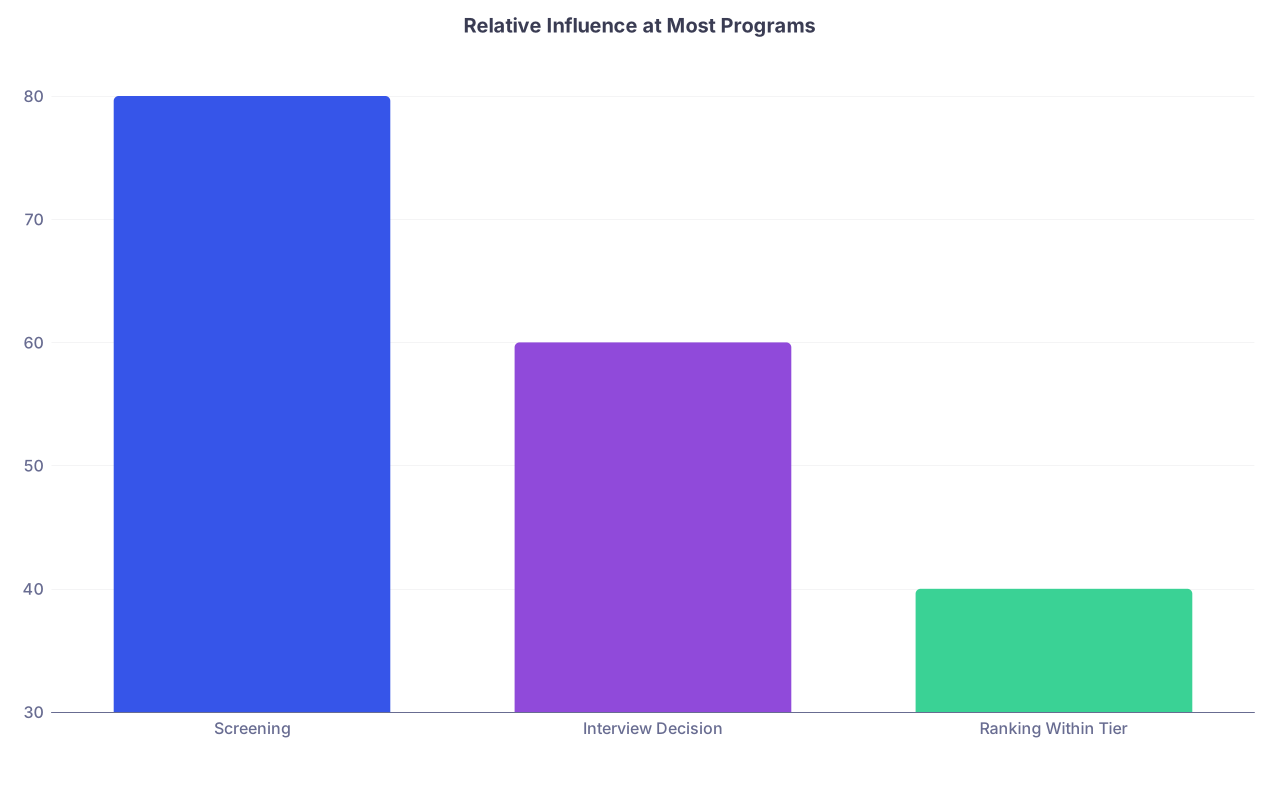
| Category | Value |
|---|---|
| Screening | 80 |
| Interview Decision | 60 |
| Ranking Within Tier | 40 |
(Values here are conceptual “weight” of Step 2 CK out of 100, not exact percentages, but they capture how programs typically lean.)
The One Case Where People Mix This Up
There is one niche where sub‑Is feel more important than CK: the student who’s already above threshold.
If you’re sitting on a 245 in IM or a 255 in a competitive surgical specialty, the marginal gain from a 248 vs 252 is negligible compared to:
- A killer letter from a PD at your dream program.
- Being the memorable student who made interns’ lives easier.
- Showing up as “rank this person high; they’re already basically an intern.”
In that narrow band, sub‑Is start to dominate the fine‑tuning of outcomes. But that’s only because Step 2 CK has already done its foundational job.
People in that situation then loudly proclaim, “It was all about my aways!” Sure. For them. From a position already secured by their numbers.
You cannot generalize their experience to the average applicant still trying to clear the bar.

The Real Answer: They’re Not Competing. They’re Sequential.
Framing the question as “Are sub‑Is more important than Step 2 CK?” is already the wrong lens.
The real sequence looks like this:
Step 2 CK
Gets you past the initial filters. Sets your general lane of competitiveness. Determines which programs will even read your letters.Core clerkship performance + narrative
Colors how your numerical profile is interpreted. Are you just a test‑taker, or a strong clinician in the making?Sub‑Is + letters + interviews
Differentiate you within that lane. Push you up or down within tiers where you’re already numerically acceptable.
See the pattern? For nearly everyone outside the top or bottom 5%, Step 2 CK is the gatekeeper. Sub‑Is are the tie‑breaker.
Stop pretending you can ignore the gatekeeper if you’re charming enough at the tie‑breaker.
Bottom Line: Myth vs Reality
Here’s where I land, without hedging:
Myth: “If you crush your sub‑Is, they matter more than Step 2 CK.”
Reality: For most applicants, a competitive Step 2 CK is prerequisite. Sub‑Is help most after CK has gotten you in the door, not instead of it.Myth: “Step 2 CK and sub‑Is are equally important; just do your best at both.”
Reality: When forced to choose due to time/energy constraints, prioritize getting the best Step 2 CK you reasonably can, then use targeted sub‑Is to convert that numerical credibility into standout letters and fit.Myth: “Sub‑Is can fix a weak CK.”
Reality: They can sometimes mitigate a slightly below‑average score at specific programs that know you and like you. They cannot reliably compensate for a significantly non‑competitive score across an entire specialty.
Treat Step 2 CK as the floor you must build. Treat sub‑Is as the architecture you add on top once the foundation is solid. Ignore that order, and you’re gambling your match on wishful thinking and hallway myths.