
The belief that surgery is the “most important” clerkship for match success is wrong. Loud, persistent, and wrong.
It feels true because surgery is visible. It’s dramatic, hierarchical, and everyone has a story about “that” attending whose eval made or broke a grade. But if you actually look at the data—and what program directors say when they’re not performing for students—surgery is not some magical golden ticket clerkship. It’s one piece of your clinical performance. For many specialties, not even the most important piece.
Let’s dismantle the myth properly.
What Programs Actually Care About (Data, Not Vibes)
Start with what residency program directors say, not what the loud M3 in your group chat swears is true.
The NRMP Program Director Survey (2022) repeatedly shows the same pattern when directors rank what matters most when deciding whom to interview and how to rank them:
Top factors for interview offers (across most specialties):
- USMLE Step 2 CK score
- Grades in core clinical clerkships (plural, not just surgery)
- MSPE (Dean’s Letter) narrative
- Letters of recommendation in the specialty
- Class ranking / honors (AOA, etc.)
Clerkship grades matter. But not “surgery above all.” Most specialties care far more about:
- Your own specialty’s clerkship
- Medicine (Internal Medicine)
- Overall pattern: consistency, not one heroic rotation
Let me make this concrete.
| Specialty | Most Scrutinized Clerkship(s) | Surgery’s Relative Importance |
|---|---|---|
| Internal Med | Medicine | Moderate |
| General Surgery | Surgery, Medicine | Critical |
| Ortho | Surgery, Ortho Sub-I | High |
| EM | EM, Medicine | Low–Moderate |
| Pediatrics | Peds, Medicine | Low–Moderate |
Is this oversimplified? Of course. But it’s closer to reality than “surgery is king for everyone.”
For most non-surgical specialties, a mediocre surgery grade with strong Medicine and home-specialty performance is absolutely fine. I’ve seen plenty of people match competitive IM, EM, derm, anesthesia, rad onc, peds—with “Pass” in surgery—because the rest of the application was coherent and strong.
Why Surgery Feels So Important (And Why That’s Misleading)
You feel like surgery is the boss level of M3 year for three reasons:
- The culture is loud and hierarchical
- You’re physically present a ton
- Feedback is often blunt, sometimes brutal
That combo makes it emotionally salient. You remember being yelled at in the OR. You don’t remember the quiet outpatient medicine day where the attending wrote a glowing eval without drama.
The problem is: what feels most intense doesn’t always drive match outcomes the most.
The “Surgery Is Make-or-Break” Narrative
You’ll hear variations like:
- “If you screw up surgery, you’re screwed for competitive fields.”
- “Program directors look at surgery first because it shows your work ethic.”
- “Surgery proves who can handle residency.”
Reality check:
- Many PDs—especially in cognitive fields—barely care about your ability to retract for three hours without moving. They care whether you can think, synthesize, write coherent notes, and not melt on night float.
- Unprofessionalism or blatantly lazy behavior on surgery can hurt you. But that’s not unique to surgery. You behave like a clown on Psych or IM and that gets noticed too.
What surgery does often reveal:
- Your attitude when work is tedious
- How you treat nurses, techs, and residents when tired
- Whether you show up on time consistently
Those traits matter, but they’re not exclusive to the surgical rotation. They’ll appear in every clerkship narrative. Surgery just gives more opportunities for them to be stress-tested.
When Surgery Actually Is Crucial
There are three groups for whom surgery really does matter a lot.
1. People Applying to General Surgery
This one’s obvious.
If you want gen surg:
- Honors or at least high performance in surgery is a big deal
- Strong surgery letters carry heavy weight
- Your sub-internship (sub-I) on a surgical service becomes even more critical
Program directors in surgery absolutely scrutinize:
- Clerkship grade and narrative on your surgery rotation
- Whether attendings describe you as “hard-working,” “teachable,” “team player,” “would work with again at 2 a.m.”
If you’re going for gen surg and you tanked your core surgery clerkship, you’re not automatically dead—but now you need:
- Strong performance on a surgical sub-I
- Great letters that explicitly say you improved or that the core grade didn’t reflect your true ability
2. Ortho, ENT, Plastics, Neurosurg, and Other Procedural Fields
These fields care about two big things from your third year:
- Surgical environment behavior (do you function in the OR and on surgical floors)
- Work ethic, endurance, and team integration
They care about your core surgery rotation both as:
- A proving ground (can you handle the environment?)
- A signal (did your surgical team actually like and trust you?)
But even here, surgery is only part of the package. I’ve heard ortho PDs say flat out: “Give me a 250+ Step 2, real research, and strong ortho letters over a single honors in surgery any day.”
3. Students With Spotty Step Scores or Pre-Clinical Grades
If your Step 1 was marginal or your pre-clinical years weren’t stellar, third-year becomes your rehab year. You show growth through clinical excellence.
In that context, surgery can help you:
- Prove you can grind and be reliable under pressure
- Generate a strong narrative in the MSPE about your “clinical maturation”
But again—same story with Medicine, EM, Peds. Surgery is one more data point in a pattern.
Where the Myth Really Breaks: Non-Surgical Fields
Here’s where the “surgery is the most important clerkship” idea completely falls apart.
Let’s look at what actually drives match success in a few common fields.
Internal Medicine
For IM, your Medicine clerkship is king. Then:
- Step 2 CK
- Letters from IM attendings
- Sub-I on wards or ICU
- Longitudinal performance pattern (not a single clerkship spike)
I’ve watched IM PDs skim right past a surgery “Pass” and spend five minutes reading the Medicine narrative and ICU letters.
For IM:
- An “Honors” in Medicine + strong narrative can blunt a lot of other imperfections
- A glowing letter from an IM ward attending is worth more than a surgery letter from a big-name surgeon you barely worked with
Pediatrics, Psych, Family Med
Same pattern:
- Home specialty clerkship > surgery
- Demonstrated interest and fit > ability to tie knots quickly
Do PDs like to see that you survived surgery without imploding? Sure. But no one is ranking you down because you didn’t love retracting a liver.
EM, Anesthesia, Radiology
These are the “procedural-adjacent” fields that students often think worship surgery. Not really.
They care more about:
- EM clerkship + SLOEs (for EM)
- Sub-Is or electives in their own field
- Consistent evaluations about teamwork, communication, and reliability
Surgery can be a plus, but for many of these PDs, a strong Medicine rotation and specialty-specific performance signal more about how you’ll function in their world.
What Actually Hurts You on Surgery
Here’s the part that’s real: surgery is risky because it’s public and unforgiving. The way you fail there can poison your narrative if you handle it badly.
Things that actually hurt:
- Documented unprofessionalism (late, rude, disappearing, lying)
- Multiple negative comments about attitude (“disengaged,” “argumentative,” “seems uninterested”)
- Needing to be “counseled” multiple times about basic behavior
Those themes, if repeated, will echo across your MSPE and letters, and then yes—surgery becomes a problem.
But that wasn’t because “surgery is the most important clerkship.” It was because you showed PDs who you are under stress. If the answer is “not good,” that matters anywhere.
A More Accurate Way to Think About Clerkship Importance
Forget the mythology. Use a better mental model: alignment + consistency.
Your target specialty’s clerkship(s)
- If you want IM: Medicine
- If you want peds: Pediatrics
- If you want gen surg / ortho: Surgery + sub-Is
Those clerkships should shine.
Medicine is the baseline
Almost every PD—surgical and non-surgical—looks at Medicine carefully. They see it as the most “generalizable” to residency life: notes, rounding, cross-coverage, communication.Then the pattern across everything
They don’t want:- Random extreme highs and lows without explanation
- A story of “great student but a disaster on teams” or vice versa
Surgery is one of the six big data points: Medicine, Surgery, Peds, Ob/Gyn, Psych, FM/Neuro (depending on school). Students inflate it to 70% of the story. In reality, it’s maybe 15–20% of the clinical picture for most fields.
How to Use the Surgery Rotation Strategically
Now the actionable part. If surgery isn’t the magical key, how should you treat it?
If You’re Going Into Surgery / Ortho / ENT / Neurosurg / Plastics
- Treat core surgery like an extended interview
- Learn names of every resident and nurse; be visibly part of the team
- Show up early, stay late when it matters, not performatively every single day until you burn out
- Ask for feedback week 1–2, not week 5
- Target at least one attending who actually knows you for a letter (and work with them enough to justify it)
If You’re Going Into Medicine, EM, Peds, Psych, etc.
Your goals are different:
- Do not be a problem
- Learn enough to function and not look lost
- Show you can work hard, respect the team, and handle stress
- Use surgery to build thick skin and time management; those skills will help you everywhere
A “High Pass / Pass with solid narrative” on surgery plus strong performance in Medicine and your target specialty is more than enough.
If You Struggle on Surgery
This happens more than people admit. You’re sleep-deprived, the culture’s rough, and you get dinged.
What to do:
- Crush Medicine and your specialty clerkship
- Get specific, positive letters that contradict any vague “concerns” from surgery
- If there’s real conflict or a clearly unfair eval, talk to your dean early—before MSPE season
- In your ERAS application or interviews (only if asked or if it’s clearly an outlier), frame it as: “I struggled early with adjusting to the pace and expectations on surgery. I sought feedback, made concrete changes, and you can see that growth in my later rotations and sub-I.”
PDs like growth arcs more than fake perfection.
One Place Where Data Backs the Myth (Sort Of)
There is a narrow truth hiding inside the myth: for students at some schools, surgery honors distributions are slightly stingier, and those honors sometimes correlate with higher overall clinical performance and Step scores.
You might see charts or hear rumors like “only the top students honor surgery.” That does not mean surgery causes match success. It usually means:
- The students who are already high performers (work ethic, Step scores, pre-clinical grades) also do well on surgery
- Those same traits help them in Medicine, sub-Is, research, and interviews
Correlation, not causation. The myth confuses the two.
To visualize the reality: clinical performance is a pattern, not one spike.
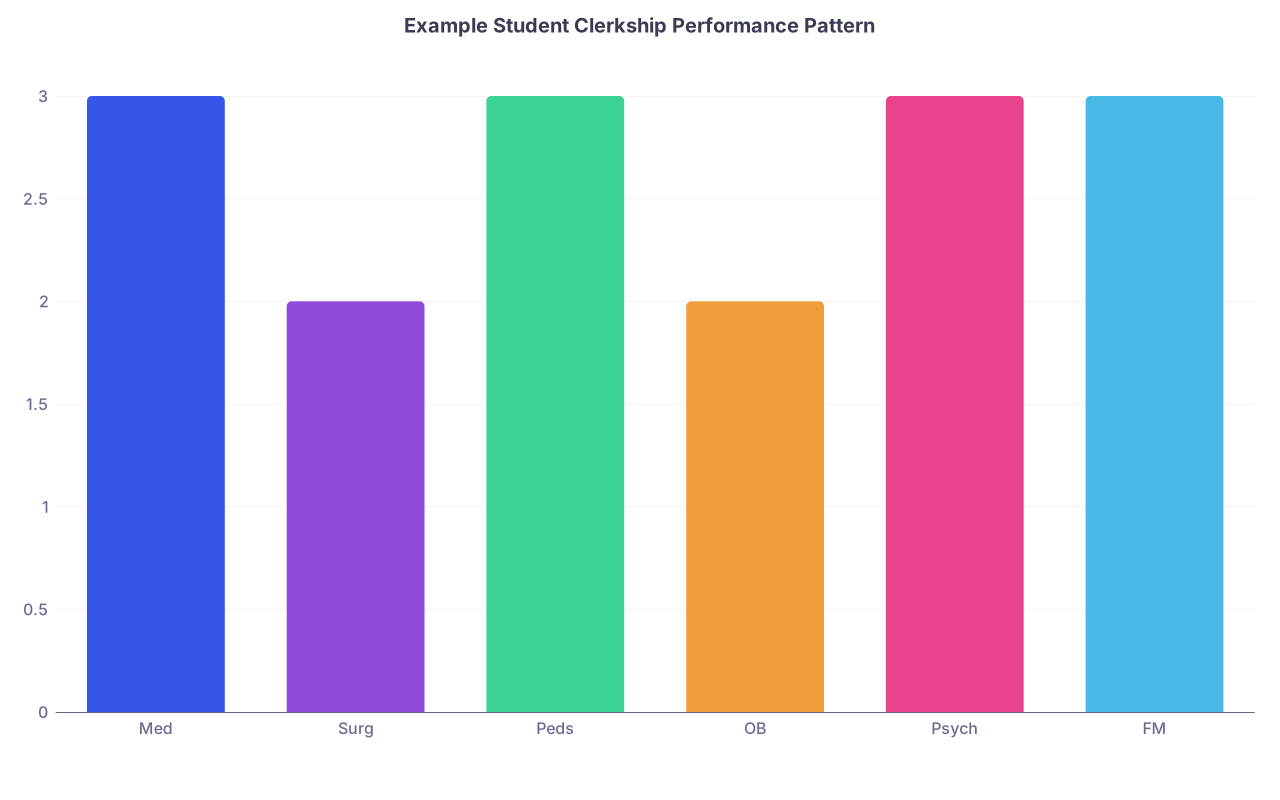
| Category | Value |
|---|---|
| Med | 3 |
| Surg | 2 |
| Peds | 3 |
| OB | 2 |
| Psych | 3 |
| FM | 3 |
(Think: 3 = Honors, 2 = High Pass, 1 = Pass.) Programs look at the whole bar chart, not one bar labeled “Surg.”
The Real “Most Important” Clerkships for Match Success
Let’s be blunt.
Across most specialties, the clerkships that matter most for your match outcome are:
- Medicine
- Your chosen specialty’s core clerkship
- Your sub-internship(s) or acting internships
Surgery can be:
- Crucial if you’re going into a surgical/procedural field
- Moderately important as a professionalism/work-ethic check for everyone else
- Dangerous if you behave badly and expose character issues
But “the most important clerkship for match success” across all specialties? No. That’s mythology passed down from the loudest residents and the most traumatized M4s, not from the actual data.
Key points to keep:
- Surgery is important mainly for surgical and some procedural fields; for everyone else, Medicine and your specialty-specific clerkships carry more weight.
- Program directors care about patterns and narratives—not one hero or disaster rotation—so your overall clinical consistency beats any single clerkship.
- Use surgery to prove professionalism, resilience, and teamwork, but stop treating it like the universal gatekeeper to a successful match. It isn’t.