
What actually happens to your match chances if you get a couple of High Passes instead of Honors in core rotations?
Let me ruin the myth quickly: No, you do not need Honors in every core clerkship to match well. Not even close. And obsessing over that fantasy is making some of you worse clinicians and weaker applicants.
Let’s separate superstition from data.
The Myth vs. The Numbers
The myth goes like this:
“If I don’t honor Medicine, Surgery, OB/Gyn, Peds, Psych, and Family, I’m dead for competitive specialties.”
Here’s what the evidence actually shows from NRMP Program Director Surveys, AAMC data, and what you see reading hundreds of applications:
- Program directors do care about clinical performance.
- They do not require a perfect wall of Honors.
- The relative weight of clerkship grades vs other factors depends heavily on:
- Specialty competitiveness
- Whether your school is pass/fail or tiered
- How well your letters match what your grades suggest
Let’s look at where clerkship performance actually sits in the hierarchy.
, Board Scores, Clerkship Grades, MSPE, Personal Statement](https://cdn.residencyadvisor.com/images/articles_svg/chart-average-importance-of-application-factors-1-5-scal-3496.svg "Average Importance of Application Factors (1–5 scale)")
| Category | Value |
|---|---|
| Letters | 4.4 |
| [Audition Rotation](https://residencyadvisor.com/resources/best-clerkships-match/away-rotations-guarantee-interviews-or-do-they-evidence-review) | 4.2 |
| Board Scores | 4 |
| Clerkship Grades | 3.7 |
| MSPE | 3.6 |
| Personal Statement | 3 |
Interpretation: Clerkship performance matters. But it’s not “all Honors or die.”
And remember: that “clerkship grades” bar includes everyone—from schools where 60–70% get Honors in Medicine to schools where 10% do. Which brings us to the next problem.
The Ugly Truth: Clerkship Honors Are a Mess
Here’s what applicants never want to admit: clerkship grades are noisy, biased, and often incomparable across schools.
I’ve sat in meetings where attendings literally said:
“Wait, at their school, High Pass is basically Honors anywhere else.”
Exactly. And that’s the core issue.
| School Type | % of Students Getting Honors in Medicine | How PDs Typically Interpret It |
|---|---|---|
| Grade-Inflated Private | 50–70% | Honors not very discriminating |
| Strict Public | 10–20% | Honors = top of a strong class |
| True Pass/Fail | 0% | Look harder at MSPE narrative & letters |
| Pass/Fail w/ Rankings Hidden | 0% | Honors meaningless; narrative rules |
Same word. Completely different signal.
Program directors know this. That’s why they read the MSPE (Dean’s Letter) like a forensic document. They look for phrases like “upper quartile” and “among the best I have worked with,” not just “Honors: yes/no.”
So no, a single High Pass at a strict school doesn’t torpedo you while some other student rides a wave of cheap Honors to dermatology. The system is messed up, but not that blind.
Where Honors Actually Matter (and Where They Don’t)
Let me be specific, because vague advice is useless.
High-Impact Rotations for Your Target Specialty
If you’re going into:
- Internal Medicine: Medicine clerkship
- General Surgery, Ortho, ENT, Neurosurg: Surgery clerkship
- Pediatrics: Peds clerkship
- Psychiatry: Psych clerkship
- OB/Gyn: OB/Gyn clerkship
- EM: EM clerkship (often sub-I / home rotation, not the basic core)
These are signal rotations. If you honor here, it helps. A lot. It makes your letters more believable and supports your personal statement story.
If you don’t honor your own field’s core clerkship, are you dead? No. But now you need:
- A standout sub-I / acting internship in that specialty
- Explicitly strong letters that contradict the grade (e.g., “Despite receiving a High Pass, I consider this student in the top 10% I’ve worked with.”)
- A clear narrative in your MSPE that explains grade distributions
Rotations That Matter Less Than People Think
- Surgery grade for Psychiatry applicants
- Psych grade for Orthopedics applicants
- Family Medicine for Radiology applicants
- Pediatrics for EM applicants
Do they still matter? Sure. They form the overall pattern. But one High Pass or Pass here is background noise as long as the specialty-relevant pieces are strong.
A psych-bound student with:
- Honors in Psych + Medicine
- High Pass in Surgery and OB
is totally fine. The reverse—Honors in Surgery and OB, High Pass in Psych and Medicine—makes less sense for psych.
The Real Red Flags vs Imaginary Ones
Students panic over the wrong things.
Not a Red Flag
- One or two High Passes among mostly Honors
- A mix of Honors/High Pass with strong narratives and letters
- A lower grade early in third year followed by stronger later rotations
- A Pass in a non-core or elective you took out of curiosity (e.g., advanced cardiology consults as an early M3)
Potential Red Flags
- Consistent mid-tier performance in everything, including core and sub-I in your chosen specialty
- A Pass in the core rotation of your target field at a school where almost everyone gets Honors/High Pass
- Narrative comments that hint at professionalism, work ethic, or attitude concerns
- Big mismatch between board scores and clinical performance (e.g., 260+ Step 2 but mostly Passes; PDs will wonder what went wrong on the wards)
Program directors are not counting Honors like Pokemon cards. They’re asking:
“Does this student reliably perform at a high level, especially in my field, without being a problem for my residents?”
That’s it.
Honors vs Narrative vs Letters: Who Wins?
If you want to know what really moves the needle, it isn’t a clean row of H’s. It’s the alignment between:
- Your clerkship grade
- The narrative comments in the MSPE
- Your letters of recommendation
I’ve seen this kind of contradiction:
- Grade: High Pass in Medicine
- MSPE: “One of the most outstanding students this year…”
- Letter: “Top 5% of students I have worked with in 10 years…”
No sane program director rejects that student because the box says “HP” instead of “H.”
On the flip side:
- Grade: Honors in Surgery
- MSPE narrative: “Completed all assigned duties” / “Will make a good resident”
- Letter: Generic, lukewarm, clearly template
That “Honors” becomes almost meaningless. The narrative and letters are what PDs trust when they imagine you at 2 a.m. in their ICU.
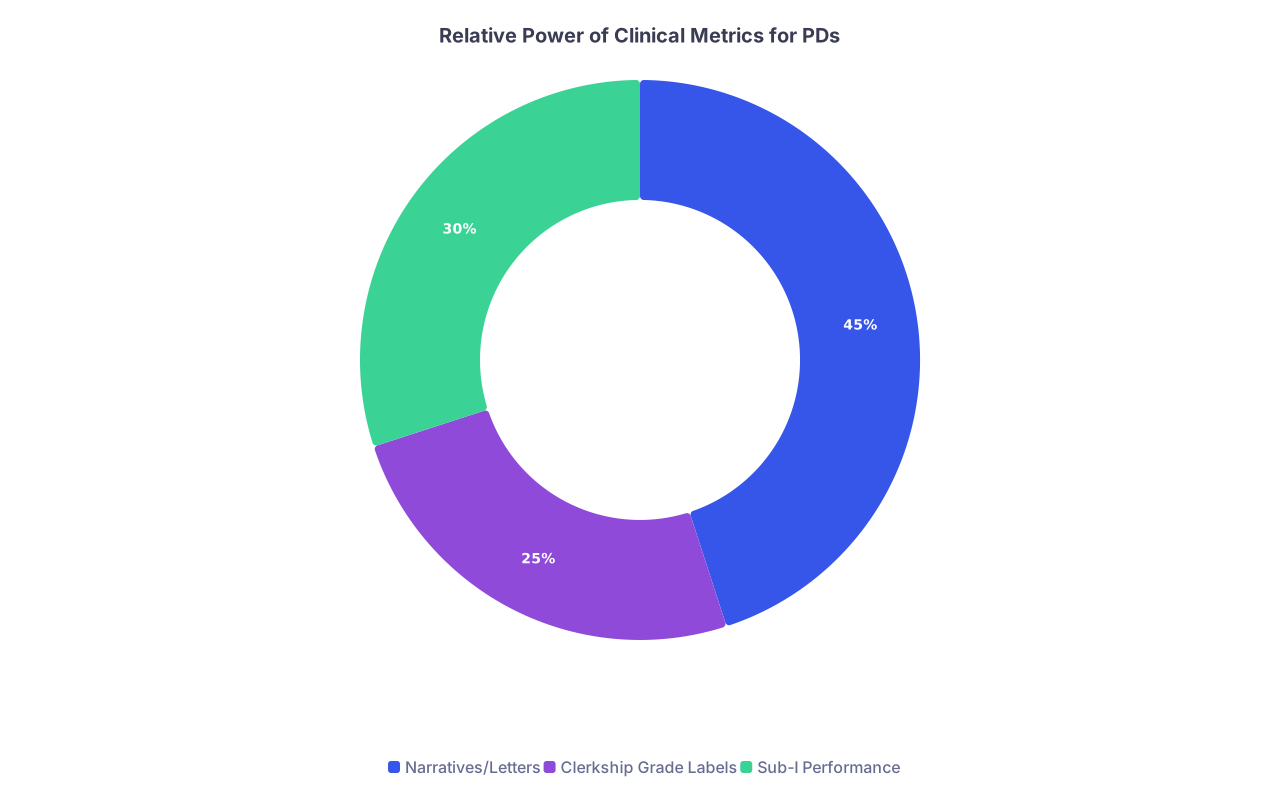
| Category | Value |
|---|---|
| Narratives/Letters | 45 |
| Clerkship Grade Labels | 25 |
| Sub-I Performance | 30 |
The myth is that Honors are the crown. The reality is they’re more like the wrapping paper: useful, but what’s inside (narratives and letters) decides if you get invited.
Competitive vs Non-Competitive Specialties: Does It Change?
Yes. But not the way people assume.
Hyper-Competitive Fields (Derm, Plastics, Ortho, ENT, Neurosurg, some Rads/Optho)
These specialties care about:
- Research productivity and fit
- Letters from big names in the field
- Performance on specialty-relevant rotations and sub-I’s
- Board scores (still heavily, even in the pass/fail Step 1 era)
Clerkship Honors help in two ways:
- They make you look consistent and “safe” (no concerns about clinical competence).
- They usually correlate with strong letters.
But a derm applicant with:
- Honors in Medicine, Peds, Surgery
- High Pass in Psych and OB
- Great derm research, strong derm letters
is competitive. The lack of “straight Honors” isn’t what breaks them. Weak derm letters or no real specialty commitment is.
Less Competitive Fields (FM, Psych, Peds, Path, some IM)
Here, being a solid, reliable clinician who is not a headache is the main currency. A mix of Honors and High Pass with strong narratives? More than enough.
The big red flag here is not “only” having High Passes. It’s any whiff of unprofessionalism, laziness, or poor interpersonal skills in evaluations. Programs will overlook a High Pass; they will not overlook “struggled to accept feedback” or “required close supervision for follow-through.”
How to Use Your Clerkship Record Strategically
Let’s get practical. Suppose your transcript looks like one of these patterns:
| Pattern | Example | Match Impact (If Other Pieces OK) |
|---|---|---|
| Near-Straight Honors | H in 5/6 cores, 1 HP | Strong everywhere, no issue |
| Mixed High Pass/Honors | 2–3 H, 3–4 HP | Very common, not fatal |
| Late Bloom | Early HP/P, later mostly H | Explainable, often fine |
| One Outlier Low Grade | 1 P in tough early clerkship | Needs explanation, but survivable |
What to actually do:
- Identify your “anchor” clerkships – the ones closest to your target specialty. Make sure those grades, narratives, and letters are your strongest.
- Use sub-internships to fix the story. If you didn’t honor your core Medicine rotation but crush your Medicine sub-I with an outstanding letter, that’s how you close the loop.
- Get at least one letter that explicitly addresses your clinical growth if your early grades were weaker. PDs like an arc, not perfection.
- Ask your Dean’s Office how your school’s grade distributions are presented in the MSPE. Many schools literally show bar charts that prove Honors are rare. That protects you more than you think.

| Step | Description |
|---|---|
| Step 1 | Non-perfect clerkship grades |
| Step 2 | Focus on strong letters in field |
| Step 3 | Do sub-I in target field |
| Step 4 | Secure powerful specialty letter |
| Step 5 | Apply with clear specialty narrative |
| Step 6 | Target specialty core grade strong? |
The Psychological Trap: Honors as Identity
Here’s the darker side: some students tie their self-worth to collecting Honors. That’s how you end up with:
- The student who never asks questions on rounds because “questions look weak”
- The terrified M3 who refuses to admit uncertainty to a senior—more focused on impressing than learning
- Burnout, anxiety, and imposter syndrome when the inevitable High Pass shows up
I’ve seen excellent future residents wreck their M3 year chasing a clean Honors record at the expense of actually becoming better clinicians. Ironically, that behavior often shows in evaluations: “seemed overly focused on grades,” “hesitant to engage for fear of being wrong,” etc.
Residents and attendings do not want the anxious Honors-collector who can’t function when things are messy or ambiguous. They want someone:
- Curious
- Reliable
- Not a jerk
- Willing to own mistakes and fix them
Your clerkship grades are one imperfect proxy for that. Not the definition of who you are.
FAQs
1. If I got a Pass in a core rotation, am I doomed?
No. A single Pass is a yellow flag, not a death sentence. It depends on:
- Was it early in the year?
- Did you improve after?
- Are there concerning comments (professionalism, attitude)?
- Is it in your chosen specialty?
If it’s not in your target field and your subsequent performance is strong with good letters, you can absolutely still match well. You’ll just want a sub-I and letter that clearly demonstrate growth.
2. Do program directors literally count how many Honors I have?
Almost never in the simplistic way students imagine. They look at the pattern, especially in your target field, then read the MSPE and letters. If something looks off—like low grades but glowing letters or vice versa—they scrutinize the narrative, not the raw count.
3. I’m at a strict school where Honors are rare. Does that hurt me?
Usually the opposite. Your MSPE will almost certainly include grade distributions showing how few Honors are given. PDs know the usual suspects: strict vs generous schools. A High Pass from a brutal grading system with strong comments often beats a cheap Honors from a grade-inflated one.
4. What should I prioritize: studying for shelf exams or impressing on the wards?
False choice. You need to be competent at both, but if you have to lean, favor reliable clinical performance and being a good team member. A slightly lower shelf with excellent evaluations and letters is far more valuable than a top shelf score with lukewarm narratives that suggest you were checked out or difficult.
Bottom line:
- You do not need Honors in every core clerkship to match well—even in competitive fields.
- Honors matter most in your specialty’s core and sub-I, but narratives and letters carry more weight than the letter grade itself.
- Stop treating Honors as your identity. Focus on becoming the kind of clinician your residents would actually want to work with at 3 a.m.—that’s who programs are trying to find.