
One bad clerkship grade is not a death sentence for your residency match. The myth that “one blemish kills your chances” is loudly repeated. The data and actual match outcomes do not support it.
Let me be blunt: what ruins people’s applications is not a single low grade. It is the pattern that grade is part of, or how the student reacts to it.
You heard “a Pass in surgery means you can’t match surgery,” or “that one Fail will follow you forever.” I have watched students with a Fail on a core clerkship match into competitive specialties at strong programs. I’ve also seen students with straight Honors struggle because the rest of their application was hollow or their letters were lukewarm.
So let’s separate superstition from what programs actually do when they see that ugly grade on your transcript.
What Programs Actually See (And Care About)
Residency selection is not built around one grade. It is built around patterns and context.
Here’s the basic reality you’re up against:
- Most programs see your transcript in PDF form, usually with:
- All your clerkship grades
- A grading distribution explanation (how common Honors/High Pass/Pass are)
- MSPE (Dean’s Letter) narrative comments
- They’re scanning for:
- Consistency or clear improvement
- Serious professionalism or conduct issues
- Evidence you can perform on the wards and on exam day
- Whether your performance in the specialty you’re applying to was solid
A single Pass (or even a Fail that was remediated) isn’t automatically disqualifying. What worries people is something like:
- Repeated marginal performance across multiple rotations
- Failing to remediate quickly or appropriately
- Professionalism flags more than the grade itself
- A clerkship in the specialty you want that went badly with bad narrative comments
If you want the mental shortcut: one bad mark in an otherwise coherent story is noise. Repeated problems or a bad mark that confirms a larger concern is signal.
What the Data and Match Trends Actually Show
No, there is not a neat “one-bad-grade” dataset, but we do have enough pieces to see the pattern.
Programs look heavily at:
- Step 2 CK (now the main standardized academic metric)
- Clerkship performance as a whole
- Letters of recommendation (especially in the target specialty)
- Class rank/quartile or overall performance bands in the MSPE
- Specialty-specific performance (e.g., your surgery grade for gen surg)
Across NRMP Program Director Surveys (pre- and post-Step 1 pass/fail), the key point is consistent: they almost never list “one clerkship grade” as a top-5 reason to reject. They talk about:
- Overall course failures
- Overall poor clerkship performance
- Concerns about professionalism
- Poor Step 2 CK
- Weak or concerning letters
A single blemish isn’t even in the headlines.
To make this concrete, here’s a simplified way programs often subconsciously “weight” things:
| Component | Typical Influence on Screening* |
|---|---|
| Step 2 CK score | High |
| Overall clerkship pattern | High |
| Specialty letters (quality) | High |
| MSPE narrative tone | Moderate–High |
| One isolated bad grade | Low–Moderate |
*Not a formal scale, but a realistic hierarchy from PD surveys and real-world behavior.
If that single bad grade is the only real weakness, you’re usually still fine—especially if:
- Your Step 2 CK is at or above the average for your target specialty
- You have strong evals and possibly Honors in that specialty’s clerkship or sub-Is
- The MSPE narrative frames the issue as resolved or isolated
To see how this plays out cumulatively:
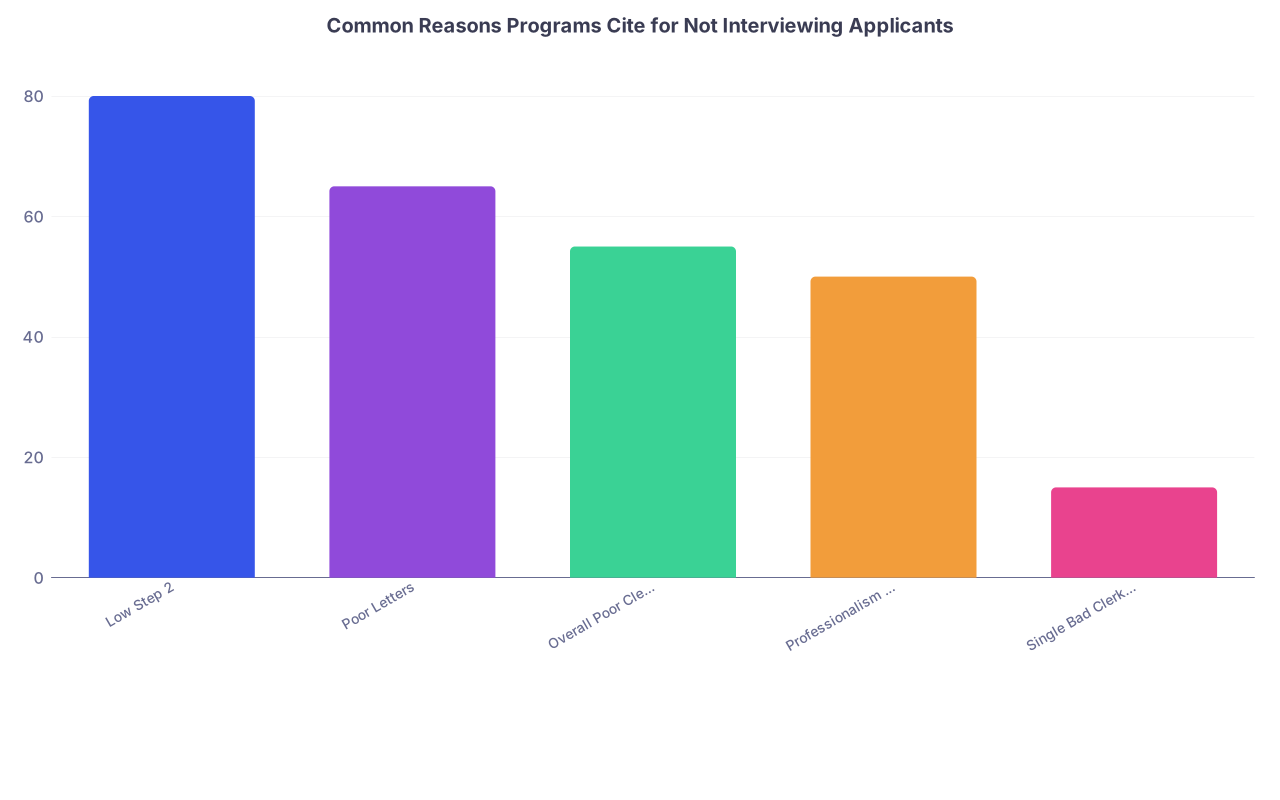
| Category | Value |
|---|---|
| Low Step 2 | 80 |
| Poor Letters | 65 |
| Overall Poor Clerkships | 55 |
| Professionalism Issues | 50 |
| Single Bad Clerkship Grade | 15 |
Interpretation: the “single bad clerkship grade” bar is way shorter. Programs care, but not nearly as much as people scare you into thinking.
The Myth of the “Fatal” Grade in Your Target Specialty
This is where the anxiety really spikes: “I got a Pass in internal medicine; can I still do IM?” Or worse: “I failed my OB/GYN clerkship; am I done for OB?”
Here’s the unvarnished version.
For most core specialties (IM, FM, Peds, Psych, Neuro, EM), a single Pass or even one rough rotation in that field is not fatal if:
- You have later rotations or sub-Is in that field that went better
- You get strong letters from those later experiences
- The narrative in the MSPE doesn’t paint you as unsafe or uninterested
Surgery and some competitive fields (derm, ortho, plastics, ENT, neurosurg) are more sensitive. But even there, the rule is not “one bad grade, you’re out.” It is “you need clear, positive counterevidence.”
I’ve seen:
- A student with a Pass in surgery but Honors in two surgery sub-Is and a 255+ Step 2 match gen surg at a strong academic program.
- A student who failed OB/GYN for poor documentation and time management, remediated successfully, then did an away rotation with stellar feedback and matched OB at a mid-tier academic institution.
The pattern is always the same: they didn’t pretend the bad grade never happened. They overwhelmed it with better data.
Where it is rough:
- Bad grade + bad narrative + no later improvement
- Bad grade that confirms a concern about professionalism (no-shows, anger issues, dishonesty)
In those cases, it’s not the letter printed on the transcript. It’s the story behind it.
How Programs Actually Read a Transcript with a Bad Grade
Let me walk through the internal monologue you never hear.
Program director opens your file. They see something like:
- Preclinical: Mostly B-level, no fails
- Core clerkships:
- IM – Honors
- Surgery – High Pass
- Peds – Pass
- OB – Honors
- Psych – Honors
- Neuro – High Pass
That Peds Pass? Unless they’re pediatrics, no one cares. Even in pediatrics, one Pass among many solid grades is not grounds to toss your file. They’ll look at the MSPE narrative: did the attending say you were disengaged, or did they say “quiet at first but improved steadily and worked well with families”?
Now the rougher scenario:
- IM – Pass (with a remediation or marginal comments)
- Surgery – Pass
- Peds – Pass
- OB – Pass
- Psych – High Pass
- Neuro – Pass
Here, the issue is not any single grade. It’s the pattern of being in the bottom or middle tier in almost everything. That’s a different conversation.
Programs round, by the way. One weird grade in an otherwise strong application gets mentally discounted. A consistent pattern of low-ish performance, poor Step 2, and weak letters reinforces itself.
The Real Red Flag: Professionalism, Not the Letter Grade
Students fixate on Honors vs High Pass vs Pass. Program directors increasingly care more about professionalism and reliability.
When I see match issues tied to clerkships, they’re usually because of:
- Documented professionalism concerns
- Repeated comments about being late, unreliable, unresponsive to feedback
- Safety issues, boundary violations, or dishonesty
A Fail based on knowledge alone that was remediated with clear improvement? Annoying, but survivable.
A Fail tied to unprofessional behavior, then vague or defensive explanations in your personal statement or interviews? That sticks.
This is why your MSPE narrative matters more than you think. It’s also why some “bad grades” are less harmful than a mildly worded but negative paragraph.
Single Bad Grade + Strong Recovery: What That Looks Like
The best counter to one bad clerkship is not hiding it. It is building a clearly upward story after it.
Common salvage pattern I’ve seen work:
- You get a bad grade (Pass or Fail) in a mid-third-year clerkship.
- You meet with the clerkship director, understand the critique, and fix your behavior tangibly.
- Your subsequent rotations show improved comments: more engaged, better notes, more ownership.
- You choose a sub-I in that same field or a related one, perform strongly, and get a letter that explicitly mentions your growth.
From the program side, that reads as: “They got knocked down, learned, and improved. Good. They can handle residency feedback.”
To clarify how often a single bad grade sinks you by itself, compared with patterns:
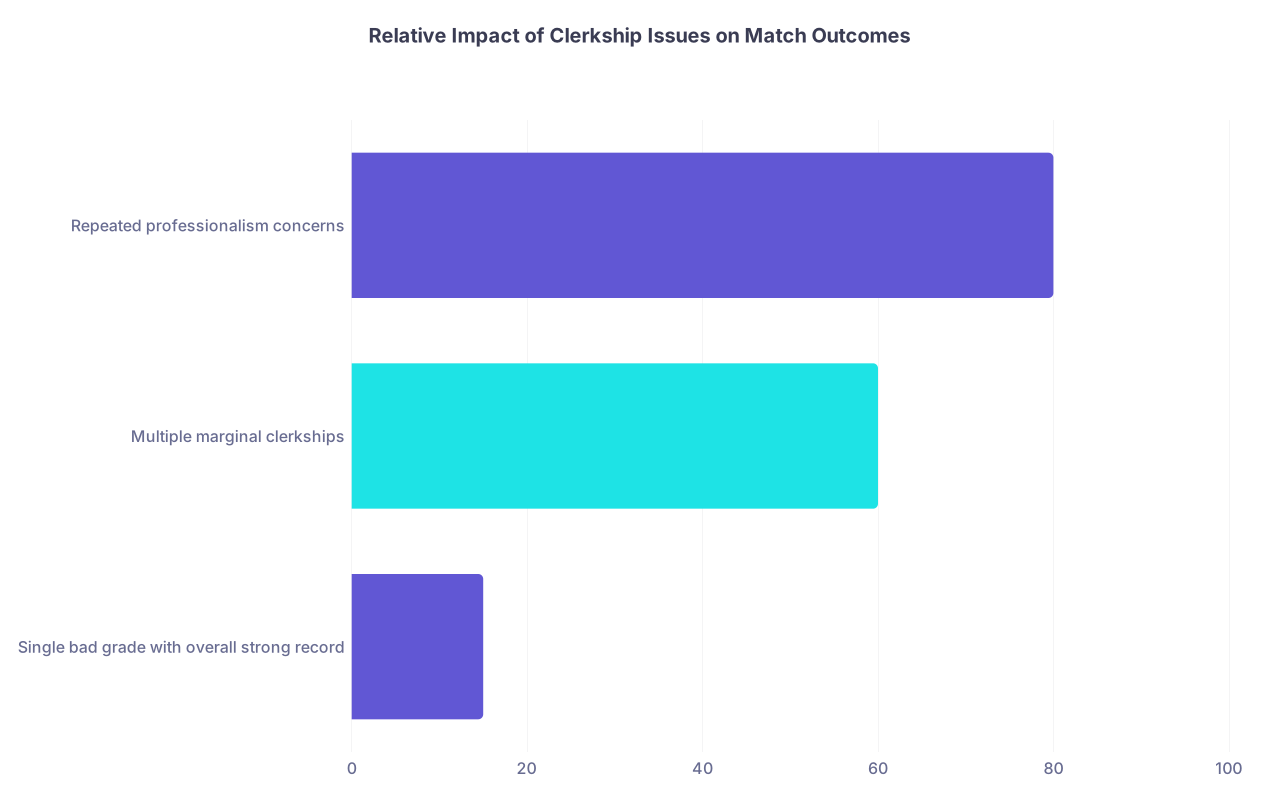
| Category | Value |
|---|---|
| Single bad grade with overall strong record | 15 |
| Multiple marginal clerkships | 60 |
| Repeated professionalism concerns | 80 |
Low impact for the first. High impact when there’s repetition or character concerns.
When You Do Need to Address the Grade Directly
Not every blemish needs a full personal statement autopsy. Over-explaining can actually make things worse.
You should consider explicitly addressing a bad clerkship grade if:
- It was a Fail in a core clerkship
- It involved any professionalism write-up, even if resolved
- It’s in the specialty you are applying into and the narrative might raise questions
How to do it without sounding defensive:
- State briefly what happened. No drama.
- Own your part.
- Describe what you changed in concrete terms.
- Point to later evidence that your adjustment worked.
Example pattern:
“I struggled early in my internal medicine clerkship with time management and prioritizing tasks. Feedback from my team made it clear I was not meeting expectations. I met with my clerkship director, adjusted my pre-rounding routine, and sought more feedback from residents. On subsequent rotations and my medicine sub-internship, I implemented these changes and was able to manage more patients independently while maintaining thorough documentation.”
No sob story. No blaming. Just: here’s what happened, here’s what I did, here’s proof I improved.
You don’t need a separate essay for every Pass. But for a Fail or a really problematic narrative, some controlled explanation is better than leaving programs guessing.
Specialty Competitiveness vs. One Bad Grade
The more competitive the specialty, the less slack you get. That does not mean you must be flawless; it means your overall signal has to remain above the bar.
Here’s how a single bad clerkship interacts with competitiveness:
| Specialty Tier | Effect of One Bad Grade (Typical) |
|---|---|
| Less competitive (FM, Peds, Psych) | Usually minor if overall record OK |
| Mid (IM, EM, Anesth, OB) | Needs counterbalance but still workable |
| Highly competitive (Derm, Ortho, ENT, Plastics, NSurg) | Tolerated only if rest is outstanding and grade is not in target field |
You won’t get cut from family medicine because you passed instead of honored surgery. But if you want ortho and had a rough surgery rotation at your home program with no strong ortho letters, yes, that’s a real obstacle.
Even then, the fix is the same: crush your away rotations, get glowing ortho letters, and score well on Step 2. Show that whatever happened earlier does not represent your current level.
What Actually Helps After a Bad Clerkship
If you’re sitting with that grade already on your transcript, the productive question is: now what?
Here’s what actually moves the needle:
- Step 2 CK: A strong score calms a lot of academic anxiety. PDs love clean standardized data.
- Strong sub-I performance: Especially in your chosen field. Sub-Is are “residency lite.” Doing well there is incredibly reassuring.
- Letters that talk about how you work in a team, own patients, handle feedback.
- Consistent or upward trend: If your earlier clerkships were the worst and later ones are your best, that’s good news. Programs like trajectories.
What doesn’t help much:
- Obsessing over whether to explain a simple Pass.
- Trying to retroactively “argue” a grade up, months later. That energy is better spent improving your next rotation.
- Hiding, avoiding feedback, or getting bitter. That attitude tends to bleed into how you interact with residents and faculty, and they notice.
Think of your application like a dataset. A single outlier doesn’t ruin the model if everything else lines up.
The Bottom Line: What Outcomes Really Show
Let’s strip this down.
First: One bad clerkship grade, by itself, is almost never a dealbreaker. Programs care vastly more about your overall pattern, your professionalism, and your Step 2 CK than whether you passed or honored some random mid-year rotation.
Second: What does hurt you is a cluster of weak clerkships or any hint that you’re unreliable, unsafe, or unable to respond to feedback. The letter grade is the symptom; the underlying behavior is what actually scares programs.
Third: The strongest response to a bad grade is not panic or denial. It is visible improvement on later rotations, strong sub-I performance, and letters that show you learned from it. When your later data contradicts that single bad mark, most programs believe the later data.
You are not your worst clerkship. But if you let that one moment define your behavior for the rest of med school, you might make the myth come true.