
It’s late. You should be sleeping. Instead, you’re zoomed in on your transcript and ERAS experiences list, stomach in knots.
You’re thinking:
“I never did ICU.”
“I didn’t do that legendary ‘hard’ sub-I that everyone talks about.”
“My schedule is full of wards, clinic, electives… but nothing that screams ‘I suffered and survived.’
And now you’re spiraling: Are program directors going to look at this and think you chose the easy path? That you can’t hack residency? That you strategically dodged the tough stuff?
Let’s actually walk through this. Because your brain is probably catastrophizing way past reality.
What PDs Actually Look At (Versus What We Obsess Over)
Here’s the uncomfortable truth: PDs are not sitting there with a red marker circling “NO ICU” and stamping REJECT across your file. They’re doing pattern recognition at scale.
Roughly, they care about:
- Can this person do the work and not crumble?
- Have they seen enough of this specialty to know what they’re getting into?
- Are they safe with patients, reasonably efficient, and coachable?
- Do they play well with others, or are they a walking HR complaint?
They look for that stuff through:
- Core clerkship grades
- Sub-I / acting internship performance
- Letters of recommendation (this is huge)
- Step/COMLEX scores where still used
- Deans letter/MSPE narratives
- Any red flags (leaves, failures, professionalism issues)
“Did this person do an ICU month?” is, at best, a secondary or tertiary question. For medicine, surgery, EM, and some critical care-heavy fields, it’s more relevant. For others, it’s almost background noise.
Does that mean it never matters? No. But the way we catastrophize it—“No ICU = definite rejection”—is just not aligned with how applications are actually read.
Will They Assume I Avoided Hard Rotations?
This is the exact fear, right? Not just “I didn’t do ICU” but “They’ll think I dodged ICU because I’m weak.”
Here’s where it can raise an eyebrow:
- You’re applying to a very acute/critical-care-heavy specialty (IM, EM, anesthesia, surgery)
- Your transcript is light on clearly demanding rotations
- You also don’t have strong letters from any rigorous inpatient experience
- And your narrative doesn’t explain anything
Put that combo together and, yeah, someone on a committee might wonder:
“Did this student just float through comfy electives and clinics?”
But if your application shows:
- Strong performance in internal medicine or surgery wards
- A solid sub-I where someone explicitly calls you reliable, hard-working, composed under pressure
- Maybe a night float or heavy inpatient experience somewhere
- Letters that actually say “this student can handle high volume and acuity”
Then the lack of ICU specifically becomes just that—a missing line, not a red flag.
The concern is never “no ICU.” It’s “no evidence of toughness anywhere.”
So your job is not to magically add an ICU rotation in the past. It’s to make sure your app clearly shows:
“I’ve done hard things. I didn’t fall apart. People who supervised me would trust me with their sickest patients.”
What If My School Didn’t Require ICU or a ‘Hard’ Sub-I?
This is much more common than people admit.
Some schools:
- Don’t require ICU at all
- Have “sub-Is” that are basically just extra wards
- Have variability so that some “ICUs” are brutal and others are glorified step-down lounges
- Used COVID schedules that nuked tons of ICU exposure
PDs actually know this. They read dozens of applications from your school every year. They see patterns:
- “Oh, this school doesn’t have a required ICU for MS3s.”
- “Their sub-I is equivalent to wards at other places.”
- “This place had disrupted rotations for years due to COVID.”
They’re not expecting you to hack the curriculum and brute-force your way into ICU if it wasn’t realistic.
If ICU wasn’t required and schedules were tight, you’re not being judged against a fantasy version of yourself who somehow took everything, everywhere, all at once.
If you’re worried, this is where you can use your MSPE and your advisor email to your advantage:
- MSPE often mentions curriculum structure and required rotations
- Faculty letters sometimes explicitly say “Our school does not require ICU; instead, X”
You can also mention this very briefly in a personal statement if relevant, but don’t write an essay about “why I never did ICU.” That starts to sound guilty and defensive.
But Everyone Around Me Did ICU… Am I Screwed?
You’re watching classmates applying to IM or EM brag about their “insane” MICU month or the surgical ICU horror stories. You feel behind. Soft. Under-tested.
Reality check:
- Plenty of people match IM, EM, anesthesia, surgery every year with minimal or no ICU on their transcript.
- What they almost always have, though, are strong inpatient experiences somewhere and letters that back that up.
Here’s where your brain does that sneaky thing: it compares your worst narrative of yourself to the highlight reel of your classmates’ self-marketing.
That guy who won’t shut up about MICU might have barely passed it. The person posting all those ICU selfies might have a mediocre letter that literally says “shows up and completes tasks.”
No one is screenshotting their MSPE narrative and posting “Attending said I struggled with time management and prioritization.” You’re only seeing the parts they spin.
Your job: stop obsessing over what you didn’t do and look at what on your record already shows you can work hard, handle pressure, and grow.
What Matters More Than ICU: Your Hard-Evidence “Grit Signals”
You can’t add ICU retroactively, but you can highlight what I call “grit signals.” Stuff that tells PDs, “This person has done more than cushy clinic.”
Think about things like:
- A demanding inpatient medicine or surgery rotation with a strong grade
- A sub-I where the letter explicitly mentions:
- reliability
- work ethic
- ownership of patients
- situational awareness
- performance under stress
- Night float or call-heavy rotations
- Busy ED shifts where acuity and volume were high
- Any setting where you had to manage multiple sick patients at once and keep your head
If you have one killer inpatient letter that says, “I would absolutely take this student as an intern; they function already at the level of a PGY‑1,” that is worth more than 10 lines of “ICU” on a transcript with generic or bland comments.
| Experience Type | How It Helps Your Case |
|---|---|
| Strong IM sub-I | Shows you can run a team, own patients |
| Busy ED elective | Shows comfort with acuity and chaos |
| Night float month | Signals resilience and real intern hours |
| Surgery wards rotation | Demonstrates stamina and task management |
If your app is missing all of these, then yeah—PDs may wonder how you’ll do when residency stops being hypothetical. But that’s about the total pattern, not ICU specifically.
Specialty-Specific Reality: When No ICU Actually Matters
Let me be blunt for a second. There are fields where never touching ICU can raise questions. Not automatic rejection. Just more questions.
Most impacted:
- Internal Medicine (especially academic, tertiary-care heavy programs)
- Emergency Medicine
- Anesthesiology
- Surgical specialties (general surgery, neurosurgery, CT, etc.)
- Combined critical-care paths (IM/CC, anesth/CC trajectories)
Less impacted:
- Psych
- Family Medicine (though some FM programs do value ICU exposure)
- Pediatrics (PICU is nice but not mandatory everywhere)
- PM&R, Path, Radiology, etc.
Even in IM/EM/anesthesia, I’ve seen people match solid programs without ICU. The common thread: they had other ways to prove they weren’t fragile.
What really causes problems is this combo:
- Weak or average IM grades
- Nothing resembling a heavy sub-I
- No ICU
- Vague or lukewarm letters (e.g. “pleasant, punctual, worked well with team” and nothing else)
- No story in the personal statement showing actual, real-world patient care responsibility
That’s when the committee starts doubting.
So if you’re applying to those “acute” fields and feel light on ICU/hard rotations, ask yourself:
- Do I have at least one rotation where I truly functioned like an intern?
- Does someone who saw that experience actually say so in a letter?
- Can I talk in my PS about taking ownership, managing competing demands, making tough calls?
If yes, you’re a lot safer than your 2 a.m. brain is telling you.
How to Frame Your Application If You Never Did ICU
You can’t change the past, but you can absolutely control how your present looks on paper.
Ways to quietly, confidently address the “no ICU” issue without sounding defensive:
Use your personal statement for substance, not apology.
Instead of: “I never had the chance to rotate in the ICU…”
Try: “On my medicine sub-I, I was responsible for 6–8 complex patients daily, including individuals with multi-organ dysfunction on high-level support. I learned to prioritize tasks quickly, anticipate decompensation, and communicate early with my seniors.”Translation: You show ICU-like thinking without groveling about ICU itself.
Make sure your letters do the heavy lifting.
When asking for letters, you can say to an attending:
“I’m applying to IM and didn’t get to do ICU. If you feel comfortable, I’d really appreciate if you could speak to how I handled sick patients and stressful situations on wards.”Not everyone will, but some attendings get it and will specifically highlight that.
Highlight “hard rotation” stories on your ERAS experiences.
Don’t just list “Internal Medicine Sub-I.” In the description, you can mention:- census numbers
- level of independence
- complex patients
- dealing with nights or cross-cover
If you’ve done ANY critical care–adjacent thing, mention it.
Step-down units, rapid response team exposure, ED shifts dealing with septic shock, respiratory failure, etc. It all counts as “I’ve seen very sick humans and didn’t faint.”
What If I’m Still in School and Haven’t Applied Yet?
If you’re reading this early enough that you can still do something, good. Use that.
You don’t need to panic-add 3 ICU months. That’s overkill and can actually hurt if you burn out or underperform. Instead:
- Try to get one rotation that’s clearly demanding and acute. That could be:
- MICU or SICU
- A heavy medicine sub-I at a large academic center
- A legit ED month with true responsibility
- Protect it. Don’t pack 20 other stressful things into that same block of time. You actually want to be able to show up and function, not just survive.
And be strategic: a strong, well-chosen “hard rotation” you crush is better than a scatter of intense rotations you limp through.
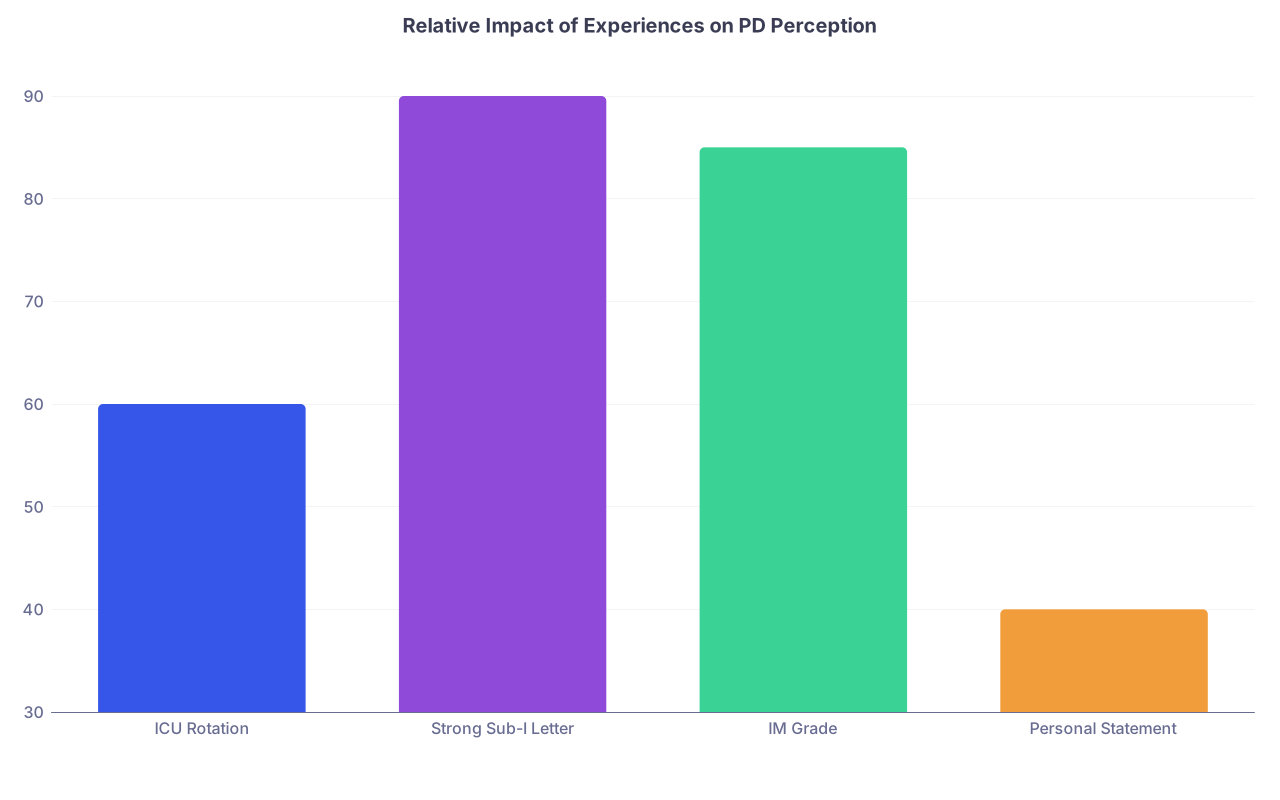
| Category | Value |
|---|---|
| ICU Rotation | 60 |
| Strong Sub-I Letter | 90 |
| IM Grade | 85 |
| Personal Statement | 40 |
Worst-Case Scenarios (Because Your Brain Is Going There Anyway)
Let me just say the quiet part out loud, because your anxiety already did.
Worst-case #1:
A PD in a very critical-care-heavy IM or EM program really wants to see ICU and you don’t have it. They’re on the fence about you and this tips them toward “No interview.”
Can that happen? Yes. To someone. Every year.
But usually, that person also has some other weaknesses: mediocre letters, unremarkable narrative, nothing that screams “top candidate.” ICU absence becomes the tiebreaker, not the main reason.
Worst-case #2:
An interviewer asks, “I see you didn’t have an ICU rotation. Tell me about that.” You freeze and ramble and basically apologize for your entire existence.
This one you can actually control. If you’re worried about the question, prep a simple, honest, unapologetic script:
- “Our school doesn’t require ICU and scheduling didn’t allow me to add it, but I had similar level-of-acuity exposure on my [X rotation]. On that month, I…” and then talk about sick patients you helped manage, nights, etc.
They’re not trying to catch you in some ICU scandal. They just want to know you’ve seen sick people and didn’t disintegrate.
Worst-case #3:
You don’t match where you wanted and your brain blames it entirely on “no ICU.” This is seductive because it gives you one clean villain.
Reality is messier: it’s usually 5 small things, not one dramatic missing rotation.
How to Calm Your Brain Down Enough to Function
No, you can’t fully kill the anxiety. If you’re reading this, you’re probably the type who replays every micro-decision from M2 onward. But you can quiet it enough to actually work on what matters.
Three practical steps:
Reality check with someone who actually reads applications.
Faculty advisor, APD, PD, senior resident who sits on the recruitment committee. Ask directly:
“I don’t have ICU on my transcript. For [specialty], how much does that really matter if I have X, Y, Z?”
Don’t rely on group chat folklore or Reddit disasters.Make a one-page “evidence of readiness” list.
List rotations, letters, specific patients, and responsibilities that prove you can:- handle acuity
- manage volume
- be reliable
- communicate under pressure
Use that list to shape your personal statement, experiences section, and how you talk in interviews.
Stop doom-scrolling your classmates’ schedules.
Their ICU month doesn’t erase your sub-I. Their horror story doesn’t equal their letter strength. You’re building your case, not cosplaying someone else’s.

| Step | Description |
|---|---|
| Step 1 | Notice No ICU On Transcript |
| Step 2 | Schedule One Hard Rotation |
| Step 3 | Identify Grit Signals |
| Step 4 | Aim For Strong Letter |
| Step 5 | Highlight In PS And ERAS |
| Step 6 | Practice Brief Explanation For Interviews |
| Step 7 | Still Time Before Apps |
Bottom Line: Is No ICU or “Hard” Rotation a Dealbreaker?
No.
Annoying? Sometimes. A small disadvantage for certain specialties? Sure. A dealbreaker? Almost never.
Program directors aren’t looking for buzzwords on your transcript. They’re looking for evidence that you can do the job, care about patients, and not implode when things get hard.
If you don’t have ICU, then make sure you:
- Show you’ve done something genuinely demanding—sub-I, busy wards, ED, nights—and highlight it.
- Get at least one strong letter that clearly says you functioned at or near intern level with real responsibility.
Do those two things and “No ICU” becomes a footnote, not your obituary.