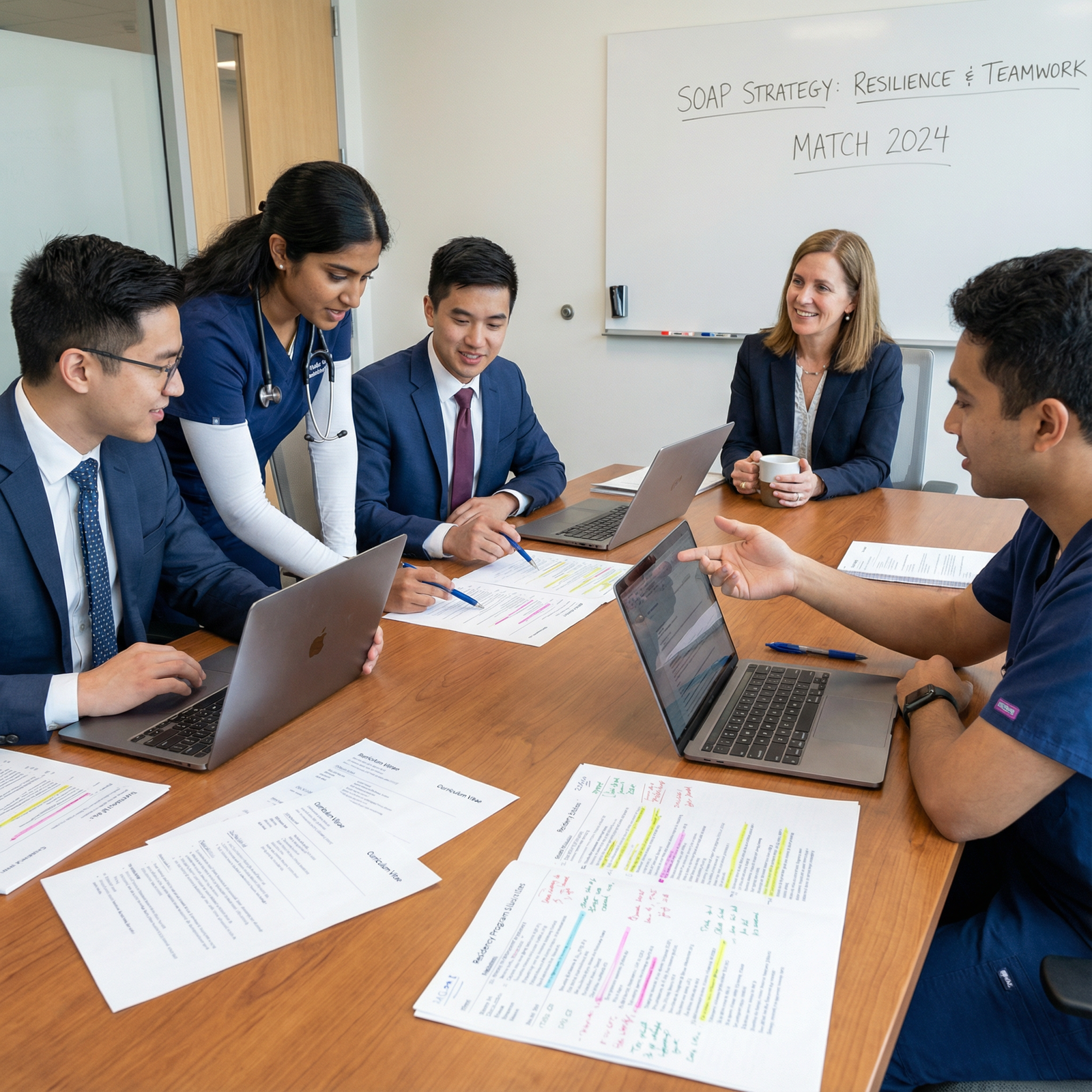
It is Monday afternoon of Match Week. You just saw the email: “We are sorry, you did not match to any position.”
Your heart is in your throat. Your dean says, “SOAP is still an option. You need a plan for Wednesday.”
This guide is that plan. Not abstract advice. Hour‑by‑hour, what you should be doing from the night before SOAP offers start until the last round ends.
I will assume the standard NRMP SOAP schedule:
- Monday 10:00 AM ET – Unmatched notification
- Monday 11:00 AM ET – List of unfilled programs released
- Monday–Tuesday – You apply through ERAS, programs review
- Wednesday – Four SOAP offer rounds (often 9, 11, 1, 3 PM ET; check your year’s exact times)
Adjust the clock to your time zone. I will speak in Eastern Time and tell you exactly where your eyes, brain, and mouse should be at each point.
The Night Before Offer Rounds (Tuesday 5 PM – 11 PM ET)
At this point you should stop treating SOAP like a theoretical backup plan. It is now your primary match.
5:00–6:00 PM – Lock Your Target List
By now, your ERAS SOAP applications should be submitted. Tonight is about offer strategy, not new applications.
You should:
- Print or write a single, clear rank list of every program you applied to
- Sort them by:
- Specialty preference (e.g., FM > IM > Prelim > TY)
- Geography constraints (family, visas, licensing)
- Absolute no‑go’s (toxic reputations, visa impossibilities, impossible cost of living)
Make three columns:
- Program name + specialty
- Priority rank (1–N)
- Quick comments: “Great PD, IMG friendly,” “Only option in Midwest,” “Prelim only, okay if desperate.”
You will not have time to think deeply when offers come. You want to be able to glance and act.
6:00–7:00 PM – Decide Your Red Lines
You need to know what you’d rather do than accept a bad SOAP offer.
Be brutally clear:
- Will you accept any categorical position regardless of location?
- Will you accept any prelim just to be in the system? Or only in specific specialties (IM, Surgery)?
- Are there states where you cannot realistically live due to personal or legal reasons?
On your list, draw a line:
- Above the line: “I will accept any offer from these programs on the spot.”
- Below the line: “Only consider after thinking. Potential decline if a better offer is likely.”
- If a program is truly unacceptable, cross it off entirely. Do not kid yourself that you will “decide later.” You will not.
7:00–8:00 PM – Tech and Logistics Rehearsal
You would be surprised how many people lose offers to basic tech failures. I have seen it.
You should:
- Confirm ERAS login works, password saved or written down
- Verify your NRMP and email logins
- Set your phone:
- Loud ringtone
- Vibration on
- Disable “Do Not Disturb”
- Turn off Focus modes
- Identify your SOAP command station for tomorrow:
- Table or desk
- Power outlets
- Stable internet
- No roommates/family bursting in every 3 minutes
Run a dry‑run:
- Open ERAS
- Navigate to the SOAP section where offers will appear
- Review how to accept/decline (screenshots or a quick note to yourself)
8:00–9:00 PM – Align with Your Support Team
If you have:
- An advisor/dean
- A mentor in your specialty
- A parent/partner who will inevitably have opinions
Talk now, not during the offer window.
You should:
- Show them your ranked list
- Tell them your red lines
- Decide:
- “If I get X offer at Round 1, I will accept immediately.”
- “If I get Y offer at Round 1, I will wait to see if something higher on my list appears in Round 2.”
Set boundaries:
- During offer windows, you make the decision, not committee‑by‑zoom. Keep advisors available but not in full control.
9:00–10:00 PM – Mental Rehearsal of Scenarios
Run through actual what‑ifs:
- Scenario A: “Round 1 – I get a categorical IM in a less‑desirable city, but it is within my top 10. Do I accept?”
- Scenario B: “Round 2 – Two prelim medicine offers, both mid‑tier cities. Is prelim acceptable to me?”
- Scenario C: “No offers until Round 4. Do I accept any prelim at that point, or do I regroup for reapplication?”
Write down your default moves:
- “Top 5 categorical: always accept.”
- “6–15 categorical: accept by Round 2 if nothing higher came.”
- “Any prelim: only accept in Round 3 or 4 if still unmatched.”
That written decision tree will keep you from panicking and making a random move.
10:00–11:00 PM – Shut It Down
Now you need sleep.
- Set multiple alarms (phone, smart speaker, old‑school clock)
- Put your ID, notebook, and phone charger next to your setup
- No more Googling “SOAP horror stories”
- Try to sleep 7–8 hours. You will need a fully functioning brain for split‑second decisions.
Offer Day Morning: Pre‑Round Setup (Wednesday 7 AM – 8:45 AM ET)
At this point you should be shifting from planning to execution.

7:00–8:00 AM – Wake, Reset, Review
You should:
- Eat something with actual calories, not just caffeine
- Re‑review:
- Your printed rank list
- Your default rules (what you auto‑accept vs. wait)
- Check:
- Email for any program outreach that came overnight
- Your phone for missed calls or messages from advisors
Do not make major edits to your rank list now. Trust yesterday’s calmer brain.
8:00–8:30 AM – Final Systems Check
Sit at your SOAP command station.
You should:
- Open:
- ERAS
- Email (personal + school)
- NRMP homepage (for schedule confirmation)
- Confirm your time zone relative to Eastern. No mistakes here.
- Put your rank list in front of you (paper, large font, highlighted).
Have:
- Pen
- Scratch paper for notes (“Offer 1: Program X, 9:03 AM, IM prelim”)
Make a big note at the top:
“When in doubt, check the list. Do not guess.”
8:30–8:45 AM – Quiet Focus
Last 15 minutes before Round 1:
- Silence non‑essential group chats
- Put your phone on the table, not in your pocket
- Deep breathing. This will feel like a code situation. Your job is to stay calm enough to think.
Round 1: First Offers (Typically 9:00–9:30 AM ET)
At this point you should be in full execution mode.
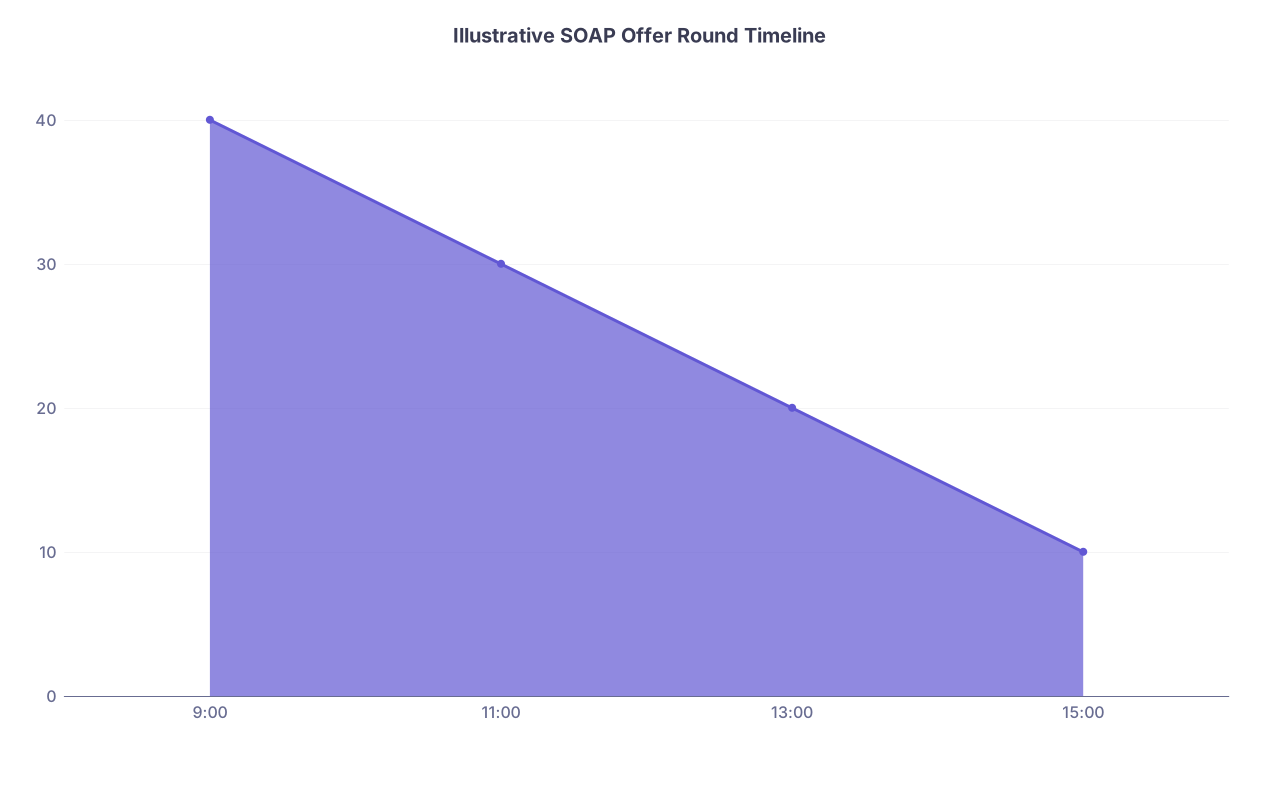
| Category | Value |
|---|---|
| 9:00 | 40 |
| 11:00 | 30 |
| 13:00 | 20 |
| 15:00 | 10 |
(Example shape only: offers usually cluster early and decrease by later rounds.)
8:55–9:00 AM – Be Logged In and Still
You should already be:
- Logged into ERAS
- On the SOAP offers screen (or the page that will show offers)
- Not clicking refresh like a maniac. ERAS often auto‑updates, but light refreshes are fine.
Have your rank list open and visible.
9:00–9:10 AM – Handling Incoming Offers
If you get an offer in Round 1, this is the crucial 10 minutes.
You should:
Read the offer details carefully
- Program name
- Specialty
- Categorical vs. prelim
- Location
Find it on your rank list immediately. Note:
- Its rank (e.g., #3 of 40)
- Whether it is above or below your red‑line threshold
Decide using your pre‑made rules:
- If this is in your top tier (e.g., top 5 categorical):
- Accept. Do not overthink. A bird in the hand.
- If it is mid‑tier:
- Ask: “Would I be okay matching here if nothing else appears?”
- If it is below your acceptable threshold:
- Decline and move on. A program you truly cannot tolerate is not a “safety”; it is a future regret.
- If this is in your top tier (e.g., top 5 categorical):
Remember: Accepting any SOAP offer ends your SOAP participation. You cannot shop between multiple offers or rounds after accepting.
9:10–9:20 AM – If You Accepted
If you click “accept”:
You should:
- Take screenshots or photos of the confirmation screen
- Check email for confirmation from NRMP / ERAS / program
- Notify:
- Your dean’s office
- Key mentors or family (briefly; you can celebrate later)
Then stay put. Occasionally, there are delays in systems aligning. Do not log out and vanish. Wait for official confirmation that your SOAP participation is done.
9:10–9:25 AM – If You Declined or Received Nothing
If you decline:
- Record in your notes:
- Program
- Round
- Reason (“below threshold,” “prelim only, saving for categorical”)
If you receive nothing in Round 1:
- Do not rewrite your entire application strategy. Round 1 is often heavy on certain specialties and program patterns.
Use this window to:
- Message your dean: “No offers Round 1. Any insight from program directors?”
- Refresh email for any program interest. Occasionally PDs will email or call before Round 2.
9:25–10:45 AM – Between Round 1 and 2
At this point you should be refining, not panicking.
You should:
Review your list:
- Any program you regret having on the “auto‑accept” side after seeing how it felt? Adjust now.
- Any prelim you are now more open to if nothing else comes? Move it up.
Touch base with mentors:
- Quick, targeted questions: “I have not heard from these X IM programs. Any known red flags?”
Do not:
- Spam‑email every program director
- Try to withdraw and refile applications—this is not how SOAP works
You are preparing your mind for Round 2, where many realistic options still exist.
Round 2: Strategic Flexibility (Typically 11:00–11:30 AM ET)
At this point you should start integrating Round 1 feedback into your offers logic.
10:55–11:00 AM – Reset for Round 2
Repeat the same pre‑round ritual:
- ERAS open on offer screen
- Rank list updated in hand
- Notes from Round 1 in front of you
Ask yourself:
- “Given no offers in Round 1, am I now willing to accept slightly lower‑ranked categorical programs if they appear?”
11:00–11:10 AM – New Offers Evaluation
If an offer appears:
- Quickly locate it on your list
- Compare to:
- Where it sits in your ranking
- How many rounds remain
- Your tolerance for walking away unmatched this year
By Round 2, my rule of thumb:
- Top 10–15 categorical: strongly consider accepting now if you had no Round 1 offers
- Prelim positions: still hold if your list contains many unexhausted categorical options you would prefer
If your metrics are weak (multiple failures, limited interviews), and a solid prelim in IM or TY appears, I lean toward accepting by Round 2–3. Better a foot in the door than another full gap year without GME.
11:10–11:25 AM – Post‑Decision Actions
Same pattern:
- Accept → document, confirm, notify
- Decline → log reason, maintain calm
- No offers → re‑center
Between 11:25 and 1:00:
- Briefly eat and hydrate
- Re‑review your realistic remaining options:
- Which programs are known to move later?
- Are there specialties where most spots usually go by Round 2?
If after Round 2 you still have zero offers, you must start mentally preparing for a higher tolerance for prelims or less preferred locations in Rounds 3 and 4.
Round 3: Calculated Risk vs. Security (Typically 1:00–1:30 PM ET)
At this point you should have a clear idea of how risky holding out has become.
| Round | Typical Strategy Shift | Categorical vs Prelim Priority |
|---|---|---|
| 1 | Very selective | Categorical strongly favored |
| 2 | Moderately selective | Categorical, consider strong prelims |
| 3 | More flexible | Good prelims move up |
| 4 | Survival mode | Any acceptable position |
12:55–1:00 PM – Honest Self‑Assessment
Look at your situation:
- US MD with decent scores and strong letters? You can justify a bit more selectivity.
- US DO / IMG with previous exam issues and no offers in 2 rounds? Time to prioritize getting any GME slot that meets your minimum standards.
Update your rules on your paper:
- For example: “By Round 3, accept any prelim IM or TY above rank #25 if offered.”
1:00–1:10 PM – Making the Call on Mid‑Tier Offers
If an offer hits in Round 3 from:
- A mid‑tier categorical in a less‑desirable place → I usually say accept. Categorical beats rolling the dice for something only slightly better.
- A good prelim program (reputation, fellowship placement, geography you can handle) → strongly consider accepting if you have had no prior offers.
Do not trap yourself in magical thinking:
- “Maybe my dream big‑name university will offer in Round 4.”
If they have shown no interest by email or phone and you had a weak application, this is fantasy.
1:10–1:25 PM – If Still Unmatched
If Round 3 ends with no offers, you should:
- Have a frank, short conversation with your dean:
- “Realistically, how likely are categorical offers in Round 4 for someone with my profile?”
- “If I take a prelim now vs. reapply unmatched, what do you recommend?”
Adjust your Round 4 threshold:
- You are now in salvage mode, not ideal fit. That is not pessimism. It is realism.
Round 4: Last Window, No Illusions (Typically 3:00–3:30 PM ET)
At this point you should be clear: this is the final SOAP chance this cycle.
2:45–3:00 PM – Set Your Final Line
Before the last round opens, write a single sentence at the top of your paper:
- “By the end of this round, I would rather [accept any prelim above line X] than [go unmatched and reapply].”
Then draw that line clearly on your list. If you cannot decide now, you will freeze when an offer hits.
3:00–3:10 PM – Last Round Offers
If an offer appears:
- If it is above your final line, accept.
- If it is borderline, ask:
- “Will reapplying next year from zero be easier than reapplying from a prelim spot with inside contacts and US clinical experience?”
- For many applicants, especially IMGs and those with weaker applications, the answer is no.
A few hard truths:
- A decent prelim in IM or TY is often better than being completely outside the system.
- A prelim in a malignant, chronically underfilled surgery program with massive burnout may not actually help you long term. That is where your research and advisor intel matter.
3:10–3:30 PM – If You Accept
Once you accept in Round 4:
- Document
- Confirm SOAP completion
- Start shifting your mindset from “crisis” to “plan for success in this program,” even if it was not your dream pick.
If you decline a Round 4 offer, you must have a very clear reason. Not “I do not love the city.” Think in terms of:
- Visa impossibility
- Absolutely unsafe environment
- Reliable reports of program collapse / non‑accreditation risk
Immediately After SOAP Ends (Late Afternoon – Evening Wednesday)
At this point you should pivot from frantic mode to damage control and planning, whether matched through SOAP or not.
If You Matched Through SOAP
You should:
- Email:
- Program coordinator and PD: brief, professional thank‑you + expression of commitment
- Inform:
- Your dean
- Financial aid office (for planning)
- Calmly process your feelings:
- SOAP outcomes can feel complicated. You might feel relief and disappointment at once. That is normal.
Start a small list:
- “What I must do by the end of this month”: paperwork, housing planning, licensing steps.
If You Did Not Receive Any Offers
This is brutal. No way to sugarcoat it. But you are not done as a physician.
That same evening:
- Meet (virtually or in person) with:
- Your dean
- A trusted advisor in your intended field
You should:
- Outline a 12‑month plan:
- Research year, MPH, or other structured gap year
- Additional US clinical experience
- Retaking failed exams or strengthening Step/COMLEX scores
- Potential specialty pivot if your initial field is essentially closed off with your stats
Do not:
- Email program directors asking “why not me?” on SOAP day. There will be time later for autopsy and feedback. Right now, you need stability and a path.
Key Takeaways
- SOAP offers are not a time for real‑time brainstorming. Do your thinking the night before and turn it into clear rules.
- Treat each round differently: Round 1 is about selectivity; Round 4 is about survival. Adjust your threshold consciously between rounds.
- Accepting a solid, if imperfect, position is almost always better than gambling everything on a fantasy offer that never comes.