
It’s Monday of Match Week. You’ve just read the email: “We are sorry, you did not match to any position.” Your stomach drops. Ten minutes later you’re logged into NRMP, staring at the SOAP-eligible positions list and a blank strategy.
Here’s the reality: you do not have time to improvise. SOAP is four tightly timed offer rounds over two days. Every hour you waste on indecision or bad advice costs you real chances at a job.
I’m going to walk you round-by-round, with specific “at this point you should…” instructions. Think of this as a playbook you keep next to your laptop during SOAP.
Big Picture: The SOAP Week Timeline
Let’s anchor you in time first.
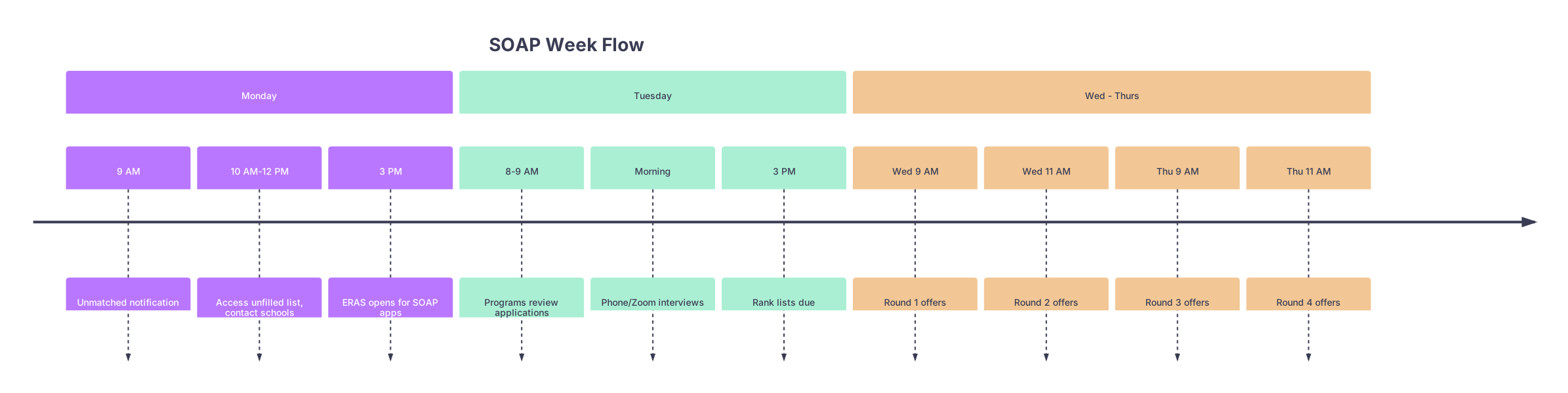
| Period | Event |
|---|---|
| Monday - 9 AM | Unmatched notification |
| Monday - 10 AM-12 PM | Access unfilled list, contact schools |
| Monday - 3 PM | ERAS opens for SOAP apps |
| Tuesday - 8-9 AM | Programs review applications |
| Tuesday - Morning | Phone/Zoom interviews |
| Tuesday - 3 PM | Rank lists due |
| Wed - Thurs - Wed 9 AM | Round 1 offers |
| Wed - Thurs - Wed 11 AM | Round 2 offers |
| Wed - Thurs - Thu 9 AM | Round 3 offers |
| Wed - Thurs - Thu 11 AM | Round 4 offers |
The exact hours shift slightly year to year, but the structure is stable:
- Monday: Find out you’re unmatched and submit SOAP applications.
- Tuesday: Programs review and may contact you; you set your own priorities.
- Wednesday–Thursday: Four SOAP offer rounds. Accept/decline/hold decisions on a short clock.
You’re here because you need to know what to do in those offer rounds—hour by hour.
Before we go round-by-round, you need a framework.
Pre‑Round Prep (Monday–Tuesday): Set the Rules Before the Chaos
If you show up to Round 1 without a clear plan, you’ll make emotional decisions. And emotional decisions during SOAP are usually bad.
Step 1: Clarify your non‑negotiables
By Tuesday afternoon, you should have answered these questions in writing:
What’s your absolute floor for:
- Specialty: Are you willing to switch? To what?
- Geography: Any states/regions you refuse under any circumstances?
- Program type: Categorical vs prelim vs transitional year?
What are you trying to maximize:
- Chance of any residency this year
- Chance of matching into a specific specialty eventually (even if via prelim/TY)
- Geographic stability (family, partner, kids)
- Visa feasibility (if IMG)
Write this down. Literally. I’ve watched people say “I’ll do anything” at 10 a.m. and reject a reasonable prelim gen surg offer at 9:03 a.m. Wednesday because they “didn’t expect it to be that far from home.”
Step 2: Tier your SOAP programs
Create 3 lists from the unfilled positions you applied to:
Tier 1 – Take immediately (auto-accept):
- Programs you’d be happy to train at.
- Reasonable workload and reputation.
- In a location you can live with for 3–5 years.
- Fits your long-term plan even if it’s Plan B specialty.
Tier 2 – Conditional:
- Programs or specialties you’ll accept only if nothing in Tier 1 comes.
- Example: Prelim surgery to eventually reach anesthesia.
- Example: Less desirable location but strong program reputation.
Tier 3 – Last resort / No:
- Programs you’d regret accepting.
- Unsafe training environments you’ve been warned about.
- Locations that are untenable because of visas/family/finance.
Be honest. Overrating Tier 3 programs as Tier 2 is how people end up miserable.
Now turn those tiers into a concrete table you’ll reference during each round:
| Tier | Example Program Type | Action in Early Rounds |
|---|---|---|
| 1 | Categorical IM at solid mid-tier | Accept immediately |
| 1 | Transitional year at home institution | Accept immediately |
| 2 | Prelim surgery with strong fellowship access | Consider hold/accept if no Tier 1 |
| 2 | Categorical FM in tough location | Only accept if nothing better appears |
| 3 | Very weak program or unsafe location | Decline in early rounds |
Mechanical Rules of SOAP Offers (Know These Cold)
You cannot make smart decisions if you misunderstand the rules. The NRMP will not bend them for you.
- You’ll have up to 4 offers per round.
- Each offer in a round can be:
- Accept – ends SOAP; you’re done and committed.
- Decline – you’ll not see that position again.
- Let expire – effectively a decline; also disappears forever.
- You cannot hold multiple offers between rounds.
- “Hold” only exists within a single round:
- You can temporarily hold one offer and see if other offers appear in that same round.
- At the end of the round, you must accept one or let them all go.
You should go into each round with a default behavior:
- “If I see any Tier 1 program → accept immediately.”
- “If I see Tier 2 but no Tier 1 → hold until final minutes, then decide.”
- “If I see only Tier 3 in Rounds 1–2 → decline; reassess before Round 3.”
Round 1 (Wednesday Morning): Aggressive but Not Desperate
By the time Round 1 hits, the best programs with unfilled positions usually fill fast. This is your highest-yield round.
At this point you should…
15–30 minutes before Round 1:
- Have your Tier 1 list printed or on a sticky note in front of you.
- Log in early, ensure no tech issues.
- Silence unimportant notifications. You have a 2‑hour window; you cannot afford to be distracted when offers appear.
During Round 1:
If you receive a Tier 1 offer:
- Accept. Immediately.
- Do not “hold” a program you already know you’d be happy with.
- Do not gamble on a hypothetical “better” offer unless:
- You have multiple Tier 1 options and know your internal ranking.
If you receive multiple offers including at least one Tier 1:
- Rank them against your list.
- Accept your highest-ranked Tier 1.
- Decline the others quickly—they’ll go back into the pool for other applicants.
If you receive only Tier 2 offers:
- Hold the best one for most of the round.
- Keep your eyes open for a Tier 1 arriving later in the same round (it happens).
- In the last 10–15 minutes:
- Ask yourself: “If SOAP ended right now, would I be glad I took this?”
- If yes → accept.
- If no → decline before round close and ride to Round 2.
- Ask yourself: “If SOAP ended right now, would I be glad I took this?”
If you receive only Tier 3 offers:
- Decline in Round 1. These are not your move now.
- You’re not desperate yet. Do not lock yourself into a nightmare on day one.
If you receive no offers in Round 1:
- Do not panic, but do adjust.
- This is a signal: either your application competitiveness is misaligned with your list, or popular programs filled internally.
Between Round 1 and Round 2, you reassess.
Between Round 1 and 2: Quick Re‑Triage
There’s not much time, but you need a reset.
At this point you should:
Talk to your dean’s office ASAP.
- Ask directly: “Given Round 1, what’s my realistic target now?”
- They may know which programs filled and which are still open to certain profiles (IMG, low Step 1, visa).
Adjust your tiers based on Round 1 reality:
- Some of your hope programs are gone.
- Some Tier 2s may move up to Tier 1 because the field shrank.
- Some fantasy options should be mentally deleted—they’re simply not going to appear.
Decide your endgame:
- Is a prelim/TY year acceptable now?
- Are you willing to end SOAP unmatched if no categorical in your chosen specialty appears?
You want those answers before Round 2 hits, not while the clock ticks down.
Round 2 (Wednesday Late Morning): Strategic Compromise
Round 2 is where most people’s ideal scenario dies and their real scenario forms. This is where you decide if you’re prioritizing training this year over waiting for exact specialty/ideal location.
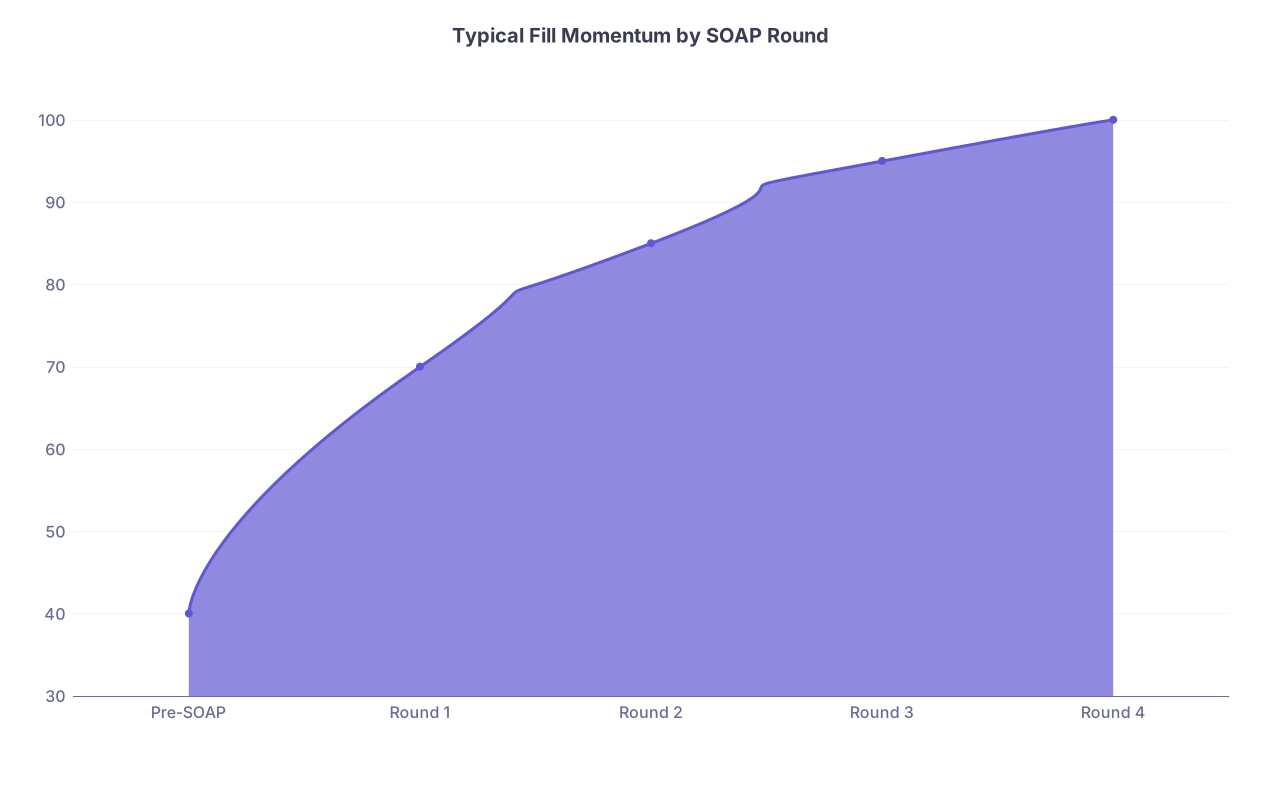
| Category | Value |
|---|---|
| Pre-SOAP | 40 |
| Round 1 | 70 |
| Round 2 | 85 |
| Round 3 | 95 |
| Round 4 | 100 |
By now, many of the stronger categorical positions are gone. Not all, but most.
At this point you should…
Before Round 2 opens:
- Tighten your rules:
- Update your written defaults:
- “Any Tier 1 → accept immediately.”
- “Tier 2 categorical → strongly lean accept.”
- “Tier 2 prelim/TY → hold, then decide based on gut and data.”
- Update your written defaults:
During Round 2:
If you get a new Tier 1 offer (rare but possible):
- Same rule: accept immediately.
If you get multiple Tier 2 offers:
Evaluate by:
- Specialty (categorical > prelim if both are aligned with your longer plan).
- Geography (places where you can realistically survive and be supported).
- Program reputation and trajectory (check with mentors if unclear).
Hold the best one initially, but do not wait until the last minute if:
- It’s a solid categorical position.
- You’ve had zero offers in Round 1 and early Round 2.
If you get only prelim or TY offers, but no categorical:
- This is where a lot of people freeze. Do not.
- Ask yourself bluntly:
- “Is my profile such that reapplying next year without any residency experience gives me a significantly better shot?”
- Low Step scores, old grad year, visa issues → usually no.
- Very strong applicant who swung for ultra-competitive specialty → maybe.
- “Is my profile such that reapplying next year without any residency experience gives me a significantly better shot?”
- If being in the system matters for your future specialty (it does for many), a good prelim/TY can be gold.
- Lean toward:
- Accepting a solid prelim/TY that aligns with:
- Internal medicine → prelim medicine.
- Anesthesia, radiology, derm → prelim medicine or TY.
- Surgery → prelim surgery if you can handle the work and still perform well.
- Accepting a solid prelim/TY that aligns with:
If you again receive only Tier 3 offers:
- You’re approaching the line between “protect my sanity” and “I need a job this year.”
- At this point, I’d only accept Tier 3 if:
- It’s at least in a specialty ladder you care about.
- The environment is not known toxic/abusive.
- Otherwise, you might reasonably hold out for Rounds 3–4 and accept the risk of going unmatched.
If you still have no offers through Round 2:
- This is a critical warning sign.
- Between Rounds 2 and 3, you need to move survival positions (prelim/TY, less desired locations) up your list.
Night Between Day 1 and Day 2: Hard Conversations
You’re now heading into Thursday, the last day. Whatever happens in the morning and late morning rounds will define your next year—or your reapplication plan.
At this point you should:
Reclassify your Tier 2 and Tier 3 programs:
- Mark which ones are now “will take if offered” survival spots.
- Distinguish them from genuine “I’d rather reapply than go there” programs.
Talk to someone who can be brutally honest:
- Not your overly optimistic friend.
- A PD, APD, or dean who has seen SOAP outcomes before.
- Ask: “If I end SOAP unmatched, what are my realistic odds next cycle? Better with or without a prelim/TY?”
Define your absolute floor for Thursday:
- “If I get this type of position, I will accept in Round 3 or 4.”
- “If I get below this line, I will decline and commit to the reapplication path.”
You must draw that line now, not in the panic of Round 4.
Round 3 (Thursday Morning): Survival Mode, Still Selective
By Round 3, remaining positions are mostly:
- Less desirable locations.
- Programs that had trouble attracting interest.
- Prelim and transitional spots.
- A few stray categorical positions in less competitive fields or challenging markets.
At this point you should…
If a solid categorical offer appears (even in a “meh” location):
- Strongly consider accepting.
- Unless the program has a known toxic reputation or would genuinely endanger your mental/physical health, this is likely your best shot this year.
If you get offers from your “survival prelim/TY” list:
- Time to be honest:
- If your goal is “be inside the system and reapply,” this is where you swallow your pride and accept.
- I’ve seen many who turned these down in Round 3 and deeply regretted it when Round 4 came up empty.
- Time to be honest:
If you get only clearly bad Tier 3 offers:
- Ask yourself:
- “Would I rather spend 1 year here than spend next year as a non-resident reapplicant?”
- For some, the answer is yes, because any US residency experience is better than none.
- For others, especially with stronger academic backgrounds and decent exam scores, reapplying makes more sense.
- Ask yourself:
If you get no offers again:
- You’re now in genuine long‑shot territory.
- Between Rounds 3 and 4, mentally plan for “no SOAP position” as a real outcome and sketch your reapplication year (research, prelim elsewhere, MPH, etc.).
Round 4 (Thursday Late Morning): Final Decisions, No Do-Overs
Round 4 is the last call. No more offers after this. Whatever you accept, you commit to. Whatever you reject, you live without.
At this point you should…
Follow your pre‑defined floor, not your panic.
- If you already decided: “I will not go below this line,” stick to it.
- Panicking and accepting a program you know is unsafe or unsustainable is not heroic. It’s just setting yourself up for burnout and possible failure.
If you receive any offer above your floor:
- Accept.
- This is not the round for exquisite preference ranking. This is yes/no on survival spaces.
If all offers are at or below your “rather reapply” line:
- Decline.
- This is painful, but it’s not automatically the wrong move.
- Many people have matched well on a reapplication cycle after saying no to a truly bad fit in SOAP.
If you end Round 4 unmatched:
- Close the window. Take a walk. Then:
- Notify your dean’s office—start the reapplication plan immediately.
- Get everything in writing: letters of support, future strategy, potential gap‑year positions.
- Close the window. Take a walk. Then:
Sample Decision Logic: What to Do in Each Round
Here’s a compact decision flow you can literally keep in front of you:

| Step | Description |
|---|---|
| Step 1 | Offer appears |
| Step 2 | Accept immediately |
| Step 3 | Hold then decide end of round |
| Step 4 | Strongly consider accept |
| Step 5 | Accept if at or above floor |
| Step 6 | Decline |
| Step 7 | Compare to reapply plan then decide |
| Step 8 | Wait or plan reapply |
| Step 9 | Tier 1? |
| Step 10 | Tier 2? |
| Step 11 | Tier 3? |
Extra Layer: IMG and Visa Considerations
If you’re an IMG, the calculus is harsher.
At this point you should:
- Move any visa‑sponsoring, reasonably functional program up your list. Especially by Round 2–3.
- Confirm visa history:
- Does the program actually sponsor your visa type?
- Have they done so in the past few years?
- Understand that “I’ll just reapply next year” is a much riskier statement for you than for a US grad.
For many IMGs, by Round 2 or 3, an acceptable prelim/TY or categorical spot that sponsors a visa becomes a “take it now” position.
Quick Visual: How Aggressive to Be by Round
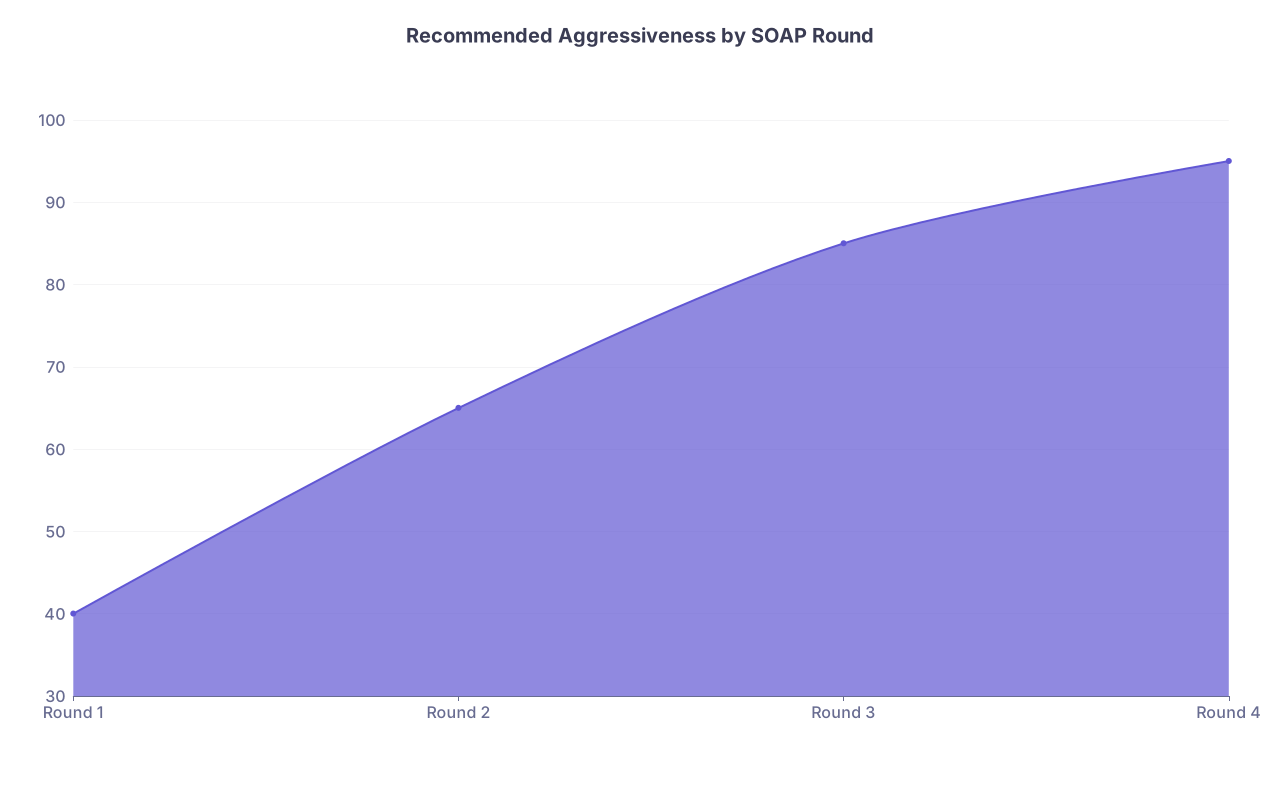
| Category | Value |
|---|---|
| Round 1 | 40 |
| Round 2 | 65 |
| Round 3 | 85 |
| Round 4 | 95 |
- Round 1: Aim for fit and quality.
- Round 2: Start trading ideal for secure.
- Round 3: Actively secure any reasonable position.
- Round 4: Only avoid truly destructive options.
After the Dust Settles
Once you’ve accepted an offer:
At this point you should:
- Stop second‑guessing. The comparison game is pointless.
- Email the PD or coordinator a short, professional note:
- Thank them.
- Express genuine enthusiasm.
- Ask about next steps (paperwork, onboarding, start dates).
If you end unmatched:
- Map a 12‑month calendar:
- Clinical work (externships, observerships, hospitalist scribe roles where allowed).
- Research, especially with program directors in your field.
- Strategic Step 3 timing if applicable.
- Start early on the next ERAS. People who wait until August repeat their mistakes.
Final 2–3 Takeaways
- Decide your priorities before the first offer appears. Tier your programs and write down your absolute floor.
- In early rounds, protect fit and quality. By Rounds 3–4, prioritize securing any position that isn’t clearly unsafe or incompatible with your long‑term goals.
- Stick to your rules, not your panic. SOAP is designed to pressure you; having a structured, round‑by‑round plan is how you keep control.