
You are sitting in a cramped study room on Monday of Match Week. Your NRMP email said what you were afraid of: “We are sorry, you did not match.” You had applied categorical surgery. Your entire application, letters, and personal statement scream “future surgeon.”
Now it is SOAP time, and guess what? There are almost no unfilled categorical surgery spots. But there are internal medicine, prelim years, maybe some family, psych, peds. You are about to pivot specialties in 24–48 hours, with faculty watching, PDs checking ERAS, and your phone ready for interviews.
You need to pivot without looking desperate, dishonest, or disloyal to people who went to bat for you. And you need to preserve relationships in case you reapply or end up working with these people later.
Here is how to do it step by step.
Step 1: Get Clear On Your Realistic Options (Fast)
Before you call anyone or touch ERAS, you need a cold, honest look at your position.
1. Know your “pivot zone”
Ask yourself two questions:
- What was my original specialty?
- Am I trying to:
- Pivot within the same general domain (e.g., surgery → prelim surgery or prelim medicine; IM → prelim medicine or FM)?
- Or pivot across domains (e.g., surgery → psych, radiology → FM, anesthesiology → peds)?
The closer the pivot, the easier the explanation. The farther the pivot, the more you must sell your story.
2. Look at what is actually unfilled
Once the unfilled list opens, do this:
- Filter by:
- Categorical vs prelim
- Specialty you could actually tolerate
- Geographic limitations (and be brutally flexible here)
- Prioritize:
- Categorical positions in any reasonable field you would truly consider
- Prelim IM or surgery at solid programs that could set you up for a second try
- Transitional years if available (rarely, but they happen)
You are not choosing your lifelong specialty at 11:45 a.m. Monday. You are buying options for the next 1–2 years.
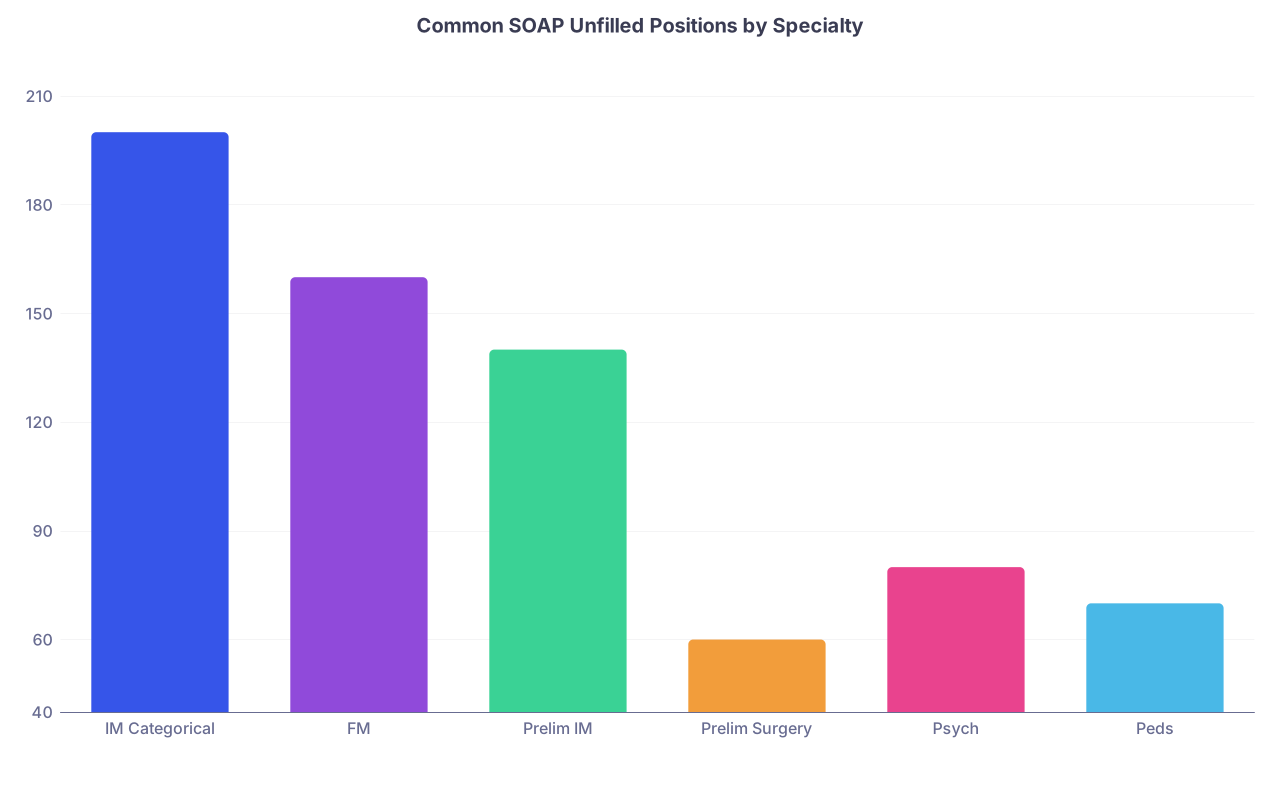
| Category | Value |
|---|---|
| IM Categorical | 200 |
| FM | 160 |
| Prelim IM | 140 |
| Prelim Surgery | 60 |
| Psych | 80 |
| Peds | 70 |
3. Decide your primary plan vs backup plan
Write it down on paper. Literally:
- Primary SOAP target: e.g., Categorical Internal Medicine
- Acceptable alternates: e.g., Prelim IM at academic centers, FM categorical
- Last-ditch positions you would still survive: e.g., Prelim surgery anywhere, community IM in less ideal locations
You will sound more coherent on phone calls if you are not improvising.
Step 2: Control the Narrative Before Others Write It For You
PDs talk. Faculty talk. Your dean’s office will be looped into SOAP. You cannot hide the pivot. But you can control the story behind it.
1. Write a 2–3 sentence “pivot statement”
You will reuse a version of this in emails, on calls, and in interviews. Keep it short, honest, and consistent.
A good pivot statement does three things:
- Acknowledge your original path, without whining about not matching.
- Explain the underlying interests that also fit the new specialty.
- Show forward-looking commitment.
Example: Surgery → Internal Medicine
“I applied in general surgery this cycle because I enjoy acute care and procedural work. Through my sub-internships and ICU rotations, I realized what I valued most was complex medical decision making and continuity with medically complex patients. During SOAP I am focusing on Internal Medicine programs because I see this as the best fit for the way I like to think and the long-term relationships I want with patients.”
Example: Radiology → Family Medicine
“I applied to diagnostic radiology, driven by my interest in problem solving and multidisciplinary collaboration. Over the past year, I have found that the parts of my clinical experience that energize me most are direct patient care, counseling, and longitudinal relationships. That is why I am now focusing on Family Medicine in SOAP. I am committed to building a career in primary care, especially in underserved settings.”
If this feels artificial, you are doing it wrong. It should be true, just compressed.
Step 3: Talk to Your Home Program Without Burning Bridges
Here is where many people screw up. They ghost the original specialty or send a vague email that sounds like a breakup text.
You owe your home program clarity and respect. They wrote your letters. They called programs for you.
1. Who to contact
Within the first few hours of learning you did not match (or at latest, Monday morning before SOAP picks start):
- Your specialty advisor (if different)
- Your home program director (or associate PD)
- Your dean of student affairs / match advisor
Do not spam them. But do not hide.
2. What to say (basic script)
Email or, better, a quick scheduled call. For email:
Subject: SOAP plans and specialty pivot
Dear Dr. [Name],
I wanted to update you promptly about my plans for SOAP. I did not match into [Original Specialty], and after reviewing the unfilled positions and reflecting on my experiences this year, I am planning to focus my SOAP applications on [New Specialty or “Internal Medicine and prelim Internal Medicine positions”].
This decision is based on [1–2 concise reasons that are honest and not insulting to their field]. I am very grateful for your mentorship and the support you and the department have given me throughout this process.
I would appreciate any guidance you have as I move through SOAP, and I want to ensure that this pivot does not come across as a rejection of the opportunities your field has offered me. My clinical experiences with your team have been some of the most meaningful in my training.
Thank you again for your support,
[Name]
On a call, same points but more conversational:
- “I wanted you to hear this from me directly.”
- “I am pivoting toward X during SOAP based on Y.”
- “I am extremely grateful for your support and do not see this as turning my back on [field]. I had to make a realistic decision in a very constrained situation.”
3. Handle hurt feelings or disappointment professionally
If they say:
- “Why did you not tell us you were considering X before?”
- “Are you sure you are not making a rushed decision?”
You can respond:
“That is fair. During the main application I was still committed to [original specialty]. Not matching forced me to step back and reassess what kind of day-to-day work I want. I have looked carefully at my experiences and believe [new specialty] is where I can contribute most over the long term.”
Do not get defensive. Do not overshare SOAP chaos. Stay steady.
Step 4: Reframe Your Application For the New Specialty (In Hours, Not Weeks)
You do not have time to rebuild ERAS from scratch. But you can strategically reframe.
1. Adjust your personal statement ruthlessly
You need a new personal statement for the pivot specialty. One page. No fluff.
Structure:
- Brief opening: 2–3 sentences connecting your background to current specialty.
- One clinical story that fits the new field.
- Explicit explanation of the pivot (1 short paragraph).
- Forward-looking plan in that specialty.
Example pivot paragraph (surgery → IM):
“While I initially pursued general surgery, several rotations made it clear that my greatest satisfaction came from managing complex multisystem disease, counseling patients and families through uncertainty, and following their progress over time. Caring for patients with decompensated heart failure and cirrhosis on my medicine sub-internship was formative. I realized that the questions I was most drawn to were medical rather than operative. For these reasons, I am now committed to training in Internal Medicine.”
Do not pretend you never liked your original specialty. That looks fake.
2. Reorder experiences and descriptions
Within ERAS:
- Move medicine-heavy experiences or relevant rotations upward if you can.
- For each experience description:
- Emphasize tasks that match the pivot specialty.
- Remove or downplay niche details only relevant for the old specialty.
Example: “Sub-I in Surgery” entry
Original bullet:
- “Assisted in 40+ major operations including Whipple and colectomy; primary surgeon on simple cases.”
Reframed for IM SOAP:
- “Managed complex perioperative patients, coordinated multidisciplinary care with medicine, anesthesia, and ICU teams, and followed patients postoperatively to address complications and chronic disease management.”
Same rotation. Different angle.
3. Letters of recommendation: use what you have, plus 1 quick ask if possible
You will not get a full set of brand-new letters in SOAP. That is fine.
Reality:
- Use your strong, generic letters that speak to:
- Work ethic
- Clinical reasoning
- Professionalism
- If you have even one letter from the pivot field (IM attending, FM preceptor), prioritize that.
- If time permits (and if someone is willing), ask a medicine/family/peds faculty to upload a brief letter quickly. Many will say yes if you have worked closely on a rotation.
How to ask (email):
“Dr. [Name],
I am participating in SOAP this week and pivoting from [original specialty] to [new specialty]. We worked closely on [rotation] in [month/year], and I learned a great deal from your approach to [specific aspect].
If you feel you can support my application, I would be very grateful for a brief letter of recommendation highlighting my clinical performance and suitability for [new specialty]. I understand the time is extremely tight; even a short letter would be very helpful in this context.
Thank you for considering this,
[Name]”
Step 5: Communicate With SOAP Programs Without Sounding Like You’re Selling Out
During SOAP, PDs know applicants are pivoting. You are not fooling anyone. The concern is not that you pivoted; the concern is whether you are going to leave or be miserable.
1. Email strategy
Short, targeted emails to a handful of top-choice programs. Do not blanket spam 100 programs with a generic message.
Your email should:
- Identify yourself.
- Acknowledge the pivot explicitly but briefly.
- Tie your background to their specialty.
- Affirm commitment.
Example (surgery → IM):
Subject: SOAP Applicant – Strong Interest in [Program Name]
Dear Dr. [PD Name],
My name is [Name], and I am a SOAP applicant who initially applied to general surgery this cycle. I am now focusing my SOAP efforts on Internal Medicine positions that will allow me to continue caring for complex, acutely ill patients in an academic setting.
I am particularly interested in [Program Name] because of [1 very specific reason: ICU training, QI focus, underserved population]. My experiences in surgical ICU and medicine rotations confirmed that my strengths and interests lie in longitudinal management of complex disease, multidisciplinary collaboration, and resident education.
I would be grateful for consideration for your unfilled PGY-1 positions. My ERAS AAMC ID is [ID].
Respectfully,
[Name]
Do not write paragraphs defending why you failed to match. They know SOAP is SOAP.
2. Interview talking points for a pivot
When they ask, “So you applied to [old specialty]. Why [new specialty] now?”
Use a 3-part answer:
- Past: “Initially, I was drawn to [old specialty] because of X.”
- Insight: “Over time, through [specific rotations/experiences], I realized I valued Y more.”
- Now: “That is why I am committed to [new specialty] and am focusing my efforts fully here during SOAP and beyond.”
Example answer (psych pivot from IM):
“I applied to Internal Medicine because I enjoy complex diagnostic reasoning and longitudinal care. Over the last year, working with patients with severe depression and psychosis on consult-liaison and outpatient psych, I realized the most meaningful part of my day was sitting with patients, understanding their stories, and helping them through mental health crises. I found myself reading psych literature in my free time. That is why I am pivoting into Psychiatry during SOAP. This is not a placeholder; I see my long-term career in this field.”
Any mention of “I just want a job” is a red flag. Do not say it, even if you feel it.
Step 6: Protect Future Options (In Case This Is Not Your Final Destination)
You might pivot into:
- A different categorical specialty that becomes your forever home.
- A prelim year that is essentially a bridge to a reapplication.
You need to preserve both possibilities.
1. If you SOAP into a new categorical specialty you did not originally plan
Once you sign that contract:
- Act like this is your specialty.
- Show up as if you plan to stay. Because maybe you will.
- Keep relationships with your original field cordial, but do not keep announcing, “I might reapply X.” PDs hate the “tourist resident” vibe.
If, after PGY-1, you still feel your original specialty is the right fit, you can explore later. But do not walk into your new program with one foot out the door.
2. If you SOAP into a prelim year
This is very common, especially for competitive fields.
During your prelim year:
- Perform like a top-tier resident. Period.
- Tell your prelim PD early and professionally if you plan to reapply in something else.
- Ask for letters that highlight:
- Reliability
- Teamwork
- Handling high workload
- Clinical judgment
And do not trash your prelim field. “IM is just a stepping stone, I am really a future anesthesiologist” gets around.

Step 7: Avoid the Common Mistakes That Actually Burn Bridges
I have watched students tank relationships in 24 hours because they panicked. Do not do these.
1. Ghosting your original specialty
Silence reads as:
- Ingratitude
- Immaturity
- “They only cared about me when things were going well”
Send the short update. Take the awkward call. That is how adults behave.
2. Lying about your intentions
Do not tell:
- Original PD: “I am absolutely reapplying to your field next year, 100%.”
- New SOAP PD: “I am 100% committed to staying here forever, no matter what.”
A more honest approach:
- To original PD: “I am open to reapplying in [field] depending on how this year and SOAP go, but right now I have to focus on securing a position and doing well there.”
- To SOAP PD: “My plan is to fully commit to this residency and specialty. I am here to train and contribute. I am not treating this as a temporary stop.”
Those statements can both be true.
3. Public venting or blame
No angry group chats. No social media rants. No “My PD screwed me” comments on Twitter.
People screenshot. PDs see it. Faculty see it. It becomes part of your unofficial file.
4. Over-selling the pivot
If you spend the entire interview saying, “I have ALWAYS wanted to do [new specialty],” while your ERAS is 100% tuned for something else, you just look disingenuous.
Acknowledge evolution. Not retroactive destiny.
Step 8: Use Your Dean’s Office and Advisors Strategically
SOAP is not a solo sport. Your dean’s office has done this before.
1. Be direct with them
On Monday morning:
- Tell them your SOAP target specialties.
- Ask:
- “Which programs do you think are realistic for me?”
- “Are there any PDs you can call on my behalf?”
- “Should I prioritize categorical X vs prelim Y?”
Deans appreciate students who come with a basic plan, not just “What should I do?”
2. Let them help with messaging
They can:
- Review your pivot personal statement quickly.
- Role-play the “Why did you pivot?” question.
- Help smooth any fallout with your original department if needed.
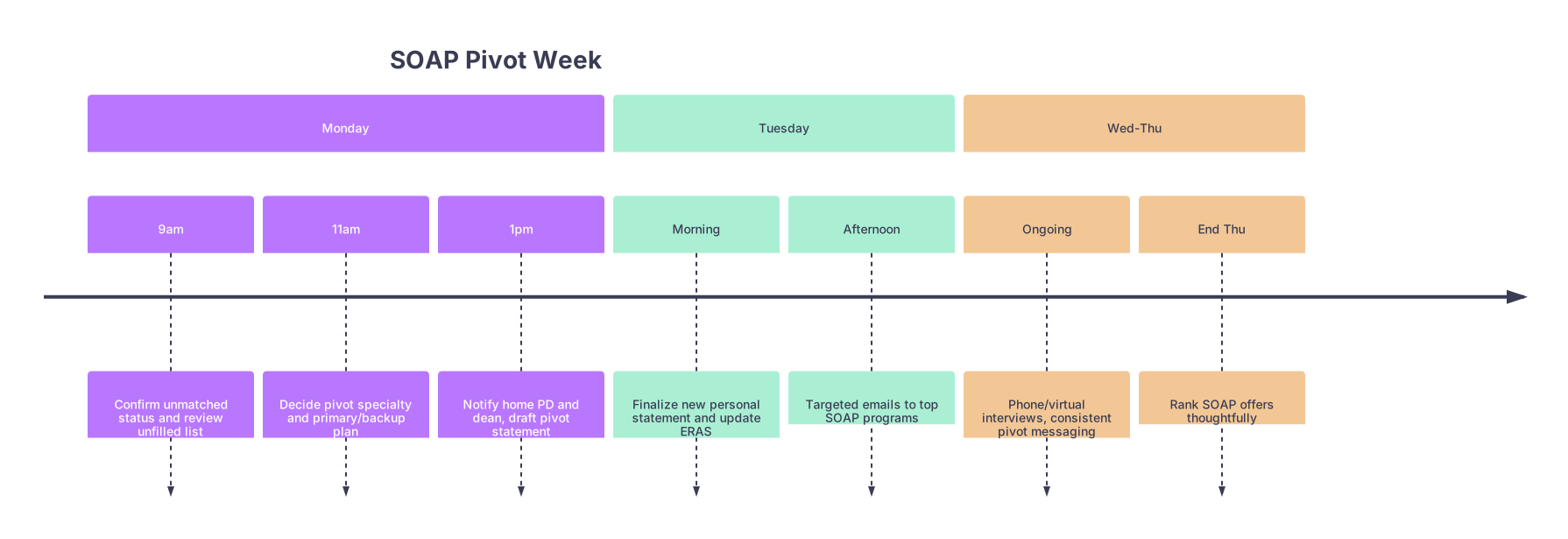
| Period | Event |
|---|---|
| Monday - 9am | Confirm unmatched status and review unfilled list |
| Monday - 11am | Decide pivot specialty and primary/backup plan |
| Monday - 1pm | Notify home PD and dean, draft pivot statement |
| Tuesday - Morning | Finalize new personal statement and update ERAS |
| Tuesday - Afternoon | Targeted emails to top SOAP programs |
| Wed-Thu - Ongoing | Phone/virtual interviews, consistent pivot messaging |
| Wed-Thu - End Thu | Rank SOAP offers thoughtfully |
Step 9: Rank and Accept Offers Without Self-Sabotage
When the SOAP offer rounds hit, judgment gets fuzzy fast. People panic-accept things they should not, or decline things they should have taken.
1. Build a rational preference list before offers
On Wednesday, make a simple table:
| Rank Order | Program Type | Specialty | Dealbreaker Concern? |
|---|---|---|---|
| 1 | Categorical | IM | None |
| 2 | Categorical | FM | None |
| 3 | Prelim IM | IM | Location difficult |
| 4 | Prelim Surgery | Surgery | Heavy workload |
| 5 | Categorical | Peds | Questionable fit |
You may adjust as you get gut feelings from interviews, but at least you start with a framework.
2. Ask the right questions in SOAP interviews
You do not have time for fluff questions. Focus on:
- “How often do your prelims successfully match into their target specialties?”
- “For categorical residents who discover an interest in a different field, how supportive is the program of exploring options?”
- “How would you describe resident morale and program culture?”
If a program dodges or gets defensive, that tells you something.
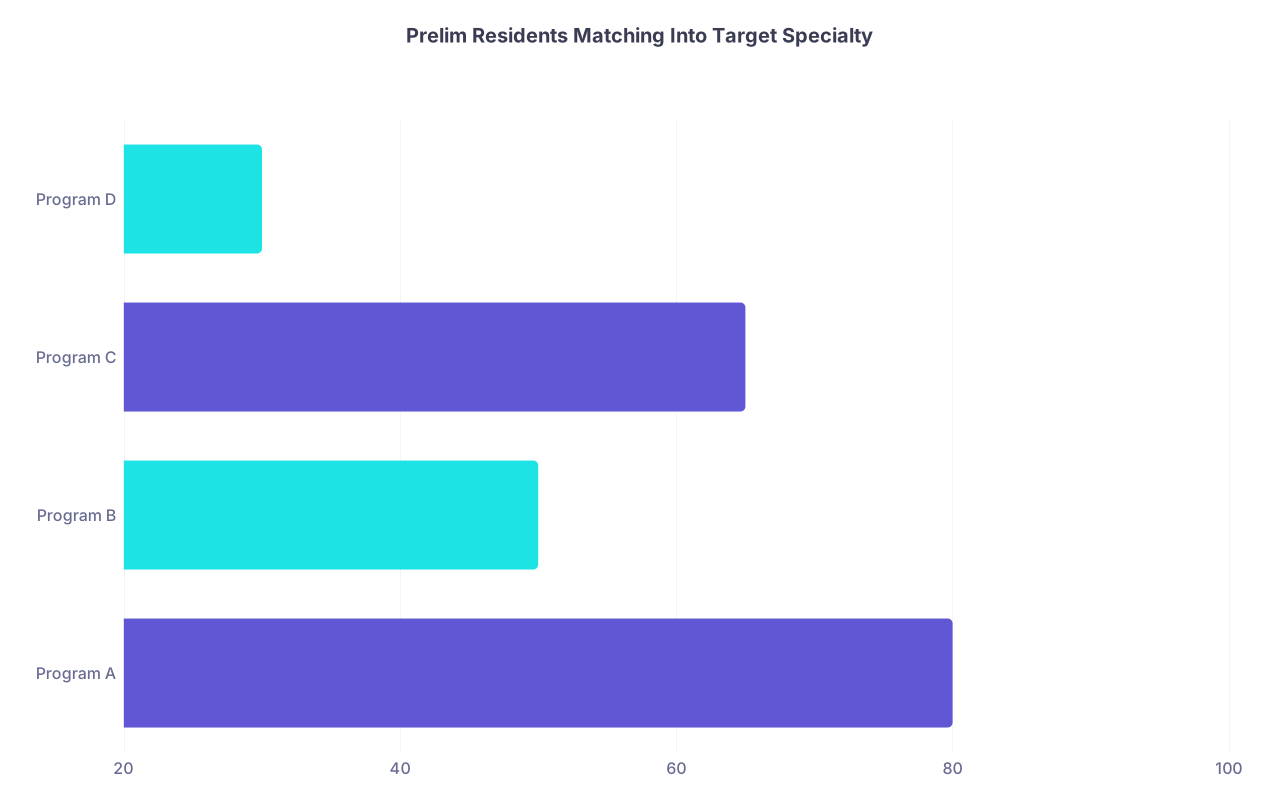
| Category | Value |
|---|---|
| Program A | 80 |
| Program B | 50 |
| Program C | 65 |
| Program D | 30 |
Quick Summary: What You Must Get Right
- Own a clear, honest pivot narrative. Not a sob story, not a fairy tale. A grounded explanation of why the new specialty fits you.
- Communicate proactively with your home program and dean. No ghosting. No blame. Respect buys you years of goodwill.
- Reframe, do not rewrite, your application. New personal statement, retuned experiences, existing letters used smartly.
- Act like an adult during SOAP chaos. No public venting, no obvious lies, no desperate overselling. Just steady, thoughtful decisions.
If you do those things, you can pivot specialties during SOAP, secure a solid position, and keep bridges intact for whatever comes next.