
The average medical student has no idea how to use their Dean’s Office during SOAP. That is a mistake. In SOAP week, your Dean’s Office can be the difference between scrambling blindly and running a coordinated rescue operation.
This is not a “be nice and keep them updated” article. This is a tactical checklist for how to deploy your Dean’s Office like an operations center during the most stressful four days of medical school.
You are not trying to be polite. You are trying to match.
The One Rule: Treat Your Dean’s Office Like Mission Control
You cannot control who did or did not interview you. You cannot control which programs enter SOAP. You can absolutely control how well you leverage the people who have done this dozens of times before: your Dean/Student Affairs team.
Here is the mental reset:
- You are the project.
- Your Dean’s Office is your ops team.
- SOAP week is a time-compressed project with hard deadlines and no do-overs.
Your job is to:
- Get them the right data.
- Tell them exactly what you need.
- Use every tool they can legally and ethically deploy.
If you treat them like a passive information source instead of an active partner, you are leaving outcomes on the table.
Before SOAP Week: Set Up Your Support System
If you wait until Monday 10:59 a.m. ET (just before results) to involve your Dean’s Office, you are already behind. The right time is 1–3 weeks before Match Week.
Step 1: Identify Your Point Person
You do not want “the office.” You want a human.
Ask directly:
- “Who is the best person to help me strategize if I end up in SOAP?”
- “Who handles SOAP advising and logistics here?”
- “Can I meet with the person who typically manages SOAP for students?”
At many schools this is:
- The Associate Dean of Student Affairs
- A designated SOAP advisor
- An administrative coordinator who knows the ERAS / NRMP logistics cold
You want all three if possible: strategy (Dean), logistics (coordinator), and specialty-specific input (your advisor or program director).
Step 2: Give Them a One-Page Snapshot
Do not make them hunt through your file. Hand them a one-page summary they can reference quickly during SOAP chaos. Something like:
- USMLE / COMLEX scores (all attempts, clearly labeled)
- Med school: MD/DO, year, any leaves or delays
- Core clerkship grades (P/HP/H), any major red flags
- Target specialties applied to and number of programs
- Interview count by specialty
- Backup specialties you would consider
- Geographic preferences (true ones, not fantasy)
- Constraints: visa needs, partner’s location, dependents, financial limitations
- Any professionalism issues or remediation (they need to know before they call anyone)
Make it clean and brutally honest. You gain nothing by hiding problems at this stage. They will hear them from programs anyway.
Step 3: Build a Realistic SOAP Range
Stop thinking “specialty I love vs. specialty I hate.” During SOAP, you care about:
- Matching to an accredited, functioning program.
- Preserving future options (switches, fellowships, etc.).
- Minimizing long-term damage.
Sit down with your Dean and do this explicitly:
- “Here is my dream range if SOAP is necessary.”
- “Here are specialties I could live with for 1–2 years then consider switching.”
- “Here are specialties I absolutely will not pursue, even in SOAP.”
And be specific:
- “I would accept prelim IM surgery-prep, but not a transitional year with no clear path.”
- “I would accept categorical FM anywhere, prelim medicine in most places, but not prelim surgery with no categorical track.”
You want them to know, in advance, your boundaries so they can move quickly when time is short.
Match Week Timeline: What Your Dean’s Office Should Be Doing With You
Let us walk the actual SOAP timeline and assign concrete actions. This is where most students guess and hope. You will not.

| Step | Description |
|---|---|
| Step 1 | Pre Match Week Planning |
| Step 2 | Mon 11 AM Did Not Match |
| Step 3 | Mon 11 AM 3 PM Triage Meeting |
| Step 4 | Tue 9 AM 11 AM Finalize List |
| Step 5 | Tue 11 AM 3 PM Applications Sent |
| Step 6 | Wed Interviews |
| Step 7 | Thu Offer Rounds and Updates |
| Step 8 | Post SOAP Debrief |
Monday 11:00 a.m. ET – You Learn You Did Not Match
This is a punch in the gut. You have 10–20 minutes to feel that, max. Then:
Notify your Dean’s Office immediately
Use their preferred channel:- “I did not match. I want to engage the SOAP plan we discussed. When is the earliest I can meet today?”
Send them your NRMP status screenshot
They need to know:- Fully unmatched vs. partially matched (prelim or advanced only)
- Original specialty you applied to
- Any prior communication from programs suggesting SOAP options
Monday 11 a.m.–3 p.m. – Intensive Triage With Your Dean
This block is non‑negotiable. If your school is serious about SOAP, they already have this reserved. If they do not, you ask for it.
In this meeting, you and your Dean’s Office must:
Analyze why you did not match
In blunt terms. No sugar-coating.- “Your Step 1/Level 1 is 205/450 with very high competition specialty.”
- “You applied late to half your programs.”
- “You had 14 interviews; the disconnect probably happened in ranking strategy.”
- “Your red flag (leave, professionalism, exam failure) likely scared programs.”
This is not therapy. It is root cause analysis so you can pivot smartly.
Set your SOAP priority order
Answer clearly:- “If there are categorical IM spots, that is top priority.”
- “If no categorical in competitive fields, we pivot to FM, IM, psych, peds as applicable.”
- “If no categorical at all, we consider prelim medicine vs prelim surgery vs transitional, in this order.”
Decide your geographic flexibility
You must say the quiet part out loud:- “I will go anywhere in the country for categorical.”
- “I strongly prefer X and Y regions, but in SOAP I will not restrict applications.”
- Or if you truly cannot move (immigration, family, medical issues), state it explicitly so they can help you strategize within that box.
Assign roles
Your Dean’s Office should answer:- Who will help you build and review your SOAP list Monday night / Tuesday morning?
- Who will be available Tuesday to review your personal statements and CV edits?
- Who can make advocacy calls for you on Tuesday/Wednesday (if your school permits this)?
You leave this meeting with a written plan, not vague feelings.
Building Your SOAP List With Your Dean’s Office
SOAP is not “click everything.” That is how you end up in a program that burns you out in 3 months and offers no pathway forward.
You get 45 applications. Your Dean can help you avoid dumb uses of those 45.
Step 1: Review the Unfilled List Together
When the List of Unfilled Programs appears:
Pull it up with your Dean/advisor on a shared screen.
Filter by:
- Specialty
- State/region (if needed)
- Categorical vs. prelim vs. advanced
- MD vs. DO focus if relevant
Your Dean’s Office may know inside information:
- “That program loses residents every year.”
- “That program director is extremely supportive for SOAP candidates.”
- “Our prior students have struggled at X, thrived at Y.”
Listen. They have scar tissue and memory that you do not.
Step 2: Create a 3‑Tier Prioritization
Use your Dean’s input and create a clear tier system:
Tier 1 – Strong fit / realistic targets
- Specialty you can see yourself in
- Reasonable academic fit given your scores and red flags
- Program has decent reputation or track record
Tier 2 – Acceptable but not ideal
- Less preferred specialty or location
- Maybe weaker program but still accredited and functional
Tier 3 – Last resort
- Programs you would accept only to avoid complete non‑match
- Might include prelim-only or less desirable locations
You involve your Dean’s Office on Tier 3 especially. Many students radically overestimate or underestimate what is “worse than not matching.” A seasoned Dean has seen people recover careers from mediocre places. They have also seen students utterly stuck in programs that made them miserable.
Step 3: Match List to Your Actual Profile
Here is where your Dean can keep you honest.
You say: “I want to apply to remaining anesthesia spots.”
Your Dean might say:
- “Your Step scores are 208 and 216, with a repeat. Be ruthless: anesthesia in SOAP will be flooded with strong candidates. These 45 clicks may be wasted if you ignore FM/IM spots where you are viable.”
Or they might say:
- “Your scores are fine for these specific anesthesia programs that have historically taken SOAP candidates from our school. We will include those and still have 30+ spots for IM/FM.”
Let them calibrate your optimism.
Step 4: Finalize and Lock With Their Review
Before you hit submit:
Share your final program list with the Dean’s Office (spreadsheet or screenshot).
Ask directly: “Given my profile, are there any clearly bad uses of my 45 here?”
They may flag:
- Programs known to be extremely malignant
- Specialties where your chance is effectively zero
- Programs that do not sponsor your required visa type
Fix it now. You will not get another chance.
Documents and Messaging: Use the Dean’s Office As Your Editing Team
Most SOAP applicants throw together new personal statements and letters in a panic. That shows. Programs can smell it.
Your Dean’s Office is sitting on years of SOAP essays. They know what reads as desperate vs. composed.
Step 1: Rapid Rewrite of Personal Statements
You may need:
- A new personal statement for an alternate specialty (e.g., FM instead of surgery).
- A modified statement explaining a red flag more clearly.
- A shorter, tighter statement emphasizing resilience and readiness.
You bring them:
- A rough draft. Do not come empty-handed.
- A 2–3 sentence narrative you want every program to “get” about you.
They help you:
- Remove specialty-specific fluff that no longer applies.
- Avoid apologizing excessively for past failures.
- Hit key themes: reliability, teachability, patient-centered focus, commitment to complete training.
You give them permission to be harsh. This is not creative writing; this is damage control.
Step 2: Standardized Email / Phone Pitch
Some programs may contact your Dean’s Office directly. Some may accept calls from deans advocating for specific students (depends on institutional policy).
You need a consistent message. Work with your Dean on a 3–4 line “summary pitch”:
- Who you are (school, year, exam status).
- Key strengths (work ethic, clinical performance, resilience).
- The specific barrier (late switch, limited interviews, exam history).
- Clear statement that you are fully committed to their specialty and would rank them highly.
You cannot control whether they call your Dean. You can control whether your Dean knows exactly what to say if they do.
Active Advocacy: When and How Your Dean’s Office Can Call Programs
Not every school allows aggressive advocacy. Some are hands-off. Ask them directly:
- “Does our school advocate with programs during SOAP?”
- “If so, who makes those calls and in what situations?”
- “What information do you need from me to feel comfortable advocating?”
What Effective Dean Advocacy Looks Like
Here is what I have seen work:
Targeted, not spammy.
Deans call 3–10 programs where:- The student is a credible fit.
- The Dean can honestly vouch for work ethic and professionalism.
- There is some prior connection (alumni at that program, historically friendly PD).
Clear, concise message.
No begging. No drama.Something like:
- “We have a student, Jane Smith, who did not match in EM. She has solid clinical evaluations, strong IM and FM rotations, and is now fully committed to Internal Medicine. Her Step scores are 222/230, no professionalism issues, and she is willing to relocate. I think she would do well in your program if you have a SOAP opening.”
If your Dean’s Office hesitates, it is usually one of three reasons:
- You have unaddressed professionalism/behavior concerns.
- They genuinely think your fit is poor for those programs.
- School policy limits their involvement.
If it is #1, ask what concrete steps you can take to address those concerns in your narrative. If #2, ask where they do see credible fits and focus there.
During SOAP Interviews: Keep Your Dean in the Loop
SOAP interviews are chaotic and short. You are juggling Zoom links, phone calls, and web forms. You still need to maintain a feedback loop with your Dean’s Office.
What You Report Back (Briefly)
After each interview, send a short, specific update to your point person:
Program name and specialty.
How the interview felt (strong / neutral / weak).
Any direct comments like:
- “We are very interested in you.”
- “We have some concern about your Step failures.”
- “We expect to fill all positions.”
These seemingly small comments help your Dean calibrate where to focus any follow-up advocacy.
What Your Dean’s Office Can Do Mid‑SOAP
Within policy, they might:
- Nudge programs where you had a very positive interview.
- Advise you on how to respond to tough questions you keep getting (e.g., about exam failures).
- Help you reframe answers that clearly are not landing well.
You are not alone in this. If you are answering the same bad question poorly in 6 programs, that is fixable in real time.
Offer Rounds: Rapid Decisions With Dean Input
On Thursday, offers come in several SOAP rounds. You will have limited time to accept or reject. This is where many students panic and either:
- Accept the first mildly acceptable offer without thinking.
- Reject something decent hoping for a fantasy that never appears.
Your Dean’s Office should be “on‑call” for these hours. Coordinate that ahead of time.
How to Decide Fast, Not Reckless
Before offers:
Review with your Dean which scenarios are “auto-accept.”
- “Any categorical IM / FM / psych in these regions = accept immediately.”
- “Any prelim medicine with a strong track record of getting people into PGY‑2 = consider carefully, call if time allows.”
- “Prelim surgery with no clear next-step pathway = borderline, discuss before accepting.”
During offers:
- If you get an offer in your pre‑defined “auto-accept” category, you accept. Do not overthink it.
- If it is borderline, call or message your Dean contact immediately. Ask one focused question:
“Given everything we discussed, is this better than what I am reasonably likely to get in later rounds or in a reapplication year?”
They cannot predict the future. They can, however, compare you to dozens of prior students in similar spots. That pattern recognition is what you are buying when you involve them.
After SOAP: Debrief and Contingency Planning
If you match in SOAP:
Schedule a short debrief with your Dean.
Clarify:
- What to expect in your program.
- How to position yourself for future fellowships or specialty switches if relevant.
- Any lingering licensing or visa issues.
If you do not match even after SOAP:
This is brutal, but there is still structure to be imposed. Your Dean is critical here.
Together, you must:
Decide on a path:
- Reapply next cycle (possibly with a different specialty).
- Pursue research, a graduate degree, or a non‑residency clinical role while you retool.
- Consider long‑term non‑clinical options if residency increasingly looks unrealistic.
Build a 12‑month plan:
- Improve exam profile (Step 3/COMLEX 3 if eligible).
- Close clinical gaps with observerships, sub‑internships, or local roles.
- Fix red flags (remediate, obtain new letters of support, demonstrate growth).
Get letters from the Dean
That explicitly:- Support your reapplication.
- Explain any academic disruptions or professionalism issues in clear, specific terms.
- Emphasize your reliability and clinical performance since those events.
A strong Dean’s Letter in a reapplication year can completely reframe an applicant who previously looked like “too risky, too many unknowns.”
Concrete SOAP–Dean Office Checklist
Here is a condensed, action-ready list you can literally print, tick, and bring into their office.
| Phase | Action |
|---|---|
| 1–3 weeks pre-Match | Identify SOAP point person and schedule contingency meeting |
| 1–3 weeks pre-Match | Give them 1-page academic and application summary |
| 1–3 weeks pre-Match | Define acceptable specialties, geographic flexibility, and deal-breakers |
| Mon 11 a.m.–3 p.m. | Triage non-match, root cause analysis, and SOAP specialty strategy |
| Mon–Tue | Build prioritized SOAP list and have Dean review before submitting 45 apps |
| Mon–Tue | Rapidly revise personal statement(s) with Dean/Advisor feedback |
| Tue–Wed | Align on advocacy strategy and standard “pitch” for programs |
| Wed | Debrief after interviews and update Dean on which programs seemed most interested |
| Thu offer rounds | Use pre‑defined “auto-accept” rules and contact Dean for borderline calls |
To make this even clearer, here is how your time and the Dean’s Office support typically distribute during SOAP:
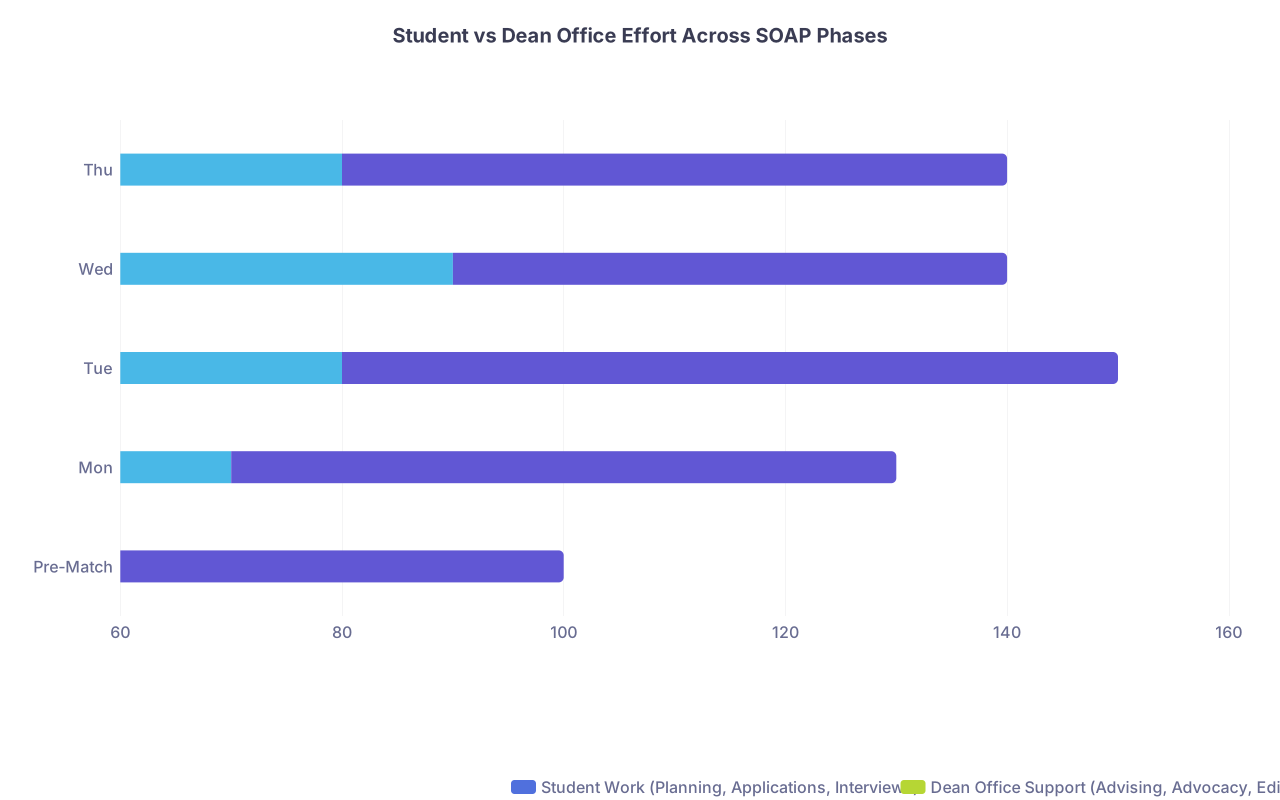
| Category | Student Work (Planning, Applications, Interviews) | Dean Office Support (Advising, Advocacy, Edits) |
|---|---|---|
| Pre-Match | 60 | 40 |
| Mon | 70 | 60 |
| Tue | 80 | 70 |
| Wed | 90 | 50 |
| Thu | 80 | 60 |
You are the one clicking and interviewing. But if you are trying to run SOAP at 100% solo, you are under-using a resource that is literally paid to help you.
How to Handle a Weak or Disorganized Dean’s Office
Sometimes you do not have a strong Student Affairs team. Or they are overwhelmed. Or they just are not very good at SOAP.
You still extract value.
Bring them something concrete, not chaos.
Come in with:- Your 1‑page summary.
- A first-pass SOAP list.
- Specific asks: “Can you review this list and tell me programs that look unrealistic?”
“Can you tell me frankly if my red flag will scare IM programs off in SOAP?”
Ask for targeted advocacy, not miracles.
Instead of “Please call everyone,” try:
“Would you be comfortable reaching out to 3–5 programs where you think I am a strong fit?”Use them for validation.
Sometimes what you need is not strategy, but a sanity check that your plan is not delusional or self-sabotaging.
And if they truly cannot help:
- Lean harder on trusted faculty mentors and alumni.
- Ask your Dean’s Office to at least facilitate those connections and endorse you to those individuals.
Final Takeaways
Two points that actually matter:
- Do not walk into SOAP alone when you have a Dean’s Office sitting 50 feet away with years of experience. Treat them as mission control, not background noise.
- Clarity wins: clear priorities, clear list, clear messaging, clear boundaries. Your Dean’s Office can only help you at the level you help them understand your situation and what you are willing to do.
Use them well, and SOAP becomes a structured crisis instead of pure chaos.