
The SOAP is not about “getting practice.” It is about turning one conversation into an offer. Anything else is noise.
You do not have time for vague advice or fluffy mindset talk. During SOAP, every 10‑minute call might be the only shot you get with that program. So you need a script, a structure, and a way to pivot fast.
This is your conversation playbook.
1. Understand What SOAP Interviews Really Are
SOAP “interviews” are not normal interviews. Programs are triaging risk at high speed.
They are trying to answer five blunt questions in minutes:
- Are you safe to put in front of patients on July 1?
- Do you understand what this program is and actually want to be here?
- Are you going to fail exams or disappear mid‑year?
- Are you going to be toxic on the team?
- Why are you still unmatched, and is that going to be our problem?
If you do not answer those five questions clearly, they will move to the next caller.
Think of SOAP calls as:
- 10–20 minutes
- High volume for them, high stakes for you
- Often done by a PD, APD, chief, or senior resident
- Light on behavioral brain teasers, heavy on red‑flag screening
Your job is not to be impressive.
Your job is to be:
- Clear
- Safe
- Grateful
- Low‑maintenance
You win when you make it easy for them to say: “This person is a safe, motivated, plug‑and‑play intern.”
2. The Three‑Layer SOAP Answer Framework
You will not memorize 50 perfect answers in time. You do not need to.
You need one reusable structure for almost every question.
Use this three‑layer framework:
- Headline – 1 crisp sentence that actually answers the question.
- Proof – 1–2 concrete details or examples.
- Tie‑back – 1 sentence linking your answer to how you will function as a resident in their program.
Example question: “Why did you not match?”
- Bad: “I believe there were many factors like competitiveness and the fact that…”
- Good (3 layers):
- Headline: “I did not match because I applied narrowly to highly competitive programs despite an average Step score.”
- Proof: “I focused on university‑based programs in large cities and applied to 35 programs. I had 4 interviews, they went fine but I did not match. Looking back, my list was top‑heavy for my Step 2 CK of 230.”
- Tie‑back: “This cycle, including SOAP, I have focused on community‑oriented programs where I can contribute immediately on the wards, and I am prepared to work hard and prove myself from day one.”
You can plug almost any question into this structure:
- “Tell me about yourself.”
- “Why this specialty?”
- “Tell me about a conflict.”
- “What are your weaknesses?”
- “Why should we pick you in SOAP?”
Practice the structure more than the exact wording. That is what reduces panic.
3. Core Messages You Must Land in Every Call
You do not control how many programs call. You do control how consistent your message is each time.
You need four core messages that show up, in some form, in every conversation:
- I am ready to start safely as an intern.
- I understand and genuinely want your type of program.
- I have addressed the reason I am in SOAP.
- I will be a low‑drama, high‑work‑ethic teammate.
If you are smart, you will write one sentence for each of these now, before the phone rings.
Example core messages:
Readiness:
“My clinical skills are current: I finished an inpatient sub‑I in November with strong evaluations on reliability, notes, and communication.”Program fit:
“I am particularly drawn to community‑based programs like yours where interns get early responsibility and close attending supervision.”SOAP reason addressed:
“I did not match because I overestimated where my application stood and applied narrowly; I have learned from that and refocused on programs where I can contribute immediately.”Team/behavior:
“Residents who have worked with me describe me as calm under pressure and very responsive to feedback; I try to make their lives easier, not harder.”
You do not read these like a robot. You work them in repeatedly.
4. Build a One‑Page SOAP Call Sheet
When the phone rings during SOAP, your brain will not be at its best. Do not rely on memory.
Make a one‑page call sheet you keep in front of you for every conversation.

Your call sheet should include:
- Top: Your 30‑second “Tell me about yourself”
- Middle left: Core messages (the four from above)
- Middle right: 3–4 go‑to patient stories / examples (teamwork, failure, conflict, leadership)
- Bottom left: Short explanation for not matching (1–2 sentences)
- Bottom right: 3 tailored questions you can ask any program
- Margin: A tiny box to write:
- Program name
- Who you spoke with
- 1 thing they emphasized (so you remember for ranking)
This is not cute. It is survival.
You should be able to glance down and instantly re‑center if you blank.
5. Script the Opening: “Tell Me About Yourself”
If you blow the opening, you will spend the rest of the call recovering. Do not improvise this.
Use a 30–45 second, very clean, residency‑focused answer.
Structure:
- Who you are (baseline identity).
- Two strengths/experiences relevant to that specialty.
- One line connecting you to their type of program.
- One line acknowledging you are in SOAP without sounding defeated (optional but powerful).
Example for Internal Medicine SOAP call:
“I am a 2023 graduate from X University with strong interest in inpatient internal medicine. In my third‑year IM rotation and my medicine sub‑I, I took on a lot of responsibility for patient workups and follow‑up, and my attendings consistently commented on my thoroughness and communication with nursing staff. I enjoy programs like yours where residents see high‑acuity bread‑and‑butter medicine and work closely with attendings. I am in SOAP this year after a narrow initial application, and I am very motivated to find a program where I can contribute solid work from day one.”
Notice what it is not:
- It is not your life story.
- It is not your CV recited line by line.
- It is not a defense speech.
It sets a frame: “Safe, motivated, realistic, knows what they are getting into.”
You can create versions for each specialty you listed in SOAP.
6. How to Explain “Why I Did Not Match” Without Sinking Yourself
This is the question that destroys people. They either minimize or overshare. Both kill offers.
Here is the protocol.
Step 1: Identify your main reason honestly
Pick one primary, believable reason:
- Overly competitive list / applied narrowly
- Late Step 2 CK score or borderline score
- Weak interview skills first cycle (if you can frame growth)
- Red flag (leave of absence, exam failure) that you have since addressed
- IMG status with late application / limited U.S. experiences
If you try to list five reasons, you sound unfocused and unstable.
Step 2: Use the “Past – Fix – Present” structure
- Past – What happened (short, factual)
- Fix – What you changed or learned
- Present – Why it is not a current risk for them
Example – Narrow list:
“I did not match because I applied too narrowly to highly competitive university programs given my Step 2 CK of 228. Since then, I have received honest feedback from advisors and adjusted my expectations. In SOAP I am targeting community‑focused programs like yours where I can be a strong, reliable intern, and I am prepared to work hard to earn your trust.”
Example – Step failure:
“I had a Step 1 failure early on. I was trying to balance family responsibilities and did not adjust fast enough. After that, I completely changed my study approach, used faculty support, and passed on my second attempt, then scored 235 on Step 2 CK on the first try. My recent performance is much more reflective of how I will handle your in‑training exams and board preparation.”
Avoid:
- Blaming “the system,” the algorithm, or “bad luck” as your main theme.
- Throwing prior programs or schools under the bus.
- Emotional dumping (“I was devastated, it was the worst…”). One brief humane line is enough.
7. High‑Yield SOAP Question Bank with Sample Structures
You cannot predict exact wording, but the themes repeat. Here is how to handle the big ones.
7.1 “Walk me through your application” / “Tell me about yourself”
We covered this. Use your 30–45 second opener.
7.2 “Why this specialty?” (even in SOAP)
They are checking: Are you desperate or aligned?
Two options:
- You are applying only within one specialty.
- You cast a broader net (IM + FM, for example).
If single specialty (e.g., FM):
“I am drawn to family medicine because I like following patients over time and managing a wide range of conditions instead of a narrow focus. In my FM rotation at [Site], I enjoyed clinic days where I saw everything from newborn visits to managing diabetes in older adults. I also value the community‑based aspect—programs like yours where residents are embedded in the community and learn continuity care from day one fit my goals.”
If multiple specialties:
Be honest without sounding indifferent.
“My primary goal is to become a strong, well‑trained clinician who can care for complex adult patients. Internal medicine is my first choice, which is why most of my experiences and letters are in IM. I have also applied to family medicine programs that have strong inpatient components because they align with my interest in adult care and broad training. For your program specifically, I am excited by the [X feature: strong inpatient service, community patient population, etc.].”
They just need to know you did not pick them randomly five minutes ago.
7.3 “Why our program?”
This is where many SOAP candidates crash with generic nonsense.
You need three buckets you can quickly adapt:
- Training structure – community vs university, inpatient focus, clinic structure, early autonomy.
- Patient population – underserved, rural, diverse language needs, high acuity.
- Culture / support – small program, close attending supervision, emphasis on teaching.
Before SOAP week, spend one focused hour looking up likely programs (or typical program types) and jot down common themes.
Then answer like this:
“From what I understand, your program offers strong inpatient exposure with a lot of responsibility for interns, but with close attending support. I like that you serve a largely underserved population, because much of my clinical experience has been in safety‑net hospitals and I want to continue that work. I also value smaller programs; I do better in environments where attendings know their residents well and can give direct feedback.”
Short, specific, and clearly not copy‑pasted.
8. Handling Red‑Flag Questions Without Spiraling
Red flags do not automatically kill you in SOAP. Poor explanations do.
Common red‑flag topics:
- Leaves of absence
- Exam failures
- Extended time to graduation
- Disciplinary issues
- Very low scores
Use a tight three‑sentence cap per red flag:
- One sentence: what happened (plain language).
- One–two sentences: what you changed and evidence it worked.
- One sentence: why they can trust you now.
Example – Leave of absence:
“I took a leave of absence in my second year due to a combination of family responsibilities and anxiety that I was not managing well. I worked with counseling services, adjusted my study structure, and returned to full‑time coursework, completing third and fourth year on schedule with strong clinical evaluations. Since then I have been stable and functioning well, and I am confident I can handle the workload and stress of residency.”
If they push for more detail, give enough, but do not start telling them your entire therapy history. You are not on trial.
9. Ask Smart, Short Questions That Signal You “Get It”
Programs in SOAP are tired. They do not need a 10‑question cross‑examination.
But you must ask something, or you look disinterested.
Have 3–4 short, residency‑level questions you can swap in:
- “How would you describe the culture among the residents here?”
- “What qualities have you seen in interns who thrive in your program?”
- “How is intern teaching structured on busy inpatient months?”
- “Are there particular challenges for new residents at your hospital that you like to warn them about?”
Avoid:
- Questions you could have answered by reading the website header.
- Vacation/salary/benefit questions as your first ask.
- Anything that sounds like you are shopping instead of trying to contribute.
Write these on your call sheet so you are not scrambling.
10. Body Language and Voice: What Actually Matters on a SOAP Call
Even on the phone, they are “reading” you. On video, even more.
Here is the minimal viable professionalism checklist:
- Quiet background – close your door; tell family/roommates you are on high alert all day.
- Neutral backdrop if video – blank wall, simple background. Not your unmade bed.
- Dress like an interview – at least from the waist up. Yes, during SOAP.
- Posture – sit up, both feet on the floor, one page in front of you.
- Pace – slightly slower than your nervous brain wants. Short pauses are fine.
- Voice – warm, steady, clear. You can stand while talking if that helps you project.

And yes, smile occasionally even if they cannot see you. It changes your tone.
11. Manage Multiple Calls and Ranking Without Melting Down
You are not just interviewing. You are also building a rank list under time pressure.
Use a simple scoring grid on paper or spreadsheet.
| Factor | Score 1–5 | Notes |
|---|---|---|
| Fit with my background | ||
| Program stability | ||
| Training quality | ||
| Location/personal fit | ||
| Vibe from PD/chief |
After each call, take 60 seconds to jot:
- One thing you liked
- One concern
- Your gut score (1–10)
Then move on. Do not obsess.
During SOAP, analysis paralysis is your enemy. You will not have perfect data. Aim for “good enough to rank confidently.”
12. Practice Protocol: How to Rehearse in 48 Hours
You do not have weeks. But you have enough time to get sharply better.
Use this 48‑hour practice plan:
Day 1 (2–3 hours total)
Write:
- 30–45 second “Tell me about yourself.”
- 3–4 sentence “Why did I not match?” using Past–Fix–Present.
- 3–4 residency‑level questions to ask programs.
- Your four core messages.
Build your one‑page call sheet.
Do two mock calls:
- Ask a friend, partner, or co‑student to call you on the phone.
- Have them ask:
- “Tell me about yourself.”
- “Why this specialty?”
- “Why did you not match?”
- “Why our program?” (they can make up program features)
- Record it (yes, really). Listen once. Fix the most awkward spots.
Day 2 (1–2 hours)
- Do two more mock calls, this time on video (Zoom / FaceTime).
- Force yourself to use your call sheet and answer in under 60 seconds per question.
- After each mock, immediately refine:
- Cut one sentence from each long answer.
- Add one concrete detail where you sounded vague.
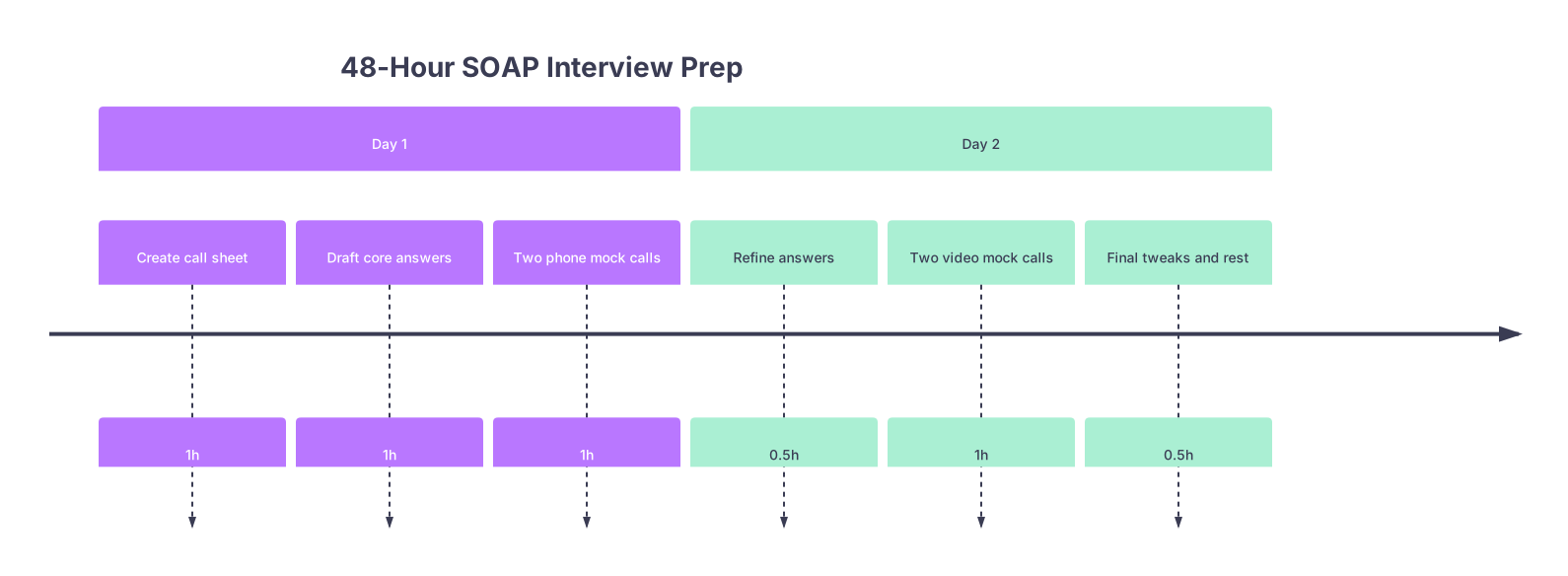
| Period | Event |
|---|---|
| Day 1 - Create call sheet | 1h |
| Day 1 - Draft core answers | 1h |
| Day 1 - Two phone mock calls | 1h |
| Day 2 - Refine answers | 0.5h |
| Day 2 - Two video mock calls | 1h |
| Day 2 - Final tweaks and rest | 0.5h |
This is enough to move you from chaotic to controlled.
13. Specialty-Specific Angles (Brief but Important)
SOAP is not the time for grandiose “I was born to be a surgeon” speeches. But each specialty has landmines. A few quick guidelines:
Internal Medicine
- Emphasize: reliability, thoroughness, comfort with complex patients, love of inpatient/ward work.
- Show: you read, you like thinking through differential diagnoses, you respect primary teams and consultants.
- Avoid: sounding like IM is just a stepping stone you settled for.
Family Medicine
- Emphasize: continuity, broad care, behavioral health, underserved populations, communication.
- Show: clinic experiences, interest in full‑spectrum training if relevant.
- Avoid: sounding like you are only here because you did not match IM or another specialty.
Pediatrics
- Emphasize: communication with parents, patience, teamwork with nurses, safety mindset.
- Show: concrete pediatric experiences, comfort at the bedside.
- Avoid: over‑cutesy stories. They want safe, competent residents, not just “I like kids.”
Surgery / Surgical Subspecialties
- Emphasize: work ethic, resilience, coachability, comfort with early mornings and long days.
- Show: OR time, ability to take feedback directly, examples of grit.
- Avoid: complaining about hours, or sounding ambivalent.
Psychiatry
- Emphasize: listening skills, comfort with difficult conversations, boundary awareness, team‑based management with social work/therapy.
- Show: clear, non‑rambling answers (ironically); ability to talk about mental health professionally.
- Avoid: oversharing your own psychiatric history; keep it framed in professional, stable terms if discussed.
14. What To Do After Each Call
Do not just hang up and stare at the wall.
Right after each call:
Write down:
- Who you spoke with
- Key features they emphasized (e.g., “Very inpatient heavy,” “Strong community focus,” “New program”)
- Your gut feeling (one line)
Send a very short thank‑you email if you have their email and time allows:
- 3–4 sentences max
- Reference one specific thing from the conversation
- Reiterate your interest and readiness
Example:
Subject: Thank you for speaking with me today
Dear Dr. Smith,
Thank you for taking the time to speak with me about the X Internal Medicine Residency during SOAP today. I appreciated hearing about the strong inpatient training and close attending supervision your interns receive. I would be very excited to train at your program and to contribute reliable, hard work on your wards from day one.
Sincerely,
[Name], [AAMC ID]
No paragraphs about your journey. They do not have time.
15. Mental Game: Staying Functional Under Stress
You do not need to be calm. You need to be functional.
A quick pre‑call routine (60 seconds) can keep you from derailing:
- Stand up, shake out your arms.
- Take three slow breaths: 4 seconds in, 4 hold, 6 out.
- Glance at your call sheet: remind yourself of your 4 core messages.
- Tell yourself one sentence: “I am here to have a clear, professional conversation.”
During the call, if you blank:
- Pause.
- Say: “Let me think for a second.”
- Look at your sheet and answer the question using the three‑layer structure (Headline – Proof – Tie‑back).
You will sound far better doing that than panicking and rambling.
16. Put It All Together: A Sample SOAP Call
To make this concrete, here is what a tight, effective SOAP call can look like.

| Step | Description |
|---|---|
| Step 1 | Program calls |
| Step 2 | Greeting and intro |
| Step 3 | Tell me about yourself |
| Step 4 | Why this specialty |
| Step 5 | Why did you not match |
| Step 6 | Why our program |
| Step 7 | Red flag or follow up questions |
| Step 8 | Applicant asks 1-2 questions |
| Step 9 | Closing and thanks |
Imagine the call:
- PD: “Hi, this is Dr. Smith from X Internal Medicine. Is now a good time?”
- You: “Yes, thank you very much for calling, Dr. Smith. I appreciate the opportunity to speak with you.”
They ask “Tell me about yourself.” You give your prepared 35‑second answer. They ask “Why IM?” You pull your 3‑layer answer. They ask “Why did you not match?” You give your Past–Fix–Present script.
You ask one or two good questions. You close with:
“Thank you again for your time. After hearing more about your program, I would be very excited to join and I am ready to work hard as an intern if given the opportunity.”
Does this guarantee an offer? No. But it moves you out of the “risky unknown” pile and into the “safe, workable candidate” group. That is the entire game in SOAP.
Your Next Step Today
Do not just nod along.
Right now, before you do anything else:
Open a blank page and write your 35‑second “Tell me about yourself” and your 3–4 sentence “Why did I not match?” using the structures above.
Then print them on a one‑page call sheet and tape it next to your laptop.
By tonight, have at least one friend call you and run those two questions. Out loud. On the phone.
You turn one interview into an offer by having the right words ready when the phone finally rings.