
Most people waste the first SOAP day panicking. You cannot afford that luxury.
You have one job now: convert a gut‑punch Monday morning into a structured rescue mission. That requires discipline by the hour, not vague “stay calm and regroup” nonsense.
This is your hour‑by‑hour SOAP plan for Monday. Follow it and you give yourself a real shot. Wing it and you bleed opportunities.
7:30–8:00 AM (ET) – The Hit and the Reset
You already know the scenario.
You check your email or NRMP.
You are unmatched or partially matched.
Your stomach drops.
Here is what you do in the first 30 minutes, not what you feel like doing.
Step away from your phone for 5 minutes.
Go to the bathroom, splash water, take 10 slow breaths. You are about to make decisions that control the next year of your life. You need a semi‑functional brain, not a crisis brain.Tell only the people who must know immediately.
- Your dean’s office / student affairs
- Your main mentor or advisor
- A trusted family member/partner (one, not ten)
Everyone else can wait. No group texts. No “what happened??” conversations. Bleeding emotional energy is a luxury you do not have on SOAP Monday.
Pull up the exact timelines.
Get the real times from NRMP and your school (they can shift by year). Usually:- 10:00 AM ET – List of unfilled programs available to schools/applicants
- 11:00 AM ET – ERAS opens for SOAP applications
- Programs can start reviewing/interviewing early‑mid afternoon
Write those times down on paper. Right in front of you.
Decide your mental frame.
You are not “a failure”. You are now running a high‑stakes sales campaign with one product: you. That mindset matters.
8:00–9:00 AM – Triage with Your School and Yourself
This hour is where most unmatched applicants drift. You will not.
1. Get on the phone or Zoom with your school
Email is too slow. Call or show up in person if possible.
Your goals in that meeting:
Confirm:
- Your USMLE/COMLEX status (all scores reported?)
- Any red flags: leaves of absence, failures, professionalism issues
- Your specialty and geographic flexibility
Ask directly:
- “Who is the point person helping me manage SOAP today?”
- “Can we block a 10‑minute check‑in at 10:30 or 11:30 after the list comes out?”
- “Do you have any sample SOAP emails or call scripts for programs?”
If your school has a “SOAP war room”, be in it (virtually or physically). If they are disorganized, you compensate by being more structured yourself.
2. Do a brutally honest self‑assessment (15–20 minutes)
Write fast and do not sugarcoat.
- What specialty did you apply to originally?
- What is your:
- Step 1: ___ (P/F? If failed: note it.)
- Step 2 CK: ___
- Class rank or quartile: ___ (if known)
- Honors / AOA / GHHS: yes/no
- Clinical issues:
- Any failed clerkships/remediations?
- Any professionalism notes?
- Citizenship/visa needs?
- Major strengths:
- E.g., “3 years of basic science research with publications,” “Strong home letters,” “Outstanding psych comments,” etc.
This assessment drives how wide you need to open your net.
9:00–10:00 AM – Build Your Target Strategy Before the List Drops
At 10:00 AM, the unfilled list appears. You do not want to start “figuring yourself out” then. You do that now.
1. Define your SOAP ranges: core vs expansion
You are going to have:
- A Core List of specialties/regions where you are most competitive and would be happiest
- An Expansion List of specialties/regions you will consider if your core is thin
Be honest about competitiveness. Let me be blunt:
If you are IMG, lower Step 2 (< 225), or have failures, you cannot afford to be “categorically or bust” in highly competitive fields. You must seriously consider:
- Prelim medicine
- Prelim surgery
- Transitional year (if any)
- Less competitive categorical fields if available
If you have solid scores (Step 2 > 240) and no major red flags but just got squeezed by specialty competitiveness, you can still prioritize:
- Your original specialty (if spots exist)
- Related fields (e.g., applied Derm → consider IM, Path; Ortho → consider Surgery prelim, PM&R)
Write down:
- Absolute yes specialties
- Maybe specialties
- Absolute no specialties (very few; do not overdo this)
2. Clarify your geographic reality
If you need to be near family or a partner, fine. But do not list entire regions as “no” just because of weather or prestige. SOAP is about getting a job and training, not Instagram happiness.
10:00–11:00 AM – The Unfilled List Drops: Attack, Do Not Browse
At 10:00 AM ET, your school gets the list. You may get it via them or a portal depending on the year.
This is a critical 60–90 minutes.
1. Pull the list into something usable
If possible:
- Export the list into Excel or Google Sheets
- Add filters for:
- Specialty
- State
- Categorical vs preliminary vs TY
- A separate column for your priority ranking (you will need this)
2. Rapid filtering pass (first 20–30 minutes)
You are not ranking yet. You are just marking.
Scan for:
- Your original specialty – star those immediately
- Any related or acceptable specialties – highlight
- Prelim/TY positions – mark these in a different color
You want three buckets:
- High priority (Core)
- Medium priority (Expansion)
- Low priority (only if desperate)
3. Reality check with your advisor (20–30 minutes)
Jump back on a quick call or Zoom with:
- Your dean’s office contact
- A trusted specialty advisor if they are available
Show them:
- Your self‑assessment from earlier
- Your three buckets
Ask them explicitly:
- “Given my profile, which of these should be my top 10–15 SOAP targets?”
- “Are there any programs on this list you have a relationship with?”
- “Any programs I should avoid due to known issues with visas, culture, or performance expectations given my record?”
11:00 AM–12:30 PM – ERAS Opens: Craft, Do Not Copy‑Paste Sloppily
At 11:00 AM ET ERAS opens for SOAP applications (check your year’s specific time). You get a limited number of applications (historically 45). They go fast. Programs start looking almost immediately.
Your mission from 11:00 to ~12:30:
- Decide where each of your applications is going.
- Customize enough so you do not look like generic spam.
1. Lock in your program list
Target 35–45 programs depending on your risk profile:
High‑risk profile (low scores, red flags, IMG):
- Use close to your maximum.
- Cast a wide net across several specialties if needed.
Moderate profile (average scores, no major red flags):
- Focus on realistic specialties + geographies, still use most of your slots.
Strong profile (good scores, just unlucky in competitive field):
- You can be more specialty‑focused but still avoid being overly picky.
2. Fix your documents fast
You cannot rewrite your entire ERAS, but you can adjust key pieces.
A. Personal statement
You need 1–2 SOAP‑appropriate personal statements, not 7.
If staying in the same specialty:
- Tweak your existing statement:
- Remove any “I must be at a top‑tier academic center” language.
- Emphasize humility, work ethic, and being ready to start Day 1.
- Add 1–2 sentences showing maturity in adversity (without saying “I did not match” explicitly).
- Tweak your existing statement:
If pivoting to a new specialty:
- Draft a lean, focused 3–4 paragraph statement:
- Paragraph 1: Brief snapshot of why this field logically fits your experiences.
- Paragraph 2–3: Specific clinical or research experiences that show fit.
- Paragraph 4: What you bring to a program (reliable, teachable, team‑oriented).
- Draft a lean, focused 3–4 paragraph statement:
Do not write poetry. Write clarity.
B. CV and experiences
- Check for obvious errors and outdated info.
- Update any recent publications or major achievements.
- Make sure any “future experiences” that never happened are removed or corrected.
3. Program‑specific signals (where possible)
You will not write 45 custom essays. But for your top 10–15 programs, do this:
- Research each program for 3–5 minutes:
- Size, location, any unique tracks
- Do they take IMGs? DOs?
- Jot a one‑line note for each:
Example: “Strong underserved focus; I have 3 years of FQHC experience” or “Close to my family; long‑term connection to this city.”
You can use this later in emails or phone calls.
12:30–2:00 PM – Submit Your SOAP Applications Early, Not Perfect
By early afternoon, many programs start scanning ERAS and scheduling same‑day virtual interviews.
Do not be the person still fussing with word choice at 3:30 PM.
1. Finalize and submit
Work in this order:
Double‑check:
- Correct personal statement attached to each specialty
- USMLE/COMLEX scores released
- Letters of recommendation properly assigned
Submit in batches:
- First batch: your highest priority 15–20 programs
- Second batch: the rest
You want your top targets to see your application early while they are fresh and not exhausted.
2. Prepare your interview “mini‑script”
Once you submit, interviews can hit quickly. Have a short script ready:
20–30 second “Tell me about yourself”
Example:
“I am a graduating student from X School with strong clinical evaluations in internal medicine and surgery, a background in community health work, and a real interest in caring for underserved adults. I am looking for a program where I can be a reliable team member from day one and grow in a supportive, hands‑on environment.”30–45 second “Why this specialty?”
Pick 2–3 concrete reasons tied to your actual experiences.30–45 second “Why our program?” (for your top programs)
Use the one‑line notes you created earlier.
Write them down and practice out loud. Yes, literally say them. You do not have time to “wing it” and ramble.
2:00–4:00 PM – Interview Window: Be Glued to Your Devices (Smartly)
This is where SOAP becomes controlled chaos.
Programs will:
- Call
- Send interview links (Zoom, Teams, phone)
Your plan:
1. Set up your environment
- Quiet space
- Neutral background
- Charged laptop and phone
- Headphones ready
- Zoom/Teams installed and tested
Put your phone ringer ON. Set email notifications to loud.
2. Respond immediately, but with structure
- Any missed call from a hospital number? Call back within 5 minutes.
- Any email offering an interview time? Respond ASAP with:
- Clear confirmation
- Professional but efficient tone
Example response:
Thank you for considering my application. I would be grateful for the opportunity to interview this afternoon and am available at 2:30 PM or 3:15 PM ET. I can also be flexible if another time works better for your team.
Best regards,
[Name], [AAMC ID]
3. Run short, crisp interviews
SOAP interviews are often 10–20 minutes. You need to be:
- Direct
- Humble
- Concrete
Expect questions like:
- “Tell me about yourself.”
- “Why [specialty]?”
- “What happened with the Match?” or “You’re participating in SOAP – can you tell us about that?”
For that last one, here is the structure:
- Brief acknowledgment (1–2 sentences).
- Non‑defensive explanation.
- Pivot to what you learned and how you are ready.
Example:
I applied this year in [specialty] and unfortunately did not match. I think the main factor was the competitiveness of the field combined with [brief factor – e.g., applying broadly but from a newer school]. I have reflected on this a lot over the past weeks, and while it was disappointing, I am fully focused now on finding a program where I can contribute, keep growing clinically, and be a dependable resident for the team.
Do not:
- Blame others
- Complain about programs
- Get emotional on screen if you can help it
If they ask about red flags (failed exam, LOA), use the same pattern: brief, factual, growth‑oriented.
4:00–6:00 PM – Track, Follow‑Up, and Protect Your Energy
By late afternoon, you are juggling:
- Submitted applications
- A few interviews done or scheduled
- Radio silence from some programs
You need structure.
1. Track every contact
Use a simple table (spreadsheet or notebook). For example:
| Program | Specialty | Contact Type | Status | Notes |
|---|---|---|---|---|
| Hospital A | IM Categorical | Email + Interview | Completed | Director seemed interested |
| Hospital B | Surgery Prelim | Email only | No reply | Sent 2:15 PM |
| Hospital C | TY | Phone call | Interview at 5:30 PM | Must be ready on Zoom |
Update this in real time. Your memory will not keep up.
2. Strategic follow‑up emails (only to a subset)
For top programs where you have applied but not heard anything by late afternoon, a short email can help, especially if:
- You have a connection (alumnus, mentor, geographic tie)
- Your school dean is willing to send a parallel note
Template:
Subject: SOAP Application – [Your Name], [Specialty], [AAMC ID]
Dear Dr. [Program Director Last Name],
I recently submitted my application to your [specialty] program through SOAP. I am very interested in the opportunity to train at [Program Name], particularly because of [one specific reason – e.g., your focus on underserved populations / your strong generalist training / your close ties to X community].
I would be grateful for any consideration and would welcome the chance to speak with you or a member of your team today if schedules allow.
Sincerely,
[Name]
[AAMC ID]
[Phone]
Do not spam all 45 programs. Target 5–10 that are both realistic and genuinely desirable.
6:00–8:00 PM – Debrief, Adjust, and Prep for Day 2 (If Needed)
Some years, interviews and decisions extend into the evening. You must stay responsive, but you also need to reset for Tuesday–Wednesday if you are not picked on Day 1.
1. Quick debrief with your advisor or dean
Schedule a 15–20 minute check‑in:
- How many programs:
- You applied to
- You heard from
- You interviewed with
- Any feedback patterns?
(e.g., several programs subtly concerned about Step failure, or about switching specialties)
Decide:
- Do you need to expand specialties tomorrow?
- Broaden geography?
- Add more prelim options?
2. Clean up your materials based on what you learned
If two interviewers in different programs both get confused by the same part of your story, adjust how you tell it:
- Rewrite a few lines in your personal statement if needed.
- Refine your spoken answers so they are tighter and more convincing.
3. Basic self‑maintenance
You are not a machine. If you want to perform on Tuesday:
- Eat a real meal.
- Hydrate more than caffeine.
- Take 20–30 minutes of screen‑free time before bed. Walk. Shower. Lie on the floor. Whatever calms your nervous system.
Set:
- Phone and laptop charging
- Alarm for early wake‑up
- Clothes ready for on‑camera professionalism
Underneath the Hour‑by‑Hour: Strategic Principles You Cannot Ignore
The timeline gets you through Monday. Let me tie together the underlying rules I have seen separate people who rescue their Match from people who spiral.
1. SOAP is not the original Match. The game is different.
You are not:
- Crafting perfect narratives for 30‑minute interviews.
- Courting programs over months with second looks and emails.
You are:
- Proving in 10–15 minutes that you are safe, teachable, and ready to work.
- Showing you understand this is a two‑way professional rescue deal: they have an open slot and real service needs; you have the skills and attitude to fill it.
So your focus shifts:
- From “why I am passionate about [sexy field]”
- To “why I will make your life easier as an intern starting July 1”
2. Prelim and TY positions are not “losing”
I have watched too many unmatched students turn up their nose at prelim spots, then end up with nothing. Common pattern.
Reality:
- A solid prelim/TY year:
- Gets you real clinical experience
- Gives you new letters of recommendation
- Often opens internal doors into categorical spots later
- Being unemployed for a year:
- Makes you forget medicine
- Makes future programs nervous
- Forces you into weak research or observer roles you did not want
Yes, some prelim years are rough. Yes, some people mistreat prelims. But if you choose carefully, a prelim can be a powerful second chance.
3. Own your story without oversharing
Programs know SOAP applicants are disappointed. What they are scanning for is:
- Blame vs accountability
- Fragility vs resilience
- Fantasy vs realistic expectations
Your job:
- Be honest but concise about what went wrong.
- Show concrete adjustment: changing specialty, broadening geography, refining goals.
- Communicate confidence without arrogance.
Visualizing Your SOAP Process
Here is a simple flow of how Monday should run for you.

| Step | Description |
|---|---|
| Step 1 | 7 -30 AM Unmatched Notice |
| Step 2 | Contact Dean and Mentor |
| Step 3 | Self Assessment and Priorities |
| Step 4 | 10 AM Unfilled List Review |
| Step 5 | Filter and Rank Programs |
| Step 6 | 11 AM ERAS Applications Open |
| Step 7 | Submit Priority Applications |
| Step 8 | Prepare Interview Scripts |
| Step 9 | Afternoon Interviews and Calls |
| Step 10 | Track Contacts and Outcomes |
| Step 11 | Evening Debrief and Adjust Plan |
And here is how your time generally shifts across key tasks on Monday:
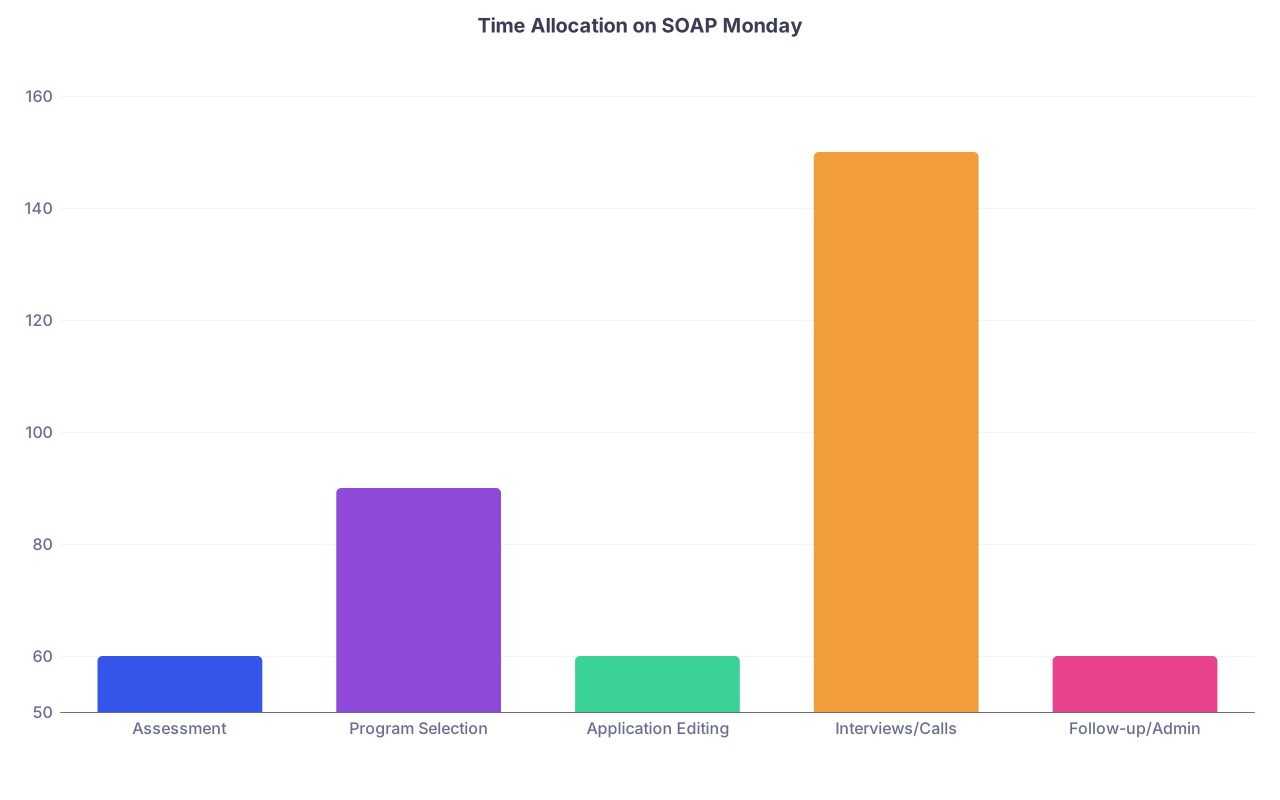
| Category | Value |
|---|---|
| Assessment | 60 |
| Program Selection | 90 |
| Application Editing | 60 |
| Interviews/Calls | 150 |
| Follow-up/Admin | 60 |
The One Thing You Cannot Do
You cannot treat Monday like a funeral.
Grieve later. Vent later. Write the “what went wrong” essay later.
Today is about:
- Relentless structure
- Professionalism under stress
- Tactical flexibility
Your worst enemy is not your Step score or your specialty choice. It is paralysis.
Your Action Step Right Now
If you are reading this before SOAP Monday:
- Start your self‑assessment document now.
- Draft one SOAP‑ready personal statement for your current or backup specialty.
- Meet with your dean to clarify their SOAP process and support.
If you are reading this on SOAP Monday:
- Open a blank page.
- Write the times: 10:00, 11:00, 2:00, 4:00 at the top.
- Under each, write 2–3 concrete tasks based on this plan.
- Then do the next one on the list. Not all of them. Just the next one.
SOAP is not about being perfect. It is about being relentlessly, repeatedly good enough in a compressed window.
Start acting like a resident now: prioritize, execute, adapt.