
The way most applicants build SOAP program lists is wrong. They click wildly in ERAS, chase big-name hospitals, and hope something sticks. That is how you waste your four shots and stay unmatched.
You have less than two hours and one job: build a targeted, realistic, rank-ordered SOAP list that maximizes your chances of signing a contract by Friday. Not impressing your friends. Not “shooting your shot.” Getting a position.
Here is the exact 90‑minute protocol I give unmatched applicants when the SOAP chaos starts.
Step 0: Know Your Hard Limits (10 minutes max)
Before you touch a single program listing, you need to set your non‑negotiables. Otherwise, you will drown in options and panic-apply.
A. Clarify your constraints
Grab a sheet of paper or open a blank note and answer, fast and honestly:
Geography
- Where can you not go under any circumstance (visa, family, health)?
- Where would be tough but acceptable?
- Are you willing to move anywhere in the U.S. for one year if needed?
Visa and citizenship
- Status: US citizen, green card, or visa‑requiring (J‑1, H‑1B)?
- Do you need H‑1B or is J‑1 acceptable?
- Are you willing to consider programs that say “No visa sponsorship”?
-
- Original specialty?
- Backup specialties you can live with? (Internal medicine, prelim surgery, transitional year, family medicine, psych, peds, etc.)
- Are you okay with prelim only?
Dealbreakers
- Night float as PGY‑1? Community vs university? These are not dealbreakers in SOAP.
- True dealbreakers: unsafe area with no support network, program excludes your visa type, program explicitly bars your graduation year.
You are not planning the rest of your life. You are getting your foot in the door. Most of the “I’d prefer not” items need to die here.
B. Write down your profile snapshot
You will reference this constantly:
- USMD / DO / US-IMG / non‑US IMG
- Grad year
- Step 1 (P/F or score) and Step 2 CK score
- Attempts / failures (yes/no, which exam)
- Number of YOG (years since graduation)
- Major red flags: gap >1 year, probation, professionalism issue, etc.
- Any U.S. clinical experience? (how many months, what specialty)
Keep this visible. Every program you consider must pass a simple test: Does my profile fit reasonably with what this program usually takes?
Step 1: Understand the SOAP Reality for You (10–15 minutes)
If you are in SOAP, you do not have the same leverage as in the main Match. You must be brutally realistic about what is possible this week.
A. Identify your realistic specialty targets
Use this quick hierarchy:
Highest chance of matching through SOAP, in order:
- Preliminary/Internal Medicine / Prelim Surgery
- Transitional Year
- Categorical Internal Medicine (especially community)
- Family Medicine
- Pediatrics
- Psychiatry
- Less commonly: Neurology, Pathology, PM&R, etc., depending on year
Most competitive and poorest SOAP yield:
- Dermatology, Plastics, Ortho, ENT, Ophtho, Urology, Rad Onc, etc.
- These rarely have SOAP‑available categorical PGY‑1 spots that match unmatched applicants without stellar records.
Unless you have a very specific, realistic reason (e.g., already interviewed at that program, strong connection, extremely high scores, prior research there), do not waste SOAP slots on long‑shot categorical competitive specialties.
B. Use your profile to trim fantasy options
Be candid:
- Step 2 CK < 220 (or multiple failures):
- Focus on community IM, FM, psych, peds, prelim spots.
- Older grad year (>5 years since graduation, esp. for IMGs):
- Expect more resistance from academic centers; lean heavily on community hospitals and prelim positions.
- No Step 2 CK yet:
- Many programs will not consider you in SOAP. Prioritize prelim or TY programs that explicitly allow pending scores (check the listing text carefully).
You are not eliminating ambition forever. You are choosing survival first.
Step 2: Set Up Your SOAP Workspace (5–10 minutes)
If you try to do this “in your head” inside the ERAS interface, you will make chaotic, emotional decisions.
A. Build a simple tracking sheet
Use Excel, Google Sheets, or even a local notepad. I prefer a sheet.
Core columns (you can add more later if you have time):
| Column | Purpose |
|---|---|
| Program Name | Identify program |
| ACGME ID | Exact program identifier |
| Specialty | Sort by field |
| State / City | Geography filter |
| Program Type | Community / University / Hybrid |
| Visa Policy | J-1 / H-1B / None |
| Filters (Score/YOG) | Red flags against you? |
| Fit Score (1–5) | Your quick gut rating |
Do not overcomplicate. You do not need 20 columns. You need speed and clarity.
B. Define a simple “fit score” system (1–5)
This is a fast heuristic, not a dissertation:
5 – Strong fit
- Specialty you are fully okay with
- Program historically takes applicants like you (based on filters, region, DO/IMG friendliness)
- No obvious dealbreakers (visa, grad year, multiple failures)
4 – Good fit
- Slight misalignment (e.g., prefers higher scores but not impossible)
- Geography not ideal but fine
-
- Score below their usual, or you are older grad year, or visa is borderline
- You would accept if offered, but chances are modest
2 – Long shot
- You are missing key preferred attributes
- But not automatically screened out (no explicit “No visa” etc.)
1 – No
- You would not go even if they offered (or they clearly will not consider you)
You will come back to this column when it is time to prioritize.
Step 3: Scan the SOAP List Strategically (25–30 minutes)
This is where people lose an hour: scrolling aimlessly and bookmarking everything. You will not do that.
A. Filter aggressively by specialty and visa from the start
In ERAS SOAP (once the list is live):
Filter by:
- Specialty (start with your realistic list: IM, FM, psych, peds, prelim, TY, etc.)
- State (group by region if you have strong preferences)
- Visa sponsorship (if applicable)
Start with your highest‑priority realistic specialties.
- Example: An IMG with 3 years since graduation, Step 2 CK 225, J‑1 only:
- Start in this order:
- Categorical IM (community-heavy states)
- Family Medicine
- Psychiatry
- Pediatrics
- Prelim IM / Prelim surgery
- Start in this order:
- Example: An IMG with 3 years since graduation, Step 2 CK 225, J‑1 only:
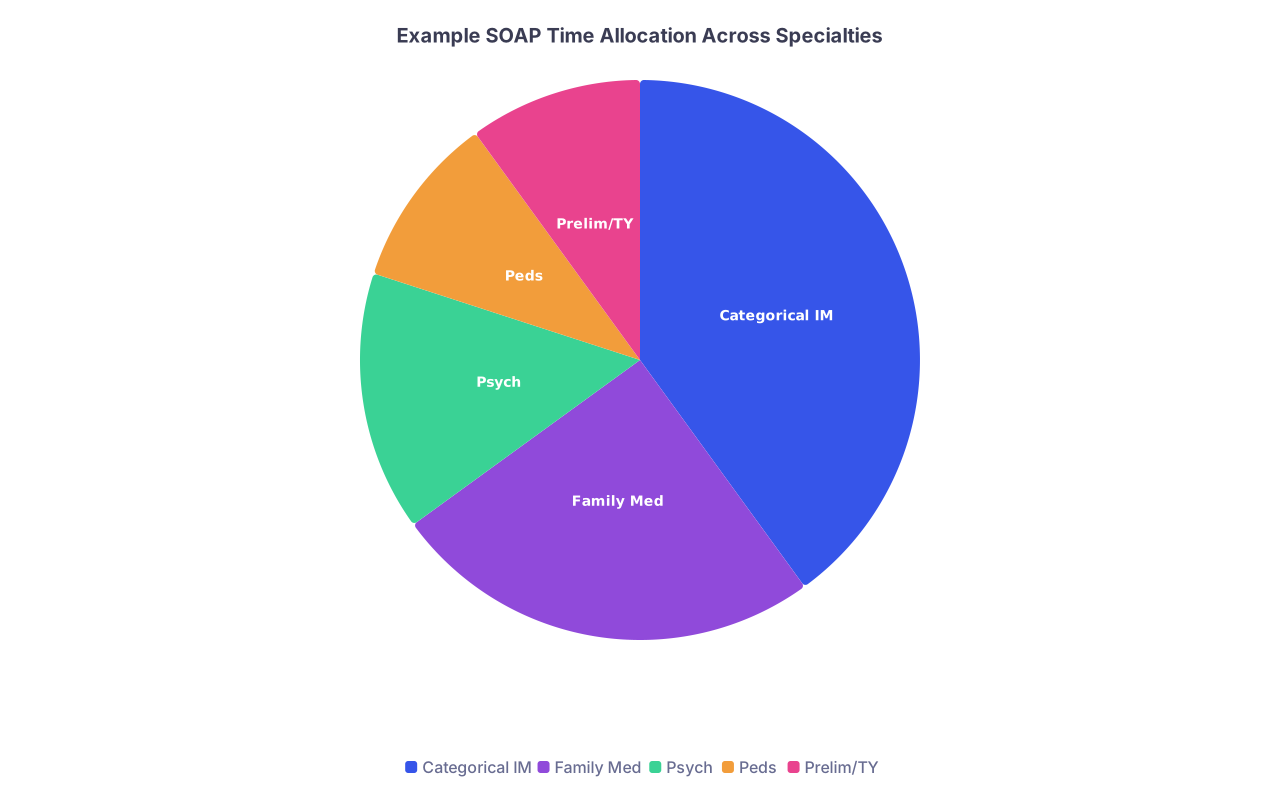
| Category | Value |
|---|---|
| Categorical IM | 40 |
| Family Med | 25 |
| Psych | 15 |
| Peds | 10 |
| Prelim/TY | 10 |
This is time, not number of applications.
B. Rapid triage each program in 30–60 seconds
For each filtered program listing:
Look for, in this order:
Visa and eligibility
- If you need a visa and they say “No visa sponsorship”: skip immediately.
- If they state “US grads only” and you are IMG: skip.
- If they say “Recent grads only (within 3 years)” and you are >5 years out: probably skip unless you have a serious connection.
Score / attempt filters
- If they explicitly require Step 2 above your score:
- Example: “Minimum Step 2 CK 235” and you have 220 – downgrade to 2 or skip.
- If they mention “no attempts / failures” and you have one – consider as 2 (very long shot) unless you have another strong tie.
- If they explicitly require Step 2 above your score:
Program type and competitiveness cues
- Big-name university hospital in a major city with a full categorical slot? Very unlikely if you are SOAPing with an average or worse record.
- Community program / smaller city / newer program? Much more realistic.
As you scan, add to your sheet:
- Program name
- City/state
- Specialty
- Notes: “J‑1 OK, prefers US grads but allows IMGs,” “Min Step 2 220 – at threshold,” etc.
You are not judging yet. You are collecting.
C. Use a simple color or category system
If your sheet allows it, mark:
- Green (likely fit) – looks compatible with your profile
- Yellow (conditional) – one or two concerns but not fatal
- Red (unlikely) – clear mismatch but not impossible (academic center, higher score requirements, etc.)
You can translate these later into your 1–5 fit scores.
Step 4: Score and Sort Your Programs (15–20 minutes)
Once you have a manageable list (usually 30–80 programs, depending on how broad you went), you turn chaos into a ranked target list.
A. Assign fit scores fast
Go down your sheet. For each program, assign 1–5 based on:
- Specialty desirability to you
- Eligibility alignment (visa, score, grad year)
- Type of program (community vs highly competitive academic center)
- Any connections (rotations, LOR writers from there, region where you lived)
Do not spend more than 20–30 seconds per program. Trust your structured instincts.
Example scoring:
- 5: Community IM program in Midwest, J‑1 friendly, grad year limit 10 years, minimum Step 2 CK 210. You are an IMG 4 years out, Step 2 CK 225.
- 4: Family medicine program, J‑1 OK, wants Step 2 230+, you have 225, but FM usually more flexible.
- 3: Psychiatry program at state university, J‑1 ok, but says “we generally prefer US grads” and average Step 2 240.
- 2: Categorical IM at strong university in popular city, “prefer Step 2 >240,” you are at 220.
- 1: Any program you truly would not attend even if they called. Remove these from your SOAP strategy.
B. Sort by fit score, then by your preference
Sort the sheet:
- First by Fit Score (descending)
- Then manually review within each score group for:
- Geography you prefer
- Specialty you prefer
Rough prioritization template:
- Row 1–10: Score 5, your preferred specialties and tolerable locations.
- Row 11–25: Score 4, still solid.
- Row 26–40: Score 3, backup layer.
- Row 41+: Score 2, emergency long shots.
Remember: in SOAP, you cannot “over‑rank.” You can only submit 25 unique programs per SOAP round, per ERAS rules (check current year for exact limits). You must be selective and intentional.
Step 5: Build Your Actual SOAP Target List (15–20 minutes)
Now you move from sheet to actual ERAS SOAP application selections.
A. Decide your specialty mix intentionally
Avoid the classic mistake: 20 slots in your original competitive specialty and 5 in things you would actually match into.
Be more ruthless. A realistic starting allocation for someone unmatched after applying to categorical IM might look like this:
| Specialty | Number of Programs |
|---|---|
| Categorical IM | 10 |
| Family Med | 6 |
| Psych | 4 |
| Peds | 3 |
| Prelim IM/Surg | 2 |
If you are very risk‑averse and just want any door:
- More FM, psych, peds, and prelim.
- Fewer categorical IM academic centers.
Adjust based on your real options list. The point is: no more than ~40–50% of your SOAP list in highly competitive or poorly aligned programs.
B. Choose the exact 25 programs
From your scored list:
Start with all score 5 programs in your acceptable specialties.
- If you have more than 25, sort by your personal priority (geography, specialty).
- If you have fewer than 25, move to score 4 programs.
Add score 4 programs to fill remaining spaces.
- Prioritize more IMG/DO‑friendly, community‑based, or smaller-city programs if your profile is average or weaker.
Only dip into score 3 or 2 if you still do not have 25 reasonably aligned programs.
Your goal: every program on your final list is somewhere you can imagine saying “yes” if they call.
Step 6: Tighten Your Materials Against That List (10–15 minutes)
SOAP is not just clicking programs. Your documents must speak to the specialties and program types you actually chose.
A. Align personal statements
Ideal scenario: you already have:
- 1 IM personal statement
- 1 FM personal statement
- 1 psych or peds or prelim/TY statement (generalist)
If not, in 10–15 minutes you can:
- Take your existing main Match personal statement.
- Strip out highly specific specialty language.
- Replace with more general or new‑specialty‑aligned content:
- Emphasize patient care, adaptability, teamwork, interest in breadth (for IM/FM/TY).
- Mention continuity, community impact (for FM).
- Emphasize communication, insight, mental health interest (for psych).
Do not try to write three brand new masterpieces. You are optimizing for coherence and lack of obvious mismatch.
B. Check your LoR set
You cannot change letters in SOAP, but you can choose:
- Which letters to assign to each program (if you have options).
- For IM/FM/psych/peds, general internal medicine/family med letters are acceptable. Avoid hyper‑specialized subspecialty or unrelated niche letters unless that is all you have.
If you have a letter from a rotation at a similar community program, push that to the top of your assignments for similar programs.
Step 7: Execute Under Time Pressure Without Melting Down
Let us pull this into a realistic 90‑minute timeline.
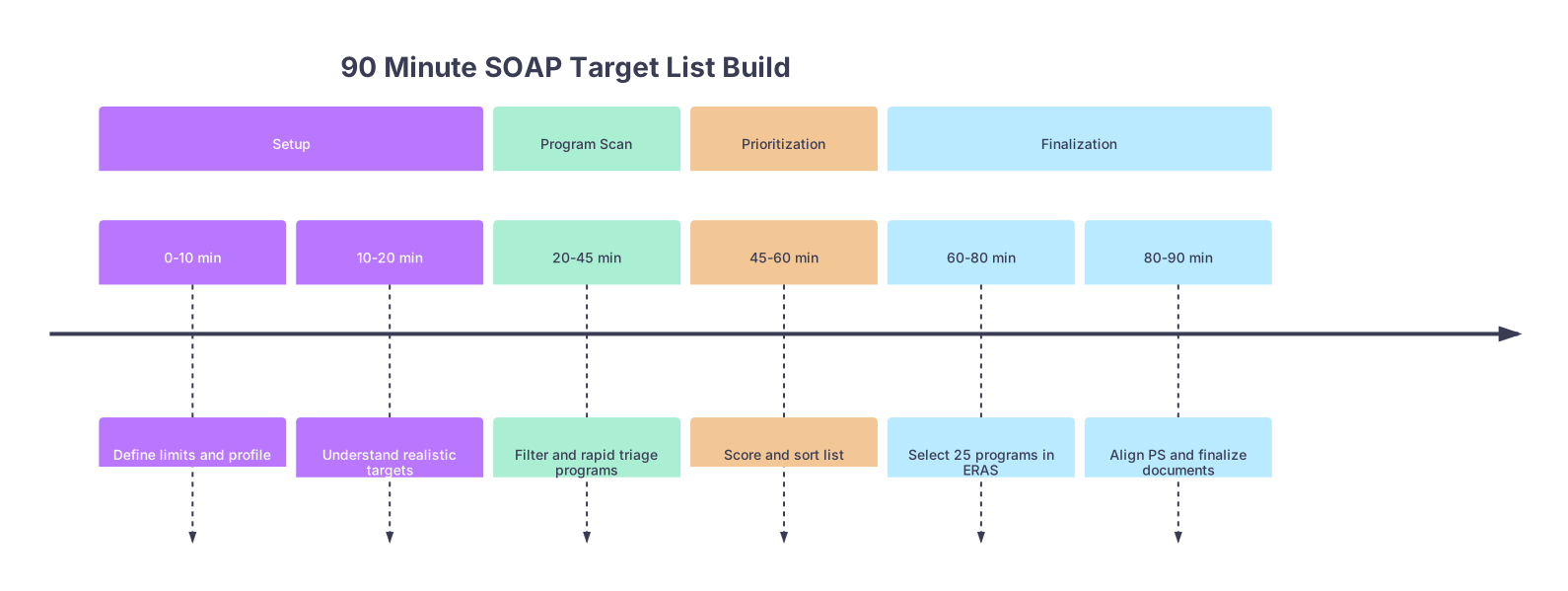
| Period | Event |
|---|---|
| Setup - 0-10 min | Define limits and profile |
| Setup - 10-20 min | Understand realistic targets |
| Program Scan - 20-45 min | Filter and rapid triage programs |
| Prioritization - 45-60 min | Score and sort list |
| Finalization - 60-80 min | Select 25 programs in ERAS |
| Finalization - 80-90 min | Align PS and finalize documents |
You will feel like this is not enough time. It is. The people who get into trouble are the ones who keep “perfecting” and never decide.
Practical Examples: Different Profiles, Different Lists
To make this concrete, here are a few typical SOAP scenarios and how I would direct the list build.
Example 1: USMD, low Step 2, no red flags
- USMD, grad year current
- Step 2 CK 217, Step 1 P/F
- No failures, no major red flags
- Originally applied categorical IM in competitive cities, did not match
Reality: You are very salvageable. Programs will see you as a safe, trainable applicant; the low Step 2 hurts, but not fatal.
Strategy:
- Focus: Community IM, FM, prelim IM, TY.
- Limit academic IM to a few realistic options in less desirable locations.
- Likely distribution:
- 12–14 Categorical IM (mostly community)
- 5–6 FM
- 3–4 Prelim IM or TY
- 1–2 Peds or psych if available and aligned
Example 2: IMG, Step 2 CK 230, 5 years since graduation, needs J‑1
- IMG, grad year 5 years ago
- Step 2 CK 230, Step 1 225
- Needs J‑1 sponsorship
- Applied IM and FM; a few interviews; unmatched
Reality: Competitive in the right context, but older YOG and visa needs narrow the field.
Strategy:
- Target: Community IM and FM in historically IMG‑heavy regions (Midwest, South).
- Avoid: Programs explicitly “US grads only” or “grad year within 3 years.”
- Likely distribution:
- 10–12 Categorical IM (J‑1 OK, IMG‑friendly)
- 7–8 FM (J‑1 OK)
- 3–4 Psych/Peds if visa‑friendly and not hyper‑competitive
- 1–2 Prelim IM as safety
Example 3: DO, failed Step 1 (now P/F era), passed Step 2 CK 220
- DO, graduated this year
- Step 2 CK 220 after Step 1 failure in old scoring era (or analog issues)
- Applied EM and IM, mostly EM heavy, unmatched
Reality: The EM market is brutal; your record will scare a lot of academic IM programs but not all community ones.
Strategy:
- Forget EM in SOAP except maybe 1–2 places as emotional closure.
- Heavy focus:
- Community IM
- FM
- Prelim IM/TY
- Likely distribution:
- 8–10 Categorical IM (community)
- 7–8 FM
- 5–6 Prelim IM / TY
- 1–2 EM long shots at places where you interviewed
Avoid These Common SOAP List Mistakes
I have seen every one of these sink decent candidates.

Chasing prestige in SOAP
- Academic name‑brand hospitals rarely take SOAP candidates with obvious red flags or below‑average metrics.
- One or two targeted choices are fine. Ten is delusional.
Ignoring visa realities
- If you need sponsorship and they do not offer it, stop dreaming. They will not change policy during SOAP week just for you.
Over‑indexing on original specialty
- If you are unmatched in a competitive specialty, your best odds now are in broader fields or prelim positions.
- One or two “heart” picks, then move on.
Not having a plan B and C within SOAP
- Your list should have layers:
- Layer 1: Best realistic matches.
- Layer 2: Slight stretches.
- Layer 3: Prelim / TY / less competitive programs you would still accept.
- Your list should have layers:
Wasting too much time reading websites
- Program websites are often outdated.
- 80% of what you need is in the ERAS posting. Website check only when truly ambiguous or you need that extra data to decide between two options.
How to Adjust If You Have More Time Than 90 Minutes
If for some reason you are early, or the list releases and you have a few hours before submissions open, here is how to upgrade your process without getting lost.
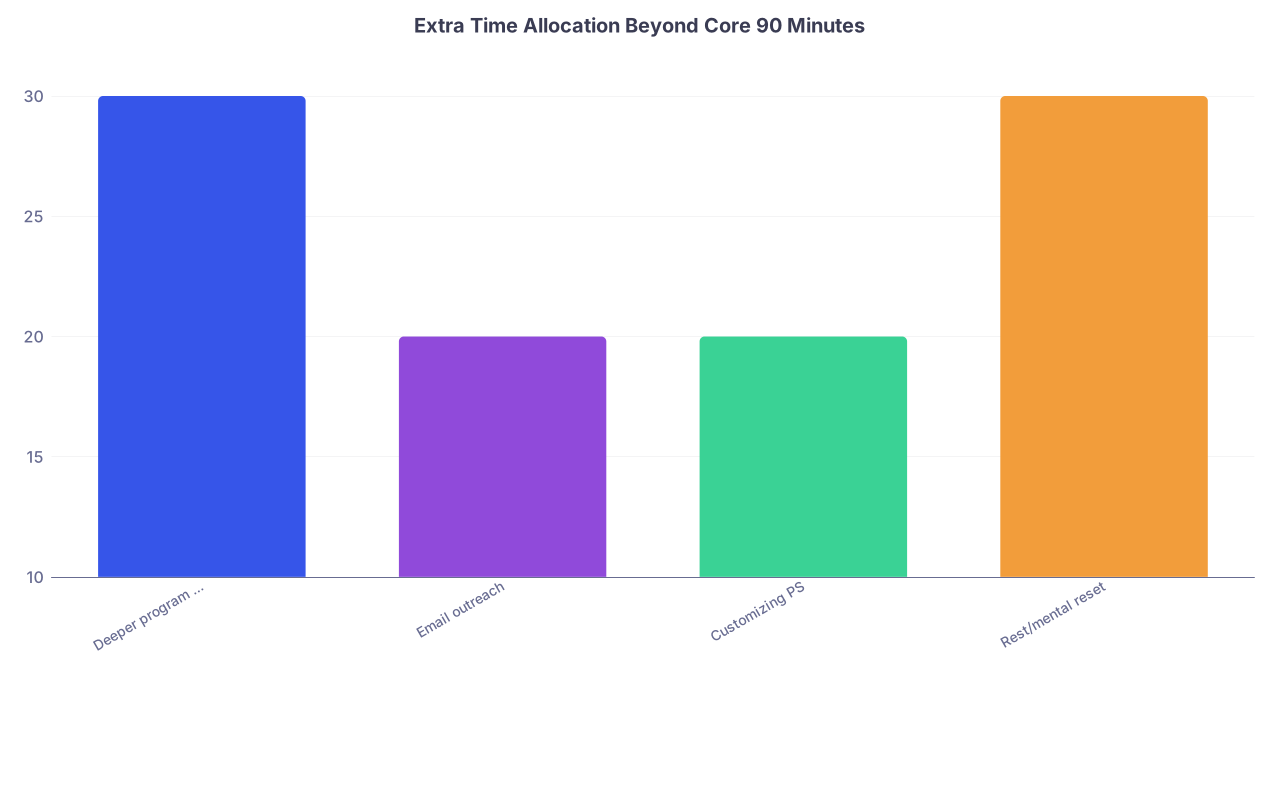
| Category | Value |
|---|---|
| Deeper program research | 30 |
| Email outreach | 20 |
| Customizing PS | 20 |
| Rest/mental reset | 30 |
With extra 1–2 hours you can:
Do quick Google / FREIDA checks for:
- Program’s historical IMG or DO intake
- Any obvious red flags (loss of accreditation, major scandals)
Send a handful of targeted emails:
- Simple, short note to PD/PC at programs where:
- You rotated there
- You have a strong regional tie
- Do not mass‑spam 50 programs. Choose 3–5 you are a genuinely strong fit for.
- Simple, short note to PD/PC at programs where:
Sharpen one or two personal statements:
- For your top 5–10 programs, tweak a paragraph to emphasize regional ties or specific aspects of the program type (community service, underserved populations, etc.).
But do this after your core 25‑program list is defined. Not before.
Mental Framing: Stop Thinking “Forever Job,” Start Thinking “First Step”
SOAP induces panic because people treat it like the final verdict on their entire career. It is not.
You are choosing where you will spend 1–3 years building a track record that lets you:
- Transfer to another program later (sometimes)
- Re‑apply to another specialty
- Build clinical credibility in the U.S.
- Prove that any past exam failure or gap is behind you
Many attendings in competitive specialties started with prelim or less‑glamorous categorical spots and moved later. The key variable is: Did they get in the game at all?
You solve SOAP by thinking like that. Not like a college applicant picking their dream campus.
Do This Right Now
Open a blank sheet and, in the next 10 minutes, write:
- Your profile snapshot (school type, scores, grad year, visa).
- A brutally honest list of 2–4 specialties you would accept.
- Three true dealbreakers (and no more).
Then, when the SOAP list drops, you are not starting from zero. You are executing a plan.
Do that first step now. Not later.