Most SOAP outcomes are lost in the first 24 hours because applicants waste time on panic and pride instead of strategy.
You do not have that luxury.
You have one day to turn a weak application into a functional, targeted, “good enough to pick” SOAP package. Not perfect. Not glamorous. But selectable.
Let me walk you through exactly how to do that.
1. Reality Check: What “Weak Application” Means in SOAP
You are not starting from zero. You are starting from “not chosen in the main Match.” That is different.
Common weak points I see in SOAP candidates:
- Low or failed Step/COMLEX scores
- Gaps in training or extended time to graduate
- Limited or no US clinical experience
- Very narrow specialty focus (e.g., all-in on derm, now SOAPing IM)
- Generic, lazy personal statement
- Poor or lukewarm letters
- Red flags (failed USMLE, professionalism issue, leave of absence)
The goal in SOAP is not to erase your weaknesses. That is impossible in 24 hours.
The goal is to:
- Stop making your weaknesses louder.
- Reframe them so programs see a stable, coachable, low-risk intern.
- Show clear alignment with the SOAP specialties you are now targeting.
You are selling one thing: “I will be a low-maintenance, hardworking, teachable PGY-1 who will not embarrass you or quit.”
Everything you do in the next 24 hours must support that message.
2. First 1–2 Hours: Triage Your Situation, Then Decide Targets
Stop doom-scrolling. Start triaging.
Step 1: Get brutally clear on your record
Write down:
- USMLE/COMLEX scores (include fails, attempts, dates)
- Medical school type (US MD, US DO, IMG, Caribbean, etc.)
- Graduation year
- Prior interviews and in what specialties
- Any big red flags (LOA, failures, professionalism notes)
You need this in front of you so you do not waste time applying to programs that will auto-filter you out.
Step 2: Accept that you must pivot if needed
If you went all-in for orthopedics, ENT, derm, plastics, or another hyper-competitive specialty and are now in SOAP?
You are not SOAPing into ortho at a top program. Stop trying to salvage the same dream in 24 hours.
You are now targeting:
- Internal Medicine (especially community, prelim, categorical at less competitive sites)
- Family Medicine
- Pediatrics (depending on your background)
- Transitional Year / Prelim Medicine or Surgery
- Psychiatry (varies; increasingly competitive but some SOAP slots exist)
- Less competitive community-based programs in any core field
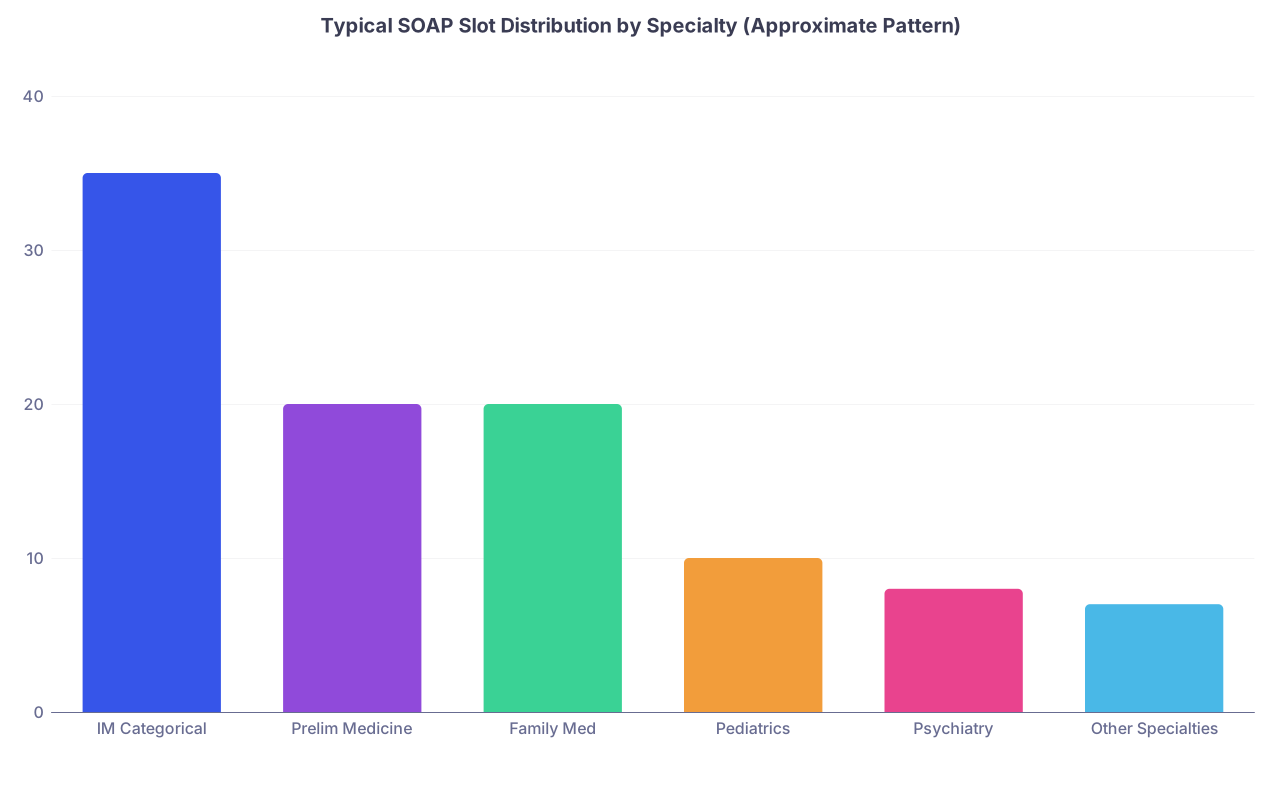
| Category | Value |
|---|---|
| IM Categorical | 35 |
| Prelim Medicine | 20 |
| Family Med | 20 |
| Pediatrics | 10 |
| Psychiatry | 8 |
| Other Specialties | 7 |
These are not exact numbers; patterns shift every year. But the trend is consistent: core specialties and prelim spots dominate SOAP.
Step 3: Narrow to 1–2 primary SOAP strategies
You have 45 total SOAP applications. You cannot spray them randomly.
Pick a primary lane and possibly a backup:
- Lane A: “I am now an internal medicine person.”
- Lane B: “I am now a family medicine person with community focus.”
- Lane C: “I will take a prelim medicine/surgery year and regroup later.”
You will shape your materials to match that lane. Not your old one.
3. Fixing the Core Documents in 24 Hours
Stop thinking “personal branding.” Think “risk minimization and clear fit.”
You have three dials you can still move:
- Personal statement(s)
- Experiences section and ERAS content
- Program communication (if allowed) and how you present yourself in SOAP interviews
3.1 Personal Statements: From Weak to Targeted in 90 Minutes
If your current personal statement is:
- A generic “I love medicine because I love science and helping people” essay
- Focused entirely on a competitive specialty (ortho, derm, etc.)
- Filled with cliché trauma stories and zero evidence of reliability
…you need to replace it.
You do not need a beautiful essay. You need:
- Clarity: What specialty are you now pursuing and why the pivot?
- Stability: Evidence that you show up, work hard, and handle stress.
- Maturity: Ownership of past stumbles without drama or self-pity.
Structure you can steal
Aim for 4 short paragraphs. No fluff.
Opening anchor (3–4 sentences)
- A specific clinical scenario or experience that points toward your new specialty.
- Avoid grand life narratives. Anchor it in one rotation or patient story that actually happened.
Track record of reliability (4–6 sentences)
- Highlight key rotations in the target area (IM, FM, peds, psych, etc.).
- Mention feedback or evaluations: “Attending physicians consistently commented on my preparation and follow-through.”
- Emphasize teamwork, communication, work ethic.
Addressing the pivot / weakness (4–6 sentences)
- If you changed specialties: be direct. “I applied initially to X. Through clinical experience I recognized Y was a better fit because…”
- If you had a failure: one clean sentence of ownership, one sentence of correction, move on.
- Example: “I failed Step 1 on my first attempt during a period of poorly structured study. I reassessed my approach, built a disciplined schedule, and passed on my second attempt, scoring higher on subsequent exams.”
Forward-looking close (3–4 sentences)
- Specific reasons you are drawn to the type of program you are SOAPing into (community focus, diverse pathology, underserved patient population, strong teaching).
- End with a simple statement of what you will bring: reliability, humility, work ethic.
Example pivot sentence you can adapt
- “My initial application focused on orthopedic surgery, where I valued procedural work and acute care, but through my sub-internship in internal medicine I realized I am most engaged by longitudinal patient relationships and complex diagnostic reasoning. For SOAP, I am seeking a position in internal medicine where I can commit fully to becoming an excellent internist.”
Write one strong, generic-to-specialty statement for each lane (IM, FM, etc.). You do not have time for 10 different micro-versions.
Use it for every program within that specialty in SOAP.

3.2 ERAS Content: Rapid Clean-Up Protocol
You do not rewrite your entire application. You reorder and reframe it.
Step 1: Reorder experiences to match your new lane
Top 3 experiences need to scream:
- Clinical reliability
- Relevant specialty exposure
- Commitment to patient care
Move these up:
- Internal medicine / family medicine / peds / psych rotations you performed well in
- Longitudinal clinics, continuity clinics
- Any leadership or long-term commitment in patient-facing roles
Move these down (or compress):
- Old research in hyper-competitive specialty if it no longer helps your story
- Tiny short-term shadowing that dilutes your impact
- Non-clinical fluff positions that do not show real responsibility
Step 2: Rewrite 2–3 key experience descriptions
Focus on:
- Concrete actions (what you actually did)
- Team roles (intern-level tasks, communication)
- Proof of reliability
Bad:
“Participated in patient care and learned to manage common conditions.”
Better:
“Pre-rounded independently on 8–10 patients, presented succinct plans on rounds, followed up on labs and imaging, and coordinated with nursing staff to address overnight issues.”
If you are targeting IM/FM: emphasize:
- Pre-rounding
- Presentations
- Documentation
- Following up on tasks
- Communication with consultants and nurses
You are telling programs: “I already do intern tasks. You will not need to babysit me.”
Step 3: Make sure red flags are not buried or weird
If there was a leave or remediation, it will show up in your MSPE anyway. You cannot hide it.
Do this instead:
- Ensure any explanation in the MSPE or dean’s letter is aligned with what you would say if asked.
- Prepare a two-sentence explanation for interviews (we will handle that later).
4. Strategy for the 45 SOAP Applications
The biggest mistake I see? People throw 45 darts blind.
You will not.
4.1 Build a target list logic
You do not see full program filters, but you can still triage:
- Favor community-based over big-name academic powerhouses.
- Favor programs that regularly take IMGs if you are an IMG.
- Lean toward programs outside the coasts and major metro hot-spots if you have a weaker record.
- Use geography where you have ties (family, prior schooling, etc.) as a secondary filter.
| Priority Level | Program Type Example |
|---|---|
| Highest | Community IM/FM in midwest/south regions |
| High | Prelim medicine in community hospitals |
| Medium | Smaller pediatrics or psychiatry programs |
| Lower | Big-name academic centers in major cities |
| Lowest | Hyper-competitive specialties in any region |
You will probably end up with:
- 25–35 applications in your main lane (e.g., Internal Medicine or Family Medicine)
- 10–20 in prelim or transitional year programs as insurance
4.2 Do not obsess over “fit” blurbs
You will not have time to micro-customize every application. This is not main Match season with 3 months to over-personalize every email.
Your personal statement and experiences must be aligned to the specialty, not each individual program.
5. Managing Red Flags Honestly but Tactically
You cannot fix a failure or professionalism event in a day. You can shift how it lands.
5.1 The 3-part formula for any negative question
Whether it is a failed Step, LOA, or bad semester, use this structure:
Ownership (1 sentence)
- “I failed Step 1 on my first attempt because I underestimated the exam and did not structure my study time effectively.”
Repair (1–2 sentences)
- “I met with faculty, created a detailed schedule, used question banks daily, and tracked my performance. I passed on my second attempt and later improved further on Step 2.”
Current stability (1 sentence)
- “Since then, I have completed all rotations on time with strong clinical evaluations and no further issues.”
If you start blaming others, life circumstances only, or “the system,” most PDs tune out. They are looking for insight and correction, not excuses.
6. Preparing for SOAP Interviews in 6–8 Hours
SOAP interviews are usually short, fast, and brutally pragmatic.
Programs are asking one main question:
“If we take this person in a crisis, will they be safe, workable, and likely to stay?”
You need:
- A tight story for your pivot
- Rehearsed answers for common concerns
- A calm, humble, ready-to-work demeanor

| Step | Description |
|---|---|
| Step 1 | Review Application |
| Step 2 | Identify Weaknesses |
| Step 3 | Write 2 sentence explanations |
| Step 4 | Practice Core Questions |
| Step 5 | Mock Interview with Friend |
| Step 6 | Refine Answers |
| Step 7 | Sleep and Day of SOAP |
6.1 Core questions you must have answers for
Prepare concise, specific answers for:
- “Why did you not match?”
- “Why this specialty now?”
- “Why our program / this type of program?”
- “Tell me about a challenging patient or situation and how you handled it.”
- “What are your biggest weaknesses?”
- “If you do not match in SOAP, what is your plan?”
Do not wing these. Script bullet points and practice out loud.
Example: “Why did you not match?”
Bad answer:
“I am not sure. I thought my application was strong. Maybe programs just did not see my potential.”
Better:
“I initially applied in orthopedic surgery, which is extremely competitive. While I had strong clinical evaluations, my research portfolio and board scores were not at the level many programs prioritize. I did receive some interviews but ultimately did not match. During this process I realized that my strengths and interests align more with internal medicine, where I can build long-term relationships with patients and engage in complex medical management. I am now fully committed to training in internal medicine.”
Short. Honest. Takes responsibility. Shows a plan.
6.2 Your new specialty “pitch”
You need 30–45 seconds on:
- What draws you to that specialty now
- What you liked in rotations
- What kind of career you imagine (hospitalist, outpatient primary care, etc., even if it might change)
Example for Family Medicine:
“I enjoy broad-spectrum medicine and the opportunity to care for patients across the lifespan. On my family medicine rotation, I liked seeing the same patients over time, managing both acute issues and preventive care, and working within a team that knew the community well. Long term I can see myself in a community-based practice, possibly in a medically underserved area, where I can build continuity relationships with my patients.”
7. Hour-By-Hour Action Plan for the 24 Hours
You need a concrete timeline. Otherwise, adrenaline and anxiety will eat the clock.
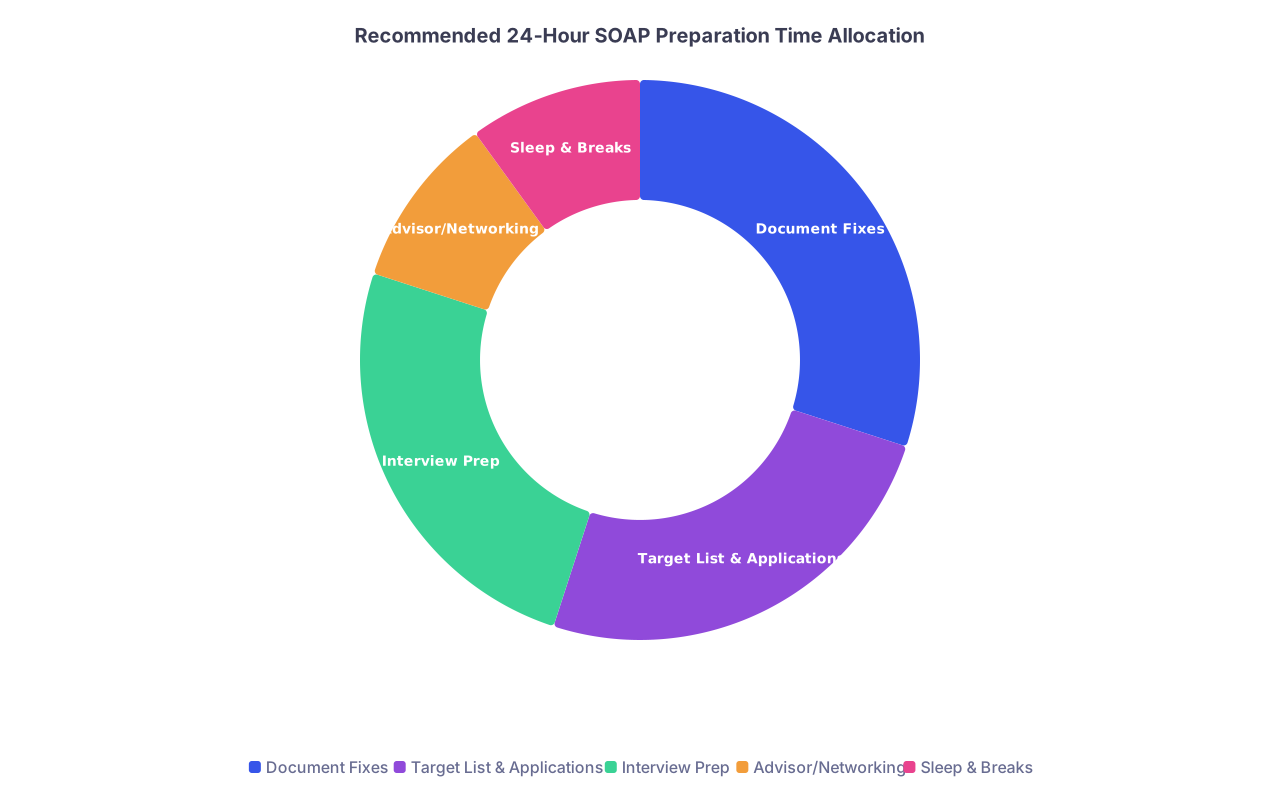
| Category | Value |
|---|---|
| Document Fixes | 30 |
| Target List & Applications | 25 |
| Interview Prep | 25 |
| Advisor/Networking | 10 |
| Sleep & Breaks | 10 |
Hours 0–2: Triage and Target Decision
- Write out your objective profile (scores, school type, red flags).
- Decide your main SOAP lane (IM, FM, etc.) and backup (prelim/TY).
- Quickly review unfilled positions list structure (when available).
Hours 2–5: Personal Statement and ERAS Clean-Up
- Draft or revise 1–2 specialty-specific personal statements.
- Reorder ERAS experiences and rewrite the top 2–3 entries.
- Check for typos, inconsistencies, weird phrasing.
Hours 5–8: Build and Prioritize Application List
- Sort programs by:
- Community vs academic
- Geography you can realistically commit to
- Historical friendliness to IMGs if relevant
- Assign applications: majority to main lane, remainder to backup.
Hours 8–12: Advisor Input and Quick Corrections
- If at all possible:
- Send your revised personal statement to a mentor, advisor, or recent graduate for a fast look.
- Ask direct questions: “Does this sound like IM/FM?” “Any red flags in how I explain my failure/pivot?”
- Make only critical edits. Do not restart from scratch.

Hours 12–16: Interview Prep – Script and Rehearse
- Write bullet answers to:
- Why you did not match
- Why this specialty
- Why this type of program
- Your biggest weakness (choose something real but manageable)
- Handling conflict or stress
- Practice out loud, ideally with another human (friend, partner, colleague).
- Record yourself once. Fix obvious issues: rambling, apologetic tone, over-defensiveness.
Hours 16–20: Logistics and Mental Prep
- Double-check application submissions in the system.
- Confirm contact info, time zones, interview availability.
- Prepare a clean shirt, quiet spot, stable internet, backup audio for interviews.
- Print or open a one-page cheat sheet:
- Key bullet answers
- 2–3 questions you can ask every program (e.g., intern support, teaching structure).
Hours 20–24: Sleep, Light Review, and Calm
You gain nothing by staying up all night rewriting sentences.
- Get 5–7 hours of sleep if at all possible.
- In the morning, skim your bullet answers again.
- Remind yourself: the bar is not perfection. The bar is “safe, stable, workable intern.”
8. How to Behave on SOAP Calls and Interviews
Programs are under pressure too. They are scrambling to fill. They are tired.
Your job is to make their decision easy.
8.1 Tone and demeanor
Aim for:
- Calm, not desperate
- Humble, not groveling
- Clear, not over-explaining
Bad vibe: Long stories about how unfair the process is or how much you “deserve” a chance.
Good vibe: “I understand the situation, I have learned from my missteps, and I am ready to show up and work hard for your patients.”
8.2 What you should ask programs
Do not interrogate them like you have 15 other offers.
But you should have 1–2 simple questions that show you are serious:
- “How is intern education structured in your program?”
- “What qualities do you value most in your interns?”
- “What kind of support systems exist for residents who are struggling?”
This signals that you are thinking about growth and support, not just a spot at any cost.
9. Mistakes That Kill SOAP Outcomes
I see the same self-inflicted wounds every year.
Avoid these:
Hanging on to your original dream specialty in SOAP
- SOAP is not the time to “prove everyone wrong” about ortho or derm. It is the time to get trained.
Overexplaining your trauma or hardships
- You can mention context. If the story becomes about your suffering instead of your reliability, you lose them.
Being vague or evasive about failures
- Program directors smell this a mile away. Clean ownership > tortured rationalizations.
Showing attitude or entitlement
- “I cannot believe I am in SOAP,” “My school really screwed me,” “I should have matched.”
- All of that might feel true. None of it helps.
Not preparing for the “What if you do not SOAP?” question
- You need a serious, practical plan: research year, improved scores, more clinical experience, reapplying with a stronger profile.
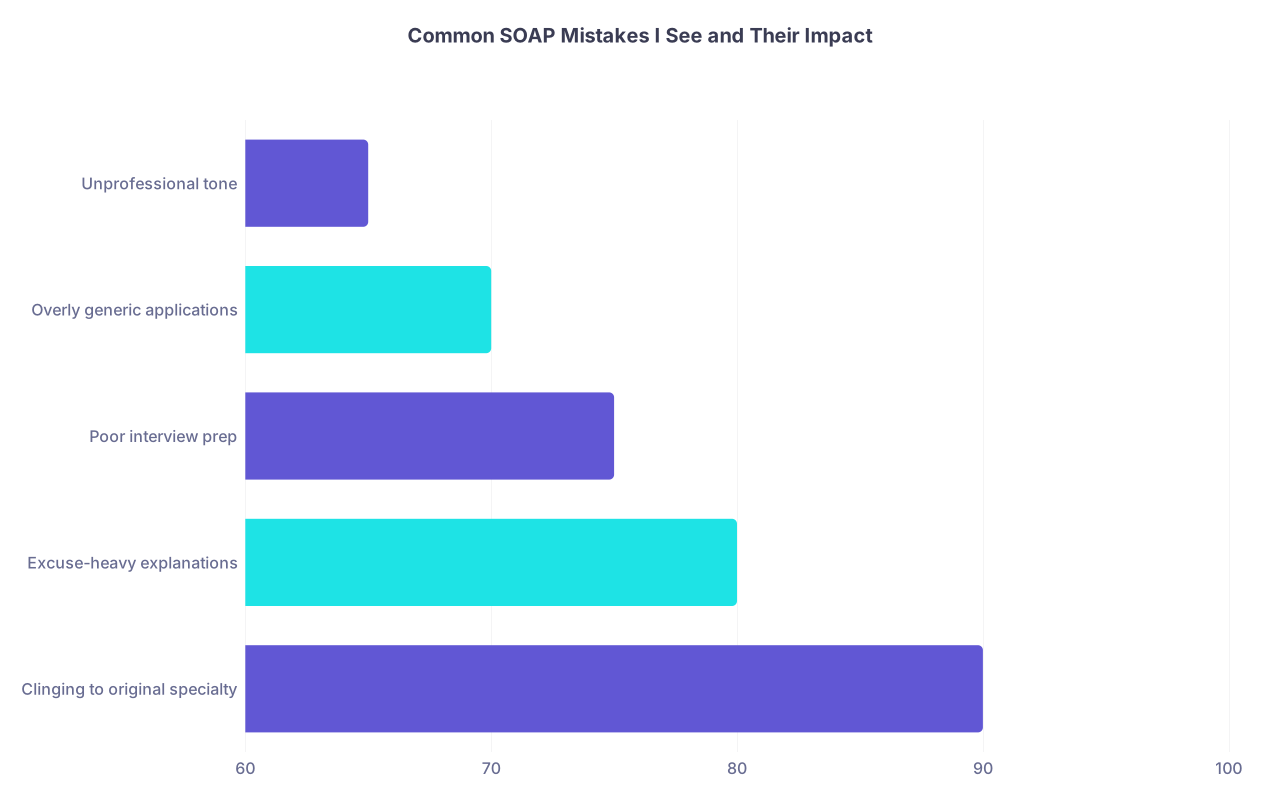
| Category | Value |
|---|---|
| Clinging to original specialty | 90 |
| Excuse-heavy explanations | 80 |
| Poor interview prep | 75 |
| Overly generic applications | 70 |
| Unprofessional tone | 65 |
(Percentages here are “how often I see this in unsuccessful SOAP candidates.” Rough, but depressingly consistent.)
10. Mental Framing: You Are Not Your Match Status
SOAP feels brutal. You are watching classmates post “I matched!” while you are rewriting your life plan overnight. It hurts.
Do not let that bleed into your presentation.
Program directors are not expecting perfection from SOAP candidates. They are expecting:
- Honesty
- Growth
- Work ethic
- Emotional stability under stress
You can deliver those in 24 hours. You cannot rebuild your CV, but you can absolutely change how it lands.

FAQ (Exactly 4 Questions)
1. Should I write different personal statements for every program in SOAP?
No. You do not have that kind of time and it will not move the needle. Write one strong, specialty-aligned personal statement for each lane (for example, one for Internal Medicine and one for Family Medicine) and use them for all programs in that specialty. Your time is far better spent tightening your explanations for red flags and practicing interview answers.
2. Can I still SOAP into a competitive specialty like dermatology or orthopedics if spots appear?
Technically yes, but practically almost never. Those rare unfilled spots usually go to very strong candidates who narrowly missed at other top programs, not to applicants with fundamentally weak files. If your application already failed to secure a position in that field in the main Match, your odds through SOAP are extremely low. Focus your energy on core specialties or prelim years where a realistic path exists.
3. How honest should I be about failing an exam or having a leave of absence?
Completely honest, but tightly controlled. One sentence of ownership, one to two sentences explaining what you did to improve, and one sentence showing ongoing stability. Do not write a full essay or blame others. Program directors are less concerned with the failure itself than with how you responded to it and whether you have demonstrated consistent performance since.
4. If I do not match through SOAP, does that mean I will never match?
No. I have seen many applicants match on a second or even third cycle after failing in both the main Match and SOAP. The difference is what they do next: structured clinical experience, stronger letters, improved exam performance, clear specialty pivot if needed, and a much more focused application strategy. SOAP is one intense window, not your entire career verdict.
Key points:
- You cannot fix your entire CV in 24 hours, but you can radically improve how programs perceive it.
- Commit to a realistic specialty lane, clean up your documents to match, and rehearse honest, concise explanations for your weaknesses.
- Present yourself as exactly what SOAP programs need: a stable, hardworking intern who has learned from setbacks and is ready to show up.