
The obsession with “geographic fit” is overblown—but the data shows location history absolutely changes how your CV is read.
Program directors are not secretly running regression models on your zip codes. But they are doing something cruder and faster: pattern recognition. Your high school, college, medical school, away rotations, and current address form a geographic narrative. That narrative can either de‑risk you…or make you look like a flight risk.
Let me walk through what the numbers actually say, what I’ve seen in real rank-list meetings, and how to use geographic mobility strategically on your residency CV instead of letting it work against you.
What the Data Actually Says About Geography
We do not have perfect randomized data on “geographic mobility” and match outcomes. We never will. But we have enough survey and aggregate data to stop pretending location is a minor detail.
Start with NRMP Program Director Surveys and match outcome reports. Multiple cycles show consistent themes:
- “Any ties to the area” regularly appears as a factor in interview offers and ranking for many specialties.
- Applicants often match in the same census region as their medical school.
- Many applicants match in the same state as their medical school at rates higher than random chance would predict.
Here is a distilled summary from typical U.S. MD match data trends across several years (numbers are representative, not exact for a particular year, but they track the published distributions closely):
| Relationship | Approximate Share of Matches |
|---|---|
| Same state as medical school | 40–45% |
| Same census region as medical school | 60–70% |
| Same institution (MD school → residency) | 18–25% |
| Completely new region | 25–35% |
That pattern is not “everyone stays home,” and it is not “geography doesn’t matter.” It is something more nuanced:
- Most people stay regionally anchored.
- A meaningful minority move across regions.
- Programs predictably use geography as a risk indicator, not an absolute filter.
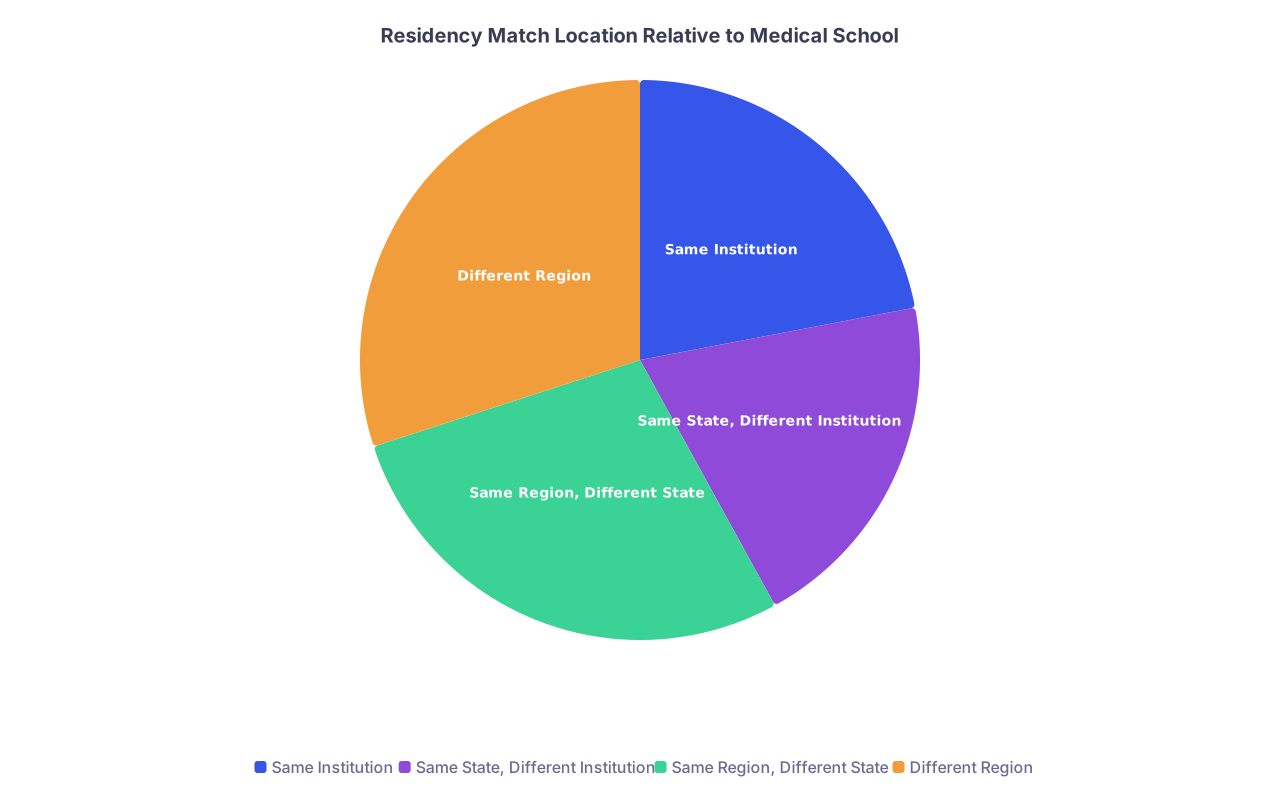
To see the imbalance visually:
| Category | Value |
|---|---|
| Same Institution | 22 |
| Same State, Different Institution | 20 |
| Same Region, Different State | 28 |
| Different Region | 30 |
If you are completely jumping regions (Midwest med school → West Coast residencies only; or international → one specific urban region), you are in that 25–35% “different region” bucket. That is not rare. But it does mean programs will silently ask: “Why here, and will this person stay?”
Your CV either answers that question quantitatively—or leaves an uncomfortable blank.
How Program Directors Read Your Location History
No one cares which Starbucks you study in. But they care about three things tied to geography:
- Retention risk (will you leave after PGY-1?).
- Likely support system (burnout, resilience).
- Realistic interest in their region (are you ranking them high or using them as a backup?).
Program directors will not phrase it this bluntly on a podcast, but I have heard versions of the following in ranking meetings:
- “She has never lived outside the East Coast. Why would she stay in a rural Mountain West program?”
- “He did undergrad and med school in Texas and has family here; he is less likely to jump ship.”
- “Their visiting rotation here plus partner working in the city → they are serious.”
They infer this from basic, countable elements on your CV:
- Number of distinct regions you have trained in.
- Whether there is a clear geographic cluster (e.g., Northeast-only vs coast-to-coast).
- Presence of explicit regional ties (undergrad, family, military, long-term volunteering).
- Any away rotations or clerkships in that area.
Think of your CV as a crude dataset. A program director is running an internal, very biased logistic regression in their head:
Probability(applicant stays 3–7 years) = f(prior years in region, family ties, past moves, visa status, couple’s match, away rotation, specialty competitiveness…)
You cannot see their model. But you can shape the input features.
Geographic Mobility: Signal or Red Flag?
High mobility is not inherently good or bad. It is context-dependent. The data and faculty behavior suggest three broad “profiles” with different interpretations.
1. The Regionally Anchored Applicant
Example:
- Grew up in Ohio.
- Undergraduate at Ohio State.
- MD at University of Cincinnati.
- Applies mostly to Midwest internal medicine programs.
On paper this reads as low risk and high geographic fit for any Midwest IM program. The data supports them: regionally anchored applicants are overrepresented among matched residents at those same-region programs.
Upsides programs see:
- Lower retention risk.
- Family/social support locally.
- Predictable preferences (likely to rank regional programs higher).
Downside:
- Less evidence of adaptability or willingness to move for opportunity.
How to optimize the CV here:
- Quantify your anchoring: “Lived in Midwest >20 years,” “10+ years in Chicago metro.”
- Highlight diverse settings within the region (urban academic, community, rural) to show breadth even if geography is stable.
2. The Selectively Mobile Applicant
Example:
- Grew up in Florida.
- Undergraduate in New York.
- MD in Texas.
- Away rotation in California.
- Applies primarily to West Coast EM and IM programs.
This profile usually does well if the story is coherent: “I have moved for better training environments and now want to settle in X region.” The match data suggests that people with cross-regional histories still cluster to preferred regions when those preferences are clearly articulated.
Upsides:
- Demonstrated willingness to relocate.
- Evidence of adaptability to different systems and patient populations.
- Potentially broader network (letters from multiple regions).
Risk:
- If your CV shows constant movement with no visible anchor, some programs will worry you will not stay.
How to optimize:
- Explicitly connect the dots: “Grew up in humid South, discovered I strongly prefer Pacific Northwest lifestyle; completed rotation at [X] to confirm fit.”
- Put region-linked activities into your CV: regional conferences, QI projects with local health systems, research addressing local population.
3. The Highly Mobile / “Flight Risk” Profile
Example:
- Born abroad.
- Multiple K–12 schools across several countries.
- Undergraduate in Midwest.
- One year research in Boston.
- MD in California.
- Applying broadly in 4 regions for a highly competitive specialty.
This is where poorly framed mobility looks like instability. The raw data—many moves, no regional clustering—does not tell a clean story. If the CV and personal statement do not explain it, people fill in gaps with their own (often negative) narratives.
Behaviors I have heard:
- “Looks like they will go wherever the next shiny opportunity is.”
- “I’m not convinced they actually want to be here long term.”
How to de-risk:
- Choose a primary geographic narrative and support it with numbers: “Lived cumulatively 7 years in the Northeast; close family now in Boston and New York.”
- Use your experiences as evidence of resilience, not randomness: “Moved across three health systems in 8 years, consistently stayed 2–4 years at each.”
How Different Specialties Treat Geographic History
Specialty culture matters. The data on geographic mobility is not uniform across the board.
Here is a simplified comparison based on NRMP, applicant surveys, and program director commentary:
| Specialty | Geographic Fit Importance* | Typical Mobility Pattern |
|---|---|---|
| Family Medicine | High | Strong local / regional retention |
| Psychiatry | Moderate–High | Mix of local and cross-regional |
| Internal Medicine | Moderate | Many within-region, some long jumps |
| General Surgery | Moderate | Mix; prestige and case volume drive |
| EM / Anesthesiology | Moderate–High | Regional clusters, some coastal pulls |
| Dermatology / ENT / Ortho | High (unspoken) | Strong home / regional bias |
| Region | Total Years Lived/Trained | |
| --------------- | --------------------------- | |
| Northeast | 0 | |
| Midwest | 8 | |
| South | 4 | |
| West Coast | 0.5 | |
| International | 6 |
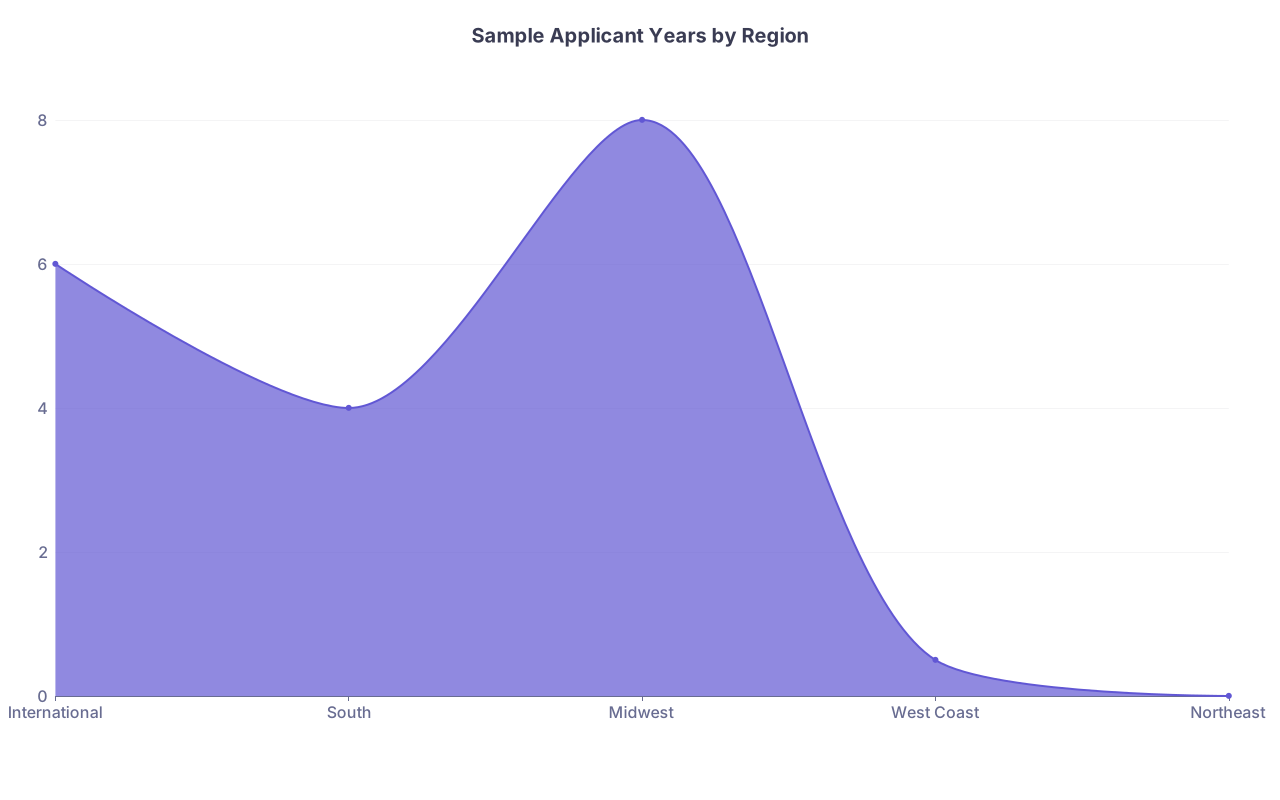
That table tells a story instantly. If this person is applying 90 percent to West Coast programs with almost no history there, the narrative gap is obvious.
You can even throw this into a quick chart to see your own imbalance:
| Category | Value |
|---|---|
| International | 6 |
| South | 4 |
| Midwest | 8 |
| West Coast | 0.5 |
| Northeast | 0 |
I am not suggesting you submit the chart with your application. But you should know exactly what a skeptical committee member would see. Then you decide how to counterbalance it—via personal statement, letters, or targeted rotations.
Mistakes That Quietly Hurt You
A few patterns show up repeatedly in rejected or underperforming applications:
Ignoring home region completely
Applicant with strong ties and excellent stats in a region applies almost nowhere local, then is surprised at a poor match. Programs quietly assumed they were not serious about staying.Random, unconvincing “ties”
“I like hiking in Colorado” is not a tie. “One 1-week conference in Boston” is not a tie. Programs see hundreds of these lines every year. They discount them.Overclaiming flexibility
Lines like “I am happy to train anywhere in the United States” ring hollow when your actual application list is 80% coastal urban programs. The data (your program list) contradicts your statement.Not aligning geography with career goals
Saying you want to work with rural underserved populations and then applying exclusively to big coastal academic centers is a mismatch. Geographic story and career narrative should line up.
How to Decide Where to Signal “Geographic Preference”
Many cycles now include some form of geographic or program signaling. That is literally the system asking you, “Where does your CV’s geographic story point?”
When you decide how to use limited signals:
- Look at your actual history table: years per region.
- Identify where you can make a credible long-term case: enough history + realistic life plans.
- Prioritize those regions for signaling, even if a different region looks “flashier.”
A signal to a region where you have zero documented connection is not useless, but it is weaker than a signal backed by years of your life, family, or repeated rotations.
The Short Version: What Actually Matters
Strip away the anecdotes and here is the reality.
Programs use your geographic history as a rough, fast proxy for three questions:
- Will you come here?
- Will you stay?
- Will you thrive with our patient population and lifestyle?
Your CV is the dataset they are pulling those answers from. You cannot fully control their interpretation, but you can do three specific things:
- Make your geographic pattern obvious and quantified, not hidden.
- Align your regional preferences with a coherent life and career narrative.
- Use rotations, research, and long-term experiences to build real ties where you are applying—not flimsy justifications.
If you do that well, high mobility stops looking like chaos and starts reading as intentional growth. And being “from somewhere else” becomes a distinctiveness factor instead of a quiet liability.