
The mythology around “holistic review” is massively overstated. Programs say they look at everything. The data show they do not. They look at a few things very hard, then sprinkle a thin layer of “holistic” seasoning on top.
If you want to improve your residency CV, you need to stop guessing what matters and start aligning with what programs actually prioritize. Fortunately, there is data. NRMP, AAMC, and specialty organizations have given you a roadmap—if you are willing to read the numbers instead of the marketing.
Let me walk through what the evidence says programs still care about, how “holistic review” has actually shifted weights (not erased them), and where you get the highest ROI for improving your CV.
1. What “Holistic Review” Actually Looks Like in the Data
On paper, “holistic review” means programs consider experiences, attributes, and metrics in context. In practice, it looks like this: numeric filters first, qualitative differentiation second.
Program director surveys make this painfully clear. Across recent NRMP Program Director Surveys (2018–2022), directors consistently rank a small set of factors as “very important” in deciding whom to interview.
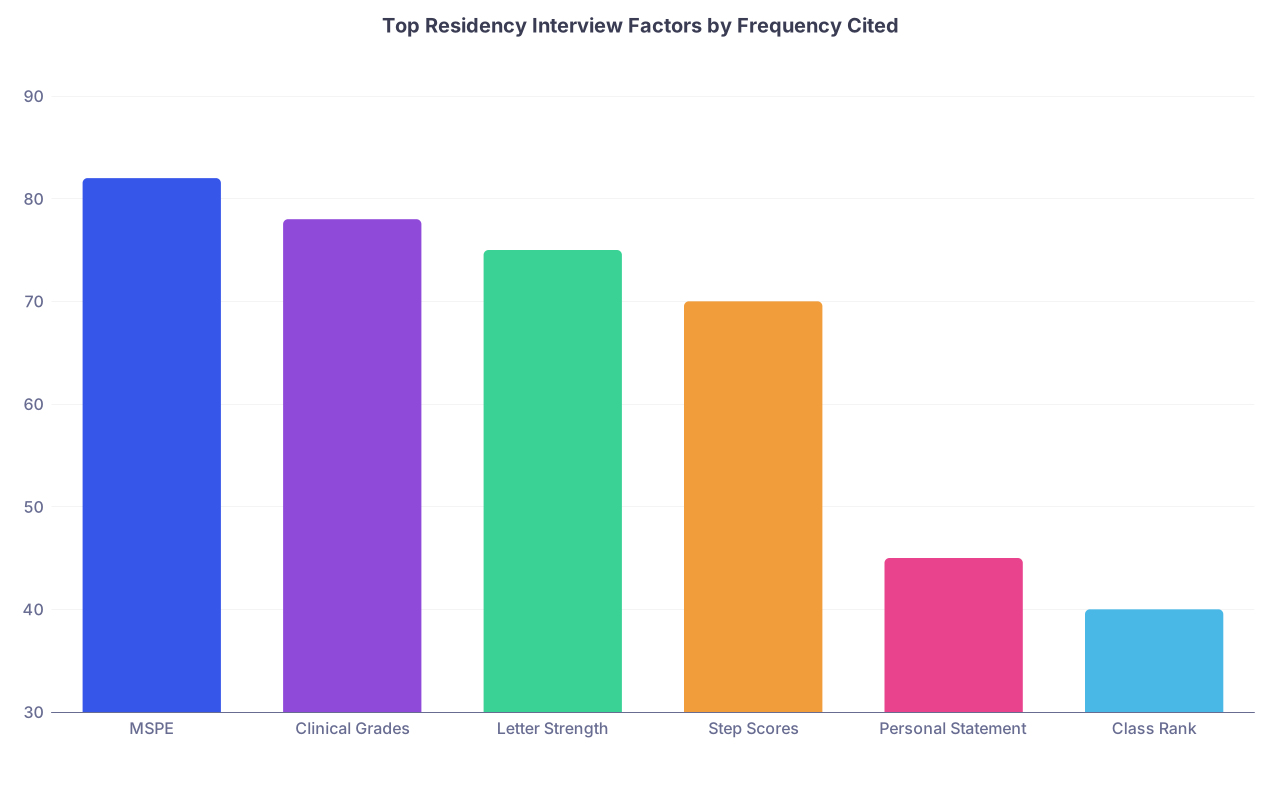
| Category | Value |
|---|---|
| MSPE | 82 |
| Clinical Grades | 78 |
| Letter Strength | 75 |
| Step Scores | 70 |
| Personal Statement | 45 |
| Class Rank | 40 |
Interpretation:
70–80% of program directors repeatedly cite:
- MSPE (Dean’s Letter)
- Clinical clerkship performance
- Letters of recommendation
- USMLE/COMLEX scores (even post–Step 1 pass/fail, Step 2 CK is now the de facto numeric gate)
“More holistic” items—volunteering, extra activities, unique backgrounds—show up, but far lower and mostly as tiebreakers once you are above the hard screens.
Holistic review has done two main things:
- Reduced the absolute dominance of preclinical exam scores (especially now that Step 1 is P/F).
- Increased the relative importance of:
- Clinical evaluations
- Narrative comments (MSPE + letters)
- Specialty-aligned experiences (research in some fields, leadership in others)
What it has not done: made your yoga club leadership equal to your Step 2 CK score.
2. Core CV Elements Programs Still Prioritize
Here is the blunt hierarchy, supported by director surveys, match data, and what I have seen when faculty scroll through ERAS at 11 PM.
2.1 Board Scores: Still the First Hard Filter
Step 1 may be pass/fail, but scores are not dead. They just migrated.
Step 2 CK (and COMLEX Level 2) is now the quantitative backbone. Many programs have unofficial (or very official) cutoffs.
Typical Step 2 CK thresholds by competitiveness:
| Specialty Tier | Typical Lower Screen (Approx.) |
|---|---|
| Ultra-competitive (Derm, Plastics, Ortho, ENT) | 245–250+ |
| Competitive (EM, General Surgery, Anesthesia) | 235–240+ |
| Mid (IM academic, OB/GYN, Radiology) | 230–235+ |
| Less competitive (FM, Psych, Peds, IM community) | 220–225+ |
Programs will not admit this on websites, but the behavior is obvious: a quick sort by Step 2 CK, bulk discard below threshold, then “holistic review” for the survivors.
What that means for your CV:
- Step 2 CK is high-leverage. A 5–10 point increase can literally move you from auto-screened-out to seriously considered.
- If your score is below your specialty’s typical band, you must overcompensate with:
- Stronger research (for research-heavy fields)
- Immaculate clinical evaluations
- Powerful, specific letters
- Strategic program selection (more community, fewer top-tier academics)
If you are still pre–Step 2, your single best “CV improvement project” is raising that score. No conference poster will match the effect.
2.2 Clinical Grades and the MSPE: The Real “Holistic” Core
Once your application clears the numeric gate, programs dive into your clinical track record. This is where holistic review actually lives.
Key components:
- Core clerkship grades (especially in your intended specialty and IM/Medicine)
- Narrative comments in the MSPE
- Trend: improving performance over time scores better than early shine then plateau
From the data:
- In NRMP PD surveys, “Grades in required clerkships” consistently sit at ~75–80% importance.
- Narrative evaluations are not just fluff; directors report often reading comments word-for-word for serious interview candidates.
Signals that help:
- Honors or top-tier grades in:
- Specialty of interest
- Internal medicine
- Surgery (if surgically-oriented field)
- Phrases that appear repeatedly in comments:
- “Hardest working student on the team”
- “Independent”
- “Strong clinical reasoning”
- “Residents requested to work with [them] again”
Signals that hurt:
- Repeated mention of:
- “Needs to work on time management”
- “Quiet, reserved, needs to speak up”
- “Occasional professionalism concerns”
You cannot retroactively fix a weak MSPE, but you can:
- Choose away rotations where you are likely to shine and be visible to writers
- Ask letter writers who actually observed your clinical work closely
- During M3 and sub-I’s, prioritize behaviors that get mentioned: showing up early, knowing patients cold, improving day to day
Holistic review here is real: a slightly lower board score with stellar clinical language often beats a 260 with lukewarm comments.
3. Letters of Recommendation: Quantitative Impact from Qualitative Text
Letters look “soft,” but program directors treat them as quasi-quantitative. They mentally convert language into tiers.
Patterns I have repeatedly seen when we scan letters together:
- Tier 1: “One of the best students I have worked with in the past 5–10 years.” These applicants almost always get interviews.
- Tier 2: “Excellent student… among the top 10–20% of students I have supervised.” Strong, but not unicorn-level.
- Tier 3: “Strong student… will make a good resident.” This is the default, almost meaningless bucket.
- Tier 4: Faint praise or vague language. Red flag.
Two variables matter most:
Who writes it:
- Same-specialty faculty at the institution
- Recognized names in the field (especially for competitive specialties)
- Program/Clerkship directors
How specific it is:
- Concrete stories: “On a busy call night, they independently managed…”
- Comparative language: “Top 5% of over 200 students…”
Where you can quantitatively “improve your CV”:
- Replace a generic letter from a famous name with a detailed letter from someone who watched you daily. Programs have learned to discount big-name fluff.
- Stack at least 2 specialty-aligned letters that use comparative language (“top X%”).
Think of letters as binary gates:
- 0–1 weak/neutral letter: you might still survive
- 2+ weak/neutral letters: you drop quickly in rank lists, even with strong boards
- 1–2 standout letters: you jump several “tiers” of program interest
4. Research: Different Weights by Specialty
Research is the most misunderstood CV component. Applicants either obsess over it or ignore it, with almost no nuance. The data are clear: its value is highly specialty-dependent.
4.1 Research-Intensive Specialties
Fields like dermatology, radiation oncology, plastics, neurosurgery, many academic IM subspecialties, and increasingly ENT treat research as quasi-required.
From NRMP Charting Outcomes in the Match (IMGs and US seniors):
- Matched US MDs in dermatology often have:
- Orthopedic surgery matches:
- Commonly 8–12 outputs
Is that inflated by people counting every poster and student journal article? Yes. Does it still signal research continuity? Also yes.
Quantitatively, for these specialties:
- 0–1 research items: major liability
- 2–5 items with at least 1–2 in-field: baseline competitiveness
- 6+ in-field, especially with peer-reviewed publications: strong asset
4.2 Middle-Weight Research Fields
General surgery, anesthesiology, radiology, academic internal medicine, OB/GYN:
- Research is “nice to have,” but not absolute gatekeeping.
- Having 3–6 items, especially in the specialty or related fields, tracks with stronger match lists.
- Quality trumps quantity more here: 1–2 decent PubMed-indexed papers > 10 meaningless posters.
4.3 Low-Weight Research Fields
Family medicine, community internal medicine, pediatrics, psychiatry, many community-based programs:
- Many programs barely care about research, especially for non-academic tracks.
- They care more about continuity, commitment, and fit with their patient population.
Where research still helps:
- Demonstrates diligence and follow-through.
- Flags you as someone who might pursue QI projects or leadership.
If you have limited time before the match, the ROI calculation is straightforward:
- Gunning for a research-heavy specialty? Yes, push hard on at least one more concrete output (submitted abstract, manuscript in review).
- Otherwise? Allocate most of your time to Step 2 CK performance, clinical excellence, and better letters. A rushed systematic review that never gets submitted will not move your application.
5. Experiences, Leadership, and Service: The True “Holistic” Tiebreakers
This is where applicants either shine or overload their CV with noise.
Program directors usually scan the “Experiences” section with one explicit question: “Does this person fit here?”
Patterns that help:
- Longitudinal involvement (1–3+ years) rather than scattershot one-offs
- Leadership with clear scope:
- “President, free clinic; oversaw 60 volunteers and 200 patient visits/month”
- “Curriculum chair; led team creating new health equity module”
- Experiences aligned with the specialty:
- EM: EMS, ultrasound interest group, ED volunteering
- Psych: mental health advocacy, crisis line involvement
- FM: community clinics, primary care quality projects
Patterns that are basically neutral:
- A dozen unrelated one-day community events
- Laundry list of “member, X interest group” with no leadership or concrete action
- Generic “tutored underclassmen” entries without scale or outcomes
Program directors are not counting experiences. They are looking for signal density.
As a rule of thumb:
- 3–5 high-quality, clearly described experiences look better than 15 micro-entries.
- Each major experience should have:
- Scope (how many people, how often, how long)
- Your role (initiated? led? maintained?)
- Outcome or metric if possible (“increased vaccination rates by 15% over 6 months”)
You improve your CV here by pruning, quantifying, and clarifying, not by padding.
6. Specialty-Specific Priorities: What Changes, What Stays
The overall structure (scores → clinical performance → letters → experiences) holds everywhere, but the weight of each component shifts by specialty.
Here is a simplified cross-specialty snapshot.
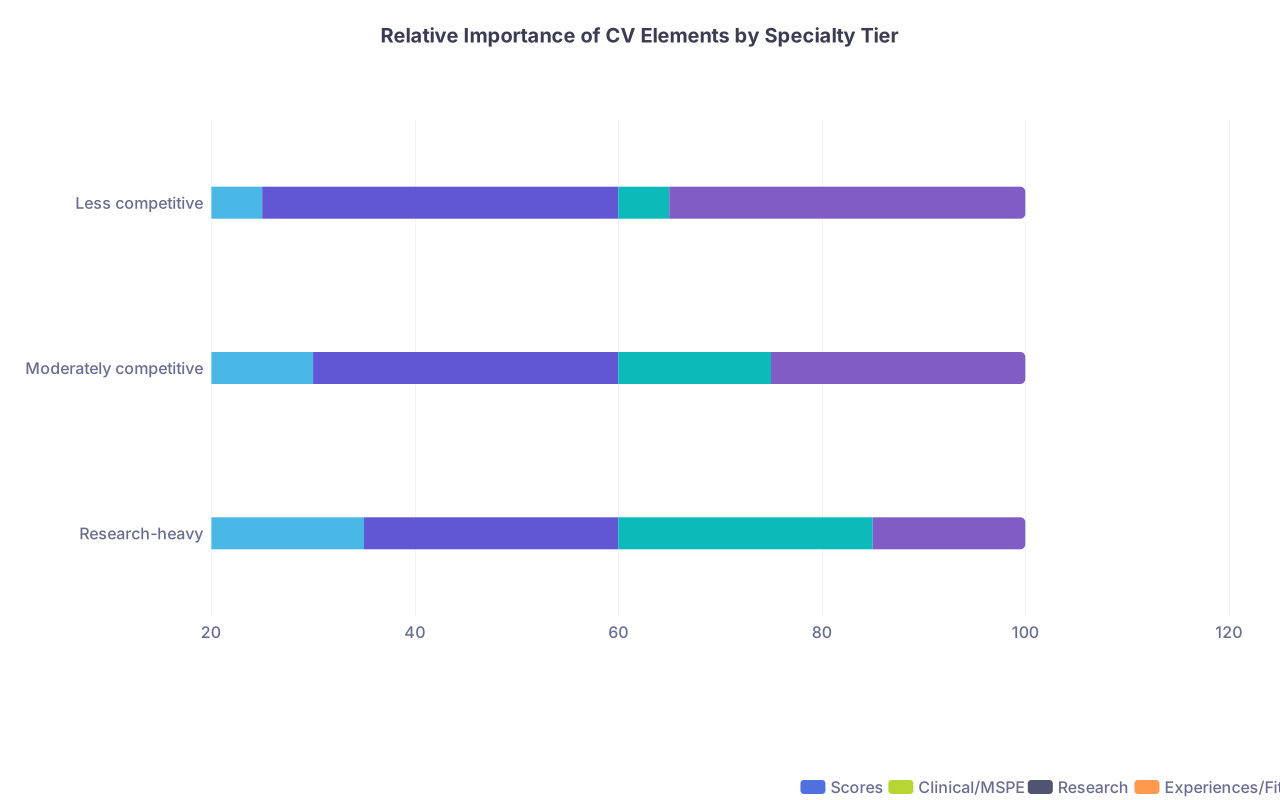
| Category | Scores | Clinical/MSPE | Research | Experiences/Fit |
|---|---|---|---|---|
| Research-heavy | 35 | 25 | 25 | 15 |
| Moderately competitive | 30 | 30 | 15 | 25 |
| Less competitive | 25 | 35 | 5 | 35 |
Interpretation:
- Research-heavy specialties:
- Scores + research dominate.
- Clinical performance still matters, but strong research can rescue borderline Step 2 in some cases (not all).
- Moderately competitive:
- Scores and clinical performance are joint anchors.
- Research and experiences tilt you up or down within a band.
- Less competitive:
- Fit, experiences, and clinical performance often trump modest score differences.
- Programs want people likely to stay in the community and work well in teams.
This is why copying your friend’s CV strategy across specialties is a bad idea. The signal weights are simply different.
7. High-ROI Ways to Improve Your CV in the Residency Application Phase
You are late in the game. You will not rewrite your entire history in six months. But you can still change outcomes if you move strategically.
Here is a realistic priority stack for someone already in the residency match/application phase:
Score optimization (if Step 2 CK not yet taken or low and retake possible)
- A 5–10 point gain can easily shift you into a different interview tier.
- Test prep hours beat almost any other use of time before ERAS submission.
Sub-internships / away rotations in your target specialty
- Direct observation by letter writers.
- Chance to generate “standout” letters and strong MSPE language.
- Opportunity to demonstrate fit with specific programs.
Letter strategy refinement
- Replace weaker or generic letters if possible.
- Target at least:
- 2 letters from your chosen specialty
- 1 from a core field or department chair/program director
- Have polite but direct conversations with potential writers: “Would you be able to write me a strong, detailed letter for X specialty?”
Research triage
- Convert in-progress projects into tangible outputs:
- Submit abstracts to conferences.
- Aim to get at least one manuscript submitted, even if still under review at application time.
- Stop starting brand new, long-horizon projects unless your specialty absolutely requires research density.
- Convert in-progress projects into tangible outputs:
CV editing: compress, quantify, clarify
- Remove low-yield clutter.
- Rewrite bullet points to show:
- Scale (“managed 30 volunteers…”, “organized 4 events/year”)
- Outcomes (“increased clinic show-up rate from 70% to 85%”)
- Highlight experiences directly relevant to the specialty higher on the list.
Program list calibration
- Match your Step 2 CK and research profile against historical match data.
- Increase applications to programs that historically accept your score band and profile type:
- More community vs. academic if needed
- More mid-tier vs. ultra-elite if you are borderline
Holistic review does not mean everyone has an equal shot. It means once you are in the consideration set, the nuances of your CV can move you more.
8. Strategic Takeaways: Reading the Hidden Rubric
If you strip away the marketing language and read program director data like a spreadsheet, a few clear rules emerge:
- Numeric thresholds still govern entry into the “holistic” pool.
- Once inside that pool, three things dominate:
- Clinical reputation (MSPE + clerkship grades)
- Strength and specificity of letters
- Specialty-aligned research and experiences
You improve your CV most effectively by reinforcing those three pillars, not by chasing every line item you see on someone else’s ERAS.
FAQ (Exactly 4 Questions)
1. How many research items do I actually need for a competitive specialty?
For research-heavy fields (derm, ortho, neurosurgery, rad onc, ENT), you are aiming for at least 4–6 tangible items: abstracts, posters, and especially peer-reviewed publications. Many successful applicants show 10+ entries, but the critical threshold is clear evidence of sustained involvement in the field, not just one summer project. Below 2–3 meaningful outputs, you will be at a disadvantage compared with your peers.
2. Can strong clinical evaluations offset a mediocre Step 2 CK score?
They can partially compensate, but only if you clear a program’s basic cutoff. If your Step 2 CK is 10–15 points below your specialty’s typical screen, many programs will never read your clinical comments. If you are just below average—say, 3–7 points under—and your MSPE plus letters are exceptional, you can still match very well, especially at programs that explicitly emphasize holistic review and clinical performance.
3. Do programs actually read the entire CV, or only certain sections?
Directors and selection committees usually skim in a consistent sequence: scores and exams, MSPE summary, clerkship grades, letters, then experiences. Many will only look at the full Experiences section for applicants who clear the first three filters. They do not read every bullet point with equal weight; they are scanning for patterns: leadership, commitment, specialty alignment, and any red flags.
4. How much do “unique” experiences (non-medical careers, elite athletics, arts) matter?
Unique backgrounds matter mainly as tiebreakers and interview talking points, not as score replacements. A prior career in engineering, Division I athletics, or serious artistic accomplishment will get attention and can push you above a similar candidate with a bland background. But you still need to meet baseline expectations in scores, clinical performance, and professionalism. Programs do not trade away reliability on the wards for interesting hobbies.
Key points: Programs still prioritize Step 2 CK thresholds, clinical performance, and letter strength far above everything else. Research and experiences matter, but their weight is highly specialty-dependent and mostly functions as a within-tier differentiator, not a substitute for weak fundamentals. If you want to “win” holistic review, you start by clearing the numeric gate, then you stack specific, specialty-aligned evidence that you will be a safe, hardworking, and high-performing resident.