
The myth that “more research is always better” is statistically false for residency applicants.
Once you look at the NRMP data, program surveys, and publication patterns, you see a clear curve: returns increase early, then flatten, then become nearly zero. Past a certain point, you are mainly signaling personality traits (persistence, niche interest) rather than significantly moving your match odds.
Let me walk through what the numbers actually show and then translate that into a concrete strategy for how many research entries matter, what kind, and for which specialties.
1. What the NRMP Data Really Says About Research Volume
The NRMP publishes “Charting Outcomes in the Match” and “Program Director Survey” every cycle. Those are the closest things you have to a residency admissions dataset.
Strip away the noise and three patterns appear:
- Matched applicants in competitive specialties have more research experiences and outputs, on average, than unmatched.
- The difference between “none” and “some” is large.
- The difference between “some” and “tons” is much smaller.
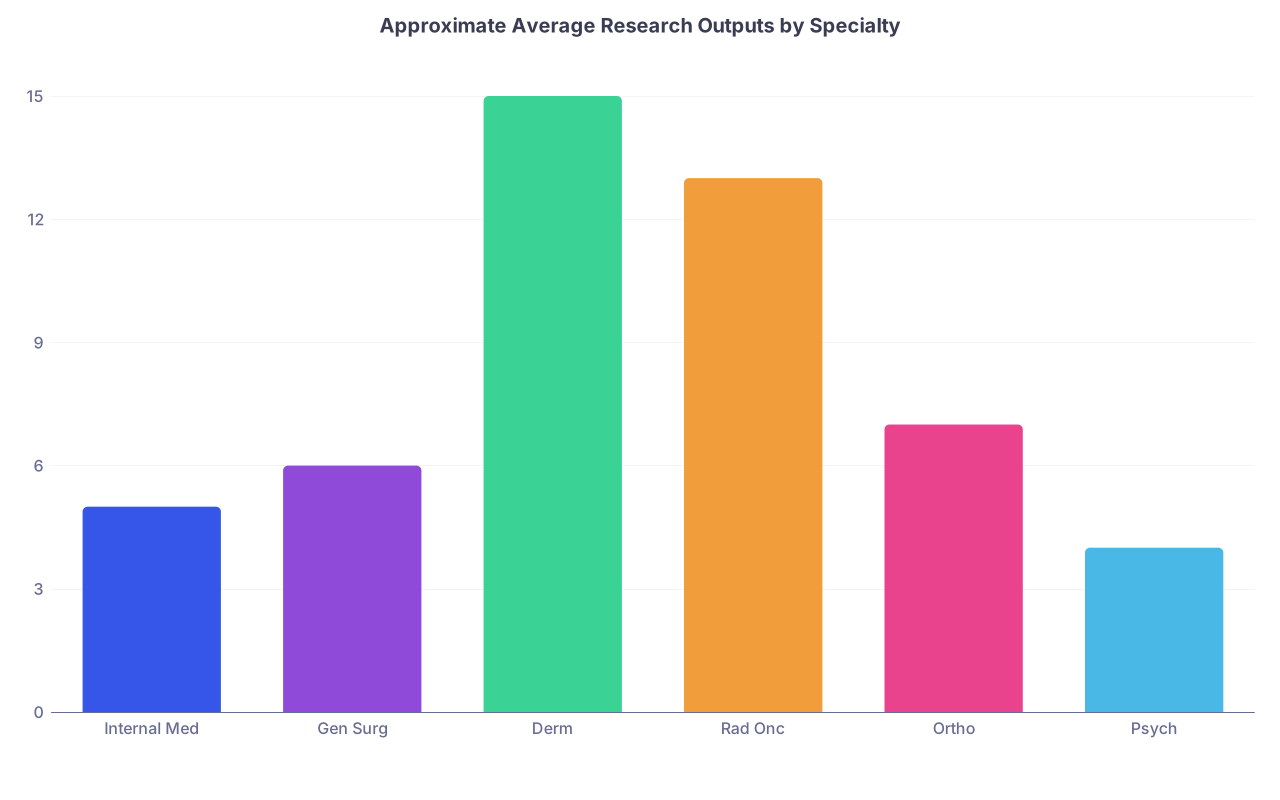
To visualize this, here is a simplified composite snapshot (numbers rounded) of average “research outputs” (abstracts, posters, publications) for US MD seniors in recent cycles, across a few specialties.
| Category | Value |
|---|---|
| Internal Med | 5 |
| Gen Surg | 6 |
| Derm | 15 |
| Rad Onc | 13 |
| Ortho | 7 |
| Psych | 4 |
Those are means, not medians, and they are dragged up by a subset of hyper-productive people. More important than the raw values is the relationship to matching:
- Moving from 0 → 1–3 outputs is associated with a meaningful bump in match probability in nearly all specialties.
- Moving from 1–3 → 4–8 is modestly helpful in competitive fields.
- Moving from ~8 → 20+ has sharply diminishing returns unless you are aiming for research-heavy academic programs (radiation oncology, dermatology, physician-scientist tracks).
The NRMP Program Director Survey consistently shows that “demonstrated scholarly activity” is rated as moderately important but not top-tier, except in certain research-driven specialties. Step scores, clerkship grades, and letters outrank raw research count.
So the key question is not “How high can I get my number?” but “Where is the plateau for my target specialty?”
2. Diminishing Returns: Where the Curve Flattens
If you plot match rate vs. number of research items for a given specialty, you get a classic diminishing-returns curve. The exact inflection point shifts by specialty, but the shape holds.
Think in bands, not exact integers.
| Band (Abstracts/Posters/Pubs) | Impact on Match Odds | Comment |
|---|---|---|
| 0 | Clearly negative | Outlier in many specialties |
| 1–3 | Basic signal | “This person participates” |
| 4–8 | Solid for most fields | Above average for many IM, Psych, FM |
| 9–15 | Competitive fields | Typical for Derm, Rad Onc, Ortho applicants |
| 16+ | Marginal returns | Mostly academic / signal of heavy research track |
The steepest jump is between 0 and “a few.” A candidate with zero research in 2026 looks out of sync with the modern curriculum at most US schools, where at least a poster or QI project is common.
The incremental gain from 2 to 7 items is real. It tells programs you did not just passively appear on one project but engaged more broadly.
Past ~10, the story shifts. Programs are no longer recalibrating your probability of passing boards or showing up to clinic. They are asking: “Is this a future faculty type, or did they pad their CV with salami-sliced case reports?”
I have seen applicants with 30+ “outputs” get two very different reactions:
- Enthusiasm at research-heavy places: “They can drive publications. Good for our grant pipeline.”
- Quiet skepticism at community programs: “Do they want to see patients, or just write papers?”
So yes, there is an upper bound where extra volume does not help and can even trigger questions.
3. How Many Entries Actually Matter by Specialty
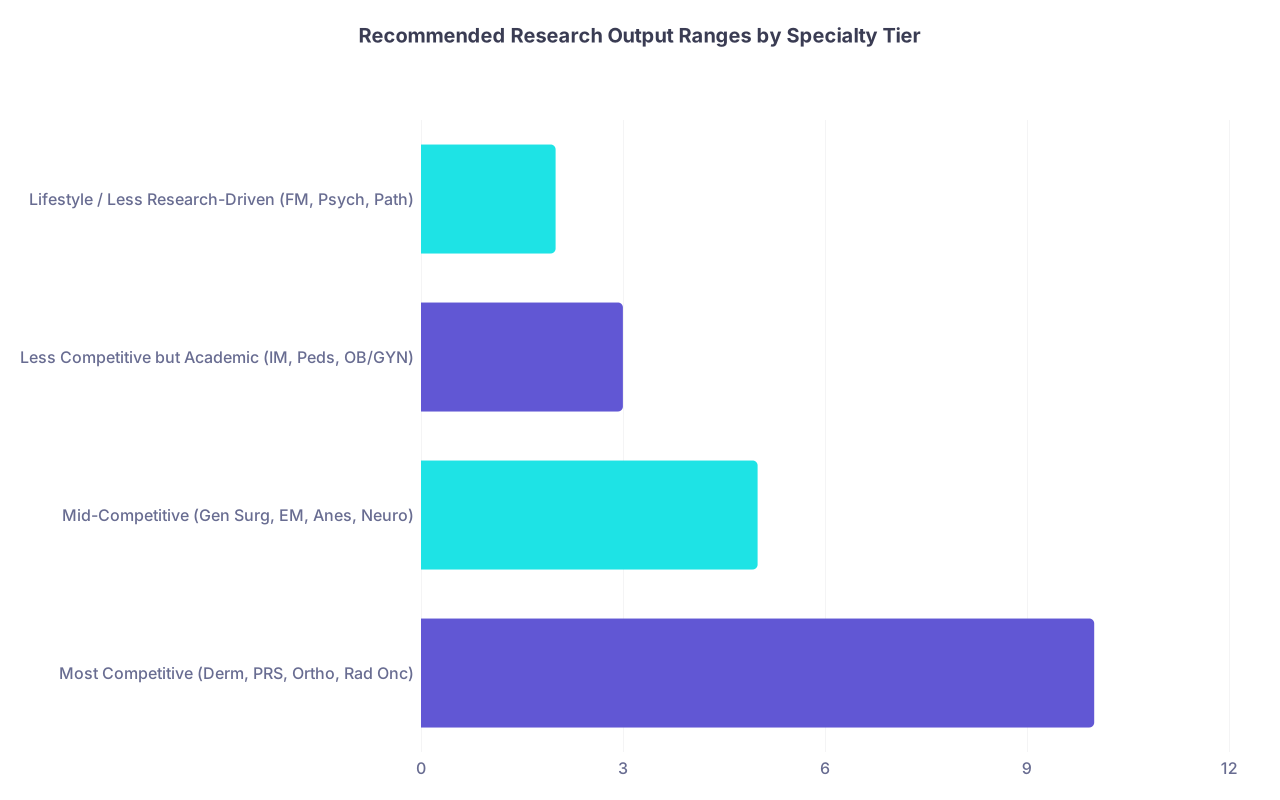
Now the part you care about: specific targets by specialty category. Not perfect, but directionally correct based on NRMP data and real applicant portfolios that matched vs. did not.
Think “competitive,” “moderately competitive,” and “less competitive but still serious.”
| Category | Value |
|---|---|
| Most Competitive (Derm, PRS, Ortho, Rad Onc) | 10 |
| Mid-Competitive (Gen Surg, EM, Anes, Neuro) | 5 |
| Less Competitive but Academic (IM, Peds, OB/GYN) | 3 |
| Lifestyle / Less Research-Driven (FM, Psych, Path) | 2 |
Interpretation:
A. Hyper-competitive (Derm, Plastic Surgery, Ortho, ENT, Rad Onc)
Realistic target if you want to be taken seriously at a broad range of programs:
- Aim: 8–15 research outputs
- Minimum not to stand out negatively: 5–6 real items
- Above ~15: mainly matters for elite academic programs, not for baseline matching
You do not need 30. I have watched applicants match derm at mid-to-upper-tier residencies with 8–10 solid items, including 1–2 first-author manuscripts and several posters.
What matters more in this tier:
- At least one or two outputs clearly tied to the specialty (derm, ortho, etc.)
- A coherent story: mentors who can vouch you actually did the work
- Some depth (same lab or PI, longitudinal project) rather than 10 unrelated case reports
B. Moderately competitive (General Surgery, EM, Anesthesia, Neurology, Radiology)
Realistic target:
- Aim: 4–8 outputs
- Minimum “comfort zone” band: 2–3
- Above ~8: marginal gains unless you want academic surgery / neurology etc.
Program directors in these fields do notice when your CV is blank. But the gap between 0 and 3 is far more consequential than the gap between 6 and 12.
In surgery, for instance, a candidate with 5–6 items (with 1–2 in surgery or related fields) is plainly competitive from a research standpoint if Step and grades are decent.
C. Less competitive but still academic (Internal Medicine, Pediatrics, OB/GYN)
Realistic target:
- Aim: 3–6 outputs if you are interested in academic programs
- Minimum that avoids awkward questions: 1–2
- Above ~6: mostly for those pushing for academic IM / fellowship-heavy tracks
I have seen many IM matches at strong university programs with 2 posters plus 1 publication. No one asked why it was not 10. They cared that the projects were coherent, clinically relevant, and that the applicant could discuss them intelligently.
D. Lifestyle / Less research-driven (Family Med, Psych, PM&R, many community programs)
Realistic target:
- Aim: 1–3 relevant outputs. You do not need double digits.
- Minimum: 1 looks better than 0, but not always a deal-breaker if the rest of the application is strong and the program is community-focused.
Here, extra research beyond a handful mostly helps if:
- The program is at a large academic center.
- You want a fellowship or niche track (e.g., consult-liaison psych, sports medicine).
4. Not All “Outputs” Are Equal: Quality vs. Count
Another trap: treating all “research items” as identical. They are not.
When program directors or interviewers scan your ERAS, they implicitly weight:
- Peer-reviewed publications > conference abstracts > posters > presentations > “submitted” or “in progress”.
- First- or second-author > middle author.
- Specialty-related > totally unrelated.
- Longitudinal, hypothesis-driven work > one-off case reports (though case reports still count and are fine early on).
If you have 8 items and they are all poster presentations of variations of the same QI project, that is not the same signal as 3 peer-reviewed publications, one of which is first author, and 2 national conference abstracts.
So the “how many matter” question has a second layer: how many strong items do you need?
Realistically:
- One well-executed, first-author paper in your target specialty can easily be worth 3–5 minor case reports in program directors’ minds.
- Two or three solid projects, each converting into at least a poster and one into a pub, is enough to demonstrate serious scholarly engagement for most fields.
If your current CV is full of low-yield items, your next move should not be “add five more low-yield items.” It should be “do one deeper project that can produce a real paper or impactful abstract.”
5. US MD vs DO vs IMG: Where the Threshold Shifts
The effect size of research is not constant across applicant types.
US MD seniors benefit from research, but they are not usually “saved” by it if scores and clinical performance are weak.
DOs and IMGs, especially aiming at competitive or academic residencies, often use research as a compensatory signal:
- A DO applying to academic internal medicine with average scores but 10+ strong publications may stand out as “clearly driven and capable in scholarship.”
- An IMG with extensive US-based research (especially at big-name institutions) can mitigate some initial bias and show they function in the US academic environment.
The practical implication: the plateau point moves.
For IMGs in derm, ortho, or academic IM, 15–20+ outputs (many from dedicated research years) is common, because they are competing not just on raw numbers but on name-brand labs and mentors. In that very narrow environment, “more” can still have marginal value.
For a US MD applying to community pediatrics, that same 20-output portfolio is overkill. You could have matched comfortably with a fraction of it, and the extra time might have been better spent on clinical honors or language skills.
6. Strategic CV Building: What to Do at Different Stages
Let me translate this into concrete decisions by MS year.
MS1–MS2: Building a Baseline
Objective: move from “zero” to “a few” and start a trajectory.
Good targets by the end of MS2:
- 1–2 posters or abstracts
- Possibly 1 submitted or accepted manuscript (even co-author)
Do not obsess about quantity early. Obsess about finding:
- A reliable mentor who publishes.
- A project that actually has a path to a presentation or paper (ask bluntly: “What is the realistic timeline to submission?”).
MS3: Maximizing Yield
This is where you can push your count into the “competitive for my target” range.
By end of MS3 for most applicants:
- Less competitive specialties: aim for ~2–4 solid items.
- Mid/competitive specialties: aim for ~4–8, including some specialty-specific.
Tactical moves:
- Tie projects to your core rotations (e.g., QI in medicine, case report in surgery).
- Prioritize projects at your home department or with established PI relationships.
- Stop starting new projects that will obviously mature after Match unless they are high-yield or recommended by a powerful mentor.
MS4 / Application Year: Converting and Curating
By this time, starting many new projects rarely moves the needle before applications. The question shifts from “How many can I start?” to “How do I present what I have to maximize impact?”
Tactics:
- Make sure all completed work is properly categorized as publications, abstracts, or presentations in ERAS. Applicants routinely under-report.
- Clarify authorship order and status (accepted vs. submitted vs. in preparation). Do not inflate; PDs smell that quickly.
- If you have >15–20 items, consider how you will frame them in your personal statement and interviews so it does not look like CV spam.
I have seen applicants with 18+ outputs hide their value because half were in the wrong ERAS section or mislabeled as “Other.” That is wasted effort.
7. How Program Directors Actually Use Your Research Count
Program directors are not sitting with regression models in front of them, but their behavior follows a pattern similar to threshold models in statistics.
Most behave as though they have soft cutoffs:
- Red flag: 0 research in an academic program or competitive specialty.
- Baseline comfort: at least 1–3 items shows engagement.
- Above-average: 4–8 items for most, higher for hyper-competitive fields.
- Beyond that: let letters, interview, and fit decide.
They use your research count to:
- Screen for outliers (zero vs. some).
- Differentiate just enough within the same band (e.g., 2 vs. 6 in derm).
- Infer traits: persistence, curiosity, follow-through, team behavior.
They do not linearly rank “12 > 11 > 10” the way premeds rank MCAT scores.
FAQ (Exactly 4 Questions)
1. Is it ever rational to do a dedicated research year just to increase my “count”?
Yes, but only in specific scenarios: you are targeting a hyper-competitive specialty (derm, PRS, ortho, ENT, rad onc) or aiming for a physician-scientist / academic pathway, and your current research profile is very weak. A dedicated year that converts into 8–15 solid outputs, especially with strong mentorship and letters, can materially change your competitiveness. Doing a research year to raise your count from 8 to 20 for community IM is a poor trade.
2. Do quality letters from research mentors matter more than the raw number of projects?
For many programs, yes. A detailed, enthusiastic letter from a PI at your home institution or a well-known center, describing your independence, writing, and analytic skills, is more predictive of success than whether you have 7 vs. 12 abstracts. High-volume but low-engagement research that yields generic letters does not buy you much.
3. How harmful is it if I have zero publications but a few posters and abstracts?
For most specialties, not very harmful, as long as you have at least 2–4 posters/abstracts and can discuss them intelligently. Programs understand that projects stall, journals are slow, and not every study gets published. One or two actual peer-reviewed papers obviously strengthen your profile, but lack of them is not fatal outside the most competitive specialties.
4. If I already have 10+ outputs, should I stop doing research?
Not necessarily. The marginal gain in match probability may be small, but further research can still be valuable if it aligns with your long-term goals (academic career, fellowships, niche expertise) or if you genuinely enjoy it. What you should stop doing is chasing tiny, low-yield projects solely to push your ERAS number higher. Focus on depth, impact, and relationships with mentors rather than raw volume.
To compress the data into a simple rule set:
- The big jump is from zero to “a few,” not from 10 to 20.
- For most applicants, 3–8 thoughtfully chosen, well-executed research outputs are enough; past that, quality and fit matter far more than quantity.