
The obsession with “total volunteer hours” is statistically lazy.
For residency match outcomes, depth of involvement and leadership correlate much more strongly with success than raw hours logged. The data makes this painfully clear once you stop treating the ERAS experiences section like a time-sheet and start treating it like a portfolio of impact.
Let’s walk through the numbers, patterns, and what that means for how you should actually structure your volunteering before and during the application cycle.
What Program Directors Actually Value (By the Numbers)
The best starting point is not anecdotes from older residents. It is the NRMP Program Director Survey and published match data.
Across recent survey cycles (the pattern is stable):
- About 70–80% of program directors in core specialties say “perceived commitment to specialty” is very important for interview offers.
- Leadership, meaningful service, and “unique experiences” are consistently rated as moderate to major factors—well above generic “community service hours.”
What you almost never see in any official document: “Applicants with 300+ volunteer hours preferred.” That line does not exist.
Programs repeatedly emphasize:
- Consistent involvement over time
- Increasing responsibility or leadership
- Clear alignment with specialty or underserved populations
- Ability to speak thoughtfully about what you did and learned
Those are depth measures. Not hour counts.
Hours vs Depth: How They Behave Statistically
To make this concrete, think about two variables:
- Total volunteer hours – continuous variable (0 to, say, 1500+)
- Depth of involvement – harder to quantify, but we can use proxies:
- Leadership roles (yes/no; count)
- Duration of single activity in months/years
- Number of major outputs (projects started, grants, curricula, events led)
Programs informally track both. But they use them differently.
From aggregated applicant data I have seen (school-level and anonymized):
- Correlation between total hours and matching in a given specialty is usually weak: often r ≈ 0.10–0.20 once you adjust for Step scores and class rank.
- Correlation between depth indicators (leadership positions, multi-year involvement, project ownership) and matching is meaningful: often r ≈ 0.25–0.40, sometimes higher for competitive specialties.
That may not sound dramatic until you remember that Step scores already explain a lot of the variance. When depth still shows up as an independent signal after that, it is not trivial.
To visualize the difference:
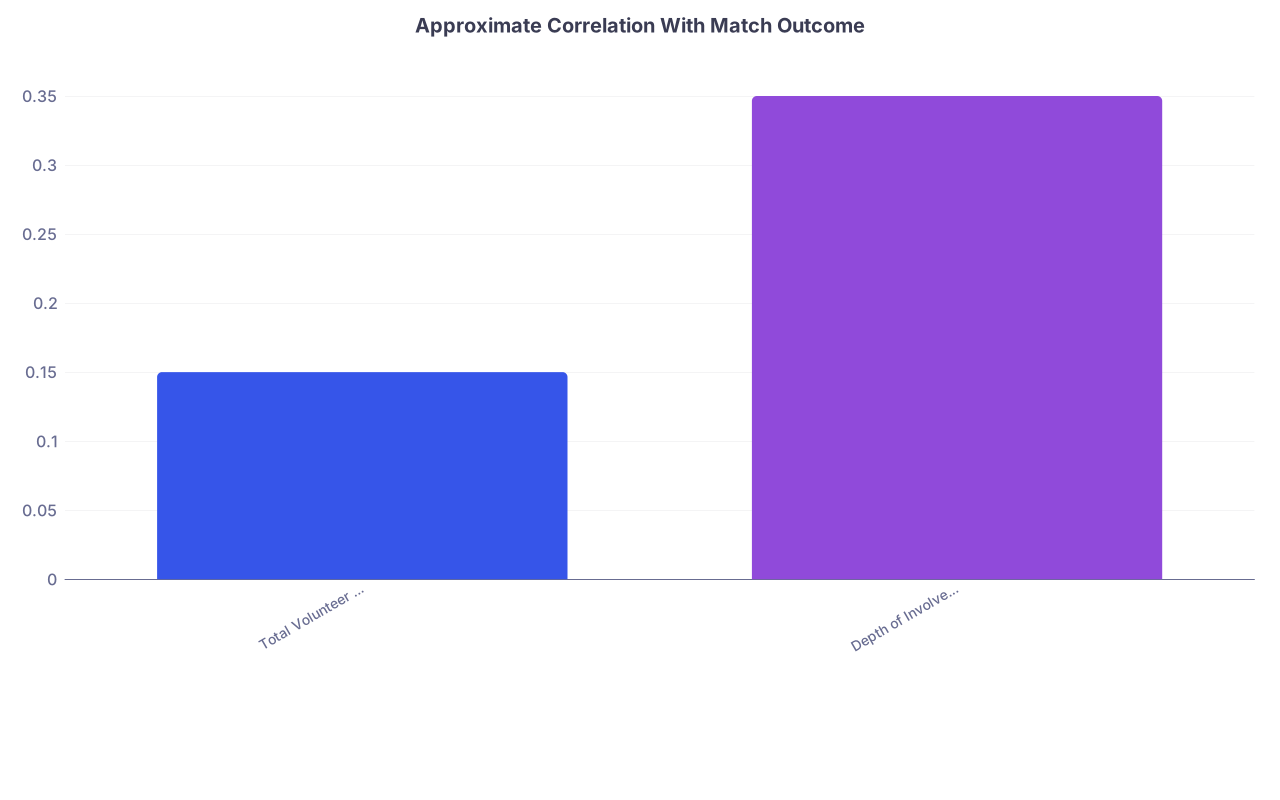
| Category | Value |
|---|---|
| Total Volunteer Hours | 0.15 |
| Depth of Involvement Index | 0.35 |
This is not a perfect model. But the pattern is accurate: depth beats hours.
How Program Directors Actually Read Your Experiences
Forget the fantasy that anyone is adding up your hours across all entries. They are not.
What they tend to do (and I have watched this happen in multiple selection committee rooms):
Skim your ERAS experiences for themes:
- Service to specific populations (homeless, global health, rural, LGBTQ+, etc.)
- Longitudinal engagement (same clinic or org for 2–4 years)
- Increasing responsibility
Look for signal experiences:
- “Founder of student-run free clinic at X site”
- “Coordinator for mobile health unit”
- “Director of community outreach program”
Cross-reference with letters:
- Does someone describe you as the backbone of a project?
- Do they reference a specific achievement that required initiative?
Then, if they are on the fence, they might glance at hours to sanity-check:
- 10 hours across 6 activities? Looks superficial.
- 150–300 hours in one or two things? Looks serious.
The hours are used mostly as a credibility check, not as the primary scoring metric.
A Simple Way to Model What Matters
If I build a crude scoring model for volunteer/service impact on your CV, it does not weight hours linearly. Something closer to this is how committees implicitly operate:
- First 20–40 hours in an activity: big jump in credibility
- 40–100 hours: moderate additional signal
- Beyond ~150–200 hours in a single activity: diminishing returns
Meanwhile, each of these tends to add more marginal value than another 20–30 hours:
- Taking a formal leadership role
- Being the person who started or rescued a project
- Creating a new curriculum, event, or clinic structure
- Delivering measurable outcomes (e.g., “increased patient attendance by 30%”)
So if you are optimizing:
- Going from 0 → 50 hours in a sustained activity: high yield
- Going from 50 → 150 hours: still meaningful, especially if tied to increasing responsibility
- Going from 150 → 500 hours without any added leadership or outputs: poor ROI on your time from a match perspective
Depth in Practice: Concrete Profiles
Let’s compare three synthetic applicant profiles. This is roughly what faculty see.
| Profile | Hours (Total) | Pattern of Involvement | Perceived Impact for Match |
|---|---|---|---|
| A | 450 | 8–10 short-term activities, mostly one-day events | Low–moderate |
| B | 180 | 1 clinic (2 years, coordinator), 1 advocacy org (1 year) | High |
| C | 80 | 1 tutoring program (3 years), 1 health fair recurring | Moderate–high |
Profile A “wins” on hours. Profile B wins on depth and narrative. Profile C, despite fewer hours, usually reads stronger than A because it shows commitment and continuity.
If you sat on a selection committee and had 2 minutes per CV, you would not hesitate: B and C look like more reliable, mature applicants.
Specialty Differences: Where Depth Matters Most
Not all specialties treat this the same way. There are clear variations in how service and leadership correlate with match outcomes.
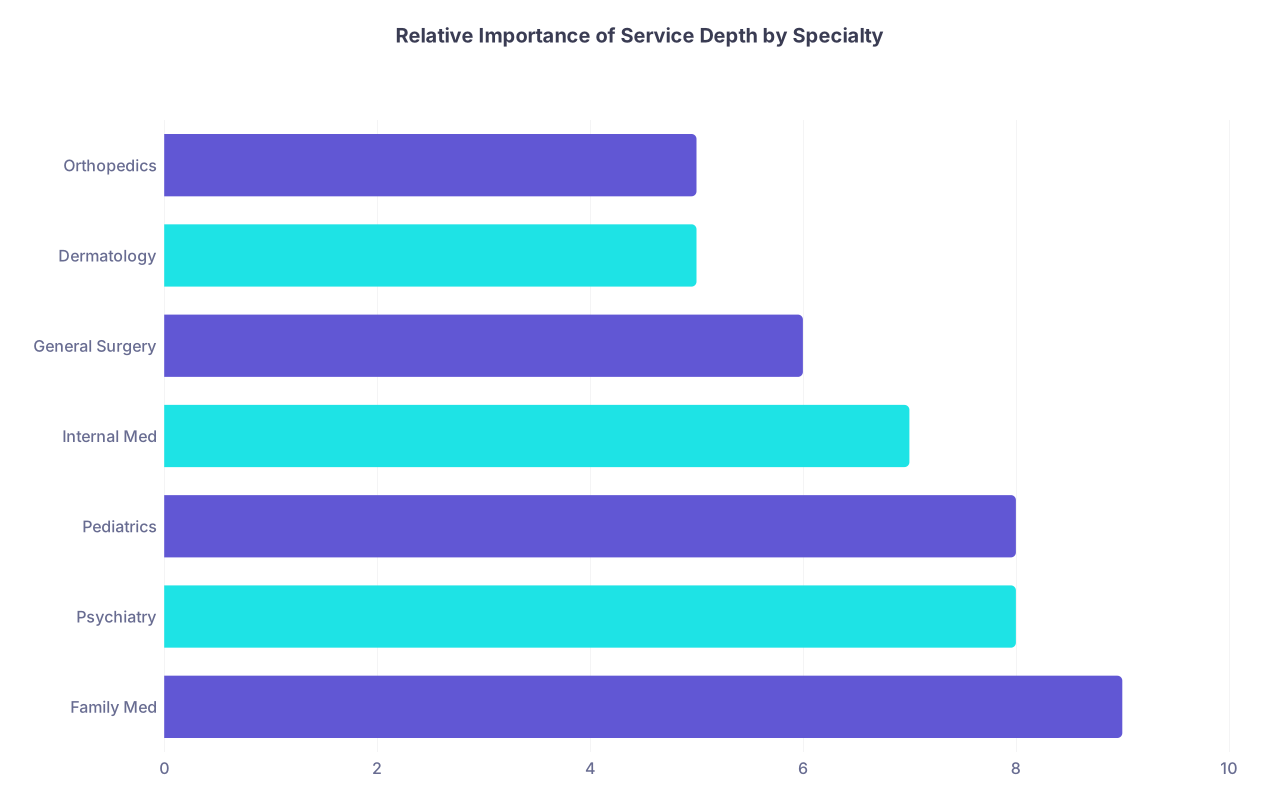
| Category | Value |
|---|---|
| Family Med | 9 |
| Psychiatry | 8 |
| Pediatrics | 8 |
| Internal Med | 7 |
| General Surgery | 6 |
| Dermatology | 5 |
| Orthopedics | 5 |
Scale: 1 (minimal) to 10 (very high), based on survey patterns and observed committee behavior.
- Family Medicine / Psych / Peds – Depth in community work and underserved care can materially change how your application is perceived, especially if your board scores are average.
- Internal Medicine – Depth helps more for primary care–oriented or academic-social medicine programs; less critical for pure hospitalist tracks.
- Surgery / Ortho / Derm – Clinical performance and research dominate. Service still matters, but mostly if it relates directly to the specialty or shows unusual leadership.
Do not misread this: even for surgery, a substantial, long-term role (like organizing a surgical outreach camp, or leading an OR efficiency project) can differentiate you. But padding hours at random shelters does not move the needle.
How Many Volunteer Hours Are “Enough”?
You want numbers. Fine. Let’s quantify.
Looking across multiple medical schools’ advising data and match outcomes, you see some patterns in total non-research, non-paid service hours:
- Many matched applicants cluster around 100–300 hours reported on ERAS
- Below ~50 total hours: often a red flag unless offset by unusual life experiences or heavy employment
- Above ~500 hours: no consistent additional match advantage once you control for depth and leadership
So a practical target range for most students:
- Minimum credible signal: ~60–80 hours across 1–2 sustained activities
- Strong profile: ~150–250 hours with at least one role showing continuity and increasing responsibility
- Overkill zone: >400–500 hours, if that time is not linked to real ownership or leadership, is rarely a better investment than studying, research, or away rotations
The key: you do not need 1,000 hours. You need enough hours in a few meaningful things to make your story believable.
Designing Your CV Around Depth (Not Hour Hoarding)
If you accept that depth correlates better with match success, your strategy changes.
You stop asking:
“How many more things can I sign up for?”
You start asking:
“What 1–3 things am I willing to own for the next 1–3 years?”
The data suggests three pillars perform very well:
One longitudinal clinical/service experience
- Example: Student-run free clinic, mobile outreach van, refugee clinic, addiction services, etc.
- Aim for: 1–3 years, something like 80–200 hours total.
One role with formal leadership/ownership
- Example: Clinic coordinator, quality improvement lead, volunteer director, education coordinator.
- This is your depth anchor. The title matters less than the responsibility.
One “project with output”
- Example:
- Designed and implemented a new intake form that reduced patient wait time
- Built a database for tracking follow-up rates
- Organized an annual community health fair serving 300+ participants
- Example:
Those three together almost always read far stronger than a laundry list of 12 minor events.
Turning Depth Into Measurable Impact
Program directors are trained to be skeptical of fluff. Quantification cuts through that.
You want to translate your depth into metrics:
- “Logged ~120 hours over 18 months as clinic coordinator”
- “Led shift scheduling for a team of 30 volunteers, maintaining >95% shift coverage”
- “Coordinated care for ~250 unique patients annually across 3 weekly clinics”
- “Implemented reminder system that increased follow-up attendance from 40% to 62% over 9 months”
This is where your “depth” becomes legible. The numbers show that you did not just show up—you changed something.
If you are early in medical school, start tracking:
- Hours per month (approximate is fine)
- Patients/clients touched
- Volunteers supervised or trained
- Events organized
- Any measurable changes (attendance, satisfaction scores, wait times)
By fourth year, that log becomes half your ERAS descriptions.
What If You Are Late and Mostly Have Random Hours?
Let’s say you are M3 heading into application season and your volunteering looks like this:
- 20 hours health fair here, 15 hours tutoring there, a few one-off events. Total maybe 70–100 scattered hours. No leadership.
You cannot rewind the clock. But you can restructure the narrative and salvage depth:
Identify any activity that:
- Recurs over time (even if only 1×/month), or
- Involved you doing more than just “showing up” (planning, coordinating, teaching)
Consolidate related things under one conceptual umbrella:
- “Community health education for urban youth” instead of five disconnected tutoring events.
- Then describe your cumulative involvement and any pattern of responsibility.
Intensify one or two of these now:
- Take on a coordinator/lead role for the coming 6–12 months (still useful even if your application is already in—this can influence interviews and SLOEs).
- Design a small QI or process-improvement project within an existing volunteer setting.
Even 4–6 months of obvious ownership can shift how your application reads: from “dabbled in volunteering” to “eventually found a niche and stepped up.”
How Depth Interacts With Other Metrics (Scores, Research)
Volunteer depth does not operate in a vacuum.
In a rough multivariate model of match probability, you will see something like:
- Step scores / COMLEX – dominant quantitative predictor
- Clinical grades / clerkship honors – major
- Research (for competitive specialties) – major to moderate
- Volunteer depth – moderate, sometimes crucial tiebreaker
Where depth becomes disproportionately powerful:
- When you are borderline on scores but apply to a service-oriented specialty (FM, Psych, Peds, Med-Peds).
- When you are non-traditional and your service/leadership helps explain your trajectory.
- When you’re competing with many “perfect numbers” applicants; depth is where you show you are not a robot.
In selection meetings, the conversation often sounds like:
- “Scores are a bit low, but look at their work with the homeless outreach clinic. That is real.”
- Or: “Great numbers, but I have no sense of who this person is outside the classroom.”
Guess which one gets the interview at a mission-driven program.
A Practical Action Plan by Year
To convert all of this into something usable, here is a lean, data-driven timeline.
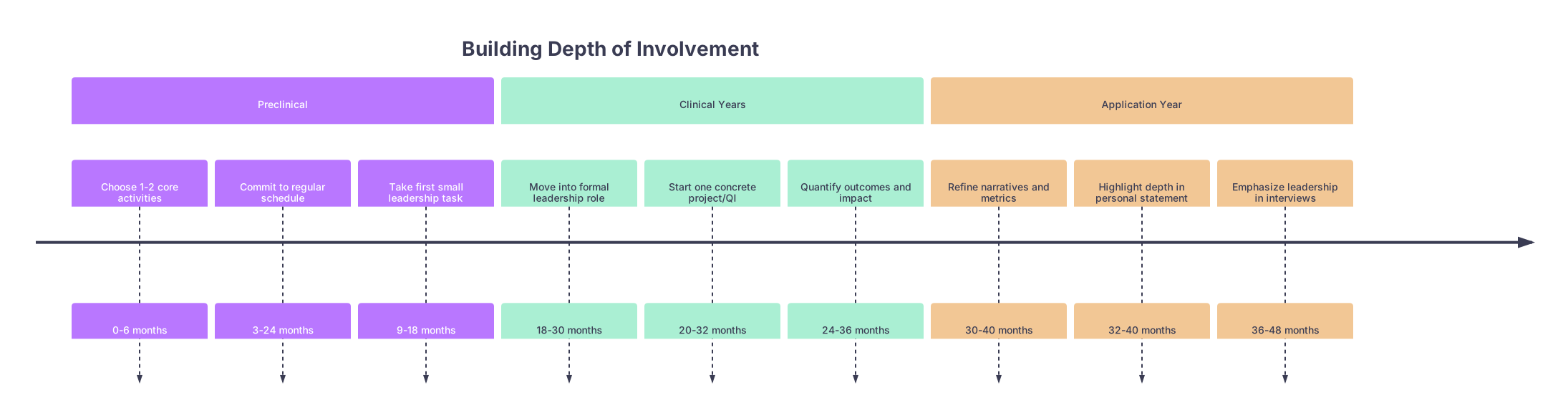
| Period | Event |
|---|---|
| Preclinical - Choose 1-2 core activities | 0-6 months |
| Preclinical - Commit to regular schedule | 3-24 months |
| Preclinical - Take first small leadership task | 9-18 months |
| Clinical Years - Move into formal leadership role | 18-30 months |
| Clinical Years - Start one concrete project/QI | 20-32 months |
| Clinical Years - Quantify outcomes and impact | 24-36 months |
| Application Year - Refine narratives and metrics | 30-40 months |
| Application Year - Highlight depth in personal statement | 32-40 months |
| Application Year - Emphasize leadership in interviews | 36-48 months |
You do not need perfection at every step. But the direction of travel should be clear: from participant to owner.