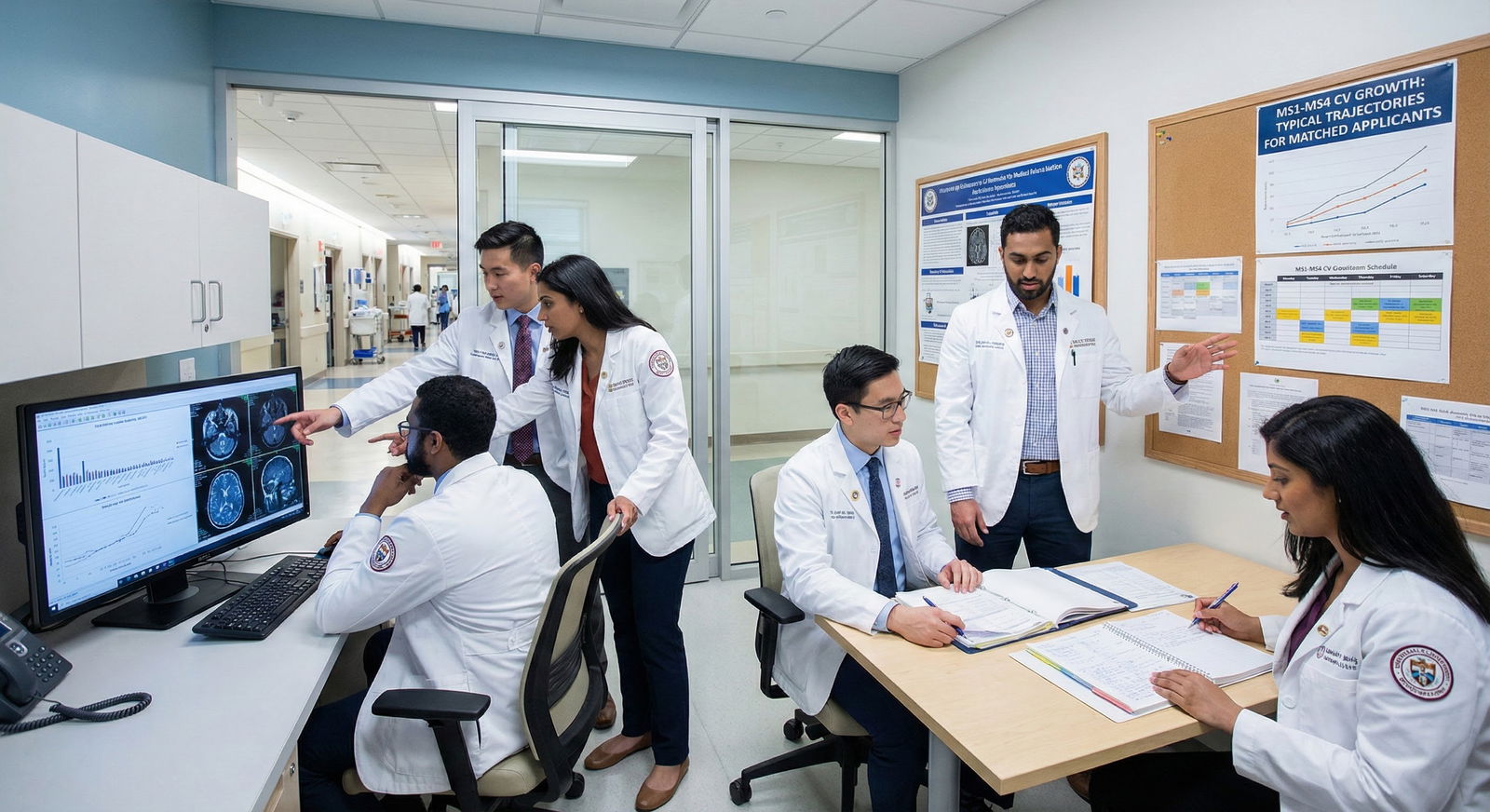
The myth that “rockstar” applicants have perfect CVs by MS2 is wrong. The data shows most matched applicants grow their CVs steadily and late, not explosively and early.
You are not competing against a fantasy applicant who had three first-author publications before Step 1. You are competing against people whose trajectories follow fairly predictable patterns from MS1 to MS4. Once you see the pattern, you can game it.
Below is what the numbers and trends actually look like – and how to use that to shape your CV from MS1 through MS4.
The Big Picture: What Matched CVs Usually Look Like
Across schools, when you look at matched vs unmatched applicants, three signals consistently separate them:
- Sustained engagement (number of years involved)
- Depth of involvement (leadership, authorship, complexity of projects)
- Specialty alignment (experiences that clearly point toward the chosen field)
Quantity matters, but it is not linear. Going from 0 to 3 substantial experiences is huge. Going from 15 to 25 minor line items is almost meaningless.
If you compress all the data into one rough score (call it a “CV signal score”) that weights activities like this:
- Major leadership role = 3 points
- First/second-author publication = 3 points
- Middle-author publication / abstract / poster = 1–2 points
- Longitudinal research (≥1 year) = 2 points
- Longitudinal clinical/community work (≥1 year) = 2 points
- Routine volunteering / short-term projects = 0.5–1 point
- Specialty-specific involvement (per year) = +1 bonus
You see a pretty consistent pattern among matched applicants in moderately competitive fields (IM, Peds, EM, Psych, OB/Gyn):
- End of MS1: CV signal score ~3–5
- End of MS2: ~7–10
- End of MS3: ~11–15
- At ERAS submission (early MS4): ~13–18
For highly competitive fields (Derm, Ortho, PRS, ENT, Neurosurgery):
- End of MS1: ~4–7
- End of MS2: ~9–14
- End of MS3: ~15–22
- At ERAS: ~18–26
Those are ballparks, but the shape matters: slow early growth, big acceleration in clinical years, then a plateau.
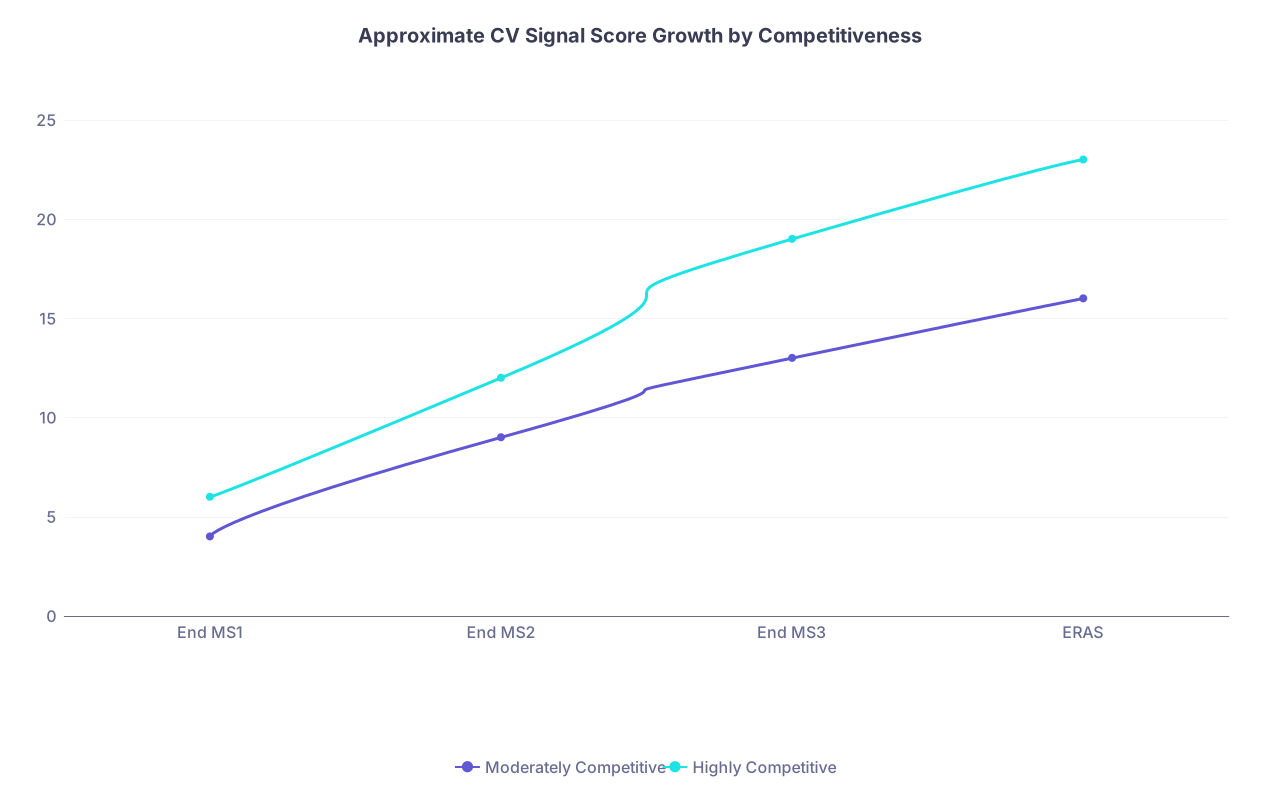
| Category | Moderately Competitive | Highly Competitive |
|---|---|---|
| End MS1 | 4 | 6 |
| End MS2 | 9 | 12 |
| End MS3 | 13 | 19 |
| ERAS | 16 | 23 |
The conclusion is blunt: if you are underweight at the end of MS2 you are not doomed, but you will need a steeper slope MS3–MS4 than your peers. And yes, people pull that off every year.
MS1: Laying the Baseline (Not Building the Final Product)
MS1 is about establishing direction and a small number of credible signalers, not building a complete CV.
Across multiple schools’ match lists and student CVs I have reviewed, matched applicants by the end of MS1 typically have:
- 1–2 fledgling research involvements (some without tangible output yet)
- 1 clinical or community longitudinal activity (free clinic, pipeline program, etc.)
- 0–1 leadership roles (usually low-level: committee member, interest group officer-elect)
- A handful of episodic volunteering / shadowing experiences
If you quantify that:
| Category | Common Range (Count) |
|---|---|
| Research projects | 0–2 |
| Publications/posters | 0–1 |
| Longitudinal clinical/vol | 1–2 |
| Leadership roles | 0–1 |
| Shadowing experiences | 1–3 |
Nobody serious is impressed by “Attended 7 lunch talks” or “Member, 11 interest groups.” Those lines pad ERAS but add almost no signal. The data that matters from MS1 is:
- Did you commit to at least one thing for ≥6–12 months?
- Is there any hint of specialty interest or research identity?
- Are you someone people trusted enough to pull into their project or team?
MS1 Targets that Move the Needle
If you want to be in the “matched-trajectory” band by end of MS1, aim for:
One research home
- Does not need to be your career field. Just stable.
- Typical conversion rate: among MS1s who start a project by January, around 40–60% have at least one abstract or poster by ERAS. Those who “wait for the perfect PI” often end MS2 with nothing.
One longitudinal clinical/volunteering role
- Free clinic, interpreter services, student-run clinic, long-term community org.
- The key variable is hours-per-month × months. Ten hours/month for 18 months makes a stronger story than 80 hours in one summer.
One light leadership role
- Interest group officer, committee member, peer tutor.
- Programs look for trajectory: involved → responsible → leading.

| Step | Description |
|---|---|
| Step 1 | Start MS1 |
| Step 2 | Email 5 faculty with CV |
| Step 3 | Join project |
| Step 4 | Commit 4 to 6 hrs per week |
| Step 5 | Join 1 clinic or community role |
| Step 6 | Run for 1 interest group role |
| Step 7 | Research spot? |
If you end MS1 with those three pillars in place, you are exactly where most matched applicants are. Not ahead. Not behind. On track.
MS2: Converting Activity into Output
MS2 is where the distribution starts to spread. Same number of applicants “do things”; only some convert those things into actual products.
At the end of MS2, among matched applicants:
- 60–75% have at least one poster or abstract.
- 30–50% have at least one peer-reviewed publication (not necessarily first-author).
- Most have held at least one leadership role for ≥1 year.
- Many have either maintained their MS1 commitment or traded up to something with more responsibility.
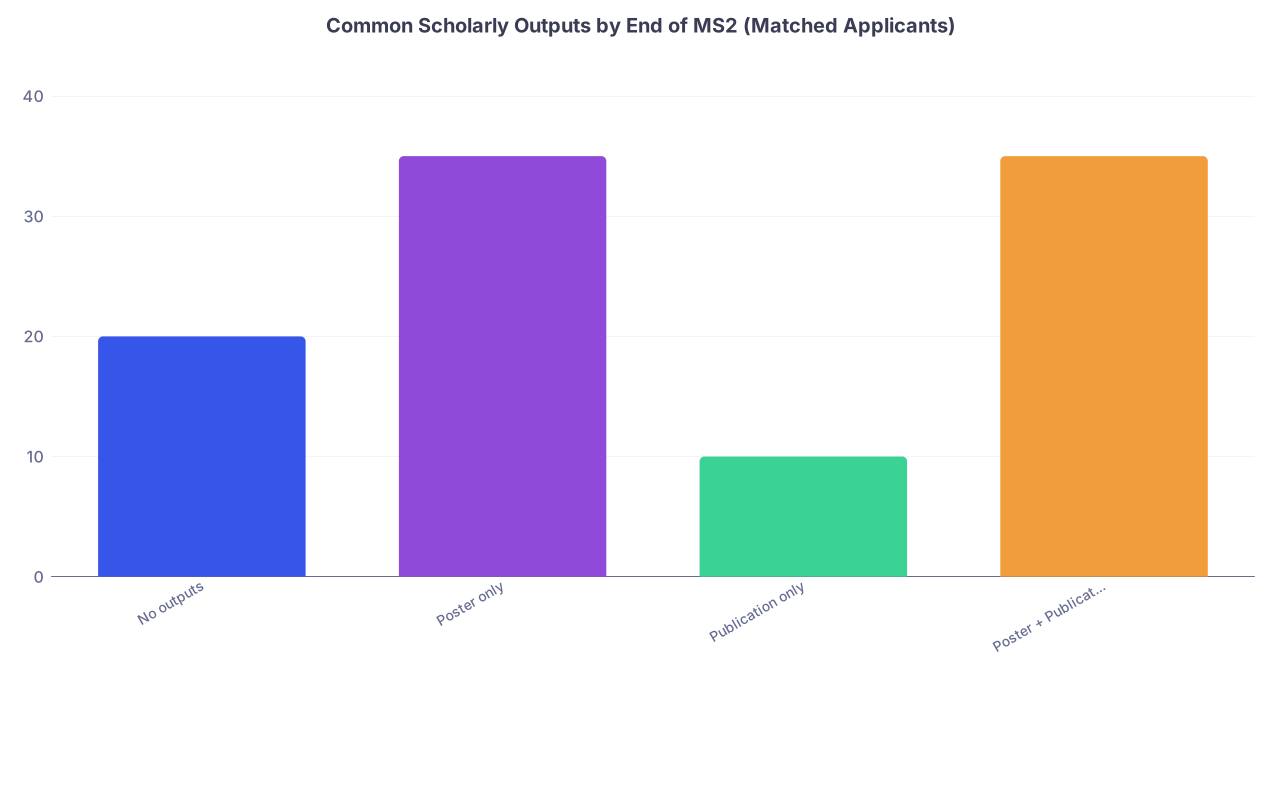
| Category | Value |
|---|---|
| No outputs | 20 |
| Poster only | 35 |
| Publication only | 10 |
| Poster + Publication | 35 |
Those percentages vary by school and specialty, but the pattern is stable: matched applicants almost always have some tangible scholarly output by the time they are entering clinical rotations.
MS2 Priorities by the Numbers
The constraint in MS2 is simple: time. You are balancing board prep against everything else. The trick is sequencing, not masochism.
What the data from cohort schedules and outcomes shows is:
- Peak preclinical exam load: Aug–Dec
- Dedicated board prep: most common Feb–May window
- Research productivity spikes in:
- Summer between MS1–MS2
- Post-board-prep lull (late spring / early summer of MS2)
So you front-load the work and back-load the output.
Concretely, for MS2 you should aim to:
- Maintain 1 existing research project with clearly defined deliverables.
- If your current PI is vague, you need a harder conversation: “What is the timeline and target for a poster or manuscript from my work?”
- Lock in at least 1 submission-ready piece by the end of MS2 (poster, abstract, or manuscript).
- Either deepen your leadership role (move to president/VP, committee chair) or add one more responsibility that shows trust.
If I compare two anonymized MS2 CVs I have seen:
Student A (matched EM at a strong academic program):
- 1 ongoing ED outcomes project since MS1
- 1 poster at SAEM by spring of MS2
- 1 local QI poster at the med school research day
- Treasurer → President of EM interest group
- 2 years at free clinic, ~8 hrs/month
Student B (did not match Derm, later matched IM):
- Enrolled in 4 different Derm projects, all in very early stages
- No posters, no publications by end of MS2
- 10+ one-off shadowing and short-term volunteering entries
- Officer in 4 interest groups, none >1 year
Total “lines” on the CV were similar. Signal was not. A’s work showed completion. B’s showed scattering.
By the end of MS2, if your CV signal score is under roughly 7–8 and you are aiming for a competitive specialty, you will need either exceptional board scores or an aggressive MS3 output phase. Preferably both.
MS3: The Inflection Point Most People Underestimate
MS3 is where the CVs of matched and unmatched candidates really diverge. Not because people suddenly “find time,” but because clinical rotations create:
- Real patients → real cases → real QI projects
- Real attendings → real letters → real networking
- Real specialty exposure → real alignment
Among matched applicants, MS3 is usually responsible for 40–60% of their final CV signal score.
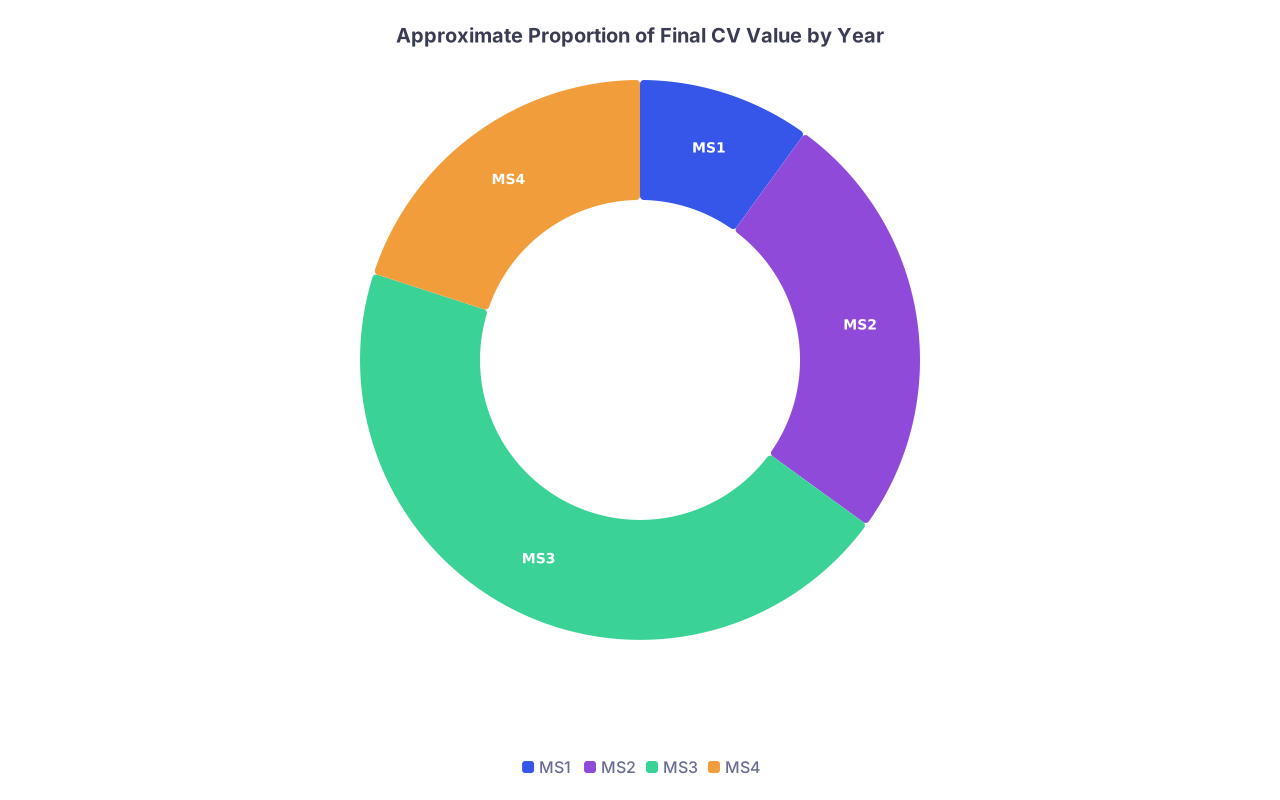
| Category | Value |
|---|---|
| MS1 | 10 |
| MS2 | 25 |
| MS3 | 45 |
| MS4 | 20 |
The strongest applicants treat each clerkship as both an educational block and a CV block. Weak applicants treat them as pass-fail hurdles and wonder later why their application looks generic.
What Grows Most During MS3
For matched applicants, the typical MS3 gains look like this:
- 1–3 additional posters or abstracts (often from clinical case reports, QI, or observational studies).
- 0–2 additional publications (if projects from MS1–2 mature).
- 1–2 specialty-specific initiatives (student-led pathway, procedure workshops, niche clinic involvement).
- Elevated leadership roles (chief of something, national committee involvement, major project lead).
By the time ERAS opens, for a moderately competitive specialty, you often see something like:
| Category | Common Range (Count) |
|---|---|
| Total research projects | 2–4 |
| Peer-reviewed publications | 1–3 |
| Posters/abstracts | 2–6 |
| Longitudinal activities | 2–4 |
| Leadership roles (≥1 year) | 2–3 |
| Specialty-specific entries | 4–8 |
For highly competitive specialties, scale those numbers up by about 50–100%, especially in publications and specialty-specific items.
MS3 Strategy: Turn Rotations Into Data
You can treat each rotation like a mini data-generation sprint. The playbook looks like this:
- Week 1–2: identify one faculty interested in teaching and projects.
- Ask a targeted question:
- “Is there any unanswered question or ongoing QI project in this clinic I can help with over the next 4–6 weeks?”
- Aim for low-complexity, high-yield projects:
- Case reports (rare but defensible)
- Simple chart review with limited variables
- QI audit with pre/post comparison
Time budget: 1–2 hours per week on rotation, more in lighter blocks. That is enough, if sustained, to generate at least 1–2 new poster-level outputs during MS3.
I have watched a student go from 0 publications at the start of MS3 to:
- 1 first-author case report
- 2 middle-author retrospective studies
- 3 posters at national meetings
…by ERAS submission, purely by following that pattern on two core rotations and staying tied to their MS1 lab. They matched into Ortho without insane Step scores.
The raw time they spent per week was not extreme. The consistency and focus were.
MS4 / ERAS Year: Packaging and Plugging Gaps
By the time ERAS opens (usually early MS4), your new activity potential drops sharply. Interviewers care about what you have already finished, not what you just started.
So MS4 is less about adding activities and more about:
- Translating late MS3 projects into submitted abstracts/manuscripts.
- Tightening specialty alignment (Sub-Is, away rotations).
- Curating and framing your CV entries so the trajectory is obvious.
Among matched applicants, additional MS4 contributions before ERAS are modest:
- 0–1 additional abstract or submission.
- 0–1 new leadership role (chief of something, AOA/GHHS if elected).
- 1–2 high-yield Sub-I experiences with strong letters.
Where MS4 makes an outsized difference is for borderline applicants. If your CV signal score is slightly below the typical range for your specialty, programs look for:
- Clear late improvement in clinical evaluations.
- Strong Sub-I letters that “explain” earlier weaknesses.
- Evidence of follow-through on in-progress research from MS3.
Snapshot Across the Four Years
Here is a rough comparison of matched vs unmatched applicants’ CV profiles by ERAS, compiled from multiple advising datasets and NRMP’s general trends.
| Metric | Matched (Typical) | Unmatched (Typical) |
|---|---|---|
| Peer-reviewed publications | 1–3 | 0–1 |
| Posters/abstracts | 2–6 | 0–2 |
| Longitudinal commitments (≥2y) | 2–3 | 0–1 |
| Leadership roles | 2–3 | 0–1 |
| Specialty-aligned experiences | 5–10 | 1–4 |
Unmatched applicants are rarely “empty.” They often have a full page of activities. The difference is depth, continuity, and specialty fit.
Specialty Differences: How Steep Your Trajectory Needs To Be
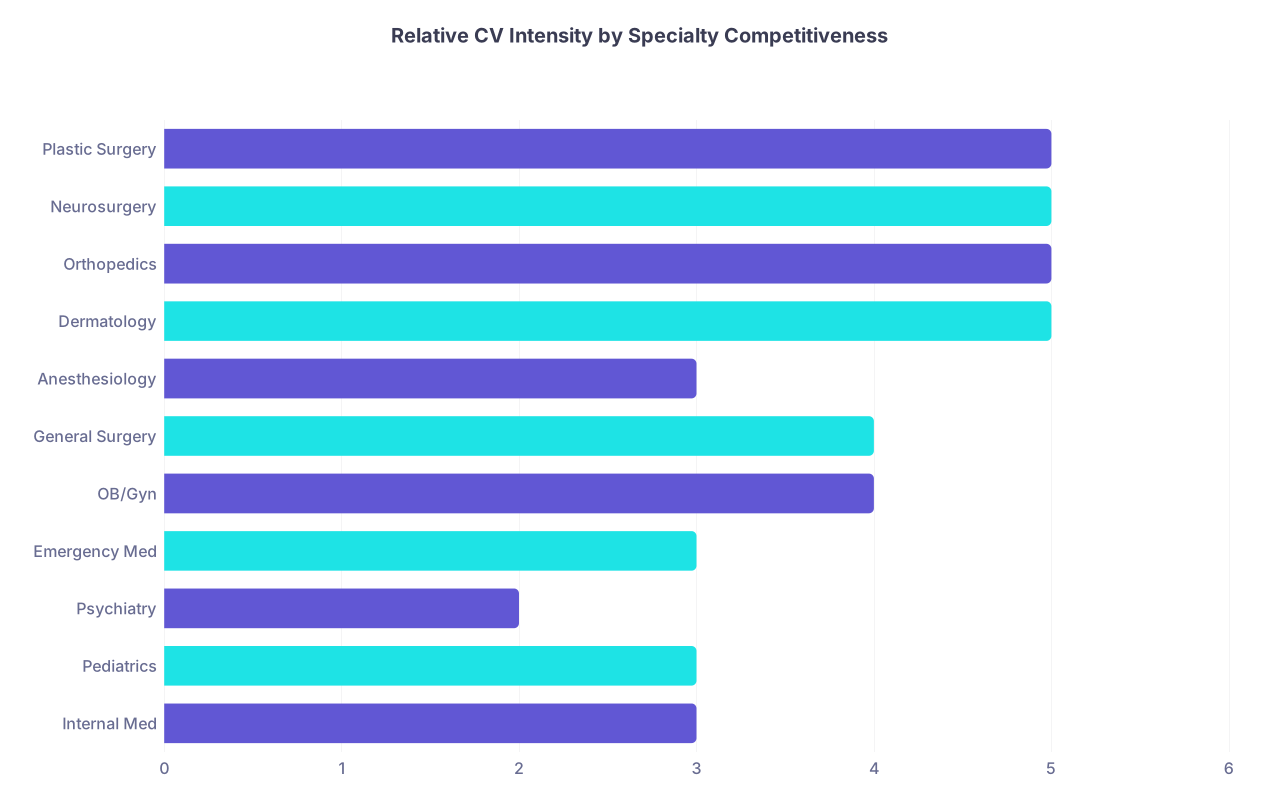
Not all specialties demand the same CV density. The data from NRMP Charting Outcomes and program-specific expectations makes this pretty clear.
| Category | Value |
|---|---|
| Internal Med | 3 |
| Pediatrics | 3 |
| Psychiatry | 2 |
| Emergency Med | 3 |
| OB/Gyn | 4 |
| General Surgery | 4 |
| Anesthesiology | 3 |
| Dermatology | 5 |
| Orthopedics | 5 |
| Neurosurgery | 5 |
| Plastic Surgery | 5 |
Scale: 1 = minimal, 5 = extremely high CV expectations (research + leadership + alignment).
Broad pattern:
- Primary care–leaning (IM, Peds, Psych, FM): decent CV helps, but strong clinical performance and letters carry more weight.
- Middle tier (EM, OB/Gyn, Anesthesia, Gen Surg): CV is important; research not always mandatory but clearly beneficial.
- Top tier (Derm, Ortho, ENT, PRS, Neurosurg): CV is almost a filter. Multiple publications and clear specialty dedication are the norm, not the exception.
If you want Derm and you hit ERAS with:
- 0 publications
- 1 poster
- 2 Derm shadowing experiences
You are not slightly under the median. You are off the grid.
For those fields, realistic targets by ERAS (for matched applicants) tend to look like:
- 3–10 publications (mix of first/middle author)
- 5–15 posters/abstracts
- 2–4 years of consistent research
- Heavy specialty-specific engagement: clinics, away rotations, national societies
Is that excessive? Yes. Is it the actual landscape? Also yes.
Using the Data to Plan Your Own Trajectory
You do not control everything. You do control your slope: how fast your CV improves once you decide to sprint.
Here is a simple way to benchmark yourself using the earlier “CV signal score” idea:
Give yourself:
- 3 points: major leadership role, first/second-author paper
- 2 points: long-term research (≥1 year), long-term clinical/vol (≥1 year)
- 1–2 points: poster/abstract, mid-author publication, national presentation
- 0.5 points: minor leadership, short projects, random shadowing
Sum your score at key milestones: end MS1, MS2, MS3.
Compare against these ranges:
| Year / Goal | Moderately Competitive | Highly Competitive |
|---|---|---|
| End of MS1 | 3–5 | 4–7 |
| End of MS2 | 7–10 | 9–14 |
| End of MS3 | 11–15 | 15–22 |
| ERAS (early MS4) | 13–18 | 18–26 |
If you are 2–3 points below those bands, you need a deliberate plan, not panic:
- Focus on finishing existing projects rather than starting new ones.
- Convert clinical experiences into at least one QI or case-based output.
- Push for leadership in something you already spend time on, instead of joining a new group.
If you are 5+ points below in MS3 and aiming for a competitive specialty, then you need to consider:
- Pivoting to a less competitive specialty where your current CV is closer to median.
- Or planning a research year, which can realistically add 6–10 points if structured well.
What Programs Actually Infer from Your CV
Programs are not counting line items like baseball stats. They infer traits:
- Time management: Did you accumulate and complete meaningful work while in a demanding curriculum?
- Reliability: Do activities last more than one semester, or do you hop?
- Curiosity: Do you ask and answer questions through research, QI, or teaching?
- Commitment to the specialty: Does your CV show more than a last-minute decision?
They also look at shape:
- Flat line (MS1–MS4 looks identical) = concern.
- Early spike then plateau or drop = concern.
- Steady upward curve with late acceleration = strong signal.
Your job is not to create the most crowded ERAS printout. It is to present a coherent growth trajectory from MS1 to MS4 that matches what successful applicants in your target specialty usually show.
The Bottom Line
Three key points, stripped of fluff:
- Matched applicants do not start with stacked CVs; they build them in a predictable curve: modest MS1, conversion in MS2, big gains in MS3, packaging in MS4.
- Depth, continuity, and specialty alignment beat raw activity counts. Finished projects and multi-year roles consistently correlate with matching more than long lists of short stints.
- You can benchmark and adjust your trajectory by year. If your “CV signal score” is lagging, you either increase your slope (finish more, lead more, align more) or recalibrate your specialty expectations.
The numbers are not there to scare you. They are there so you stop guessing and start planning.