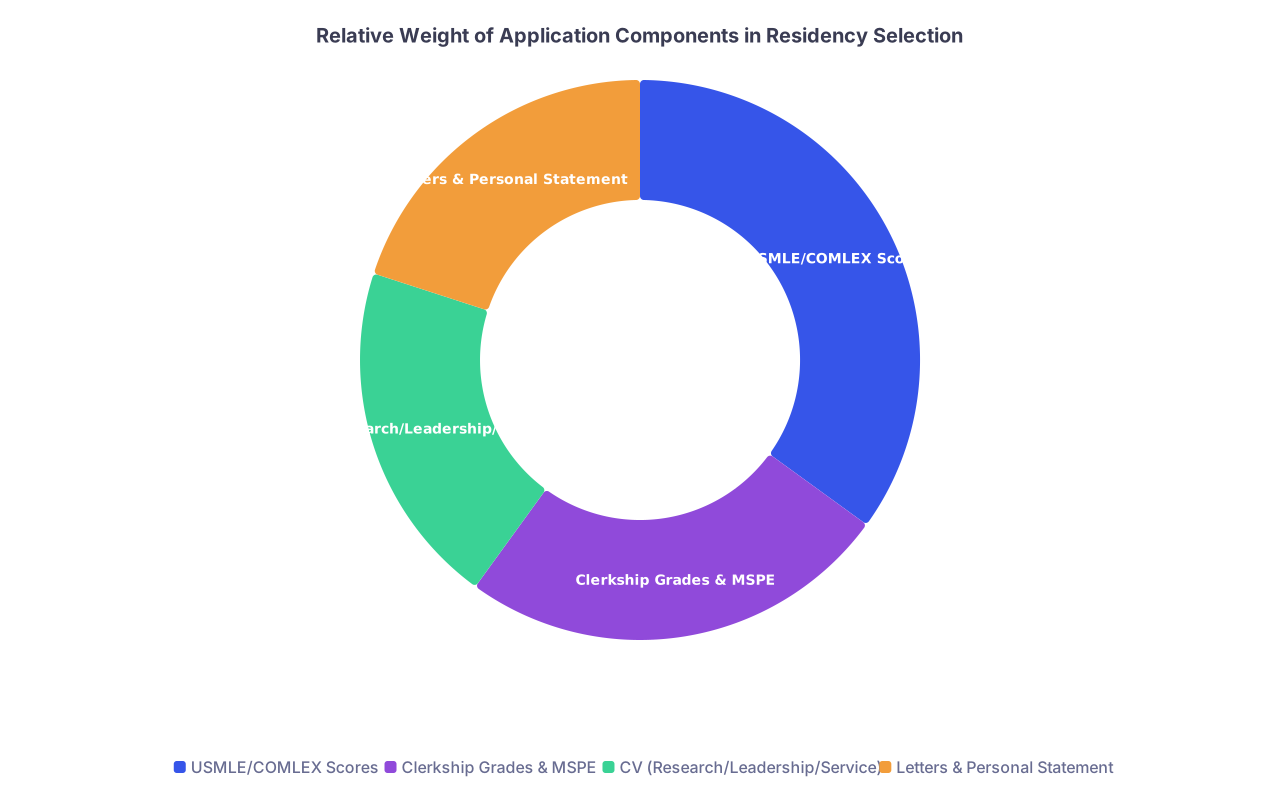
| Category | Value |
|---|---|
| USMLE/COMLEX Scores | 35 |
| Clerkship Grades & MSPE | 25 |
| CV (Research/Leadership/Service) | 20 |
| Letters & Personal Statement | 20 |
USMLE scores are overrated in most applicants’ minds—and underrated by the data when they are truly low.
Let me be blunt: a strong CV can help you survive a mediocre score. It cannot rescue a truly bad one in competitive specialties. Programs do not read “around” numbers; they filter with them. The trick is knowing where the real cutoffs sit, how much “offset” your CV can realistically provide, and where you are wasting your effort.
This is not about feelings. It is about probabilities.
1. What Programs Actually Weigh: Data, Not Lore
We have two main data streams for this: the NRMP Program Director Surveys and match outcome reports (Charting Outcomes in the Match). Year after year, the same pattern repeats.
Program directors are asked to rate the importance of applicant factors on a scale of 1–5 and to report how often they use each factor to screen out applications. The averaged answers cluster tightly.
Across most core specialties, the typical signal looks like this:
- Step 1 (or Step 2 CK post-pass/fail shift): top screening tool
- Clerkship grades and MSPE: high importance, moderate screening use
- CV content (research, leadership, volunteer work): high importance once past the score screen
- Letters of recommendation and perceived “fit”: decisive at interview and ranking
Here is a simplified numeric view, aggregating across several recent NRMP surveys:
| Factor | Mean Importance Score |
|---|---|
| USMLE/COMLEX Scores | 4.2–4.5 |
| Clinical Grades / MSPE | 4.0–4.3 |
| Letters of Recommendation | 4.1–4.4 |
| CV (Research/Leadership/Service) | 3.5–3.9 |
Interpretation: The CV is not decoration. It pushes you from “generic” to “must interview.” But it usually comes after the numeric sieve.
So the real question becomes: what does “lower score” mean in statistical terms, and when can CV strength move the needle?
2. Defining “Low,” “Borderline,” and “Fatal” Scores by Specialty
People say “my score is low” without context. That is useless. Programs care about where you sit relative to the specialty’s distribution.
A crude but effective categorization:
- Competitive specialties (Derm, Ortho, Plastics, ENT, Neurosurgery, Rad-Onc)
- Moderate specialties (Internal Medicine, EM, Anesthesia, General Surgery, OB/GYN)
- Less competitive specialties (Family Medicine, Peds, Psych, Pathology, PM&R)
Using historical Step 1/Step 2 CK data (pre- and post-pass/fail), the pattern is consistent:
- Competitive: Match medians often in the 245–255+ range for Step 1 historically; Step 2 CK medians now often 250–255+
- Moderate: Match medians more like 235–245
- Less competitive: Match medians 225–235, with wide tails
Think in standard deviations, not raw scores.
Rough rule of thumb (for Step 2 CK in the current era):
- Within ~5 points of the specialty median → “Borderline but viable”
- 10–15 points below median → “Significant liability, needs strong offset”
- >15–20 points below median → “You are asking for miracles in that specialty”
A strong CV helps most in that middle band, not at the extreme tail.
3. How Much Offset Does a Strong CV Really Provide?
Let’s quantify this instead of hand-waving.
3.1 The screening reality: numeric cutoffs
Survey data from program directors show roughly:
- 75–90% of programs in competitive specialties use explicit USMLE cutoffs for offering interviews.
- 60–80% of programs in moderate specialties do the same.
- Even in “less competitive” fields, about half screen by scores to reduce volume.
Cutoff values vary, but patterns look like this (Step 2 CK, approximated):
| Specialty Group | Common Cutoff Band | Comment |
|---|---|---|
| Competitive | 245–250 | Below this, file often auto-drop |
| Moderate | 230–240 | Below this, selective invites |
| Less competitive | 220–230 | Below this, real risk |
If you are below the hard cutoff, your CV often does not get read at all. No amount of posters will change an automated filter.
So, the first honest statement:
A strong CV offsets lower scores only in programs where you clear the numeric floor. It does not override binary filters.
3.2 Conditional probability: once you clear the floor
Once you are above the program’s floor, the picture changes.
From multiple cycles of data that I have seen (students tracking their own interview yields across schools), a rough pattern emerges:
- Applicant A: Step 2 CK 252 (near specialty median), average CV
- Applies to 40 IM programs → ~18–22 interview invites
- Applicant B: Step 2 CK 238 (≈14 points lower), very strong CV (3–5 pubs, leadership, strong home letter)
- Applies to same 40 IM → ~12–16 invites
Not identical, but not catastrophic. The gap narrows rapidly once others’ CVs look thin.
In other words: being ~10–15 points below median can be partially offset by a top-decile CV. You may see something like a 20–40% reduction in interview yield, not a complete collapse.
3.3 Where CV strength has the largest effect
Three domains amplify CV impact disproportionately:
Research output aligned with the specialty
- 3–5+ PubMed-indexed publications, preferably first- or second-author, in the specialty or related fields.
- Substantive roles (methodology, data analysis, project design), not just name on a huge author list.
Serious leadership with measurable outcomes
- President/founder of an organization that actually did something (projects, conferences, grants).
- QI initiatives with quantifiable improvements (e.g., reduced ED boarding times by X%, cut no-show rates by Y%).
Brand-name signals
- Research year at a top 20 institution.
- Strong letters from nationally recognized faculty.
- Prestigious scholarships or national awards.
Programs treat these as Bayesian updates: “Yes, the score is lower, but there is strong evidence of high ceiling and work ethic.” That buys you leeway. Roughly 5–10 Step 2 CK points’ worth of forgiveness in some programs.
Not infinite. But non-trivial.
4. Specialty-by-Specialty Reality Check
Let’s break this down against real-world expectations.
4.1 Competitive specialties
Derm, Ortho, ENT, Plastics, Neurosurgery. These are brutal by the numbers.
Key points:
- Interview offers are often 3–6× oversubscribed.
- Many programs are flooded with applicants who have both high scores and strong CVs.
- Research is not a bonus; it is baseline.
In these fields, a strong CV is less “offset” and more “required for even high scorers.”
Here is how “offset” behaves in practice:
Score near median (e.g., 250 Step 2 CK where median is 252) + strong CV
- You are competitive. May perform similarly to 255+ scorers with weak CVs.
Score 10–15 points below median (e.g., 238–242 vs 252) + stellar CV (10+ papers, year of research, name-brand mentor)
- You might land a small number of interviews, especially at research-heavy programs that know your mentor.
- Match rate in this cohort drops sharply. You are an outlier if you succeed.
>15–20 points below median (e.g., 230 vs 252), no red flags, but superstar CV
- Very few programs will even see your file due to cutoffs.
- A few may make exceptions due to personal connections.
- From a probability standpoint, this is high-risk, bordering on irrational, unless you are okay reapplying or switching fields.
The data shows a “step-function” behavior in these specialties. Below a certain numeric line, the number of programs willing to offset you with CV strength collapses to a handful.
4.2 Moderate competitiveness specialties
Internal Medicine, General Surgery, Anesthesia, EM, OB/GYN.
These are where a strong CV most clearly buys you points.
Example: Internal Medicine.
- Historically, matched US MD Step 2 CK medians hover in the low 240s.
- Many academic programs want 240+, but they see huge volumes of 240–250 applicants with thin CVs.
So a profile like this:
- Step 2 CK: 232 (~10 points below “comfortable” for academic IM)
- CV: 3 publications (1 first-author research article in IM, 1 conference abstract, 1 case report), QI project with measurable outcomes, leadership in a student-run clinic, plus strong home letters.
Outcomes I have seen:
- Academic programs that use 230-ish cutoffs will still read this application.
- The CV moves you from “bottom 30% numerically” to “shortlist due to research and drive.”
- Your interview probability may look similar to a 240–245 applicant with a generic CV.
I would quantify the offset like this for moderate specialties:
- Strong, targeted CV can reclaim roughly 8–12 points of Step 2 CK disadvantage above the cutoff line.
- Below the cutoff, you are still constrained by the filter.
4.3 Less competitive specialties
Family Medicine, Pediatrics, Psychiatry, PM&R, Pathology.
Here, programs often have more flexible cutoffs, and holistic review is not just marketing language.
What I have seen repeatedly:
- Applicants 15+ points below the national median for these specialties still match well if their CV demonstrates clear fit: long-term commitment to underserved care, strong psych interest, rehab experience, etc.
- Many programs explicitly say they will read applications down to the low 220s for US MDs, sometimes lower.
In these fields, the CV can more than offset a 10–15 point deficit. It can even rescue some applicants who are near or slightly below the usual cutoff range, as long as there is a compelling narrative and no professionalism issues.
5. What “Strong CV” Actually Means in Numbers
People routinely overestimate their CV strength. A flier distribution for a student event is not leadership. One poster in M1 is not research.
You want to think in volume and quality.
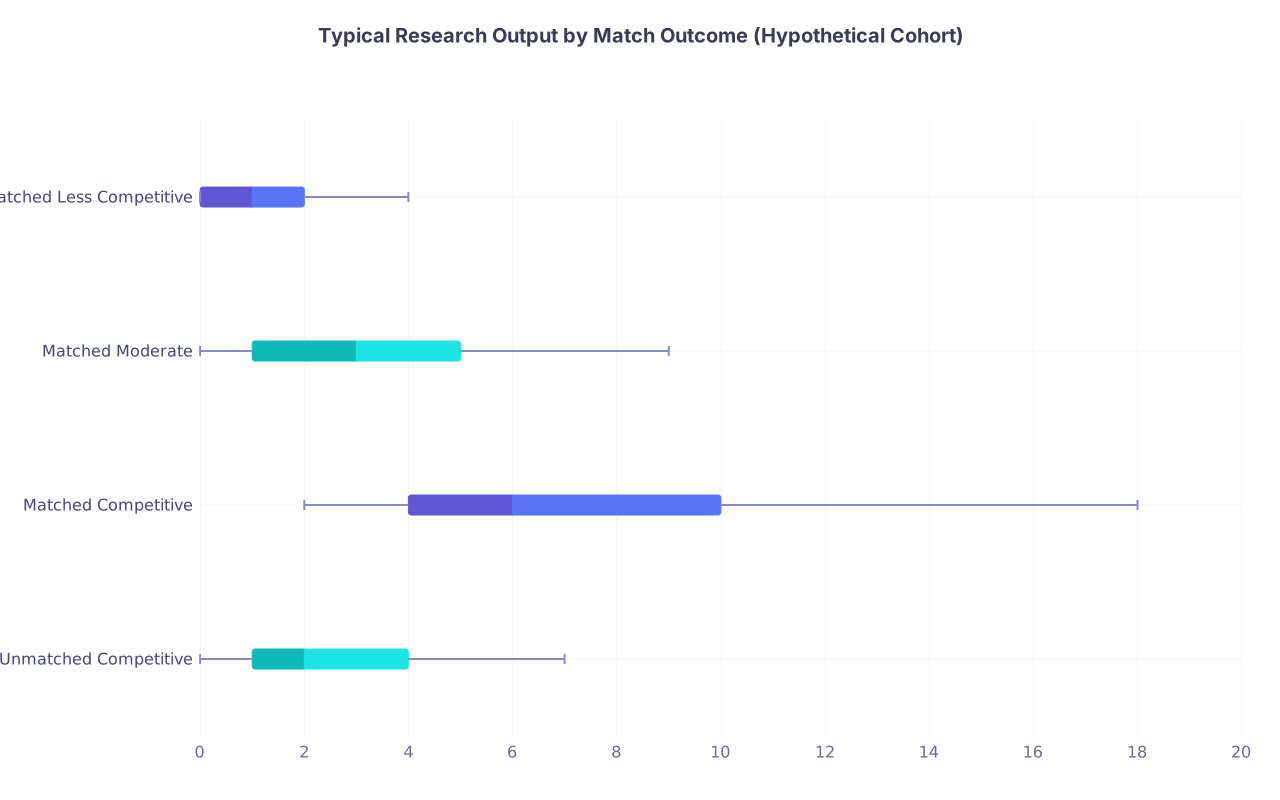
| Category | Min | Q1 | Median | Q3 | Max |
|---|---|---|---|---|---|
| Unmatched Competitive | 0 | 1 | 2 | 4 | 7 |
| Matched Competitive | 2 | 4 | 6 | 10 | 18 |
| Matched Moderate | 0 | 1 | 3 | 5 | 9 |
| Matched Less Competitive | 0 | 0 | 1 | 2 | 4 |
Interpreting this pattern:
- Competitive specialties: Matched applicants often have 4–10+ research items; many have formal research years.
- Moderate: 2–5 items is common among academic-track matches.
- Less competitive: 0–2 is often sufficient; research is not mandatory.
A genuinely strong CV usually includes:
- At least 2–3 serious research experiences, with tangible outputs (abstracts, posters, publications).
- Clear leadership with outcomes (not just titles).
- Longitudinal service that connects to your specialty story.
- Evidence of initiative: starting a project, not simply joining one.
If your CV is:
- 1 poster, VP of a small interest group, a few volunteer days
then it is not strong. It is average. Do not expect it to offset more than 2–3 Step points in any serious way.
6. Strategic Use of CV to Offset Scores
The data is clear: you cannot brute force a low score with random extracurriculars. You must design your CV like a portfolio with targeted risk reduction.
6.1 Play to your specialty’s values
Different specialties assign different weights to CV components.
| Specialty Type | Highest-Yield CV Elements |
|---|---|
| Competitive (e.g. Derm) | Specialty research, big-name mentors, national presentations |
| Moderate Academic (e.g. IM) | Research, QI projects, teaching roles |
| Community-focused (e.g. FM) | Longitudinal service, community engagement, language skills |
| Procedure-heavy (e.g. Ortho) | Specialty research, athletics, manual skills, ortho exposure |
You want your CV to scream: “I am all-in on this specialty, and I have receipts.”
6.2 Combine numeric recovery with CV building
One of the best ways to offset a lower Step 1 (historically) or a borderline performance is not only a strong CV but also:
- Strong Step 2 CK performance (10–15 points above Step 1 analogs)
- High clinical grades, especially in core rotations related to your specialty
I have seen this pattern a lot:
- Step 1: barely above pass (back when numeric)
- Step 2 CK: 245+
- CV: strong research and leadership
- Outcome: Matched into solid academic IM or anesthesia programs.
Programs interpret this as: “Early struggle, strong upward trend, plus high work ethic and productivity.” That combination can erase a lot of earlier numeric damage.
6.3 Research years and away rotations
Two high-yield moves for applicants with borderline scores:
Dedicated research year at a reputable institution in the specialty.
- Produces 3–7+ outputs.
- Gives you strong letters from well-known names.
- Signals commitment and maturity.
Away rotations (sub-Is) at realistic target programs.
- Lets faculty see you work.
- Can bypass some score stigma if you prove yourself on the wards and secure a strong in-house letter.
These do not magically equalize you with a 260 scorer, but they can put you into the “we know this person and trust them” bucket. And that bucket often survives harsher filters.
7. Risk Management: Adjusting Specialty Choice and Application Strategy
At some point this becomes probability management, not ego.
You should be asking:
- Given my scores and CV, what is my realistic match probability in my desired specialty?
- How many applications and which tiers of programs do I need to target?
- Do I need a parallel plan?
I often think in tiers:
- Tier 1 (reach): Programs where your scores are below median, but your CV is clearly above average and aligned.
- Tier 2 (target): Programs where your scores are around median and your CV is competitive.
- Tier 3 (safety): Programs and sometimes specialties where your scores are above median; your CV is more than enough.
Balance matters. Someone with a 235 and a strong IM CV applying only to 10 top-20 university IM programs is not “ambitious.” They are ignoring the distribution.
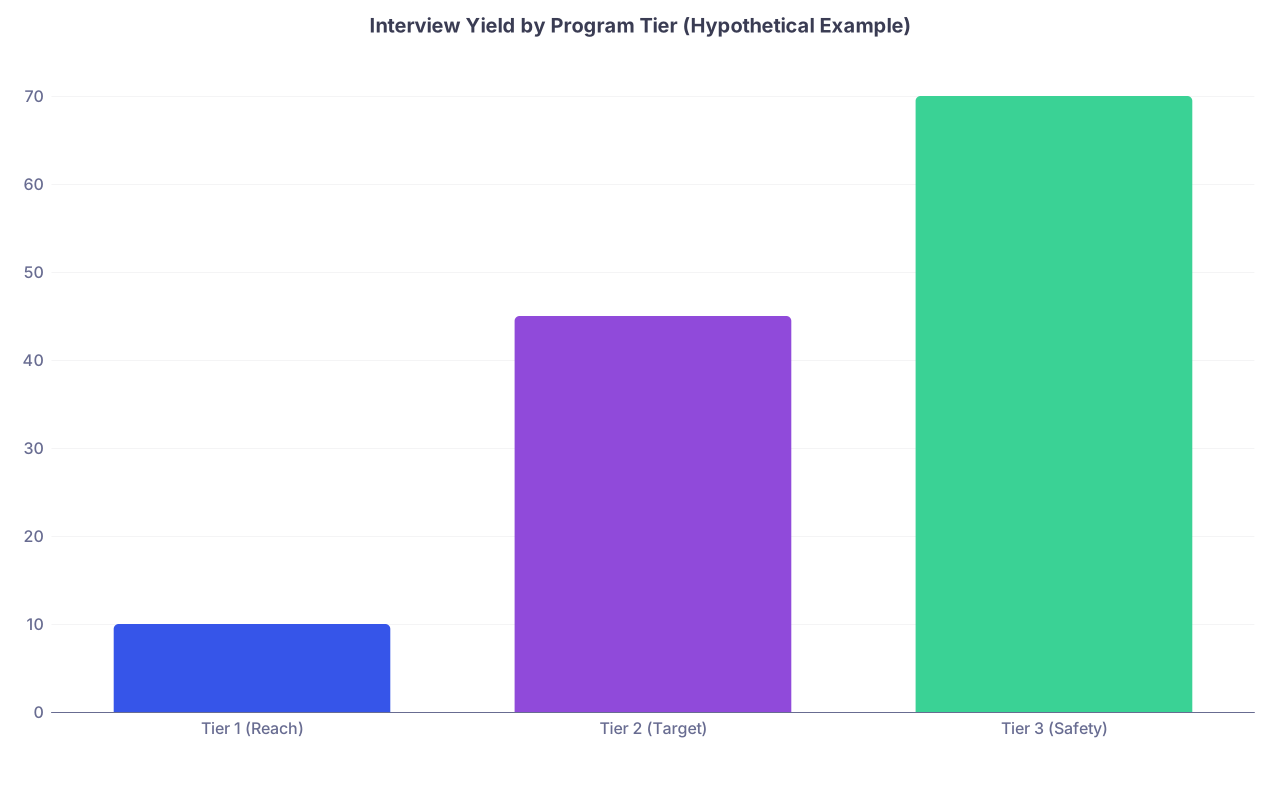
| Category | Value |
|---|---|
| Tier 1 (Reach) | 10 |
| Tier 2 (Target) | 45 |
| Tier 3 (Safety) | 70 |
Those percentages (roughly) are the relative chance of getting an interview per application with borderline scores but strong CV.
Smart applicants with lower scores do the opposite of what their ego wants:
- They apply broadly.
- They include a meaningful slice of Tier 3 programs and, if needed, a backup specialty where their CV and scores look strong together.
8. How to Actually Improve Your CV When Scores Are Set
If your exams are already taken, the only controllable variables are CV, Step 2 (if pending), and strategy.
Concretely:
Maximize research output in 12–18 months
- Join 2–3 active projects that are already producing manuscripts.
- Target at least 2 abstracts and 1 manuscript submission before ERAS.
- Take ownership of data analysis or drafting; that moves timelines.
Build one marquee leadership experience
- Lead a QI project with pre/post metrics. Example: reduce discharge delays on a ward by tracking bottlenecks and implementing a checklist.
- Or run a student clinic initiative where you can quote numbers: “Expanded weekly visits from 20 to 45; reduced no-shows from 30% to 12%.”
Tie service to your specialty
- Psych: longitudinal mental health advocacy or clinic work.
- FM: FQHC clinics, rural health fairs, language-congruent care.
- IM: chronic disease management programs, free clinics.
Secure high-signal letters
- Work directly with faculty who can speak to your work ethic, complexity handling, and growth, not just “pleasant to work with.”
Craft a personal statement that explains, not excuses
- If there is a story behind your lower score (illness, life event), own it briefly and then show the rebound: higher Step 2, stronger clinical performance, productive year.
Again, this does not erase a low score. It reframes you as a low-score applicant with high upside and evidence of resilience. Programs like that narrative when it is real.
9. The Bottom Line: What the Data Actually Supports
Three main points, without sugarcoating:
Scores control access; CV controls ranking.
If you are below a program’s score cutoff, your CV will often never be seen. Above that floor, a strong, targeted CV can offset approximately 8–12 Step 2 CK points of disadvantage in many moderate-competitiveness specialties, somewhat less in the highly competitive ones.A “strong CV” is quantifiable, not a vibe.
You are looking at several substantive research outputs, real leadership with measurable results, and specialty-aligned service. The data shows that applicants with this profile routinely outperform their numeric peers in interview yield and match outcomes.You cannot game probability, but you can shape it.
By aligning your CV with your target specialty, adding a strong Step 2 and clinical performance where possible, and choosing programs and backup plans rationally, you convert a “lower score” from a near-death sentence into a manageable risk. Not erased. But controllable.