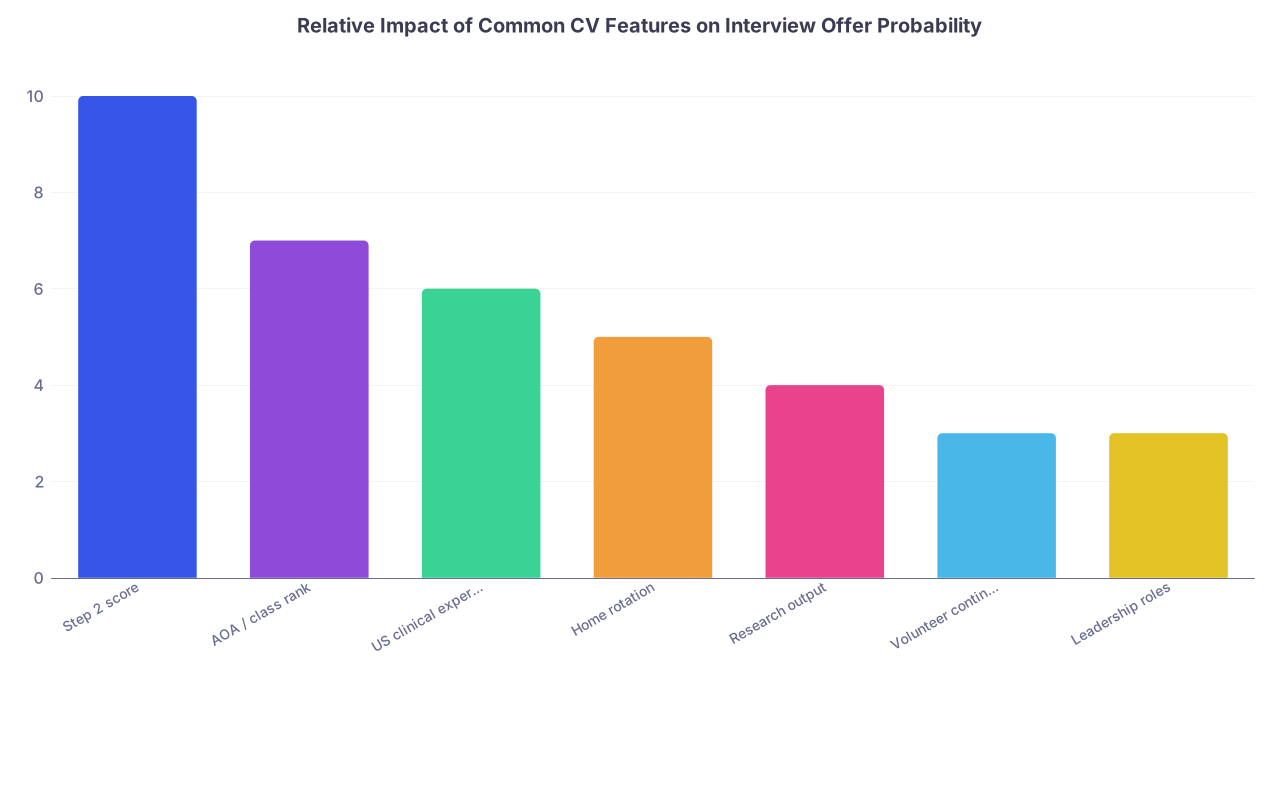
| Category | Value |
|---|---|
| Step 2 score | 10 |
| AOA / class rank | 7 |
| US clinical experience | 6 |
| Home rotation | 5 |
| Research output | 4 |
| Volunteer continuity | 3 |
| Leadership roles | 3 |
Program directors are not reading your CV like a story. They are scanning it like a spreadsheet. The data backs this up every year.
If you want more interview offers, you stop guessing and start aligning your CV to what match data consistently shows: certain features move the needle, others are cosmetic. Let’s walk through what actually correlates with interview invitations and how to re-engineer your CV around those signals.
1. How Programs Really Screen: The “Shortlist” Math
Most applicants underestimate how brutally numerical the first pass is.
NRMP Program Director Survey data, ERAS filters, and what I have seen sitting next to selection committees all say the same thing: interview decisions come from a combination of hard screens and quick pattern recognition.
The typical order looks like this:
- Automatic filters (scores, attempt history, degree type, sometimes visa).
- Shortlist by “fit” markers (home institution, rotations, region).
- Tie‑break with academic markers (AOA, class rank, honors).
- Then, and only then, research, leadership, and service meaningfully shape who gets called.
So your CV’s primary job is not to “tell your story.” Its job is to survive the filters and make you look like low‑risk, high‑fit inventory.
Let’s quantify the big drivers.
2. Examination and Academic Metrics: The Gatekeepers
You already know exam scores matter. But the way they interact with your CV features is misunderstood.
Step 2 CK: The Single Biggest Multiplier
With Step 1 pass/fail, Step 2 CK is now the main standardized comparator. Program director surveys consistently show Step 2 CK as the most important numeric factor for getting an interview.
From aggregated PD rankings and observational data:
- Moving from <230 to 240–249 often roughly doubles the proportion of programs willing to interview you in competitive fields.
- Crossing ~250 bumps you into a very different tier in specialties like derm, ortho, plastics, ENT, and rad onc.
Your CV features do not erase a weak Step 2, but they can compensate within limits. Realistically:
- Below ~220: you need a strong narrative plus substantial mitigating features (home program, outstanding clinical performance, heavy advocacy) just to stay in the pile.
- 220–235: CV strength (research, leadership, rotation fit) meaningfully changes your odds.
245: your CV becomes more about differentiation than damage control.
What this means for the CV: foreground anything that reinforces “strong test taker / strong clinician.” Honors in core clerkships, high class rank, academic awards. These features amplify what your Step 2 already signals.
Class Rank, AOA, and Honor Societies
Data point: In multiple NRMP PD surveys, AOA membership ranks in the top 5 academic factors for interview decisions in competitive specialties. Why? Because it compresses a lot of signals—grades, professionalism, faculty trust—into a single line.
Impact hierarchy (all else equal) tends to look like this:
- Step 2 CK score
- Class rank / quartile / decile
- AOA / Gold Humanism / school-based honors
- Individual clerkship grades
For many programs, the first skim is simple:
- Any “bottom quartile” flag? Risky.
- AOA or top decile? Safe, probably interview.
- Mostly high passes but no honors? You need stronger secondary signals (research, fit, rotations).
Translation for your CV:
- Pull your strongest academic markers up into the first third of the CV.
- If your school provides exact rank or decile and it is favorable, display it clearly, not buried.
- If you have AOA or equivalent, do not hide it in a long list of minor awards. Give it its own line.
Where the data is blunt: CV “shine” without at least average metrics rarely gets you past baseline filters in high‑volume, competitive specialties. You might get a few interviews with a great story, but not widespread traction.
3. US Clinical Experience and Rotations: The Fit Engine
Once you clear numeric screens, programs start looking for evidence that you understand the clinical environment and specialty. Here, the data is very consistent: structured, documented clinical experience tied to the specialty strongly predicts interviews.
Home Program and Sub‑I Rotations
Look at match lists: a disproportionate number of residents match at their home program or at a place where they rotated.
For many academic programs:
- 20–40% of their class are home students.
- Another 20–30% are students who did a sub‑internship / away rotation there.
That is not accidental. It is risk management. Faculty have directly observed performance.
Your CV needs to make these experiences unmissable.
High‑leverage features:
- Sub‑internships in the specialty at your home institution.
- Away rotations at realistic target programs.
- Clear documentation of responsibilities (not “observer,” but “admitted patients,” “wrote notes,” “presented on rounds”).
The data pattern: applicants who completed a sub‑I at a program have dramatically higher interview and match rates there compared to those who only applied cold. People on selection committees literally say, “We know this person; they worked hard on our service.”
US Clinical Experience (Especially for IMGs)
For international graduates, US clinical experience (USCE) is often as important as scores.
Many IM and FM PDs use simple filters:
- Minimum months of hands‑on USCE.
- No credit for “observership only” at first pass.
Programs frequently state they require 3–6 months of USCE. The relationship with interviews is not linear; it is threshold‑based:
- 0–2 months: many programs auto‑screen out.
- 3–4 months: acceptable for a significant number of community and some academic programs.
- ≥6 months: looks serious and mitigates some concerns about system familiarity.
On the CV, vague language kills you. “Clinical exposure” is noise. You need precise, filterable descriptions:
- “Internal Medicine Sub‑internship, 4 weeks, direct patient care, H&P, progress notes, order entry under supervision.”
- “Family Medicine Clerkship, 6 weeks, continuity clinic and inpatient service.”
If your CV has USCE but it reads like a shadowing experience, you lose the benefit.
4. Research Output: Quantity vs Signal Strength by Specialty
Research is massively overvalued by some applicants and undervalued by others. The data shows a very specialty‑dependent effect.
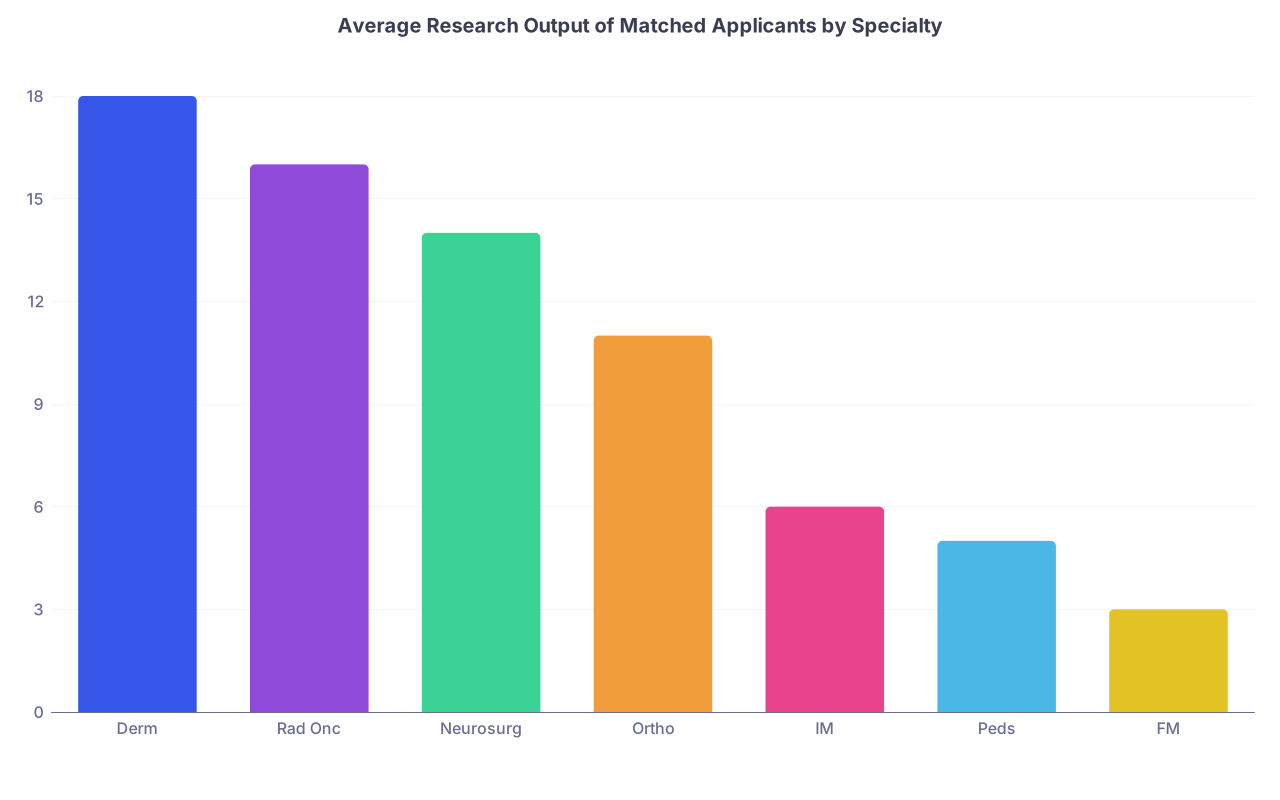
| Category | Value |
|---|---|
| Derm | 18 |
| Rad Onc | 16 |
| Neurosurg | 14 |
| Ortho | 11 |
| IM | 6 |
| Peds | 5 |
| FM | 3 |
These are representative ballparks from recent NRMP Charting Outcomes reports (abstracts, posters, presentations, publications combined). The absolute numbers are inflated by how ERAS counts, but the relative differences are real.
Key patterns:
- In derm, rad onc, and neurosurgery, higher research activity correlates strongly with interview offers, especially at academic programs.
- In IM, peds, and FM, research helps, but strong USCE and letters often matter more for interview selection.
- A small number of high‑quality, first‑author publications or major presentations carries more weight than 20 low‑impact abstract listings… but the raw count still plays a psychological role.
What actually moves interview decisions:
- Specialty‑aligned research (ortho applicant with 4 ortho abstracts > 10 generic basic science posters).
- Recognizable institutions or mentors (PDs notice “MGH,” “Mayo,” “Hopkins,” or known local faculty).
- First‑ or second‑author positions.
If your specialty is research‑heavy, your CV should:
- Have a clean, well‑organized “Publications and Presentations” section.
- Group by type (peer‑reviewed papers, abstracts, posters, talks).
- Clarify authorship position and specialty relevance.
And do not bury your strongest project in the middle of a wall of text. Highlight the serious work.
If your specialty is not research‑obsessed, a modest but coherent research profile—1–3 projects, ideally clinically related—signals curiosity and follow‑through. That can be a meaningful tie‑breaker.
5. Leadership, Volunteering, and “Soft” Features: What the Numbers Suggest
This is where most applicants lose the plot. They treat any activity as equally meaningful. The data says otherwise.
Program director surveys constantly rank “evidence of professionalism,” “teamwork,” and “commitment to the specialty” as important. But they infer those traits from structure and continuity, not from one‑off volunteering.
Continuity Beats Variety
From multiple PD commentaries and internal scoring systems:
- Longitudinal activities (≥1–2 years) consistently score higher than a laundry list of short stints.
- Leadership roles (president, coordinator, founder) dramatically increase the perceived value of an activity.
Think in terms of signal strength:
- “Free clinic volunteer, 3 years, later became student director” signals reliability, altruism, and growth.
- “5 different 1‑day health fairs” signals… you showed up when convenient.
Your CV should:
- Compress short, similar activities into a single line if they are not individually significant.
- Expand 2–4 long‑term or high‑impact roles with 2–3 bullet‑level details (responsibility, scope, measurable outcomes).
You want a PD to glance at your CV and think: “This person sticks with things and takes ownership.”
Specialty‑Targeted Involvement
The data is less formal here, but patterns are obvious when you look at matched vs unmatched applicants:
- EM applicants with EM interest group leadership, EM‑related QI projects, and EM shadowing get more interviews than those without, even with similar scores.
- Pediatrics applicants engaged in tutoring, mentoring, or longitudinal child health volunteering hit the “fit” radar quickly.
On the CV:
- Cluster or label activities clearly tied to your chosen specialty.
- Use descriptive titles: “Emergency Medicine Interest Group – Vice President,” not “Medical Interest Group.”
This helps busy readers connect dots in seconds.
6. Letters of Recommendation: Invisible on Paper, Massive in Practice
Letters are not visible directly on the CV, but your CV features drive who writes your letters and what they say.
Every PD survey places “letters of recommendation in the specialty” near the top for interview invitations. The strongest letters tend to come from:
- Sub‑Is and aways where you did real work.
- Research mentors on long‑term projects.
- Longitudinal clinics and service commitments.
Your CV strategy here is simple: design your experiences so that at least 3 people can credibly say, “I have seen this student repeatedly and in depth.”
This means:
- Fewer, longer‑term commitments.
- Sub‑I performances where you are clearly on the radar of attendings.
- Research with direct mentor interaction, not just data entry in a massive group.
You cannot “write” letters into your CV, but you can absolutely reverse‑engineer your CV to produce high‑yield letter writers.
7. Structuring Your CV for the Way Programs Read
The content matters, but structure alters how that content is perceived. I have watched faculty skim 200+ CVs in a single evening. They do not read left to right. They scan for anchor points:
- Metrics (Step, rank, honors).
- Clinical exposure in the specialty and at similar institutions.
- Research/academic output.
- Leadership and continuity.
If your CV hides any of those, you are leaking value.

| Step | Description |
|---|---|
| Step 1 | Application Submitted |
| Step 2 | CV Skim |
| Step 3 | Screened Out |
| Step 4 | Interview Offer |
| Step 5 | Low Priority |
| Step 6 | Score and Filter |
| Step 7 | Specialty and Program Fit |
Design decisions that help you in that C–D zone:
- Put “Education and Academic Performance” near the top with Step 2, class rank, and key honors in one clean block.
- Follow with “Clinical Experience” focused on your core clerkships, sub‑Is, aways, and relevant USCE.
- Place “Research and Scholarly Work” before “Volunteerism and Leadership” in academic specialties; reverse that order in community‑heavy or primary care fields if research is sparse.
The goal is to line up your strongest evidence with the reading order that PDs actually use.
8. Quantifying and Re‑writing Weak Sections
You cannot magically add research years or a 260 Step 2. But you can materially change how your existing experiences score in a PD’s mental rubric just by rewriting them with numbers and outcomes.
Three rules:
- Quantify responsibilities. “Managed 8–12 inpatients daily,” “Coordinated scheduling for 25 volunteers,” “Organized 3 skills workshops attended by 60+ students.”
- Clarify scope. “Student director,” “Lead coordinator,” “Curriculum designer” stand out more than “member.”
- Connect to specialty. “Focused on transition‑of‑care QI in heart failure patients” tells a cardiology or IM PD that you are already thinking in their space.
Example transformation:
- Weak: “Volunteer, Student‑Run Clinic, 2019–2023.”
- Stronger: “Student‑Run Free Clinic, Volunteer then Operations Lead, 2019–2023 – Provided continuity care for underserved adult patients 1 evening/week; later supervised 12 junior volunteers and optimized triage flow, reducing average patient wait time from 90 to 55 minutes.”
Same activity. Very different data signature.
9. Strategic Tradeoffs: Where to Invest Your Limited Time
You cannot maximize everything. You are under time and energy constraints. Data‑driven prioritization matters.
Think in marginal returns:
- If your Step 2 is pending or borderline, incremental score gain almost always outperforms adding one more poster. A 10‑point jump can move you across multiple program filters; a single extra abstract rarely does.
- If you already have above‑average scores for your target specialty, shifting time from pure studying into a high‑yield sub‑I or away rotation can yield more interviews than marginal Step 2 improvements.
- For IMG applicants, moving from 2 to 4–6 months of meaningful USCE often does more for interview volume than tacking on low‑impact remote research.
You also need to calibrate to specialty competitiveness. A crude but useful comparison:
| Specialty Tier | Score Emphasis | Research Emphasis | USCE / Rotations | Leadership / Service |
|---|---|---|---|---|
| Ultra-competitive (Derm, PRS) | Very High | Very High | High | Moderate |
| Surgical (Ortho, ENT, NSG) | Very High | High | High | Moderate |
| Academic Medicine (IM subspecial) | High | Moderate–High | High | Moderate |
| Core (IM, Peds, OB/GYN, EM) | High | Moderate | Very High | Moderate–High |
| Primary Care (FM, Psych) | Moderate | Low–Moderate | Very High | High |
You do not need to master all categories equally. You need to be above water in the big two for your tier, then use the rest to differentiate.
10. Putting It All Together: A Data‑Aligned CV Blueprint
Boil the data down and you get a simple but non‑negotiable stack:
- Survive filters: Step 2 CK and, where visible, class rank / clerkship performance.
- Demonstrate clinical fit: sub‑Is, aways, and USCE that match your target specialty and environment.
- Add academic weight: research output scaled to your specialty’s norms.
- Prove character and continuity: long‑term leadership and service.
If your current CV does not map cleanly to that stack, you have work to do. Not necessarily more activities. Often, fewer but deeper.
The next step for you is not to keep tweaking bullet points forever. It is to run a brutally honest gap analysis:
- Compare your metrics to recent Charting Outcomes distributions for your specialty.
- Count your months of substantive USCE and rotations in your target area.
- Tally your research outputs against the average for matched applicants.
- Identify exactly 2–3 long‑term experiences that will become your CV’s backbone.
Then restructure your CV so those high‑yield features are impossible to miss in the first 30 seconds of a PD skim.
Once that is locked in, the real leverage shifts to strategy: which programs you choose, how you time your away rotations, what signals you send, and how you make those interview offers convert into ranks. With a data‑aligned CV in place, you are finally ready to think about that next phase. But that is a different analysis.