
The mythology around gap years and publications is statistically wrong. Programs are not counting lines on your CV. They are optimizing for probability of successful board passage, low attrition, and future academic output—and the data shows very specific patterns in who actually matches.
Let me walk through this like a data review, not a motivational speech.
The Core Numbers That Drive Match Probability
Residency selection, underneath the narrative fluff, is a probability game. Program directors look at three clusters of variables:
- Academic risk (boards, class performance).
- Productivity and trajectory (research, publications, advanced degrees, gap years).
- Signal and fit (specialty-specific experiences, letters, sub‑Is).
You asked about gap years and publications. So I will anchor those against what actually moves match rates.
Match rates by applicant type and “academic signal”
Across multiple NRMP Program Director Surveys and Charting Outcomes reports, the pattern is stable:
- US MD seniors have the highest baseline match rates (around 92–94% overall).
- US DO seniors slightly lower (around 89–91%).
- IMGs are far lower (40–65% depending on US vs non‑US graduate and specialty).
But within each group, the increment from research and dedicated time is what matters.
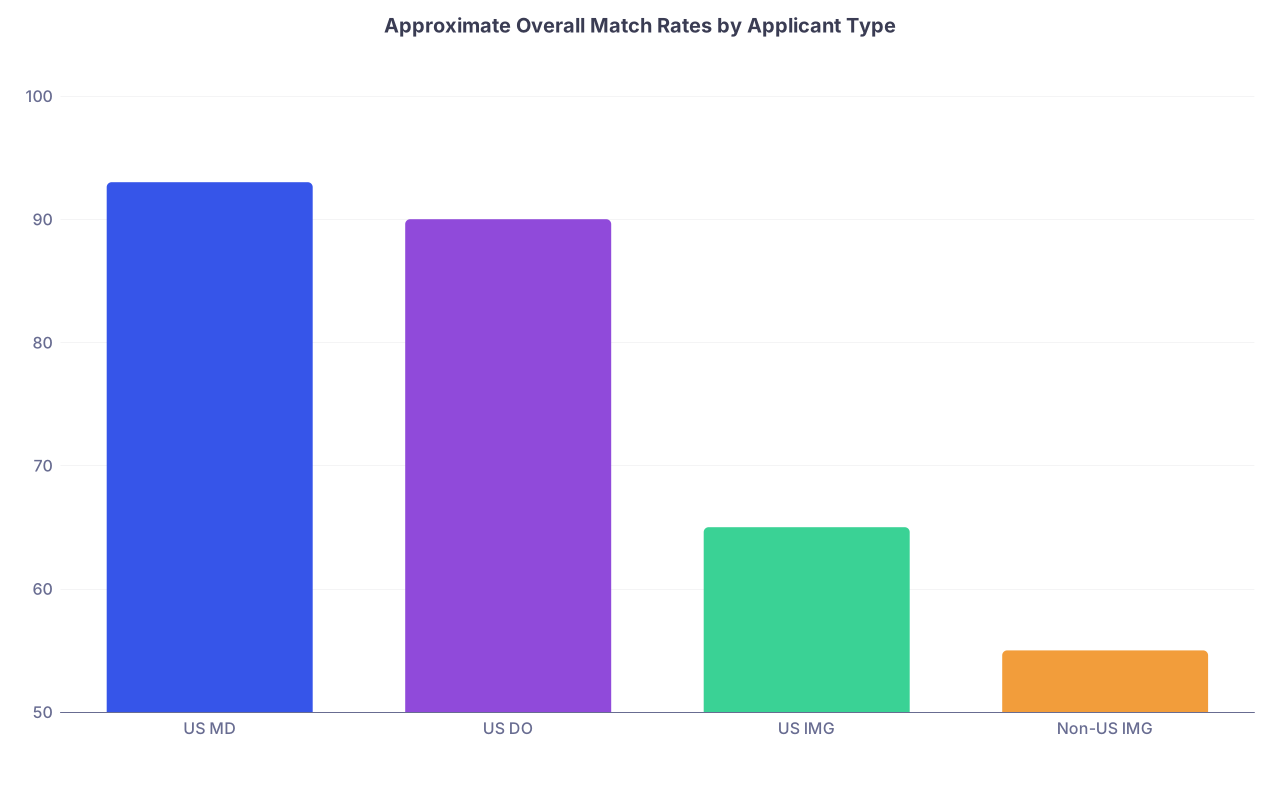
| Category | Value |
|---|---|
| US MD | 93 |
| US DO | 90 |
| US IMG | 65 |
| Non-US IMG | 55 |
You are not improving your CV in a vacuum. You are improving it relative to others in your bucket. And the data show:
- The impact of a gap year plus publications is modest for a mid-tier US MD applying community internal medicine.
- The impact is huge for a non‑US IMG aiming for radiology or dermatology.
So any CV strategy that ignores applicant type and specialty competitiveness is fantasy.
Gap Years: When the Data Says “Yes” vs “You’re Wasting Time”
Gap years are not magical. They are a multiplier on your baseline stats and your specialty choice.
What program directors report about dedicated research time
Take the NRMP Program Director Survey patterns (I am summarizing several years’ data here):
For highly competitive specialties (derm, plastics, ortho, ENT, neurosurgery, radiation oncology):
- 60–80% of PDs say research is “very important.”
- Large fractions (often >50%) “expect” or “strongly prefer” applicants with dedicated research time or advanced scholarly productivity.
For moderately competitive specialties (radiology, anesthesia, EM in good markets, OB/GYN, some academic IM):
- 30–60% of PDs rate research as “important but not mandatory.”
- Dedicated time helps disproportionately at academic centers.
For less competitive specialties (FM, psych at many programs, community IM, pathology in some markets):
- Research is often “nice to have” or neutral.
- USMLE/COMLEX scores, clinical performance, and letters dominate.
Here is how that looks simplified:
| Specialty Tier | Research Year Impact on Match Odds | Typical PD Attitude |
|---|---|---|
| Very competitive (Derm) | High | Often expected for top programs |
| Competitive (Radiology) | Moderate to High | Distinct advantage, not mandatory |
| Mid (Anesthesia, OB/GYN) | Moderate | Helps at academic programs |
| Less competitive (FM, Psych, IM community) | Low to Moderate | Rarely decisive |
| Non-clinical focus careers | High (for research tracks) | Often required for research pathways |
When a gap year is a statistically good move
Let me be blunt. A research gap year makes sense in scenarios like these:
You want a very competitive specialty and your current metrics are mediocre.
- Example: US MD, Step 2 of 237, average clinical grades, aiming for dermatology.
- Without research: your application is fundamentally unconvincing for top programs.
- With a high‑yield derm research year and 3–8 derm‑related pubs/posters: you convert from “auto-filter” to “serious but still risky” candidate.
You are an IMG aiming for any competitive or mid‑competitive specialty.
- For IMGs, the research year is often the only path to offset the baseline disadvantage.
- Especially powerful if done at a US academic center in your target specialty and yields US mentors and letters.
You had academic damage and need a reframing narrative.
- Step 1 failure, leave of absence, or weak preclinical record.
- A strongly productive research year, with clear structure and output, demonstrates recovery and reliability.
You are targeting research‑heavy careers (physician‑scientist tracks, PSTP, T32, etc.).
- Here, lack of significant research is disqualifying.
- Dedicated year boosts grant potential, networking, and long‑term output.
When a gap year is statistically dumb
I have seen too many people do this:
- US MD, Step 2 = 250, strong MS3 clerkships, wants community internal medicine or family medicine.
- Takes a full research year “because everyone else is doing it.”
Data reality:
- For that target, your pre‑gap profile already puts your match odds >95% at a wide range of programs.
- The marginal probability gain from a research year might be 1–2 percentage points at best, heavily concentrated at a few academic IM programs.
- You lose a year of attending salary (~$250–350k for IM over that lost year) to maybe nudge into a slightly more academic program.
The ROI is almost always negative in that scenario.
Publications: How Many, What Type, and What Actually Moves the Needle
Programs do not weigh “a publication” as a single scalar unit. They implicitly weight:
- Relevance to specialty.
- Role (first author vs middle vs last).
- Venue (PubMed-indexed vs obscure).
- Evidence of sustained productivity vs one-off token effort.
What the match data show on publications per matched applicant
If you look at NRMP Charting Outcomes tables, you see something like this pattern (numbers vary by year, but the shape is stable):
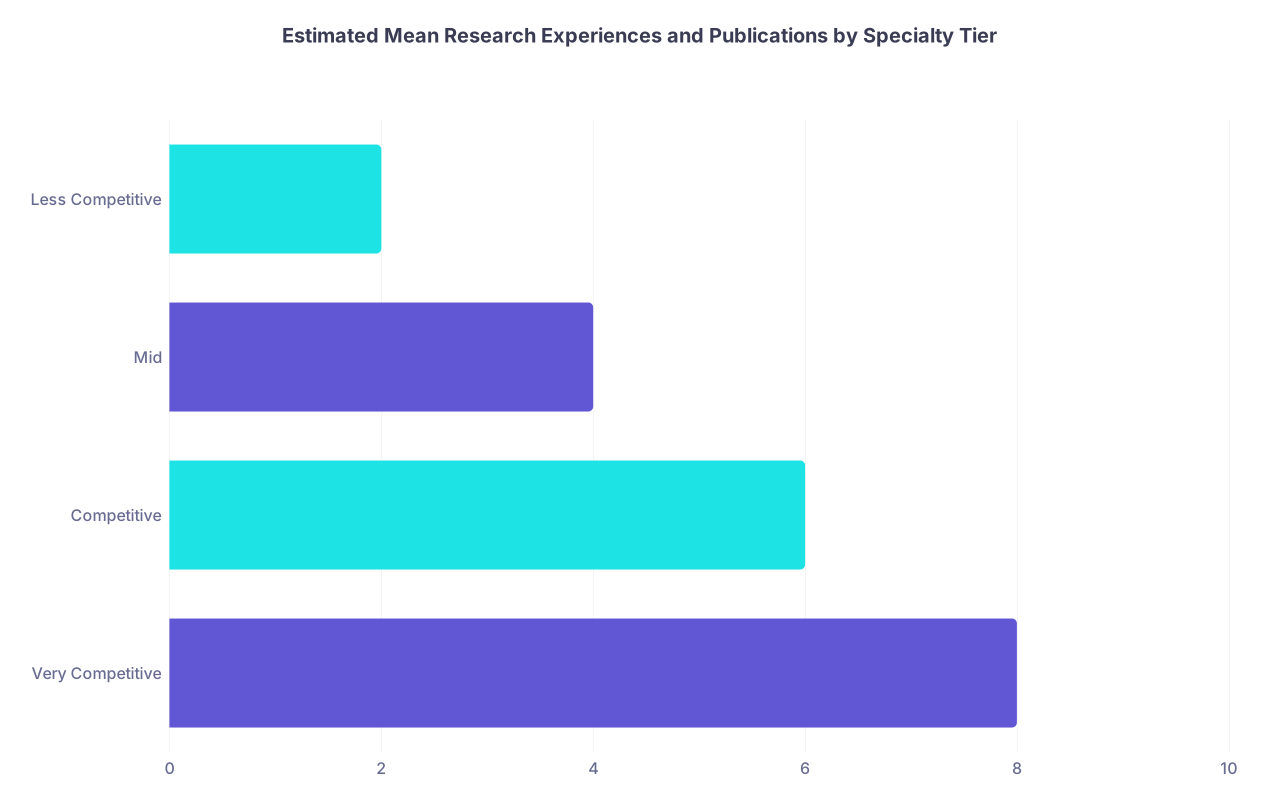
| Category | Value |
|---|---|
| Very Competitive | 8 |
| Competitive | 6 |
| Mid | 4 |
| Less Competitive | 2 |
That “8” for very competitive is not 8 New England Journal papers. It is a mix of:
- Posters.
- Abstracts.
- Case reports.
- Middle‑author papers.
- Maybe 1–2 decent first‑author manuscripts.
But the key pattern: those who match competitive fields usually have more entries and more continuity in research.
Quality vs quantity: the unspoken thresholds
From reading hundreds of applications and talking to PDs, there are de facto thresholds:
Threshold 0 – No meaningful research:
- Acceptable only in less competitive fields or at community programs.
- Problematic in derm, ortho, ENT, plastics, radiation oncology, neurosurgery, competitive rads, academic IM.
Threshold 1 – Basic exposure (1–3 items, minor role):
- Shows you can function in a research environment.
- Not a differentiator, but prevents your application from looking empty.
Threshold 2 – Moderate productivity (4–10 items, at least 1–2 first‑author, some specialty relevance):
- This is where doors open at many academic programs.
- Strong positive signal for any competitive or mid‑competitive field.
Threshold 3 – High productivity (>10 items, multiple first‑author, clear research focus):
- Distinctly advantageous for PSTP, research tracks, and top programs.
- Moves you into the “we expect this person to become faculty” bucket.
What matters is signal density: do your publications clearly indicate a trajectory in the field you say you want?
Gap Years + Publications: How They Interact in Real Match Outcomes
A research year is just a time‑box. Its value is purely a function of what you produce and who vouches for you.
Reasonable output expectations from a 12‑month research year
Realistic for a full‑time, structured, mentored year (not fantasy, but also not passive):
- 1–2 first‑author manuscripts submitted (maybe 1 accepted by match season).
- 2–4 co‑author papers where you contributed data analysis, chart review, etc.
- 2–6 abstracts/posters at national or regional conferences.
- 1–3 strong letters from recognized faculty, ideally in your target specialty.
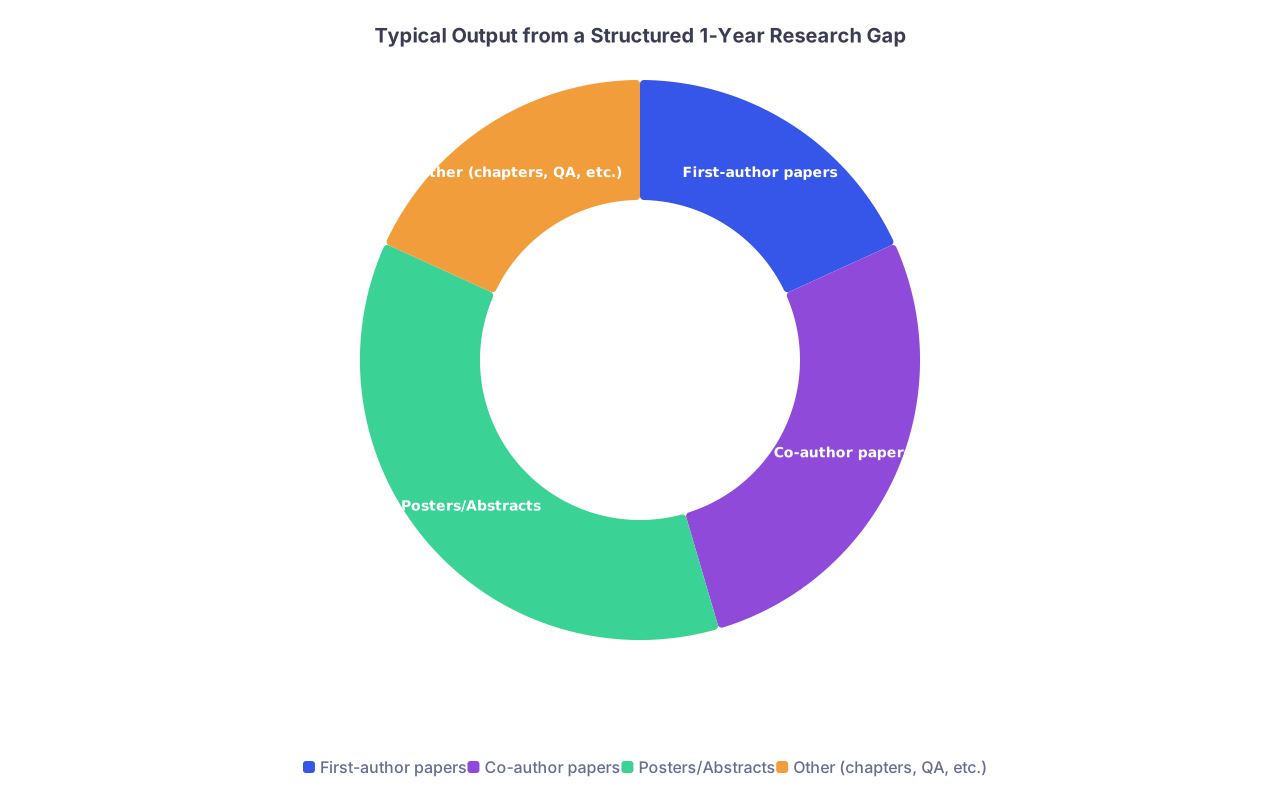
| Category | Value |
|---|---|
| First-author papers | 2 |
| Co-author papers | 3 |
| Posters/Abstracts | 4 |
| Other (chapters, QA, etc.) | 2 |
If your proposed gap year is unlikely to hit at least half that, the probability that it meaningfully shifts your match odds drops sharply.
The “CV upgrade” effect by starting baseline
Think in terms of deltas.
Scenario A – Already strong candidate:
- US MD, Step 2 = 250+, honors in most clerkships, 2 minor publications, wants anesthesia or radiology.
- Without gap: Maybe 80–90% chance at a good mix of academic and community programs.
- With strong research year: Maybe you convert a few stretches into realistic options and slightly improve fellowship positioning.
- Net: Positive but modest CV upgrade. ROI depends on your long‑term academic goals.
Scenario B – Borderline for a competitive field:
- US MD, Step 2 = 235, average clerkships, zero publications, wants ortho.
- Without gap: Match probability at categorical ortho is low. Honestly maybe <25% for solid programs.
- With a structured ortho research year, 5–8 ortho‑related pubs/posters, and strong ortho letters:
- You may shift to ~50–60% match probability at least somewhere in ortho, and increase backup prelim/TY options.
- Net: High‑impact upgrade, gap year justified if you accept the residual risk.
Scenario C – IMG, wants internal medicine at academic institutions:
- No US research, no US letters, Step 2 in high 230s–240s.
- Without US research: Many US academic programs will auto‑screen you out or downgrade due to lack of US exposure and letters.
- With 1–2 years of US‑based research, a handful of IM‑related pubs, and US faculty letters:
- You drastically increase the odds of interviews and match, sometimes from sub‑20% to >50% at reasonable programs.
- Net: For IMGs, the US research year is often the main lever.
How to Structure a Gap Year So It Actually Improves Your Match Odds
If you are going to spend a year, treat it like an operations project with deliverables.
Step 1: Choose environment and mentor like you are optimizing an experiment
You want three things:
- A high‑volume environment with multiple active projects.
- A mentor with a track record of publishing and of putting students on papers.
- Clear alignment with your target specialty.
If a PI cannot tell you, before you start, “Here are 2–3 projects where you will be first author if you execute,” that is a red flag.
Step 2: Define quantitative targets up front
I push students to write it down. Example:
- By month 3: Data collection underway on 2 projects, IRB approved on at least 1 new project.
- By month 6: Drafts of 1–2 manuscripts, 1–2 abstracts submitted.
- By month 9: Manuscripts submitted, additional abstracts/posters submitted.
- By month 12: 1–2 acceptances, strong letters lined up.
You can even map it like a Gantt chart, but the key is this: if you are not on track by month 4–5, you are already losing yield.
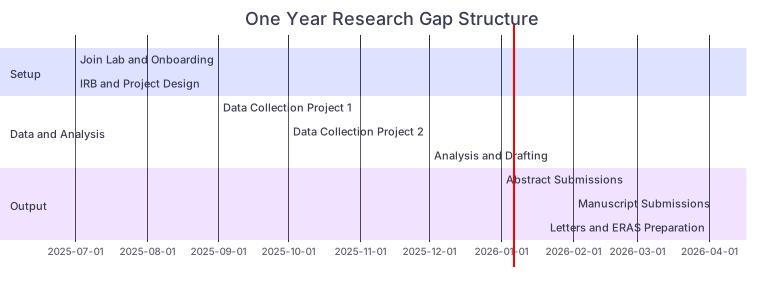
| Task | Details |
|---|---|
| Setup: Join Lab and Onboarding | a1, 2025-07, 1m |
| Setup: IRB and Project Design | a2, after a1, 2m |
| Data and Analysis: Data Collection Project 1 | b1, 2025-09, 4m |
| Data and Analysis: Data Collection Project 2 | b2, 2025-10, 3m |
| Data and Analysis: Analysis and Drafting | b3, 2025-12, 4m |
| Output: Abstract Submissions | c1, 2026-01, 2m |
| Output: Manuscript Submissions | c2, 2026-02, 3m |
| Output: Letters and ERAS Preparation | c3, 2026-04, 3m |
Step 3: Avoid “fake busy” work
You do not get credit for:
- Sitting in on lab meetings with no output.
- “Helping” with data entry but never being on a paper.
- Working in a basic science lab with a 3–5 year timeline when your match is in 12–18 months.
High‑yield activities are:
- Retrospective chart reviews with feasible sample sizes.
- Clinical outcomes studies where the dataset already exists.
- Systematic reviews and meta‑analyses (if your PI publishes them).
- Well‑structured case series or case reports if your field still values them (some do).
Integrating Gap Years and Publications into a Convincing CV Narrative
Strong numbers without a coherent narrative look random. Programs subconsciously ask: Does the trajectory make sense?
You want the data on your CV to tell a story with three clear steps:
- Exposure → 2. Commitment → 3. Productivity.
Concrete example: Orthopedic surgery applicant
Bad version:
- Two scattered publications: one in endocrinology, one in psychiatry.
- Gap year in a lab with no ortho connection.
- Personal statement says ortho was always the dream.
The data do not match the story.
Better version:
- MS2: Started in an ortho outcomes group, one poster at AAOS.
- MS3: Continued on a project, co‑author on one ortho paper.
- Gap year: 2 first‑author ortho outcomes papers, 3 posters, letters from well‑known ortho faculty.
Now your CV has temporal and thematic coherence. Programs can see you as a future orthopedist, not just a random “research person.”
Tactical CV Upgrades Without a Full Gap Year
Not everyone can or should take a year off. You can still optimize.
High-yield micro‑moves:
- Join an ongoing retrospective project that is near submission. Your contributions can still yield middle‑author credit within 6–9 months.
- Attach yourself to a mentor with a track record of writing and revising quickly. One efficient mentor beats three disorganized ones.
- Convert clinical case encounters into case reports where appropriate, especially if your specialty values them.
- Target at least 1–2 specialty‑relevant abstracts/posters before ERAS, even if the manuscript lags.
This is about capturing low‑hanging fruit that shifts you from “no research” to “basic exposure” or from “basic exposure” to “moderate productivity.”
Putting It All Together: A Data-Driven Decision Framework
If you strip out emotion and peer pressure, your decision comes down to three questions:
- Baseline: What are my current match odds for my target specialty and tier of program?
- Leverage: How much can a research year and more publications move that probability based on my applicant type?
- Cost: What is the true cost (time, money, burnout) of taking that year relative to the benefit?
Summarized succinctly:
| Profile | Gap Year? | Publication Target by ERAS |
|---|---|---|
| US MD, less competitive specialty | Usually No | 1–3 basic items |
| US MD, competitive specialty | Often Yes | 5–10 specialty‑relevant |
| US DO, competitive specialty | Often Yes | 5–10 specialty‑relevant |
| IMG, any competitive/mid field | Strongly Consider | 5–10, plus US letters |
| IMG, less competitive field | Sometimes Helpful | 3–6, ideally US‑based |
FAQs
1. How many publications do I “need” to match into a competitive specialty?
The data show that successful applicants in very competitive specialties often report around 8 total “research items” (papers, posters, abstracts, etc.). That does not mean you must hit that number to match, but being in the 5–10 range with at least 1–2 first‑author and clear specialty relevance places you closer to the profile PDs are used to ranking highly.
2. Does a gap year look bad if I do not have personal or academic issues?
No. A well‑structured research year with clear output and strong letters is interpreted as a positive investment in your academic development. What looks bad is an unproductive year with little to show. Programs care about productivity and clarity of purpose, not whether you followed a straight 4‑year timeline.
3. Are posters and abstracts “worth less” than full publications on my CV?
Individually, yes, they carry less weight than peer‑reviewed manuscripts. But they still matter. Posters and abstracts demonstrate you can complete projects and disseminate results. The pattern of multiple specialty‑relevant posters plus a smaller number of full papers is common among successful applicants, especially in fields like ortho, ENT, and derm.
4. If I have low Step scores, can research alone compensate enough to match a competitive specialty?
Research helps, but it does not fully overwrite board performance. For many competitive fields, programs have hard or soft cutoffs. Strong research and a gap year can move you from “no realistic chance” to “selectively competitive at research‑heavy or holistic programs,” but not from 210 to guaranteed derm. You still need a credible overall academic profile.
5. How late is too late to start research if I want it to impact my ERAS application?
To have meaningful output (especially accepted manuscripts) visible by ERAS, you generally want to be actively involved by early MS2 or very early MS3. Starting in late MS3 can still yield abstracts and some middle‑author work, but the probability of major first‑author publications before application season is low. A late start is better than nothing, but it limits how much your research record can shift your match odds.
Key points: treat gap years and publications as levers to modify match probabilities, not as checkboxes. The data show their impact is highly dependent on specialty, applicant type, and baseline stats. If you are going to invest a year, structure it aggressively for measurable output—otherwise, you are just pausing your career, not upgrading it.