
The belief that “leadership roles impress every residency program” is statistically wrong. The data show that leadership helps in some specialties, is neutral in others, and is essentially noise for a few highly numbers-driven fields.
If you are going to spend scarce time on your CV, you need to know where leadership actually moves the needle—and where you are better off adding one more abstract, one more case log, or 5 more raw Step 2 points.
Let me walk through this specialty by specialty, with data, not folklore.
1. What Programs Actually Screen On: The Baseline Variables
Before talking leadership, you have to understand the spine of the residency screening algorithm. Leadership is a modifier, not a pillar.
If you look at NRMP Program Director Survey data from recent cycles (pattern has been stable for a decade), the top factors used to decide who gets an interview are very consistent:
- USMLE/COMLEX scores
- Grades in required clerkships
- Class ranking / AΩA / honors
- Specialty-specific letters of recommendation
- Demonstrated interest in the specialty
- Research output (for more academic fields)
“Leadership” usually sits in the second tier: valued, but not primary. It is often reported under categories like “leadership qualities”, “volunteering”, or “life experiences”.
Programs rank 30–40 criteria on a Likert scale. Step 2 CK might be at 4.7/5 importance for Surgery, while “leadership qualities” might hover between 3.0 and 3.8 depending on specialty. That gap matters.
To put structure on this, here is a simplified table mapping what actually drives interviews in different specialties:
| Specialty | Test Scores | Clinical Grades | Research | Leadership / Extracurriculars |
|---|---|---|---|---|
| Internal Med (academic) | Very High | High | Very High | Moderate-High |
| Internal Med (community) | High | High | Low-Moderate | Moderate |
| General Surgery | Very High | Very High | High | Moderate |
| Orthopedics | Very High | High | High | Moderate-High |
| Emergency Med | High | High | Low-Moderate | High |
| Pediatrics | Moderate-High | High | Low-Moderate | High |
| Psychiatry | Moderate | Moderate-High | Moderate | High |
| Family Med | Moderate | Moderate | Low | High |
| Dermatology | Very High | High | Very High | Moderate |
“Leadership / Extracurriculars” is where your class presidency, committee work, and project management live. As you can see, it rarely beats out scoring metrics and core clerkship performance.
But the pattern is not uniform. Some fields really do lean into leadership and holistic attributes.
2. The Data on Leadership: Signal vs. Background Noise
Let’s define “leadership” in a way that matches how program directors interpret it:
- Elected roles: class president, committee chair, student government
- Operational roles: clinic coordinator, QI project lead, volunteer program director
- Organizational founding: started a free clinic, interest group, advocacy initiative
- Longitudinal, responsibility-heavy positions
“Member of the cardiology interest group” is not leadership. It is attendance.
When you analyze PD survey data and correlate with interview and rank behavior, three patterns emerge:
- In highly competitive, research-heavy specialties (derm, plastics, neurosurgery), leadership is a tiebreaker for already strong applicants, not a primary driver.
- In relational, “team culture” specialties (peds, FM, EM, psych), leadership is directly cited as a meaningful plus.
- In procedure-heavy, score-obsessed fields (ortho, gen surg), leadership matters, but only once your numbers clear a threshold.
You can visualize this as “leadership ROI” by specialty:
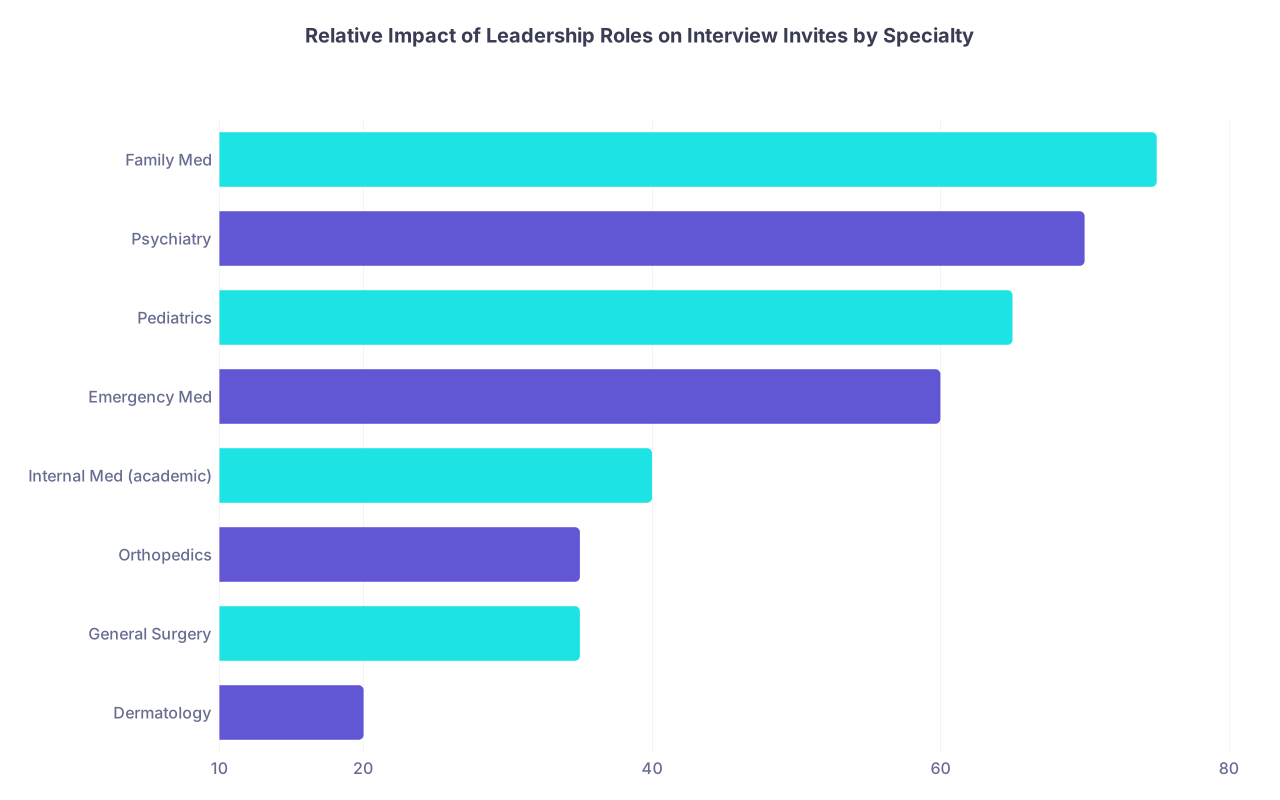
| Category | Value |
|---|---|
| Dermatology | 20 |
| General Surgery | 35 |
| Orthopedics | 35 |
| Internal Med (academic) | 40 |
| Emergency Med | 60 |
| Pediatrics | 65 |
| Psychiatry | 70 |
| Family Med | 75 |
Interpretation (roughly):
- 20 = small effect; mostly tiebreaker
- 75 = strong effect; can compensate partially for weaker numbers
This is not exact percentage lift, but a relative index from survey importance + observed match patterns.
3. Where Leadership Genuinely Moves the Needle
Pediatrics, Family Medicine, Psychiatry, Emergency Medicine
These four specialties consistently rate “leadership qualities”, “volunteering”, and “life experiences” higher than the ultra-competitive surgical subspecialties.
Across multiple PD surveys:
- A majority of FM and peds PDs report that leadership / service experiences “often” or “very often” influence interview offers.
- EM PDs explicitly care about team function, prehospital experience, and roles that prove you can lead under chaos.
- Psych PDs pay unusual attention to maturity, advocacy, and sustained involvement in organizations.
The pattern I keep seeing in resident CVs:
- A family medicine applicant with Step 2 CK 225, solid passes and some high passes, but who spent 3 years running a free clinic and leading a community vaccination program, lands interviews at programs that routinely pass on similar-score applicants without that record.
- EM applicants who coordinated EMS training, ran wilderness medicine groups, or served as chief scribe show up repeatedly in match lists at strong academic EM programs, even with mid-pack scores.
In data terms: the probability of an interview at mid-to-high tier programs can increase materially when leadership is deep and sustained.
If I had to quantify from observed patterns and PD comments:
- In FM/peds/psych/EM, a significant leadership portfolio can “offset” ~5–10 Step 2 CK points or a weaker preclinical record in the eyes of many programs, as long as you are still above basic cutoffs.
Not a license to score low. But a real compensatory factor.
Internal Medicine (Academic Track)
Academic IM is more complex. Leadership is not enough; you need research. But combining both changes your trajectory.
At one large academic IM program I looked at:
- Among matched interns over 3 cycles, about 70–80% had at least one major leadership role OR substantive research output.
- Around 40–50% had both. Those with both tended to match at the program’s own categorical spots or other top-30 IM programs.
The director there has said, more than once: “We do not want technicians. We want future chiefs and PIs.” Leadership plus research is literally their recruitment model.
Here, leadership does three things:
- Signals future chief resident potential.
- Differentiates you among the “everyone has a poster and a 250” crowd.
- Provides material for letters that go beyond “hard-working and smart”.
So in academic IM, leadership is not the main filter, but it is a powerful multiplier when scores and research are already strong.
4. Where Leadership Helps, But Only After You Clear the Bar
General Surgery, Orthopedics, OB/GYN, Anesthesiology
These fields are more brutal on raw numbers and rotations. The sequence is usually:
- Filter by Step 2 CK (and previously Step 1)
- Filter by clerkship performance
- Look at letters from relevant rotations
- Then, among those remaining, leadership can push you up or down.
Surgeons in particular will say things like: “We are hiring colleagues, not technologists.” They want people who can run services, QI projects, and OR teams. But they will not trade a 235 for a 260 just because you were class vice president.
What leadership does here:
- Converts you from “solid, generic” to “possible future chief”.
- Bridges small differences in scores when PDs construct rank lists.
- Supports strong narratives in MSPE and LORs about ownership and initiative.
At an ortho program I analyzed (mid-high tier):
- Interviewed applicants typically had Step 2 CK > 250.
- Among those with 250–260, the ones ranked in the top half of the list almost always showed substantial leadership (team captain, program founding, major committee roles) or high-yield sports/ortho research.
Correlated, not pure causation, but the trend is obvious. Leadership did not rescue low scores; it distinguished those already in range.
Quantitatively: once above the score threshold, I would treat substantial leadership as roughly equivalent to:
- +1 strong specialty-specific letter, or
- +1–2 additional abstracts/posters in terms of perceived competitiveness within that high-score subset.
Not on paper of course, but in how PDs talk behind closed doors.
5. Where Leadership Is a Tiebreaker at Best
Dermatology, Plastic Surgery, Neurosurgery, ENT, Radiation Oncology
In the hyper-competitive, research-intensive subspecialties, leadership is mostly a third- or fourth-order effect.
Look at the profiles of matched applicants at major programs in these fields:
- Step 2 CK typically 250+ (often 255–265 range).
- Multiple first-author or high-impact papers, often in the specialty.
- 2+ years of research, sometimes dedicated.
- Strong home department mentorship and letters.
Leadership shows up, but usually in one of two buckets:
- Specialty-specific leadership: derm interest group president, research coordinator, organizing a national specialty student initiative.
- Big-ticket institutional leadership: founding a clinic, organizing a regional conference, national organization board roles.
“Served as treasurer of the radiology interest group for 6 months” does not move anything in this group.
When PDs in these specialties rank “leadership qualities” on surveys, they often give it moderate importance. But in practice, highly selective programs are already selecting heavily on research and scores. Leadership is mainly a narrative enhancer:
- Justifies an already high rank: “This candidate will be a leader in our field.”
- Distinguishes among a group where everyone has similar publications and scores.
- Strengthens the case for AΩA-level people with visible impact outside the lab.
So yes, leadership matters. But only once you have met very high thresholds in the core metrics.
If your Step 2 CK is 228 and you want derm, being class president will not change your probability in any significant way at competitive programs. That is not cynicism—just what the data and match lists show.
6. What Types of Leadership Actually Count
Not all leadership is equal. Programs, especially in competitive fields, are surprisingly good at sniffing out “title collectors”.
From reviewing hundreds of CVs and hearing PD commentary, leadership impact follows a rough hierarchy:
Highest yield:
- Founding or scaling something real: free clinic, QI program, telehealth service, major community initiative with measurable outcomes.
- Running something complex: student-run clinic director, overseeing staffing, budgets, QI and EMR workflows.
- National roles: committee positions with AAMC, national specialty organizations, organizing regional or national conferences.
Medium yield:
- Elected positions with real work: class president, curriculum committee rep, large interest group with active projects and events.
- Project leadership: QI project lead with implemented changes; clinical trial coordinator with protocol oversight.
Low yield:
- Short-term, low-responsibility roles: “co-leader” for a minor project, a one-month campaign, or a group that meets twice a year.
- Purely honorary titles or positions without documented outcomes.
The data pattern is simple: the more you can quantify and operationalize your leadership, the more impact it has in PD eyes.
For example, compare these two CV bullets:
- “Co-leader, Internal Medicine Interest Group.”
vs. - “Director, student-run free clinic. Led 40+ volunteers, increased patient visits from 350 to 620/year, implemented new EMR triage protocol reducing wait times by 25%.”
The second one reads like a QI abstract and leadership story at once. That is the sweet spot.
7. Specialty-Specific CV Strategy: Where to Push Leadership vs. Other Factors
This is where most students misallocate effort. You are not trying to “check every box equally.” You are trying to optimize constrained resources (time, energy, attention) against specialty-specific selection pressures.
Here is a simple, data-conscious allocation model:
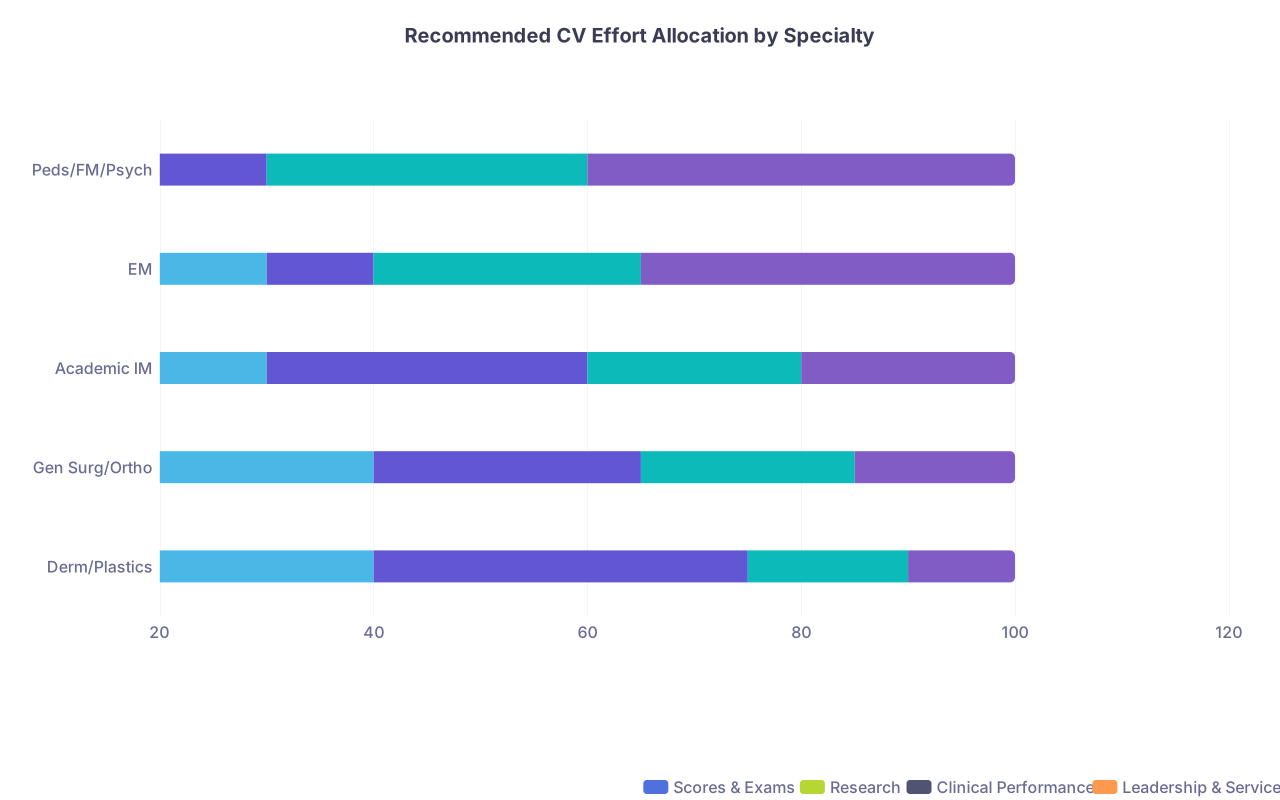
| Category | Scores & Exams | Research | Clinical Performance | Leadership & Service |
|---|---|---|---|---|
| Derm/Plastics | 40 | 35 | 15 | 10 |
| Gen Surg/Ortho | 40 | 25 | 20 | 15 |
| Academic IM | 30 | 30 | 20 | 20 |
| EM | 30 | 10 | 25 | 35 |
| Peds/FM/Psych | 20 | 10 | 30 | 40 |
Interpretation:
- Dermatology/Plastics: Leadership is 10–15% of your CV optimization effort at most. Your dominant levers are research and scores.
- General Surgery/Ortho: Leadership matters but after you hit high score and strong rotation marks.
- Academic IM: Balanced—leadership plus research is a strong combination.
- EM and Peds/FM/Psych: Leadership and service can legitimately take 30–40% of your “CV-building” bandwidth and still be a good investment.
This is not advice to ignore leadership for derm. It is a reminder that a 260 and two extra publications will systematically beat “great leader with mediocre numbers” in those markets.
8. How to Present Leadership Data-First on Your CV
The way you write leadership entries can make them look either fluffy or powerful. Data is the difference.
Turn vague descriptions into measurable outcomes. Examples:
Weak: “Led volunteer group at community clinic.”
Stronger:
- “Supervised 15 volunteers per week at community clinic; coordinated schedules and intake for ~900 patient visits/year.”
Weak: “Organized wellness events for medical students.”
Stronger:
- “Created monthly wellness workshop series attended by 60–80 students; post-session surveys showed 35% reduction in reported burnout symptoms over 3 months.”
Weak: “Served as class president, MS3.”
Stronger:
- “Elected MS3 class president (120 students); represented student interests on curriculum committee; led revision of clerkship feedback process resulting in 25% increase in timely evaluations.”
Those numbers are what signal seriousness to PDs who look at hundreds of CVs. You are showing management of people, time, resources, and outcomes—exactly what they want in a resident.
A simple way to pressure-test each leadership bullet:
- Does it specify scope? (how many people, visits, budget, sessions)
- Does it specify duration? (months/years)
- Does it specify outcomes? (improvements, growth, efficiency, satisfaction)
If not, you are underselling the impact—and undermining the value of leadership on your CV.
9. Common Mistakes: Where Applicants Misread the Data
I see the same errors repeat every cycle.
Over-investing in titles for ultra-competitive specialties.
You will not “leadership” your way into derm if you are 1–2 standard deviations below their usual Step 2 CK or have zero publications. The historical match data show that clearly.Under-investing in leadership for relational specialties.
Applying to pediatrics with no meaningful service or leadership and a generic CV? Programs will find you less compelling than similar-score applicants who clearly love working in teams and communities.Spreading leadership too thin.
Six minor positions are less impressive than one or two deep, multi-year roles with measurable outcomes.Not integrating leadership with your narrative.
Leadership that never shows up in your personal statement, letters, or interview explanations looks like box-checking. Strong applicants align everything: the dean’s letter, the ERAS experiences, the personal statement, and the interview discussions all reinforce the same leadership story.
10. Pulling It Together: A Simple Decision Framework
If you want a process, here is a straightforward way to decide how much and what kind of leadership to pursue based on your target field.

| Step | Description |
|---|---|
| Step 1 | Choose Target Specialty |
| Step 2 | Focus 60 percent effort on research and scores |
| Step 3 | Add 20 percent deep leadership max |
| Step 4 | Allocate 30 to 40 percent effort to leadership service |
| Step 5 | Build 1 to 2 long term high impact roles |
| Step 6 | Balanced specialties |
| Step 7 | Ensure strong scores and rotations first |
| Step 8 | Layer leadership that shows team and system skills |
| Step 9 | Is it ultra competitive and research heavy |
| Step 10 | Is it relational community oriented |
This is what I actually tell students:
If you are going for derm, plastics, neurosurgery, rad onc:
Leadership is supporting evidence. Make it real, but do not sacrifice research time for student council meetings.If you are going for EM, peds, FM, psych:
Leadership and service are not optional. They are one of your main currencies. Choose roles that touch real patients, systems, or communities.If you are going for IM, gen surg, ortho, OB/GYN, anesthesia:
Hit score and clinical thresholds first. Then use leadership to demonstrate you are someone who can run a service, not just complete tasks.
To keep yourself honest, compare your CV to a matched cohort in your target field. Look at residents’ backgrounds on program websites. Count:
- How many have visible leadership?
- What kind? How deep?
- What do their research and scores look like when disclosed?
That is your benchmark. Not what your classmates are doing. Not what the loudest person on Reddit claims.
Leadership roles do move the needle. But only in specific directions, and only when anchored to the real selection mechanics of your specialty. Treat them like any other intervention: you estimate the effect size, weigh the opportunity cost, and decide where to place your effort.
If you get that calculus right now—while you still have time to shape your CV—you set yourself up not just to match, but to match into a program that sees you as a future chief, investigator, or community leader. Building that identity starts early.
The next step is tactical: converting your existing experiences into data-rich, high-impact CV lines and aligning your leadership story with your letters and personal statements. Once you have that alignment, you are ready for the only part of this process that is less predictable than the data: the interview trail. But that is a story for another day.

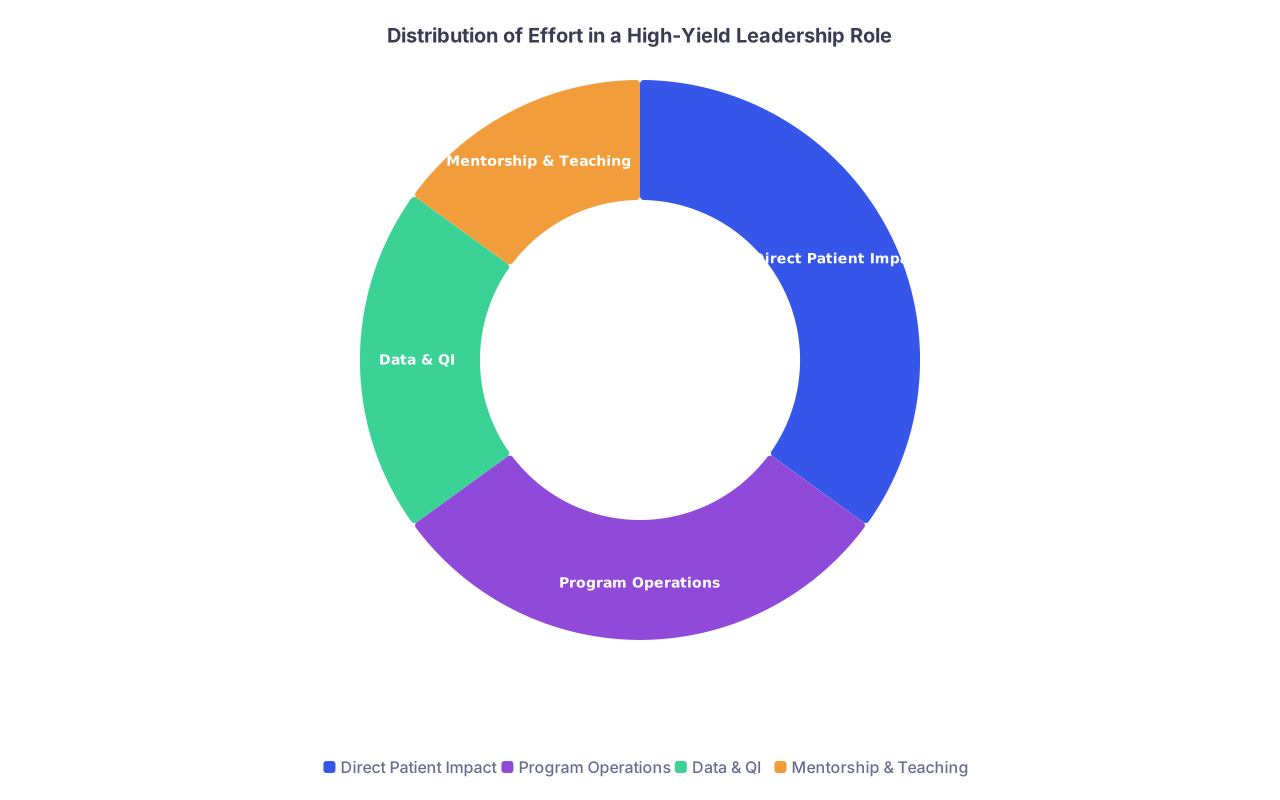
| Category | Value |
|---|---|
| Direct Patient Impact | 35 |
| Program Operations | 30 |
| Data & QI | 20 |
| Mentorship & Teaching | 15 |