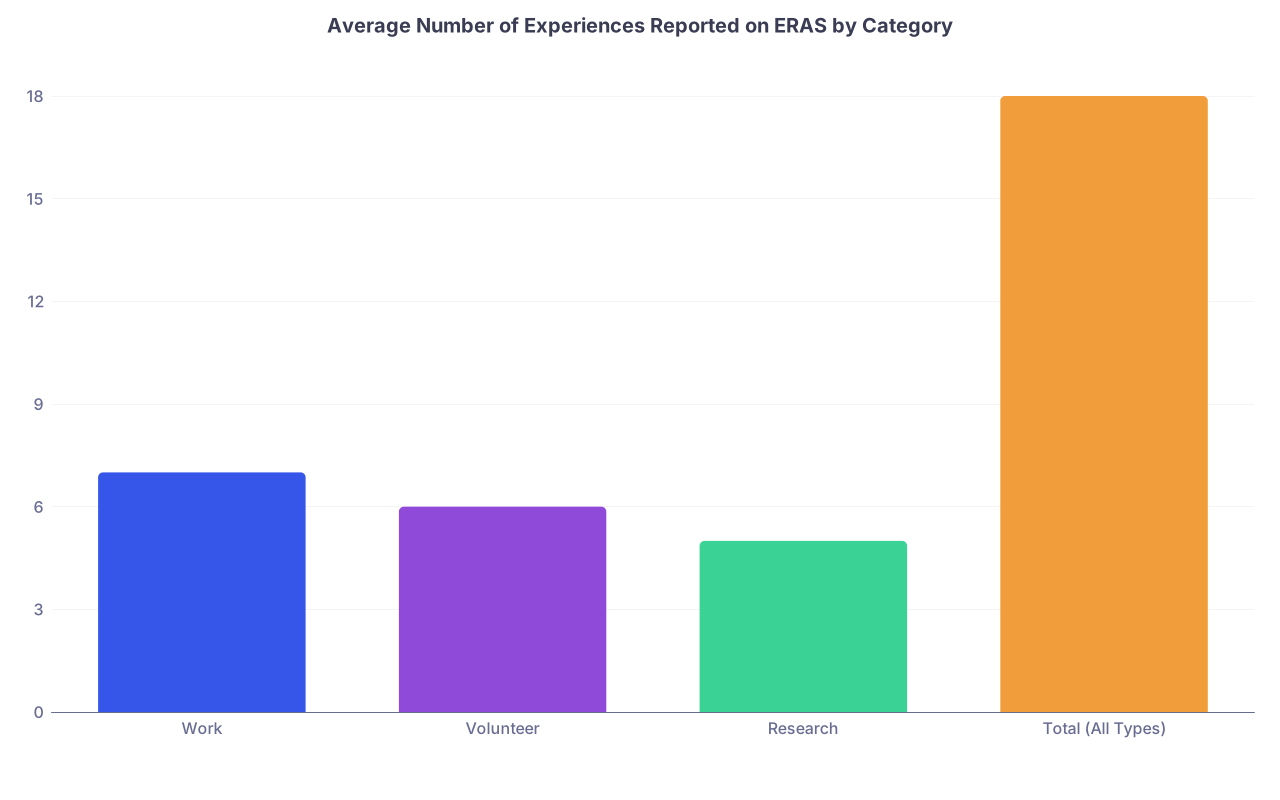
| Category | Value |
|---|---|
| Work | 7 |
| Volunteer | 6 |
| Research | 5 |
| Total (All Types) | 18 |
The biggest myth about ERAS is that matched applicants have “massive” CVs. The data show something different: most successful applicants list a moderate number of well‑sustained experiences, not 40+ scattered entries.
You are not trying to stuff a LinkedIn feed. You are trying to look like a focused resident.
Let me walk through what the numbers actually say about how many experiences matched applicants typically list on ERAS—and what that means for how you build your CV.
What Counts as an “Experience” on ERAS?
Before we start throwing numbers around, you need the categories straight. ERAS splits non‑education entries across several buckets:
- Work Experiences
- Volunteer Experiences
- Research Experiences
- Teaching (often captured as work or volunteer)
- “Other” (including hobbies, large personal projects, sometimes leadership if not tied to work/volunteer)
- Publications/Presentations/Posters (separate section, but functionally part of your “CV signal”)
When programs talk about “experiences,” they usually mean the first three: work, volunteer, and research. Publications sit in their own lane, but PDs read them in the same mental pass as experiences.
So when I say “experiences” below, I mean entries in those ERAS experience sections, not individual tasks or responsibilities.
What Do Matched Applicants Actually List?
There is no single official AAMC “average count” PDF, but we can triangulate from:
- NRMP Charting Outcomes in the Match (specialty‑specific profiles)
- AAMC data on research and volunteer participation
- Program director (PD) survey comments
- Real ERAS printouts from matched residents I have seen over several cycles
The ranges are narrower than people think.
Overall Experience Counts: A Reasonable Baseline
Across mainstream US MD applicants (non‑reapplicants) who match into core specialties (IM, FM, peds, psych, OB/GYN, gen surg prelim/categorical), the pattern usually looks like this:
- Total work + volunteer + research experiences: roughly 12–25 entries
- Median clustered around 15–18
- Outliers (true gunners or nontrads) go 25–30+, but they are not the norm
Put differently: many matched applicants have low‑to‑mid teens of experiences, not dozens.
A pretty realistic distribution for a competitive but not absurd candidate:
| Category | Common Range | Typical Midpoint |
|---|---|---|
| Work | 3–10 | 6–7 |
| Volunteer | 3–8 | 5–6 |
| Research | 2–8 | 4–5 |
| Total | 12–25 | 16–18 |
If your total count falls somewhere in that 12–25 window and you have continuity and leadership, you are in the statistical comfort zone.
Specialty Differences: Where Counts Actually Matter
The raw number of experiences is not evaluated in a vacuum. It interacts heavily with specialty choice.
Broad vs. “CV‑Heavy” Specialties
Patterns I see repeatedly:
Primary care (FM, IM community‑focused, peds, psych)
Matched applicants often have:- 4–7 work experiences
- 4–7 volunteer experiences
- 1–4 research experiences
- Total ~12–18
Emphasis is more on longitudinal service, community work, and clinical continuity than sheer volume.
Moderately competitive (OB/GYN, anesthesia, EM, categorical gen surg outside top tiers)
- 5–8 work experiences
- 4–7 volunteer experiences
- 3–6 research experiences
- Total ~15–22
Here, a bit more research and leadership usually appears.
Highly competitive fields (derm, plastics, ortho, ENT, neurosurg, rad onc, some academic IM tracks)
- 4–7 work experiences
- 3–6 volunteer experiences
- 5–10 research experiences (often multiple longitudinal labs or multi‑institution projects)
- Total ~16–25, occasionally higher
Focus is strongly research‑weighted. Not necessarily more total experiences than primary care, but a much deeper research subset.
Notice what is not happening: the number of total experiences does not double just because the specialty is competitive. The composition shifts.
Publications and Presentations: Another Signal
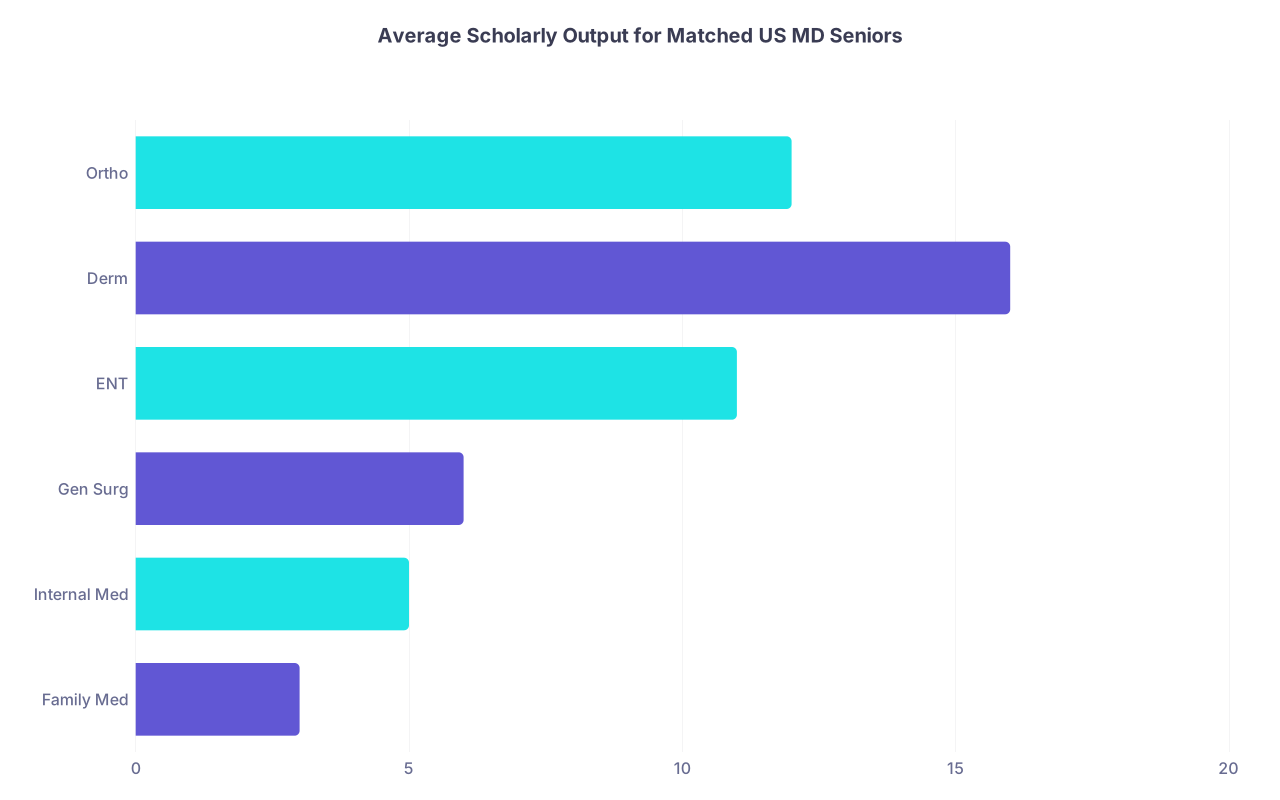
For many specialties, NRMP publishes the average number of “abstracts, presentations, and publications” for matched US MD seniors. A few rounded examples from recent cycles (values are typical ballparks, not exact for every year):
| Category | Value |
|---|---|
| Family Med | 3 |
| Internal Med | 5 |
| Gen Surg | 6 |
| ENT | 11 |
| Derm | 16 |
| Ortho | 12 |
Two important takeaways:
- A higher‑number specialty (derm, ENT, ortho) expects more research outputs, not just more ERAS “experience” items.
- Applicants sometimes over‑translate these numbers into “I need 16 different research experiences.” No. Those 16 items can come from 2–4 long‑term projects that produced multiple abstracts/posters/papers.
How Many Experiences Is “Too Many”?
There is a quiet cutoff most PDs will never write into a guideline, but you see it in their faces during rank meetings.
When I look at ERAS PDFs side by side, two candidates stand out for the wrong reasons:
- Applicant A lists 34 experiences, each 1–3 months, scattered across medical school and undergrad.
- Applicant B lists 15 experiences, 8 of them running >12 months, with multiple promotions and leadership roles.
Applicant B almost always reads as more serious, more reliable, more like a resident.
Once you push past about 25–30 experiences, the signal flips:
- PDs start to suspect padding, box‑checking, or an inability to commit.
- The narrative becomes “busywork collector” rather than “focused future colleague.”
I have literally heard a PD say: “If they had time to do 30 different things, how much time did they spend actually learning medicine?”
So there is a practical upper bound:
- Ideal zone: ~12–22 total experiences
- OK but watchful: 22–28 (needs strong continuity and coherence)
- Red flag territory: 30+ unless you have an unusually long timeline (e.g., prior career with 5+ years of work pre‑med)
Time Distribution: Longitudinal vs. One‑Offs
The raw count is only half the data. Duration and intensity matter more.
There is a clear pattern in strong ERAS applications:
- A few core experiences lasting 12–36+ months
- Several others in the 6–12 month range
- Only a handful of <6 month entries, usually well‑explained (e.g., summer research, short‑term camp, away rotation–linked activities)
Programs read a timeline, not a list. They mentally ask:
- Where were you spending most of your time each year?
- Do you stick with things long enough to matter?
- Is there progression—member → leader → creator?
A messy ERAS with 20+ entries all 2–3 months long screams: “I dabble and then quit.”
If you are wondering whether to list every 3‑week health fair and 1‑day event, here is the practical rule: very short‑term activities usually subtract more than they add once you cross ~15 entries. Better to aggregate (“Volunteer, City Health Fair Series”) or leave off entirely unless it was truly distinctive.
How Many Experiences Should You List?
Let me be blunt. You probably fall into one of three buckets, and the strategy differs for each.
1. You Have Fewer Than 10 Total Experiences
Example:
- 3 work experiences (clinical jobs, tutoring, paid TA)
- 3 volunteer experiences
- 2 research experiences
You are under the typical matched range. That does not mean you cannot match, but it changes the story you must tell.
Datawise, programs will look more closely at:
- How longitudinal and responsible those entries are
- Whether there are obvious gaps in time
- Whether your experiences match your specialty choice (e.g., ANY psych‑related work for psych, ANY surgical exposure for surgery)
If you are very early in medical school or preclinical:
- You have time. Target quality growth over raw count. Add 1–2 substantial experiences per year, not 6 tiny ones.
If you are entering the ERAS year:
- Fill obvious holes smartly:
- Add 1–2 ongoing activities you can maintain through application season
- Avoid 3‑month checkbox projects that will look desperate
The goal should be to end up in at least the 12–15 experience range by submission, with several entries ≥1 year.
2. You Are in the 12–22 Experience Zone
This is where most matched applicants sit.
Your task is not to increase the count. It is to improve the shape of the data:
- Make sure every year of med school has at least 1–2 visible, ongoing commitments
- Emphasize leadership, teaching, and initiative within existing entries
- Trim or merge redundant one‑off events so the list reads cleanly
You do not get extra points for turning 16 good experiences into 26 mediocre‑looking ones.
3. You Have 25+ Experiences and Feel Proud of It
I have seen this a lot with gunners who were told “more is better.” The data do not support that for perception.
If you are at 25+:
- Very carefully analyze which experiences would survive the “would a PD care?” test.
- Group similar short‑term or recurring events:
- Instead of listing 6 separate health fairs: one “Health Outreach Volunteer, City X” experience with a 2‑year span and cumulative hours.
- Remove purely ornamental entries:
- One‑day workshops
- Micro‑shadowing (especially in med school, where your entire curriculum is basically shadowing with responsibility)
- Activities that contradict your narrative (applying to ortho but 10 entries are poetry clubs with no medical link and no leadership)
A trimmed, coherent 18‑entry ERAS almost always reads stronger than an unfiltered 32‑entry dump.
Hours and Depth: The Unspoken Variable
Most applicants obsess over “how many experiences.” PDs care more about how much time you actually put into your key experiences.
ERAS forces you to enter:
- Start and end dates
- Estimated hours per week
- Total hours (calculated)
The pattern I see in strong matched applicants:
- Several experiences with 100–500+ total hours
- A few flagship ones with >500–1000 hours (e.g., long‑term employment, years‑long research)
- Only a few entries under 50 hours, and those usually have a compelling explanation
Low‑hour, short‑term entries are the main reason an application with 20+ experiences can still feel “thin.”
For improving your CV:
- Ask: “If I cut this, would my total clinical / research / leadership hours still look solid?”
- If the answer is yes, that short entry is probably safe to drop.
Strategic Composition by Specialty
Let’s get more concrete. Suppose you are targeting different specialties. How should your final ERAS mix look?
Internal Medicine (non‑super‑competitive academic tracks)
A typical strong matched applicant often ends up near:
- Work: 5–8 entries
- Mix of clinical (MA, scribe, CNA, clinic assistant) and teaching (TA, tutor).
- Volunteer: 4–7 entries
- Longitudinal free clinic / community health work plus some focused projects.
- Research: 2–5 entries
- Ideally 1 long‑term project + 1–2 smaller side projects.
Total: around 14–20 experiences, with 2–4 flagship items that carry most of the narrative.
Emergency Medicine
- Work: 5–9 entries (EMT, ER tech, night shift jobs look good).
- Volunteer: 3–6, often EMS, free clinic, crisis lines.
- Research: 2–4, EM‑related if possible, but not mandatory at every program.
Total: 13–19 experiences. Programs like seeing comfort with chaos: longitudinal ED work, EMS, leadership in fast‑paced environments.
Dermatology / Ortho / ENT / Plastics
Here, the number of research experiences goes up more clearly:
- Work: 3–6 (often traditional clinical jobs and TA).
- Volunteer: 3–5 (quality matters more than volume).
- Research: 5–10 separate experiences is not unusual:
- Multiple labs
- Multi‑site studies
- Chart reviews that spin off into several abstracts/papers.
Total: often 16–24, but with research skew. Someone with 18 total experiences where 8–10 are research is very typical in these specialties.
How to Improve Your CV Efficiently (Not Just Make It Longer)
You are in the “HOW TO IMPROVE YOUR CV FOR RESIDENCY” category, so let’s pin down, with some numbers, what actually moves the needle.
High‑Leverage Additions
If you have 6–12 months before ERAS submission, data from matched profiles suggest these give the best return per hour:
One longitudinal clinical role
- Aim for 150–400+ hours over the year.
- Scribes, clinic assistants, on‑campus student‑run clinic leads.
- This single line can outweigh 3–4 minor shadowing experiences.
One sustained leadership or teaching role
- Class officer, interest group president, course TA, head of student‑run clinic shift.
- Even if only 2–4 hours/week, over 6–12 months this becomes a 100–200 hour high‑impact entry.
A focused research project with a clear endpoint
- One new project that realistically yields at least a poster or abstract within the timeline.
- Better to have 2 research experiences with output than 5 “ongoing” with nothing.
Contrast this with low‑leverage padding:
- 6 separate 1‑day volunteer events, each 6–8 hours → 36–48 hours and 6 messy ERAS entries that scream padding.
- Random committee memberships where you attend 3 meetings total.
- Short‑term “assistant to the assistant” roles with no real responsibility.
Those do not change your competitiveness profile in any meaningful way.
Visualizing a Healthy ERAS Profile
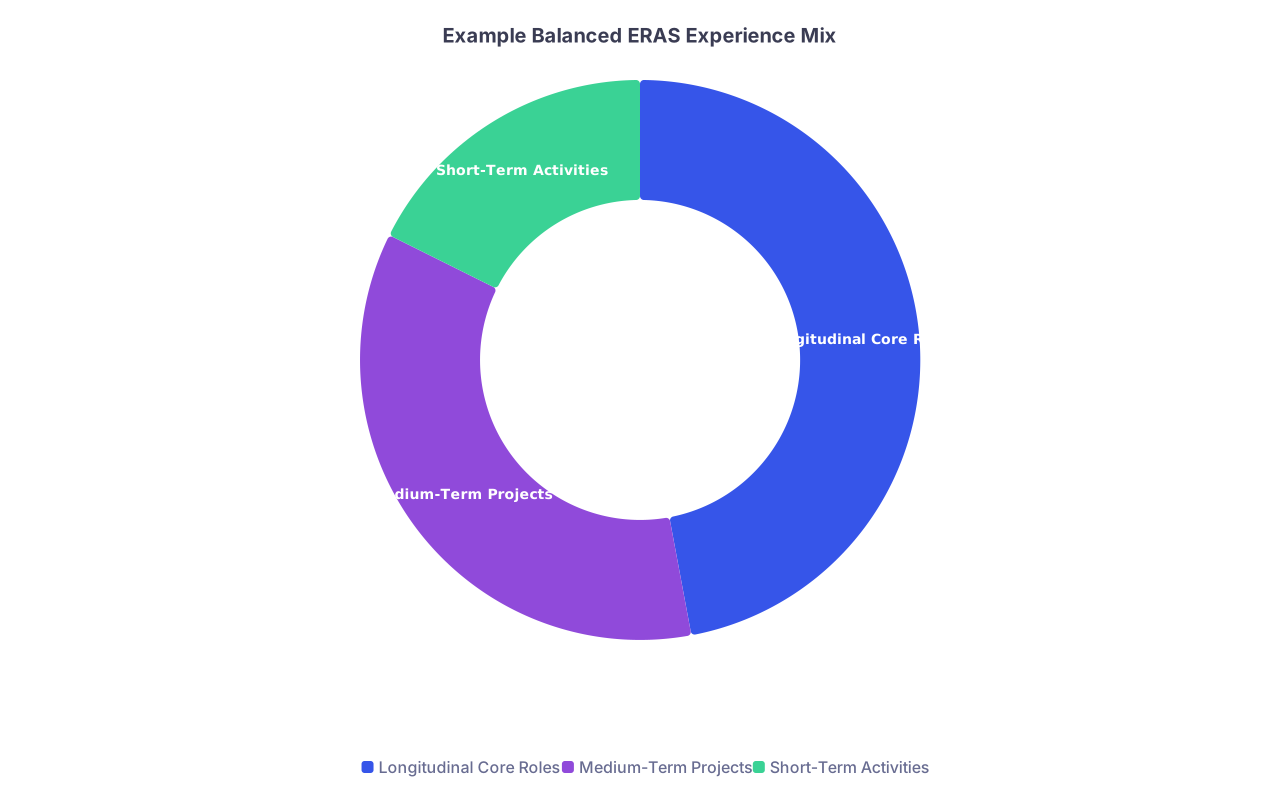
To give you a mental model of balance, here is what a solid, competitive (but not insane) ERAS breakdown might look like for a US MD senior matching a mid‑competitive specialty:
| Category | Value |
|---|---|
| Longitudinal Core Roles | 8 |
| Medium-Term Projects | 6 |
| Short-Term Activities | 3 |
Interpretation:
- 8 experiences running ≥12 months (jobs, major leadership, long‑term research, major volunteering).
- 6 experiences in the 6–12 month range (projects, committees, electives with extended follow‑up).
- 3 short‑term but meaningful activities (e.g., a distinct summer research project, an away experience that is truly discrete).
Total: 17 experiences. Comfortably in the matched range, with a strong continuity signal.
Final Numbers You Should Remember
Strip away the noise, and three data‑driven points matter:
- Most matched applicants list roughly 12–25 total experiences, with 15–18 being common. Volume is moderate, not extreme.
- Depth and duration beat raw count. A few 200–1000‑hour longitudinal roles push your application further than 10 short, 20–40 hour entries.
- Past ~25–30 experiences, you are more likely to hurt than help yourself unless your history is unusually long and coherent. Trim, merge, and focus on a narrative that makes you look like a reliable resident, not a professional activity collector.