
The usual Step study advice completely ignores people who have to work.
If you’re in med school, working part-time, and trying to prep for boards, your problem is not motivation. It’s time, energy, and the wrong kind of study plan. You do not need “more resources.” You need a lean system that survives after a 10-hour day that included lectures, notes, and a shift.
Let me walk you through exactly how to do that.
1. The Hard Reality of Working During Med School
If you’re working part-time in med school, you’re playing the game on hard mode. Pretending otherwise is stupid.
Here’s what you’re up against:
- Less total study time than your classmates
- More cognitive fatigue when you do sit down to study
- Zero margin for wasted effort (extra videos, side resources, “nice to have” stuff)
- Extra mental load: schedules, income, maybe family responsibilities
So your strategy has to be different. Not “slightly adapted.” Different.
The goal is simple:
One primary Qbank + one core text + one flashcard system. Everything else is suspect unless it proves its value.
If a resource doesn’t directly raise your probability of getting a question right on test day, it’s out.
2. The Core Lean Resource Stack (No More Than This)
If you’re working even 10–20 hours a week, this is your realistic upper limit.
| Component | Primary Option | Backup Option |
|---|---|---|
| Qbank | UWorld | Amboss |
| Core text | First Aid/Boards & Beyond | USMLE-Rx book/video |
| Flashcards | Anki (mature deck) | Custom small deck |
Let’s break it down.
2.1 Qbank: Your Non-Negotiable
If you work, your Qbank is not just “practice.” It’s your main learning tool.
You should be living inside one of these:
- UWorld (USMLE or COMLEX-specific) – default choice
- Amboss – slightly faster interface and better for “in the moment” reference
Pick one and commit. Don’t do this nonsense where you “sample” 3–4 qbanks because you’re anxious. You don’t have the time.
Your rule:
If it doesn’t make me better at questions like the ones on my exam, I’m not doing it.
2.2 Core Content: One Spine Only
You get one “spine” resource for content:
- Step 1: First Aid + maybe Boards & Beyond videos (selectively)
- Step 2/Level 2: OnlineMedEd or similar high-yield outline resource
Key thing: you are not “watching all the videos.” You are only using them:
- When you’re consistently missing a topic in Qbank
- When your class exam is heavily tied to a certain source
- When you feel truly lost on a concept
Otherwise, your content learning happens through Qbank + quick look-ups in First Aid/AMBOSS.
2.3 Flashcards: Done the Smart Way
You are allowed exactly one flashcard system.
Realistically: Anki, shared deck (e.g., AnKing for Step 1, updated Step 2 decks).
Your rules if you’re working:
- You don’t make massive new decks. You don’t have the time.
- You do suspend aggressively. If a card feels trivial or low-yield, kill it.
- Daily reviews capped: 30–45 minutes max, ideally broken into two sessions.
You’re not trying to be the Anki hero. You’re trying to pass or crush boards while holding a job.
3. Weekly Structure When You’re Working
The biggest mistake I see: people try to follow the same plan as their non-working classmates and just “squeeze it all in.” That fails fast.
You need a rhythm that respects your energy.
Let’s say you’re working 15 hours a week: two 5-hour shifts + one weekend shift. Adjust as needed.
3.1 Basic Weekly Template
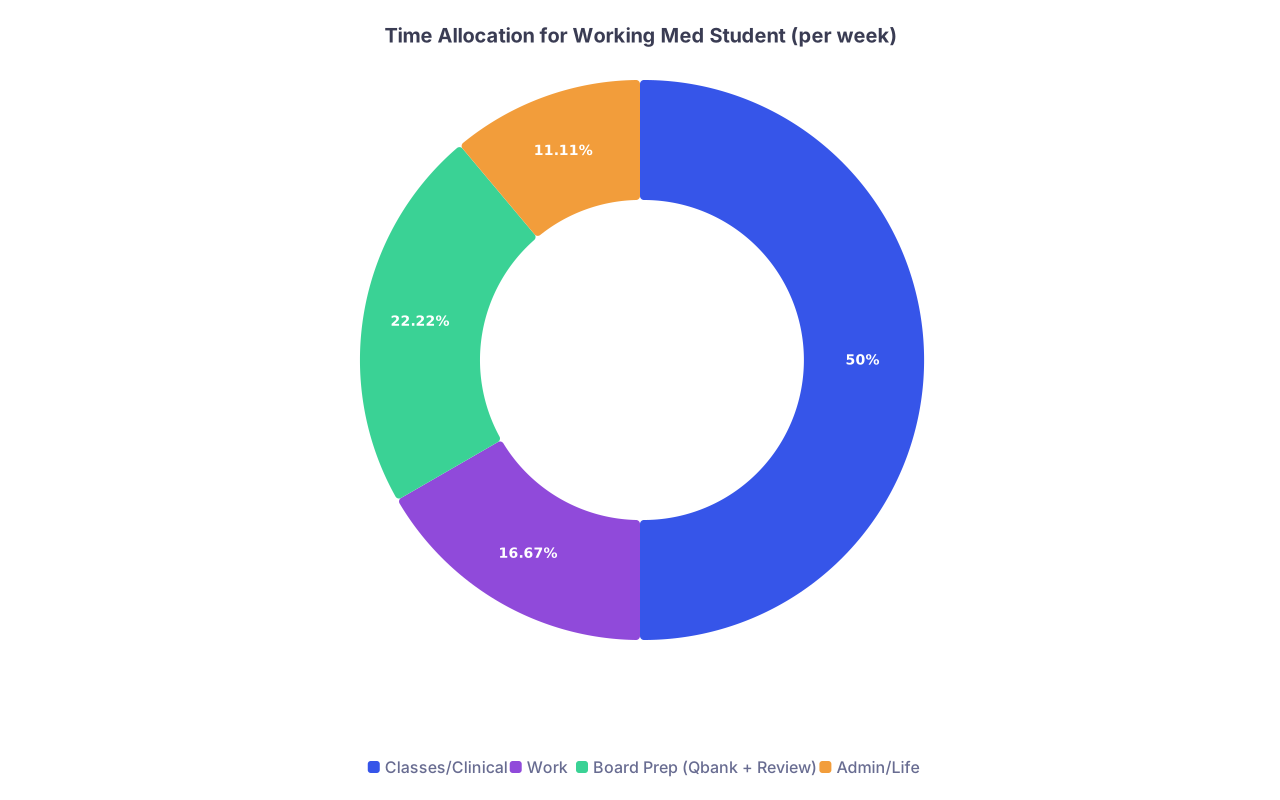
| Category | Value |
|---|---|
| Classes/Clinical | 45 |
| Work | 15 |
| Board Prep (Qbank + Review) | 20 |
| Admin/Life | 10 |
Rough pattern:
- Weekdays with work (e.g., Mon, Thu):
- 30–45 min Anki in small chunks
- 10–20 Qbank questions, max
- Weekdays without work:
- 30–45 min Anki
- 20–40 Qbank questions
- Short, targeted video or text review if needed
- Weekend:
- One heavier board day: 40–60 Qs + review
- One lighter or off day: admin, catch-up, rest
The important shift:
You’re measuring in questions completed and reviewed, not hours “studied.”
4. Daily Blueprint: What To Actually Do
You walk in the door after work. You’ve been up since 6. You’re tired and a little angry at everything.
This is where most people either quit or doom-scroll. You can’t afford that.
Here’s the structure that actually works when you have nothing left in the tank.
4.1 Priority Order for a Tired Brain
On a weekday:
- Anki reviews (short bursts, 10–15 minutes at a time)
- A small, pre-defined question block
- Only if needed: quick content review for your most-missed topic
Do not start with videos “to ease in.” They expand to fill whatever time you give them.
4.2 What a Real After-Work Study Session Looks Like
Example: Thursday after a 5-hour shift, already had class that morning.
Timeline, realistically:
- 6:30–6:45 pm – decompress, food, water, quick scroll
- 6:45–7:00 pm – Anki set #1 (cards limited to 20–30 at a time)
- 7:00–7:35 pm – 10–15 Qs timed (mixed or subject, depending on phase)
- 7:35–8:05 pm – Review those questions, make exactly 0–3 new cards from key misses
- 8:05–8:15 pm – Short Anki set #2 or just stop
Total: about 90 minutes of focused work. That’s it. Then you stop. Because tomorrow you have to do it again.
You’re playing a consistency game, not a heroics game.
5. How To Aggressively Cut Resource Bloat
If you’re working, “but my friends use it” is not a reason to touch a resource.
Here’s the kill list I’d enforce if we were sitting down together:
- Multiple full lecture series (B&B + Pathoma + Sketchy + Kaplan) – no
- Reddit “recommended resource” chains where people list 12 things – absolutely not
- Rewatching lectures “to feel better” – almost always wasted time
- Passive note copying or rewriting – nope
Instead, every resource must justify its existence. Ask:
- Has this resource directly helped me answer questions I used to miss?
- Does this resource overlap heavily with something I’m already using?
- Can I get 80–90% of the benefit from something faster?
If you say yes to #2, you drop one of them. You do not need two explanations of the renin-angiotensin system from two different lecturers.
6. Adapting During Dedicated While Still Working
Some of you do not have the luxury of “true” dedicated. You’re working through it—financially or contractually stuck.
So you cannot run a 12-hour study schedule like the sample ones floating around.
6.1 Realistic Dedicated Targets If You’re Working
If you’re working ~10–20 hours/week during dedicated:
Daily realistic board targets:
- 40–60 high-quality Qbank questions with full review
- 30–45 minutes Anki
- 30–60 minutes focused content clean-up for weak areas
That’s it. If you hit that, consistently, you’re in a good place.
6.2 Sample Dedicated Day (With a 5-Hour Shift)
Let’s say shift is 2–7 pm.
Morning:
- 8:00–8:30 – Anki
- 8:30–10:00 – 20–25 Qs, timed or tutor
- 10:00–11:00 – Review those questions
Afternoon/evening:
- 7:30–8:15 – 10–15 Qs
- 8:15–8:45 – Review those
- 8:45–9:15 – Short, high-yield video segment or focused review on your weakest system
Again, not heroic. Just consistent.

| Step | Description |
|---|---|
| Step 1 | Wake |
| Step 2 | Anki 30 min |
| Step 3 | Qbank 20-25 Qs |
| Step 4 | Review 20-25 Qs |
| Step 5 | Work Shift |
| Step 6 | Qbank 10-15 Qs |
| Step 7 | Review 10-15 Qs |
| Step 8 | Targeted Content 30 min |
7. Handling Class Exams + Boards While Working
Now the fun part: you’re not just prepping for Step/Level. You also have school exams, which often do not perfectly match board style.
You can’t “do everything.” So you prioritize like this:
7.1 Preclinical Years (Step 1 / Level 1 on Horizon)
Priority stack:
- Pass your courses – non-negotiable
- Align board prep where it overlaps with course content
- Only add extra board topics if you’re comfortably passing
Concrete approach:
- For each block (e.g., cardio), identify 3 things:
- Required school resources (lecture notes, syllabus, faculty handouts)
- Board-aligned resources (First Aid, Pathoma/Boards & Beyond chapters for that system)
- Qbank questions tagged to that system
You do just enough school-specific studying to pass, then weight the remaining time toward board-style questions and First Aid coverage of that system.
7.2 Clinical Years (Step 2 / Level 2 + Shelf Exams)
You’re tired, you’re on rotation, maybe still working extra shifts. Prioritization is brutal here.
Per rotation:
- One main resource (e.g., OnlineMedEd + notes)
- One Qbank channel (UWorld Step 2 blocks filtered to that rotation)
- Minimal extras (maybe one small book like Case Files, if time allows)
Again, shelves and Step 2 are both question exams. Qbank is not optional.
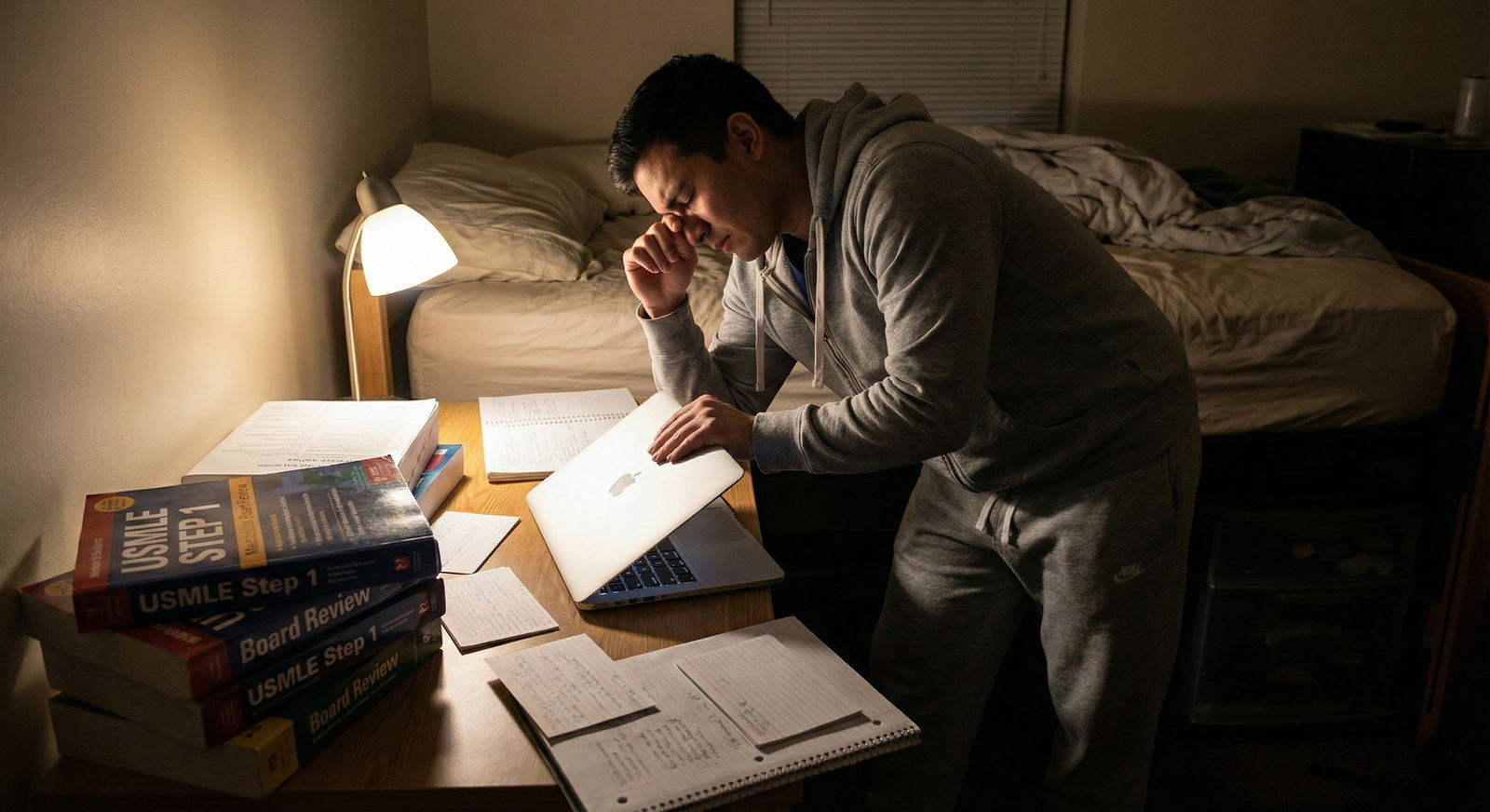
8. Energy Management: The Real Bottleneck
Working part-time plus med school is less about time and more about energy. If you burn yourself out in month 1, none of the plans matter.
A few non-negotiables from what I’ve seen actually matter:
- Sleep is not the variable you cut. Under 6 hours repeatedly and your Qbank accuracy will tank.
- You pre-decide how many questions you’ll do before you start the block. Otherwise you’ll quit early.
- You protect one half-day per week where you don’t touch board material. Do life things. See a human. Do laundry.
This isn’t soft advice. It’s performance maintenance.
9. Communication and Boundaries Around Work
If you’re working, that job cannot be “whenever they need you.” It will eat your study blocks.
You need:
- Fixed shifts where possible
- Clear limits (e.g., max 15–20 hours/week during term, maybe less in dedicated)
- The backbone to say no when they try to inch up your hours
Script you can actually use with a boss/manager:
“I’m in an intense period with board exams coming up. I can commit to [X] hours per week reliably—beyond that, my schedule will fall apart and I’ll have to cut back entirely. I’d rather set a realistic limit and stick to it.”
You might feel guilty. That’s fine. Guilt doesn’t help you on test day.
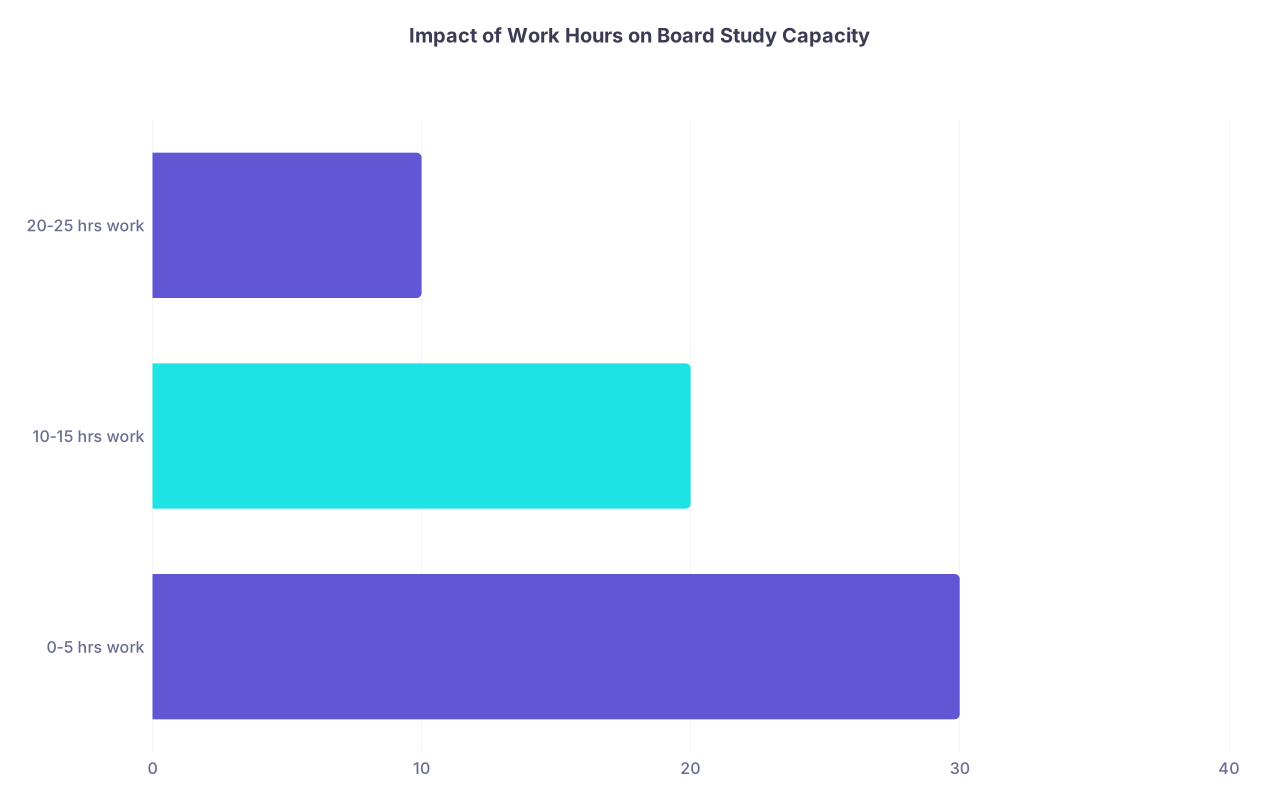
| Category | Value |
|---|---|
| 0-5 hrs work | 30 |
| 10-15 hrs work | 20 |
| 20-25 hrs work | 10 |
Numbers here = average hours per week you can realistically devote to real board prep (Qbank + review), not “time in front of laptop.”
More work = fewer high-quality study hours. You can’t escape that math. You just plan around it.
10. When to Add or Drop Resources
You can make small adjustments as you go, but you need guardrails.
Add a resource only if:
- You have evidence it addresses a recurring weak area
- It can be slotted into an existing time block without expanding your total hours
- It replaces something else (you swap, not stack)
Drop a resource if:
- You haven’t touched it in 2–3 weeks
- It’s not clearly improving your question performance
- You dread it so much you procrastinate studying at all
You’re not optimizing for FOMO. You’re optimizing for score per minute.
11. A Sample 7-Day Plan For A Working M2 (Integrated With Work)
Let me make this painfully concrete.
Assume:
- Class: ~8–4 most weekdays
- Work: Tue 6–10 pm, Thu 6–10 pm, Sat 9–3
- Goal: Solid Step 1 score, not perfection
Sample week:
Monday (no work)
- Before class: 20–30 min Anki
- After class: 60–75 min Qbank (15–20 Qs + review)
- Short video or reading: 20–30 min on weakest topic from that block
Tuesday (evening shift)
- Before class: 20–30 min Anki
- After class / before work: 45–60 min Qbank (10–12 Qs + quick review)
- After work: nothing. Bed.
Wednesday (no work)
- Morning: 20–30 min Anki
- Afternoon: 80–90 min Qbank (20–25 Qs + review)
- Evening: 20–30 min review in First Aid/AMBOSS for patterns you keep missing
Thursday (evening shift)
- Same as Tuesday, maybe even slightly lighter if you’re dragging.
Friday (no work)
- Morning: Anki
- Afternoon: 20–25 Qs
- Evening: Review, then done. Maybe catch up on any key lectures if absolutely needed for class.
Saturday (day shift)
- Morning: 20–30 min Anki
- After work: light day. Maybe 10–12 Qs or nothing board-related if you’re wrecked.
Sunday (board-heavy day)
- 2–3 short Qbank blocks to hit 30–40 Qs total
- Full review of all questions
- 30–60 min focused content review
- Anki sprinkled in
Is it pretty? No.
Is it doable for months? Yes.
FAQ (Exactly 3 Questions)
1. Should I delay my board exam because I’m working and feel behind?
Delay only if two things are true: your Qbank performance is well below passing range and you genuinely have a path to more high-quality study time in the delay window. If your work and life situation are not changing, pushing the exam back 4–8 weeks just prolongs stress without fixing the root constraints. Often the better move is to tighten your resource list and get ruthless about consistency.
2. Is it worth buying a second Qbank if I’m working part-time and already behind?
Almost never. A second Qbank sounds productive but, in your situation, usually becomes an expensive guilt object. You’re far better off fully exploiting one Qbank—redoing incorrects, deeply understanding explanations, and tracking patterns in your misses—than half-using two. Depth beats breadth when your hours are capped.
3. How do I know if my lean strategy is actually working?
You track three things weekly: average Qbank percentage (on mixed/timed blocks), how often you’re hitting your planned question counts, and how your practice NBME/COMSAE/CCSSA scores trend every 3–4 weeks. If Qbank % and practice scores are creeping up or holding steady in a safe range, your lean approach is effective—even if you feel behind compared with classmates who seem to study all day.
Key points to leave you with:
- Working in med school means you cannot afford resource bloat. One Qbank, one core content source, one flashcard system.
- You win with consistency and ruthless prioritization, not heroic 10-hour cram days you can’t repeat.
- If a resource doesn’t help you answer more questions right, it doesn’t belong in your life right now.