
What do you do when you realize halfway through second year that your “COMLEX-only” study plan will not cut it for USMLE?
You’re sitting there with a stack of OMM notes, a COMBANK subscription, and that one COMLEX review book everyone talks about. Then your classmates start talking NRMP data, competitive specialties, and “you really should take USMLE if you want options.”
Now you’re stuck in the worst spot: you’ve invested months in a DO-only approach, but your future might require both exams. And you do not have time—or money—to burn everything down and restart.
Good. Let’s fix that.
This is the playbook for switching from COMLEX-only prep to a combined USMLE/COMLEX strategy without losing your mind, failing your exams, or buying every shiny resource on the internet.
Step 1: Get brutally clear on your situation
Before you touch another resource, you need to know exactly where you stand. Not vibes. Data.
Ask yourself these three questions and answer them honestly:
- What’s my timeline?
- What’s my baseline?
- What’s my specialty reality?
1. Timeline audit
Pull up your calendar. Not in your head—on the screen.
You need three dates (or at least rough windows):
- Planned COMLEX Level 1 date
- Planned USMLE Step 1 date (or when it would be)
- Start of dedicated study period
If you do not have a USMLE date, assume this: you want USMLE Step 1 within 7–10 days of COMLEX Level 1, or vice versa. The closer they are, the more efficient your study overlap.
If your planned dates are more than 4–6 weeks apart, you’ll end up doing extra work. Still doable, but we’ll have to adjust the plan.
2. Baseline audit
You can’t switch strategies in the dark. You need practice numbers.
- Have you done any NBME-style USMLE questions?
- Have you done any COMSAE or COMFIRST-type questions?
- How are you doing in your current COMLEX question bank (percent correct, not just number of questions done)?
If you have zero USMLE-style experience, assume your “real” performance is lower than your COMLEX Qbank percentage suggests. The style and depth are different.
3. Specialty reality check
Here’s where people lie to themselves.
If you’re even thinking about:
- Derm
- Ortho
- Plastics
- ENT
- Urology
- Radiology
- Anesthesia (at competitive programs)
- Any academic program in a big city
…you should behave as if you need USMLE. Not optional. Required for options.
If your realistic goal is FM, IM, peds, psych, or community programs and your school has solid placement with COMLEX alone, you still might benefit from USMLE—but it’s less critical. But since you’re reading this, I’m going to assume you want the option.
Step 2: Stop the COMLEX-only drift
Most DO-only plans have the same weak points when you try to add USMLE:
- Too much OMM early, not enough core pathophys
- Too COMLEX-style questions, not enough NBME-style
- Not enough micro, pharm detail, or biochem clarity
- Too much scattered resources, not enough integration
So you need to pause the drift.
For the next week (before you overhaul your resources), make these changes:
- Cap OMM to 20–30 minutes per weekday. Not 2 hours of viscerosomatics.
- Start doing some USMLE-style questions daily (even 10–20) from a proper qbank.
- Reduce passive content time (videos/reading) in favor of questions and review.
You’re shifting the center of gravity from “DO-specific” to “board-general.”
Step 3: Build a lean dual-resource spine
You do not need 10 resources. You need a core spine that serves both exams, with a couple of DO-specific add-ons.
Here’s the structure I’ve seen work repeatedly:
- One primary question bank focused on USMLE-style questions
- One secondary question bank or mode for COMLEX-style (if needed)
- One core reference for concepts (like a board review book)
- One high-yield DO/OMM resource to layer in later
- A schedule that rotates USMLE + COMLEX emphasis strategically
Let’s compare the typical combos:
| Slot | US-Heavy Option | Balanced Option | Notes |
|---|---|---|---|
| Primary Qbank | UWorld USMLE | Amboss (USMLE mode) | Depth vs flexibility |
| Secondary / COMLEX | COMBANK or COMQUEST | TrueLearn COMLEX | Use 1 COMLEX-style resource |
| Core Reference | First Aid / Boards&Beyond | Boards&Beyond + Sketchy | Use 1 main content framework |
| OMM / DO-specific | Savarese | OMM-specific qbank | Add late, not early |
| Assessment | NBME + COMSAE | NBME + COMSAE | Need both types if possible |
If you already bought COMBANK or COMQUEST, fine. Keep it. But that becomes your secondary now, not your main driver.
Your primary learning engine for both exams should be a strong USMLE-style qbank (UWorld, Amboss, or similar). Why? Because USMLE-style mastery backfills almost everything COMLEX tests—just not the OMM, and with less guessing/ambiguous answer stems.
Step 4: Reframe how you think about the two exams
Right now you probably think:
- “COMLEX is weird and vague”
- “USMLE is more detailed and organized”
Not wrong. But useless.
Here’s the only framing that matters:
- USMLE = deeper pathophys, mechanisms, micro, pharm, biostats
- COMLEX = same diseases, less clean stems, plus OMM, ethics, and random practice details
So your sequence should be:
- Learn for USMLE depth.
- Translate to COMLEX style and add OMM.
Not the other way around.
Step 5: Concrete weekly structure for a dual-prep switch
You probably want something you can actually follow tomorrow. So here’s a template that works when you’re mid-M2 or entering dedicated.
Assume:
- 8–10 study hours per day on dedicated weekdays
- USMLE and COMLEX planned within ~10 days of each other
Sample Week (Transition Phase – 6–8 weeks before exams)
Daily baseline:
- 40 USMLE-style questions (UWorld/Amboss), timed, random or system-based
- 10–20 COMLEX-style questions (COMBANK/TrueLearn) a few days per week
- 60–120 minutes video/reading tied directly to your missed questions
- 20–30 minutes OMM review
- 15 minutes biostats/ethics once daily, or every other day
Breakdown could look like this:
Morning:
- 40 USMLE-style questions block (timed, tutor OFF)
- Full review of explanations + annotation into your reference (First Aid/Boards&Beyond notes)
Afternoon:
- Focused content (video/reading) on topics you’re repeatedly missing
- 10–20 COMLEX questions in the same general topics
- OMM/spine mechanics or viscerosomatic review (Savarese or equivalent)
Evening:
- Light: flashcards (Anki if you’re already using it), quick micro/pharm hits
- Short OMM drill (Chapman’s points, key counterstrain positions, etc.)
Once per week:
- One 40-question COMLEX-style block (random) just for test style calibration
- One 40-question additional USMLE block in your worst subject
Step 6: Handle content gaps created by DO-only prep
Let me be blunt: many DO curriculums and COMLEX-only plans under-emphasize three things that USMLE will punish you for:
- Detailed biochemistry and molecular mechanisms
- Deep pharmacology (mechanisms, adverse effects, weird associations)
- Biostatistics and epidemiology (proper NBME flavor)
So if you’re switching tracks, you have to explicitly patch those.
Biochem / Molecular
No, you don’t need to love it. You just need a structured hit:
- Use a short, high-yield resource (e.g., dedicated biochem section in Boards&Beyond or another concise video series)
- Spend 30–45 minutes a day on biochem for 2–3 weeks
- Immediately reinforce with questions—never watch passively
Focus: pathways that actually show up on exams (urea cycle, glycogen storage diseases, lipid transport, collagen disorders, vitamin deficiencies, etc.). Not every enzyme.
Pharm
You cannot COMLEX-hand-wave pharm and expect USMLE to forgive you.
Fix:
- Start building drug-class tables: drug → mechanism → key use → key side effect
- Do pharmacology-tagged questions deliberately for 1–2 weeks
- Use flashcards for mechanisms and side effects—spaced repetition matters here
Rough rule: if a class of drugs exists, you should know at least one prototypical member cold.
Biostats/Epi
USMLE is annoyingly formula- and concept-heavy here, COMLEX is more erratic.
Your move:
- Learn the core formulas (sensitivity, specificity, PPV, NPV, LR+, LR–, NNT/NNH)
- Do 5–10 pure biostat questions 3–4 days per week
- Practice interpreting graphs, Kaplan-Meier curves, and study designs
This is the easiest section to turn from a weakness to a strength with focused practice.
Step 7: Practice test strategy – when and what
You now need both NBME-style and COMLEX-style practice exams. You cannot just take COMSAE and pray.
Here’s a simple sequence if you have ~8–10 weeks before exams:
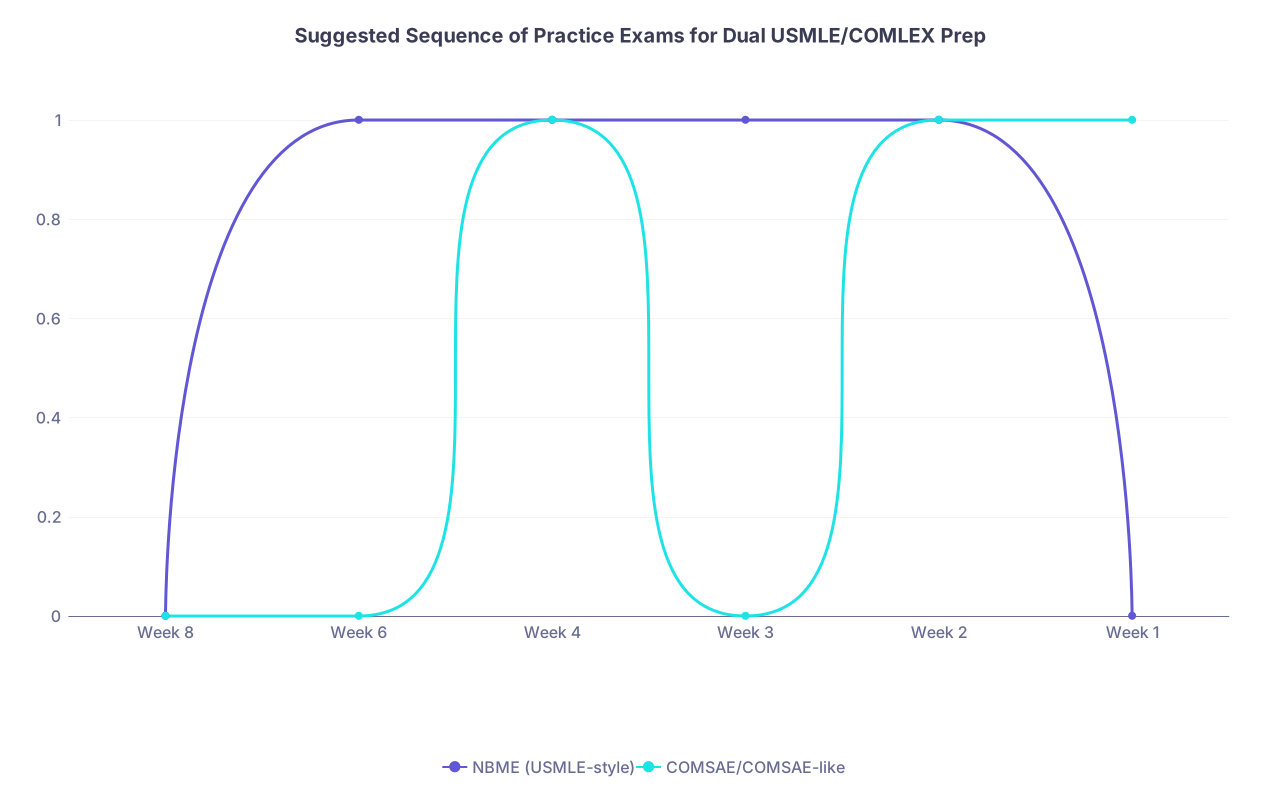
| Category | NBME (USMLE-style) | COMSAE/COMSAE-like |
|---|---|---|
| Week 8 | 0 | 0 |
| Week 6 | 1 | 0 |
| Week 4 | 1 | 1 |
| Week 3 | 1 | 0 |
| Week 2 | 1 | 1 |
| Week 1 | 0 | 1 |
Interpreting that as an actual plan:
- Week 6: First NBME (baseline USMLE-style prediction)
- Week 4: COMSAE or COMSAE-like exam
- Week 3: Second NBME
- Week 2: Second COMSAE (preferably a different form)
- Week 1: Shorter, targeted assessments or half exams as needed
Every time you take a practice test, don’t just stare at the score. Build a reaction plan:
- Where did I get crushed? (subject and question style)
- Did I miss more “I didn’t know this” or “I misread/rushed this”?
- Do I need a content block (videos/reading) or just more questions?
I’ve watched people waste entire weekends “reviewing” practice exams by rereading every explanation and doing nothing with it. Don’t do that. Extract 3–5 themes and attack those.
Step 8: Make OMM fit into the end of the plan, not the center
The classic DO panic move: 4 weeks out, someone realizes they haven’t learned half of Savarese, so they try to binge OMM and forget heart failure pharmacology exists.
COMLEX does not reward that.
Here’s the smarter approach:
- Weeks 8–4 out:
- Daily 20–30 minutes of OMM: basic models, Fryette’s, key reflexes
- Weeks 4–2 out:
- Increase to 30–45 minutes on days when you’re not doing full practice tests
- Start doing OMM-heavy COMLEX blocks (mix in with regular questions)
- Final 7–10 days before COMLEX:
- One solid pass of Savarese or your favorite OMM summary
- Daily mixed OMM questions (10–20) plus drilling high-yield lists
You want OMM to feel like a series of patterns you recognize, not random trivia.
Step 9: Adjusting if your exams are far apart vs. very close
Your strategy shifts depending on how far apart the exams are.
If USMLE and COMLEX are within 7–10 days
Do this:
- Treat USMLE as your primary target for the month leading up
- Take USMLE first if possible
- Use the 7–10 days after USMLE to:
- Shift fully to COMLEX questions
- Drill OMM and ethics
- Do one COMLEX-style full-length or long block set
- Review any topics that showed up weirdly on USMLE that COMLEX might also hit
This “USMLE first” approach works because your knowledge is freshest and highest then. COMLEX will then feel like a style shift plus OMM, not an entirely separate universe.
If they’re 3–6 weeks apart
You’ll need a two-peak plan.
- 4–6 weeks out: heavy USMLE focus, with a bit of COMLEX
- Take USMLE
- 2–3+ weeks of COMLEX-focused studying afterward, with:
- More COMLEX-style questions
- More OMM
- Less detailed micro/biochem drilling (just maintenance)
In this scenario, do not let yourself “relax” into vague reading after USMLE. You’re tired, but you still need question-based study to adapt to COMLEX’s style.
Step 10: Resource triage – what to keep, what to drop
If you’ve been COMLEX-only for months, you probably have:
- A COMLEX qbank (COMBANK, COMQUEST, TrueLearn)
- An OMM book (Savarese or similar)
- Maybe some random DO-school slides and PDFs
You need to add USMLE resources without drowning.
Here’s how to triage:
Keep and prioritize:
- One USMLE-style qbank (UWorld or Amboss – pick one, not both unless you have tons of time)
- One COMLEX qbank (what you already have is fine)
- One OMM review book
- One primary content/video resource (Boards&Beyond, Pathoma, something coherent)
Drop or minimize:
- Extra random review books (if they duplicate your main reference)
- Long lecture recordings from school that don’t match board style
- Any resource you “plan to get to later” but never do—cut it now
Your brain thrives on repetition from a few good sources, not scatter from a dozen.
Step 11: Mindset shift – from “DO-only” to “I’m aiming for maximal optionality”
You’re not just changing resources. You’re changing target.
The DO-only mindset often sounds like:
- “As long as I pass COMLEX, I’ll figure it out later.”
- “USMLE is extra; I’ll see how I feel.”
That’s how people end up scrambling in M3 when they decide on ortho after loving their rotation and then realize they never took USMLE.
Switch your internal script to:
- “My prep is built to keep doors open, not close them.”
- “USMLE-style depth first, COMLEX and OMM layering second.”
- “I use resources that force me to think, not just memorize cheats.”
You can absolutely do this without doubling your study time. The overlap between exams is massive—if you plan it right.
Your next move (today, not “soon”)
Do this as your concrete step right now:
Open a blank document or notebook and create three lists:
- Current resources I’m actually using
- Resources I’ve bought but am not using
- Resources I now need for a dual USMLE/COMLEX plan
Then:
- Circle exactly one USMLE-style qbank on list 3
- Circle exactly one COMLEX-style qbank on list 1 or 2
- Circle exactly one OMM/DO book
That’s your spine.
Next, block out tomorrow with:
- 40 USMLE-style questions
- 10–20 COMLEX-style questions
- 20–30 minutes of OMM review
If you can execute that day cleanly, you’re already on the new path. The big “switch” isn’t some dramatic resource overhaul. It’s one focused, dual-style study day, repeated enough times that your exams don’t stand a chance.