
What if you’ve been out of the grind for months… and now your brain goes blank when you hear ‘mitral regurg’?
You step back into clinic or onto the wards after time away—LOA, research year, parental leave, illness, whatever—and suddenly everything feels far. You used to rattle off the CHF meds sequence without thinking. Now “beta-blocker” takes a second to surface. You open UWorld and it feels like reading a different language.
You’re not starting from zero. But it does not feel like that.
This is where people either:
- Panic and try to brute-force First Aid from cover to cover (bad idea), or
- Float along “hoping it comes back” (also bad idea).
You need something in between: a targeted book reset. Not a full curriculum. A sharp, focused re-entry plan that respects the fact that you once knew this stuff—but your recall speed is trash right now.
Let’s build that.
Step 1: Get brutally honest about your situation
You’re not just “studying again.” You’re re-entering training, with real patients and real evaluations. That changes the priority list.
Ask yourself three concrete questions:
How long were you away from active clinical work or heavy studying?
- ~1–3 months
- ~4–9 months
9–12+ months
What are you re-entering into?
- Pre-clinical classes
- Dedicated board prep (Step 1/COMLEX 1 or Step 2/COMLEX 2)
- Core clinical rotations
- Sub-I / acting intern level
What do you actually feel when faced with clinical content right now?
- “I remember concepts but can’t pull them fast enough.”
- “I can vaguely recognize things but not explain them.”
- “I’ve lost entire systems. Cards? What is that?”
That last one matters. If recall is slow but recognition is decent, you need lean, high-yield summaries. If recognition is weak, you need slightly fuller, clinically framed narrative to wake up the network.
You’re not choosing “a good book.” You’re choosing:
- The right level of detail
- The right tone (narrative vs bullet)
- The right format (cases vs outline) for your specific gap.
Step 2: Decide your main target: boards vs wards
Most people re-enter with one primary driver: either an exam deadline or a rotation deadline. The mistake is thinking you can optimally prep for both simultaneously from day one after a long break.
You can’t. Pick a 60/40 priority split.
If your Step 2 is in 6–10 weeks:
Step 2 is 60–70%. Wards competence is 30–40%.
If you’re re-entering an intense rotation (IM, surgery) with no exam for 3+ months:
Rotation performance is 60–70%. Boards 30–40%.
This determines your “anchor” books.
| Situation | Primary Anchor Book | Secondary Support |
|---|---|---|
| Step 1/COMLEX 1 within 8–12 weeks | Boards & Beyond outline / First Aid | Pathoma / Sketchy refresh |
| Step 2/COMLEX 2 within 6–10 weeks | Step-Up to Medicine (IM-heavy) | Case Files series (targeted) |
| Heavy IM rotation, no near exam | Step-Up to Medicine | MKSAP for Students / UWorld |
| Surgical rotation re-entry | NMS Surgery Casebook | Surgical Recall |
| OB/Gyn or Peds restart | Case Files OB/GYN or Peds | Blueprints (if more time) |
You won’t use all of these. You’ll pick one or two and go deep.
Step 3: If you’re going back into core rotations
Let’s say you’re coming back to medicine, surgery, OB, peds, or psych after 4–12 months away. The priority is: not sounding lost on day one, and building back exam-level thinking over 4–6 weeks.
Here’s a rotation-focused reset plan that actually works.
Internal Medicine re-entry
If you remember “I used to know this” but details are smudged:
- Primary: Step-Up to Medicine (SUTM)
Use it as a systems-based refresher, not a reference text.
How to use it in 3–4 weeks:
- Week 1: Cardiology + Pulm
- Week 2: GI + Renal
- Week 3: Endo + ID + Heme/Onc highlights
- Week 4 (optional): Rheum + random topics
Per day:
1–2 sections of SUTM (e.g., CHF and valvular disease), then 10–15 UWorld questions only from that topic. You’re not trying to crush Qbank volume yet. You’re trying to convert reading into active recall.
If you feel truly rusty:
- Start with MKSAP for Students (or an IM-specific question source) on the same topics. Fewer “weird” questions, more bread-and-butter. Read the explanations like a mini-textbook.
Surgery re-entry
If you’re scared of getting pimped on day one:
- Primary: NMS Surgery Casebook or Case Files: Surgery
These walk you through cases the way an attending actually thinks.
How to run this:
Aim for 1–2 cases per day, every single day for 2–3 weeks before starting.
For each case:
- Read the scenario, pause, and write down your differential and next step.
- Then read their discussion.
- Make a tiny 3–5 line “micro-note” on:
- The key diagnosis
- The one do-not-miss complication
- The pre-op or post-op management highlight
Secondary: Surgical Recall, but don’t try to memorize it front to back.
Use it 10–15 minutes each day or before cases, scanning:- Common pimp questions on fluids, electrolytes, pre-op clearance, post-op fever
Pediatrics / OB-GYN / Psych
You don’t need three books. That’s the trap.
Use:
- Case Files: Pediatrics / OB/GYN / Psychiatry as your reboot backbone.
- Aim: 1 case most days. 2 on weekends.
Then layer:
For OB: some people like Blueprints: OB/GYN as a quick structured pass. If you’re short on time, skip Blueprints and instead read through UpToDate or a concise outline on:
- Prenatal care
- Hypertensive disorders of pregnancy
- Labor management basics
- Postpartum hemorrhage
For Peds: focus your Cases + any outline reading around:
- Fever in different age groups
- Developmental milestones
- Vaccines and well-child visits
- Common respiratory and GI conditions
Bottom line:
Cases first. Outlines second. Don’t reverse that order coming off a break; your brain will glaze over.
Step 4: If you’re re-entering specifically for exams (Step 1/COMLEX 1)
This is the “I took time off, now I have 6–10 weeks until Step 1, and my brain feels hollow” scenario.
The mistake: jumping straight back into 80-question UWorld blocks when you haven’t looked at basic science in months. That just hammers your confidence.
You need a fast scaffolding pass with targeted books/resources.
I’d do this:
Foundation reset (first 7–10 days)
Pathoma
Re-watch (but at 1.5–2x) and annotate only the stuff you don’t remember. Skip obsessively pausing every 20 seconds. This is a reboot, not your original build.Boards & Beyond (or equivalent)
If you used it before: pick your known weak systems (neuro, renal, biochem) and do a condensed re-watch, then immediately read the corresponding section in your main book (FA or a similar annotated outline).
Key trick:
Right after a short video block, do 5–10 related Qbank questions just for that topic. You’re teaching your brain: “we don’t just watch; we use.”
Structured book choice
Use one primary book:
- First Aid for the USMLE Step 1 if you already annotated it before your break and mostly need prompting.
- Or a slightly more explanatory text (e.g., Boards & Beyond PDF notes or Step-Up-style book) if FA now looks like cryptic code.
You’re not reading end-to-end. You’re doing system-targeted spirals:
- Day 1–2: Cardio
- Day 3: Pulm
- Day 4: Renal
- etc.
For each system:
- Read the path, phys, pharm sections actively (cover and recall).
- Immediately do 10–15 Qs from that system.
- Write 3–5 “can’t miss” mechanisms or patterns in a small notebook (not a massive Anki revival yet).
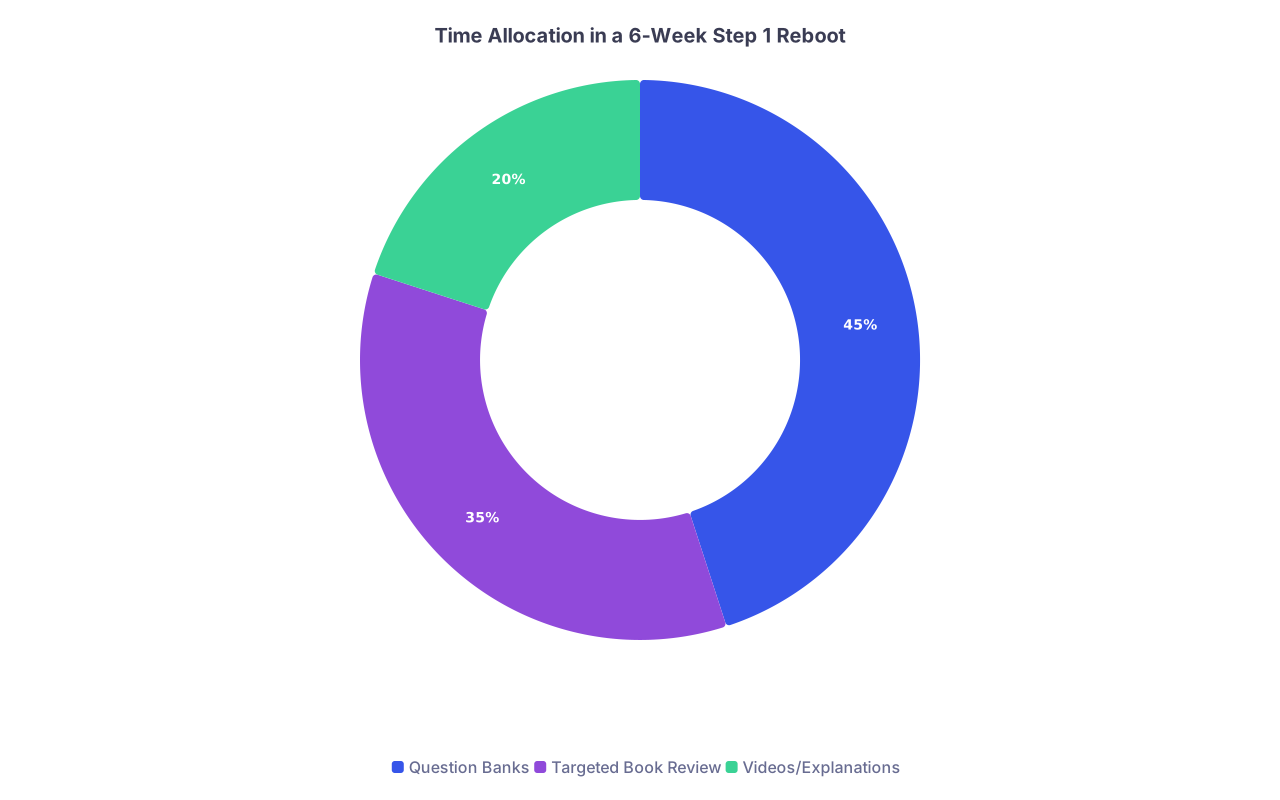
| Category | Value |
|---|---|
| Question Banks | 45 |
| Targeted Book Review | 35 |
| Videos/Explanations | 20 |
Notice: 35% of your time is targeted books. Enough to restore structure; not enough to drown you.
If you’re COMLEX-bound, same logic applies; just layer in OMM from Savarese or a concise OMM review book after you’ve stabilized your core systems.
Step 5: If you’re re-entering for Step 2 / COMLEX 2
This is more clinical, which actually helps. Your break hurts your fluency and pattern recognition, but if you’ve had rotations before, the “stories” are still there—just buried.
Your main reset tool should be one strong clinical book plus case-style practice.
Here’s what I’ve seen work over and over:
Your main book: Step-Up to Medicine (even if you’re not on IM)
Yes, even for Step 2 in general. Why?
Because IM is half the exam, and SUTM teaches you how attendings think:
- What’s the first diagnostic test?
- What’s the initial management vs long-term?
- What are the absolute must-not-miss red flags?
Run SUTM as a 3–4 week sprint:
- 5–6 days per week
- 1–2 sections per day (e.g., chest pain, arrhythmias, COPD, pneumonia)
But you must immediately convert reading into questions.
Example daily recipe:
- 45–60 minutes SUTM (one focused topic)
- 20 UWorld Step 2 questions from that domain
- Review explanations for another 30–45 minutes
Then supplement with:
- Case Files: Internal Medicine and/or specialty volumes matching your weak rotations (OB, Peds, Surgery, Psych).
Aim for:
- 1 case per day on weekdays
- 3–5 cases per day on weekends
This hits:
- Clinical pattern recognition
- Step-style decision making
- “What do I do next?” reflex
Step 6: Short, high-yield books for specific “I forgot this” problems
Sometimes you’re not globally rusty. You have surgical-level PTSD about one subject. Renal phys. EKGs. Antibiotics. OB triage.
These are situations where a truly tiny book or dedicated resource can reset you in 2–5 days, instead of flailing on random questions for weeks.
A few examples:
EKG refresher
Pick one concise, practical book (e.g., “Rapid Interpretation of EKGs” if you like the Dubin style, or a slim clinical EKG manual) and commit to 1–2 hours per day for 3–4 days. Focus only on:- Rate, rhythm, axis
- Classic ischemia patterns
- A-fib/flutter, SVT, AV blocks
Antibiotics & bugs
Use a short, clinically focused guide (some schools give you a pocket ABX book; if not, find something similar).
Build 1-page summaries:- Pneumonia coverage (inpatient vs outpatient)
- UTI/pyelo
- Skin/soft tissue
- CNS
Fluids/lytes
Don’t re-read an entire physiology textbook. Instead, use:- Your favorite concise IM book (SUTM or similar) +
- A handwritten 1–2 page cheat sheet on:
- Maintenance fluids
- Common Na disorders
- K and Ca emergencies
The rule: If a topic is crippling your confidence, buy or borrow one tiny resource and destroy it in 3–5 days. Then move on.
Step 7: Build a 2–4 week re-entry schedule that doesn’t kill you
You’re not at your prior stamina yet. If you try to jump back into 12-hour study days, you’ll burn out in 3 days and then feel even worse.
Start with a realistic framework: 4–6 focused hours per day, divided.
Example 2-week re-entry structure for someone restarting IM + prepping for Step 2:
Morning (1.5–2 hours):
- Targeted book reading (SUTM, specific system)
- Write down 5 “today’s anchors” (core takeaways)
Midday (1.5–2 hours):
- 20 UWorld questions (timed or tutor, but single-system initially)
- Full explanation review, link back to SUTM as needed
Evening (1–2 hours):
- 1 Case Files case
- 10–15 flashcards or micro-notes review (things you wrote, not a massive shared deck—at least for the first 2 weeks back)

| Step | Description |
|---|---|
| Step 1 | Day Start |
| Step 2 | Book Review 1-2h |
| Step 3 | System-Specific Qbank 1.5-2h |
| Step 4 | Clinical Case 1h |
| Step 5 | Light Review / Notes 0.5-1h |
| Step 6 | End of Day |
The exact hours don’t matter. The structure does:
- Book → Questions → Cases → Brief review
- Same routine most days, so you’re not burning energy on “how should I study?”
Once your stamina returns (usually around week 3–4), then you can crank up Qbank volume if needed.
Step 8: Dealing with the “everyone is ahead of me” brain spiral
A quick reality check, because this kills more re-entry attempts than anything else.
You will:
- Feel slower than your peers who never took a break
- Hear acronyms you’ve half-forgotten
- Get pimped and blank out on something you used to know
That doesn’t mean you’re broken. It means you’re rusty.
Two practical tactics here:
Micro-prep for tomorrow:
Every evening, spend 20–30 minutes previewing just one topic you know is likely to come up the next day (e.g., CHF on an IM service where every patient has CHF). Read SUTM or a short guide for that topic only. When it appears the next day, you’ll feel the difference, and that positive feedback loop matters.Humility script:
Have a stock sentence ready for when your brain lags during a question from an attending:
“I’m returning from a break and I’m rebuilding my knowledge. I don’t know that one off the top of my head yet, but I’ll read about it tonight and follow up.”
Then actually do it. And mention it the next day: “I read about X last night—do you mind if I run by what I learned?”
Attendings respect that. They do not respect hiding and guessing.
Step 9: When to not add more books
You’ll be tempted to keep buying new resources every time you hit something you forgot.
Resist that.
If you already have:
- One main board-style book (FA, SUTM, etc.)
- One case book (Case Files / NMS Casebook)
- One Qbank
You’re probably set. You don’t need three IM texts. You need reps and repetition.
A new book is only justified when:
- You have a very specific deficit (e.g., OMM for COMLEX, EKG interpretation)
- Your current main book is at the wrong level (either too dense or too skeletal) and you’ve confirmed that over several days, not one bad session
Otherwise, stick to your chosen set and squeeze all the value out.
Quick recap: your re-entry cheat sheet
- Choose your main priority: boards vs rotation performance. Let that dictate your one anchor book.
- Use targeted books as a scaffold, not as a new curriculum: read a slice, then immediately convert it into questions and/or cases.
- Start with structure, not volume: 4–6 solid hours with a clear Book → Qbank → Case → Brief review sequence will beat a scattered 10-hour “I stared at my laptop” day.
You’re not starting over. You’re reconnecting circuits that already exist. Use the right books to give your brain something sharp to lock onto, then let questions and clinical days do the rest.