
Most pharmacology visual mnemonics are wasted. Not because they are bad, but because students never learn to convert them into answers under a 90‑second clock.
Let me be blunt: staring at pretty Picmonic/Sketchy-style images and “feeling good” about them is not studying. The only memory aids that matter are the ones you can translate into question stems on NBME/Step-style exams.
You want visual resources that:
- Encode high‑yield facts in a stable, reusable image, and
- Can be mentally “queried” in the exact way the exam will query you.
Everything else is entertainment. Let me break this down specifically.
The Core Problem: Visual Mnemonics Without Question Mapping
Most students make the same mistake with pharmacology visuals: they treat them as art appreciation. Watch, smile, “that’s clever”, next video.
Then on test day:
- Question: “Elderly patient on multiple medications develops gynecomastia, impotence, and decreased libido. Which antihypertensive is most likely responsible?”
- Brain: “I remember a wizard, a spiral staircase, maybe a moon… was that spironolactone or eplerenone? Why is this so fuzzy?”
The gap is not memory. The gap is translation.
You are not just memorizing that “gynecomastia = spironolactone.” You are memorizing:
- Drug class
- Mechanism
- Clinical use
- Adverse effects
- Contraindications / interactions
…and how those appear in a stem.
Good visual systems are designed around that. Bad use of good systems ignores that.
How Visual Pharmacology Resources Actually Work (When Used Correctly)
You have three main categories of visual aids that matter for pharmacology in medical school:
- Full-scene mnemonic platforms (Sketchy, Picmonic, Osmosis-style cartoons)
- Pathway / mechanism visuals (enzyme diagrams, receptor maps, pharmacokinetics charts)
- Custom micro‑sketches you build yourself
Let us go through them in a way that actually maps to Step-like questions.
1. Full-Scene Mnemonic Platforms
These are the big names most students know: characters, settings, and visual puns for each drug or class.
Used correctly, each image should function as a compressed “database” you can query.
Example: Beta-blockers
Imagine a visual scene for nonselective vs β1‑selective vs partial agonists vs ISA vs combined α/β blockers. You do not just remember “Propranolol is a nonselective β-blocker.” You remember:
- Mechanism: “Nonselective β1/β2” hinted by one symbol
- Clinical uses: performance anxiety, portal HTN, angina… each as mini-objects
- Adverse effects: bronchospasm, masking hypoglycemia, sexual dysfunction
- Contraindications: asthma, diabetics on insulin, vasospastic angina, etc.
Now look at how that translates:
- Stem mentions “patient with COPD” + “needs migraine prophylaxis”
- You mentally walk through the nonselective vs β1‑selective symbols
- You pick a β1‑selective agent for minimal β2 blockade (like metoprolol or atenolol)
If your visual does not let you answer those kinds of stems without re-reading a textbook, it is incomplete.
2. Pathway / Mechanism Visuals
These are not cute cartoons. These are diagrams that show:
- Where a drug acts in a biochemical or physiological pathway
- What comes before and after the targeted step
- What happens if you inhibit / activate upstream or downstream
Classic examples:
- Renin–angiotensin–aldosterone system with ACEi, ARB, aliskiren, spironolactone
- Arachidonic acid pathway with NSAIDs, COX-2 inhibitors, leukotriene modifiers
- Folate pathway with methotrexate, trimethoprim, pyrimethamine
Boards love asking:
- “What accumulates?”
- “Which upstream metabolite increases?”
- “Which drug interaction occurs because of this blocked enzyme?”
Those are mechanism questions, not just name-recognition questions.
You need to see the pathway in your head, not just the drug’s logo.
3. Custom Micro‑Sketches
This is where most students underestimate themselves.
No resource on earth will create the perfect image for every obscure or less-popular drug that still shows up on your school exam. You will have to fill gaps.
I tell students to develop micro‑sketches: tiny, ugly, but memorable drawings you can reproduce in 10–20 seconds.
Examples:
- For digoxin: crude heart + power outlet + “Na+/K+ pump” box with X through it, with a side note: ↑contractility, ↓AV node conduction, toxicity: blurry yellow vision, arrhythmias, hyperkalemia.
- For isoniazid: “INH – Injures Neurons and Hepatocytes” with stick figure liver and peripheral nerve.
You do not need to be a designer. You need repeatable shorthand that your brain accepts as a stable symbol for a set of facts.
Translating Visuals to Exam Stems: The Four-Level Framework
If a pharmacology memory aid does not translate into these four levels of questions, it is incomplete.
| Level | Question Focus | Typical Wording Clues |
|---|---|---|
| 1 | Identification | “Which drug…”, “Most likely” |
| 2 | Mechanism | “Mechanism of action”, “Receptor” |
| 3 | Effects & Side Effects | “Adverse effect”, “Complication” |
| 4 | Clinical Reasoning | “Next best step”, “Contraindicated in” |
Level 1: Identification (Recognition)
Low-level NBME or school questions live here. The stem essentially asks “Which drug fits this description?”
Example: “Patient with angina, bronchospasm after starting new medication, HR down, BP down.”
Your visual mnemonic for nonselective β-blockers should give you:
- Bronchospasm clue → β2 block
- HR/BP reduction → β1 block
- So your brain jumps to propranolol, nadolol, timolol, etc.
Your image needs:
- A clear symbol for nonselective vs selective
- A clear symbol for affected organs (lung vs heart vs eye vs etc.)
If the image you use does not distinctly differentiate those, you will confuse them under pressure.
Level 2: Mechanism-Based Questions
These usually ask about:
- Receptors
- Enzymes
- Second messengers
- Upstream/downstream metabolites
Example: “A new antiarrhythmic prolongs phase 3 of the myocardial action potential. Which ion current does it most likely affect?”
Your visual for Class III antiarrhythmics must be tied to:
- Phase 3 = K+ efflux
- Class III = K+ channel blockers (amiodarone, sotalol, dofetilide, ibutilide)
So when you see “phase 3” + “prolonged AP duration,” you mentally see your antiarrhythmic cartoon where K+ exit is blocked, not just a fuzzy “I think this might be class III.”
This is where pathway visuals beat cutesy art. You need to see the action potential shape, labeled phases, and where each drug class acts.
Level 3: Effect / Side Effect Questions
This is where pharmacology either makes you or breaks you on Step 1/2 and shelf exams.
Board writers are obsessed with:
- Adverse effects
- Drug–disease interactions
- Organ toxicity patterns
You need consistent, repeated symbols for:
- Nephrotoxic
- Ototoxic
- Hepatotoxic
- Teratogenic
- Bone marrow suppression
- QT prolongation
- Hyper/hypokalemia
- Endocrine side effects (gynecomastia, thyroid, etc.)
For example, if your aminoglycoside mnemonic uses:
- Ears symbol → ototoxic
- Kidney symbol → nephrotoxic
- Crossed-out “pregnant” symbol → teratogenic
Then when a question stem describes:
“Newborn with sensorineural hearing loss born to mother treated with an antibiotic during pregnancy…”
You immediately think: What in my visuals had ears + pregnancy crossed-out? Aminoglycosides.
If your visual resource does not use consistent, repeating icons across different drug classes, side effect questions will feel like random trivia.
Level 4: Clinical Reasoning / Next Step / Contraindication
This is where Step 2 CK and many school exams live now. Mixed pharmacology and clinical judgment.
Example: “Asthmatic patient with stage 2 hypertension and angina pectoris needs a drug. Which of the following is the best choice?”
You are not just recalling “β1-selective is safer in asthma.” You are:
- Eliminating nonselective β-blockers
- Considering ACEi/ARB, CCBs, etc.
- Recognizing comorbid angina, so β1-selective or certain CCBs work
- Avoiding something that worsens asthma
Your visuals must encode:
- “Good in asthma” vs “bad in asthma”
- “Good in pregnancy” vs “teratogenic”
- “First-line in CHF” vs “contraindicated in acute decompensated HF”
- “Safe in CKD” vs “avoid in renal failure”
Otherwise, your knowledge stays at trivia-level and never matures into clinical reasoning.
Specific High-Yield Drug Classes and How Visuals Should Map to Questions
Let me walk through several concrete classes where visual mnemonics help, and how to ensure they translate to stems.
Antibiotics: Where Overwhelm Kills You
Students drown in antibiotic charts. Visuals are almost mandatory here.
You need images that separate:
- Cell wall synthesis inhibitors (beta-lactams, vancomycin)
- Protein synthesis inhibitors (30S vs 50S)
- DNA/RNA synthesis inhibitors (fluoroquinolones, rifamycins, metronidazole)
- Folate synthesis inhibitors (sulfonamides, trimethoprim)
Your image MUST encode:
- Spectrum:
- Gram+ vs Gram-
- Anaerobes
- Pseudomonas
- Atypicals
- Toxicities:
- Red man syndrome (vanco)
- Tendon rupture / QT (FQs)
- Disulfiram-like (metronidazole, some cephalosporins)
- CYP interactions (macrolides, rifampin)
Question patterns you should mentally see when you look at your visuals:
- “Patient on warfarin starts antibiotic, INR jumps” → which of your antibiotic images has CYP inhibition or induction symbols?
- “Teenager with acne develops pseudotumor cerebri + teeth discoloration” → tetracycline visual with skull/ICP symbol + tooth discoloration.
If the visual is not segmented by these spectra + toxicity clusters, you will mix up which drug does what.
Autonomic Pharmacology: Receptor Overload
This is where visuals can be lifesaving. Too many α1/α2/β1/β2 mixed agonist/antagonist combos.
You want:
- One master scene / diagram for adrenergic receptors by organ:
- Heart (β1)
- Lung (β2)
- Vasculature (α1, β2)
- Bladder/prostate (α1)
- Pancreas (β2, α2), etc.
- Separate theme for cholinergic:
- Muscarinic (M1, M2, M3)
- Nicotinic (Nm, Nn)
Each drug should plug into that shared visual instead of 50 disjointed cartoons.
Example mapping:
- Question: “Drug causes urinary retention and mydriasis without cycloplegia in a patient treated for nasal congestion.”
- In your head: α1 agonist affecting vasculature and sphincters → phenylephrine or similar agent.
If your resource scatters this info across random “stories” without a central receptor map you have internalized, your recall under pressure will be too slow.
Cardiovascular: Antiarrhythmics, Antianginals, Heart Failure
Antiarrhythmics are a classic NBME trap. They are built for visuals.
You need:
An action potential diagram with:
- Phase 0 (Na+)
- Phase 1 (early repolarization)
- Phase 2 (Ca2+ plateau)
- Phase 3 (K+ repolarization)
- Phase 4 (resting potential, funny current in pacemaker cells)
For each class (I–IV), a visual “overlay”:
- Class I: Na+ block → effect on slope of phase 0
- Class II: β-block → affect SA/AV node (phase 4)
- Class III: K+ block → prolong phase 3
- Class IV: Ca2+ channel block → slow AV node conduction
Then connect drugs to:
- EKG changes
- Proarrhythmic potential (Torsades)
- Clinical use (SVT vs VT vs AF vs atrial flutter)
If your mnemonic is “some cat cartoon in four boxes” without actual linkage to the action potential, you will keep guessing on mechanistic questions.
Endocrine: Insulins, Thyroid, Steroids
Here visuals must do two things:
- Timeline: onset/peak/duration (insulin types)
- Organ system side effects (glucocorticoids, antithyroid drugs, etc.)
For insulin:
- A chart visual showing:
- Lispro/aspart/glulisine (rapid)
- Regular (short)
- NPH (intermediate)
- Glargine/detemir/degludec (long)
You want an image that anchors “when do they peak” to concrete daily scenarios (meals, bedtime, etc.), because questions will ask:
- “Which insulin peaks 2–3 hours after administration and carries the highest risk of hypoglycemia during that period?”
For glucocorticoids:
- Visual must include:
- Skin thinning, striae
- Osteoporosis symbol (fragile bone)
- Immunosuppression (infections, TB reactivation)
- Hyperglycemia
- Adrenal suppression (HPA axis)
Then stems that mention:
“Elderly woman on chronic high-dose prednisone for RA develops vertebral compression fracture…”
Your mental image for glucocorticoids should scream “bone loss” before you even reach the answer options.
How to Actually Study With Visual Pharmacology Resources
Looking is not learning. Let me give you a concrete workflow you can use.
Step 1: Pre-Question Exposure (Short, Targeted)
For a new drug/class:
Spend 10–15 minutes with the visual mnemonic scene
While watching/looking, manually write a mini-table:
- Mechanism
- Clinical uses
- Major adverse effects
- Contraindications/special considerations
Create 1–2 micro-sketches in your notes replicating the key symbols
You are not trying to memorize every detail in one go. You are trying to bind text facts to visual anchors.
Step 2: Immediate Question Drilling (Translate While Fresh)
This is the step students skip. They watch the video and walk away.
Bad idea.
Right after the visual:
- Do 10–20 questions ONLY on that topic:
- UWorld, AMBOSS, or NBME-style sources
- Not random mixed blocks yet
As you do each question:
- Pause and explicitly ask: “Which symbol in my visual corresponds to this clue in the stem?”
- If you cannot find a symbol that matches, your visual is incomplete. Add a micro-sketch or note.
That translation step is what trains your brain for test day.
Step 3: Spaced Retrieval – But Visual
Use Anki or similar, but do not just memorize Q&A text.
Make card types like:
- Image occlusion:
- Show cropped part of the mnemonic and ask: “What’s the mechanism / side effect represented here?”
- Text→image:
- Front: “Nonselective β-blocker causing bronchospasm in COPD.”
- Back: “Mentally call up the scene and name the symbol / type.”
The best cards force you to mentally pull up the visual and walk through it.
Step 4: Mixed Blocks and “Image Querying”
Once you have a base:
- Do mixed question blocks (cardio + renal + ID, etc.).
- For each pharmacology question, deliberately:
- Pause for 2–3 seconds
- Ask yourself: “Which visual scene does this belong to?”
- Once you have it, walk through that scene in your head before seeing answer choices.
It slows you down at first. Then you get fast. Eventually, you do it unconsciously.
Where Students Go Wrong With Visual Memory Aids
There are predictable failure patterns.
Mistake 1: Collecting, Not Encoding
Downloading every visual guide, subscribing to every platform, screenshotting every chart.
Then doing almost no active retrieval, no questions, no self-testing.
That is digital hoarding, not studying.
Use fewer resources, more intensely.
Mistake 2: Treating Every Detail as Equal
Good visuals are dense. They will include obscure details. Boards typically test a smaller subset.
You need to prioritize:
- Mechanism by class
- Classic “buzz” adverse effects
- Big contraindications
- Really common or really unique clinical uses
If you find yourself stressing because “I cannot remember all five minor side effects for this random drug,” you are misallocating effort. Focus on what always shows up in stems.
Mistake 3: No Unifying Frameworks
If every drug exists in its own cartoon universe, you will fail integration questions.
You need:
- One “big picture” autonomic map
- One “big picture” renal handling / RAAS diagram
- One “big picture” coagulation cascade with anticoagulant / antiplatelet sites
Then individual drug visuals plug into those.
This is exactly how NBME structures questions. They do not ask “What is the name of the wizard?” They ask “What happens to renin if you block angiotensin II here?”
Mistake 4: Never Simplifying
Some resources overdo it. Twenty characters in one scene, each carrying three separate puns.
You do not have to memorize every gag.
Look at the video once or twice, then compress it:
- Strip it down to 5–7 core symbols
- Redraw them in your own shorthand
- Ignore non-essential decorations
Your brain loves compression. It hates clutter.
Concrete Example: Turning One Visual Into Many Question Types
Let me show you how a single ACE inhibitor visual should map to questions.
Picture you have a scene with:
- An ACE machine converting “Angiotensin I” gear to “Angiotensin II” gear
- Drug character cutting the machine (ACEi)
- Blood pressure gauge falling
- A “bradykinin balloon” inflating and causing cough/angioedema
- A kidney with efferent arteriole dilated
- A fetus symbol with a danger sign
From that single image, you should be able to answer:
Mechanism:
- “Blocks conversion of angiotensin I to II”
- “Decreases efferent arteriole constriction → ↓GFR”
Adverse effects:
- Cough, angioedema (bradykinin)
- Hyperkalemia
- ↓GFR, renal failure in bilateral renal artery stenosis
- Teratogenic
Clinical scenarios:
- Good in diabetic nephropathy (↓intraglomerular pressure)
- Bad in pregnancy
- Bad in bilateral renal artery stenosis
- Can precipitate renal failure in volume-depleted states
Interactions:
- Combined with K+‑sparing drugs → hyperkalemia
- NSAIDs + ACEi + diuretics → “triple whammy” kidney injury
Now look at how NBME will ask this:
- Patient with DM2 + microalbuminuria improves on a drug → which mechanism?
- Patient starting this drug develops dry cough → what is elevated?
- Patient with bilateral renal artery stenosis deteriorates on this drug → what changed in kidney hemodynamics?
If your visual is not built (or supplemented) to allow those jumps, you are underusing it.
Tracking What Actually Sticks: Use Simple Data
Most students have no idea which visual sets are actually helping.
You can be more objective.
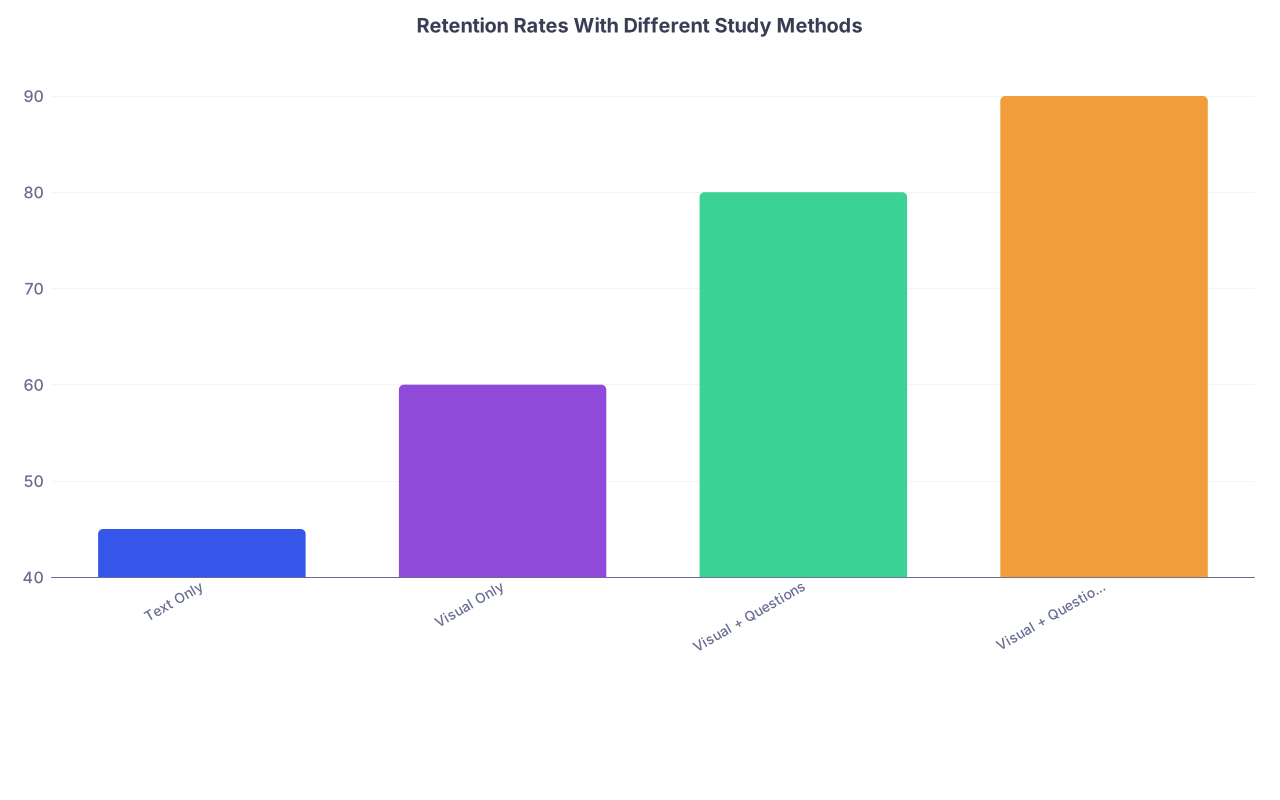
| Category | Value |
|---|---|
| Text Only | 45 |
| Visual Only | 60 |
| Visual + Questions | 80 |
| Visual + Questions + Anki | 90 |
In practice, I see:
- Text-only cramming → retention ~40–50% after 1–2 weeks
- Watching visuals only → maybe 60% if you are lucky
- Visuals + immediate questions → 75–85%
- Visuals + questions + spaced repetition → 85–95%
You do not need an RCT to see what works for you. Just track:
- For each drug class, after 1 week, how many questions on that class do you get right?
- Which classes feel “automatic” vs “I kind of remember the video but not the answer”?
Focus your energy where performance lags, not where the visuals look the coolest.
Putting It All Together: A Practical Weekly Plan
To make this concrete, here is a simple structure for one week of pharmacology with visuals and question translation.
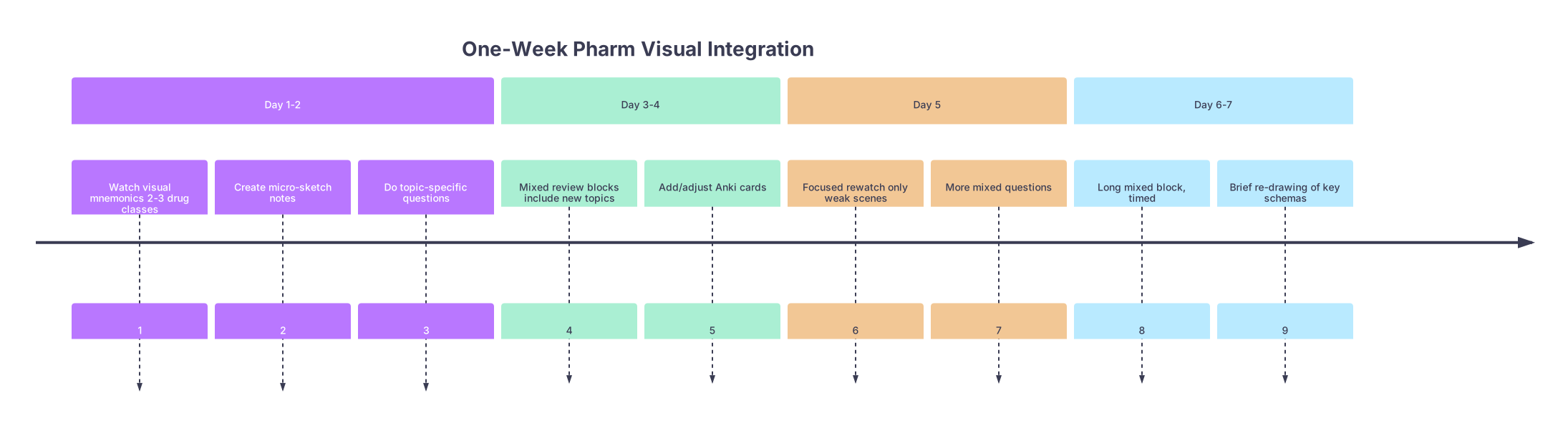
| Period | Event |
|---|---|
| Day 1-2 - Watch visual mnemonics 2-3 drug classes | 1 |
| Day 1-2 - Create micro-sketch notes | 2 |
| Day 1-2 - Do topic-specific questions | 3 |
| Day 3-4 - Mixed review blocks include new topics | 4 |
| Day 3-4 - Add/adjust Anki cards | 5 |
| Day 5 - Focused rewatch only weak scenes | 6 |
| Day 5 - More mixed questions | 7 |
| Day 6-7 - Long mixed block, timed | 8 |
| Day 6-7 - Brief re-drawing of key schemas | 9 |
Each cycle:
- Introduce 2–3 new drug classes with visuals
- Immediately translate to 10–20 questions per class
- Convert to Anki/memory cards
- Revisit in mixed blocks
- Redraw key pathway or receptor maps by hand
That is how you turn “fun mnemonics” into exam scores.
Final Takeaways
- A pharmacology memory aid is only as good as its ability to answer four types of questions: identification, mechanism, effects, and clinical reasoning. If your visuals do not clearly encode those, modify or replace them.
- Watching visuals passively is almost useless. You must immediately force translation into practice questions and spaced retrieval so that images become fast, automatic mental lookups.
- Unifying frameworks—pathways, receptor maps, organ toxicity icons—are the backbone. The cartoons plug into those, not the other way around.