

The worst decision you can make right after not matching is making big decisions too fast.
Month 0 is triage time. Not reinvention time. If you try to lock in your entire “gap year plan” in the first 72 hours, you will almost certainly choose badly.
Here is what you should actually do, week by week, in the first month after not matching, so that your gap year is strategic, not just “I panicked and took whatever showed up.”
Overall Month 0 Game Plan
At this point you should focus on three parallel tracks:
- Stabilize – Emotional, financial, logistical.
- Clarify – Why you did not match, what you actually want, what is realistic this cycle.
- Position – Start lining up the kinds of roles and experiences that will repair your application, not just fill your time.
You are not trying to fill 12 months yet. You are trying to make the next 4–6 weeks extremely productive and clear-headed.
To keep this concrete, I am going to break Month 0 into weeks and then key days.
Week 0–1 (Match Week + 7 days): Do Not Plan the Whole Year Yet
At this point you should do less than you think. But the things you do matter a lot.
Day 0–2: Match Result & Emotional Triage
You just learned you did not match (or partially matched). In these first 48 hours:
Do:
- Inform your inner circle:
- Family / partner.
- One trusted faculty mentor.
- Your medical school’s student affairs / dean’s office.
- Decide your immediate participation:
- If you are SOAPing: all energy goes there now.
- If SOAP is over or not an option: shift immediately to post-Match planning.
Do NOT:
- Do not blast social media with explanations.
- Do not email 25 program directors in a desperate monologue.
- Do not commit to radical specialty changes yet (“I’ll just do FM instead of Derm”) without data.
If you are in SOAP, your “Month 0” starts after SOAP ends. Use this guide counting from the day SOAP results finalize.
Day 3–7: Hard Reality Check and Data Gathering
Once the acute sting settles a bit, you need a brutally honest appraisal.
At this point you should assemble your application snapshot. Pull together:
- USMLE/COMLEX scores (and any failures/low scores).
- All attempts (yes, the fail on Step 1 in 2019 matters).
- Transcript and class rank/quartile.
- Specialty choices and number of programs you applied to.
- Interview numbers and where.
- Notable red flags:
- LOA, professionalism issues, remediation, late graduation.
- Heavy specialty switch (e.g., from surgery to psych late in the season).
- Strengths:
- Research output (pubs, posters, abstracts).
- Leadership, teaching.
- Strong letters (who, where from; not just “3 letters”).
Summarize this in one page. No storytelling. Just facts. I have seen people skip this and then spend 6 months “improving” the wrong thing.
Now, set up two sets of meetings to happen in Week 2:
- Institutional people
- Dean of students / student affairs.
- Your home department for the specialty you applied to.
- External or brutally honest mentors
- Faculty who have been on selection committees.
- Alumni who successfully matched after a gap year.
- If available, a GME director you know from rotations.
Your goal is to have these meetings booked by the end of Week 1.
Week 2: Diagnosis Before Treatment
At this point you should stop guessing about “why” and get real input.
Early Week 2: Structured Feedback Meetings
Go into each meeting with the same 1-page snapshot and very specific asks:
- “I did not match into [specialty]. I would value your completely honest opinion on:
- My main weaknesses.
- Whether I should reapply to the same specialty.
- What would need to change in the next 12 months to be competitive.”
Do not accept vague fluff like “you are a good candidate, it was a competitive year.” Push for specifics:
- “If you had to name the top 2 reasons I did not match, what would they be?”
- “If I change nothing and reapply exactly as is, what do you predict happens next year?”
You are looking for patterns:
- Red flag pattern: Failed Step, professionalism note, LOA.
- Competitiveness mismatch: 210 Step 1, 225 Step 2, applied to 20 EM programs. Unrealistic.
- Application strategy error: Applied late, weak personal statement, poor letters.
- Specialty fit issue: Weak home support, no home program, minimal exposure.
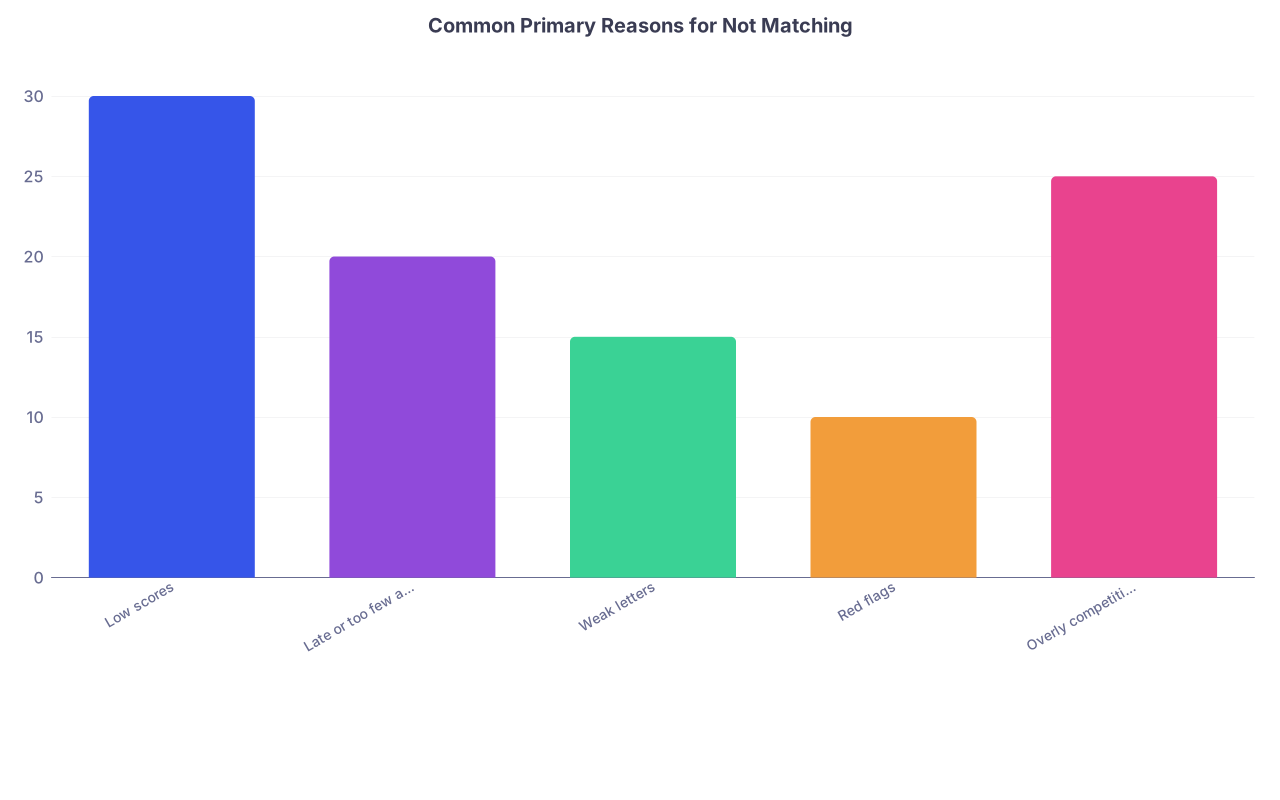
| Category | Value |
|---|---|
| Low scores | 30 |
| Late or too few apps | 20 |
| Weak letters | 15 |
| Red flags | 10 |
| Overly competitive specialty | 25 |
Capture these in writing. By end of Week 2 you should have a clear working hypothesis:
- “Main issues: applied too few programs, late, mediocre letters.”
- Or: “Step 1 fail + specialty too competitive.”
- Or: “No home program, minimal clinical exposure, no strong advocates.”
Late Week 2: Decide Your Likely Pathway (Provisional)
You are not locking in every detail, but you should narrow to one of three primary tracks:
- Reapply to the same specialty
- You have a realistic shot with targeted improvements.
- Reapply but pivot to a less competitive specialty or dual-apply
- Example: From ortho to IM, or EM + IM.
- Step away from residency pursuit
- Rare in Month 0, but sometimes appropriate if multiple cycles failed and you are done.
Most people reading this fall into #1 or #2. So the rest of the month focuses there.
Week 3: Designing a Strategic Gap Year Skeleton
At this point you should build a skeleton plan for the year, not a detailed calendar. Think in categories of what your application needs.
Common deficits and the best Month-0 targets:
| Main Weakness | Highest-Yield Gap Year Focus |
|---|---|
| Low or failed exams | Dedicated Step/COMLEX retake + strong score |
| Weak clinical experience | Full-time prelim/TY, research year with heavy clinical, hospitalist scribe |
| Weak letters/no advocates | Home or affiliated hospital position under known faculty |
| Limited research | Structured research fellowship in specialty or IM |
| Applied too few programs | Better advising + broader application; less about gap year job |
Step 1: Clarify Non-Negotiables
Before you chase positions, you need constraints:
- Geography:
- Are you tied to a city because of visas, family, or finances?
- Can you temporarily relocate for a 1-year research or prelim spot?
- Finances:
- Minimum monthly income to avoid debt collapse.
- Ability to work unpaid or low-paid research (many cannot; be honest).
- Visa status (if applicable):
- Requirements for maintaining status.
- Types of positions that qualify.
Write these down. You will use them to filter opportunities.
Step 2: Identify Your Primary Gap Role Target
By the end of Week 3, you should choose your primary gap-year role target, for example:
- Preliminary or transitional year (PGY-1) in any reasonably aligned field.
- Research fellow / post-doc in your target specialty.
- Clinical research coordinator with built-in patient exposure.
- Full-time non-resident clinician role (e.g., UK or other system, if feasible).
- Scribe or advanced clinical assistant role in your desired specialty (less ideal, but sometimes necessary).
You want something that:
- Gets you inside a department or hospital.
- Puts you next to people who write strong letters.
- Shows commitment and growth in your chosen direction.
“Random retail job plus scattered shadowing” does not do that, unless you are in true financial emergency.
Week 4: Concrete Actions and Applications
At this point you should convert planning into applications, emails, and deadlines.
Early Week 4: Contact Programs and Departments
Now you start reaching out in a structured way.
1. Explore Off-cycle PGY-1 / Prelim Spots
There are often unfilled or late-opening positions:
- Check:
- NRMP’s list of unfilled positions (if still accessible).
- FREIDA and program websites for “unexpected vacancy” announcements.
- Specialty listservs and forums (with caution; ignore the drama, just watch for positions).
For each relevant program:
- Send a short, targeted email to:
- Program Director.
- Coordinator.
- Possibly an APD or department chair if you have any connection.
Attach:
- ERAS CV or a cleaned-up CV.
- Short explanation of your situation and goal (3–4 sentences, not a memoir).
- USMLE/COMLEX transcript if requested or clearly acceptable.
You are not writing, “I am desperate, I will take anything.” You are writing:
- Who you are.
- Why you are interested in their program/position.
- That you are eager to work hard, contribute, and reapply strong.
2. Contact Your Home Department Aggressively
If you have a home program:
- Ask directly about:
- Gap year research positions.
- Funded clinical roles (e.g., research coordinator).
- Observership-like roles that can expand into more.
If you do not have a home program:
- Contact nearby academic centers in your region.
- Ask faculty you know if they can introduce you to someone running trials, QI projects, or registries.
Mid–Late Week 4: Build a 12-Month Roadmap (Draft)
At this point you should draft a month-by-month goal map for the next year. It will change. That is fine. But you need a starting blueprint.
Here’s a simple structure:
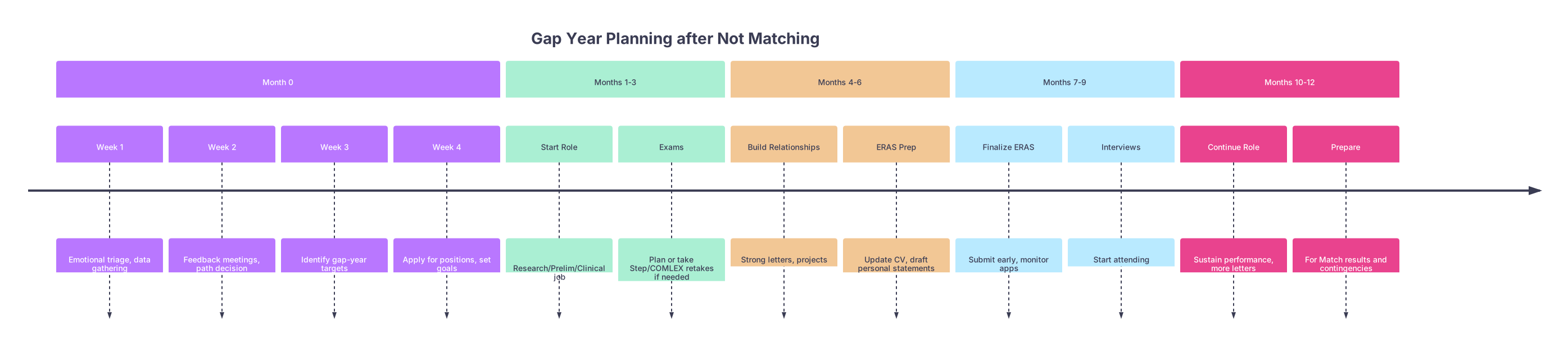
| Period | Event |
|---|---|
| Month 0 - Week 1 | Emotional triage, data gathering |
| Month 0 - Week 2 | Feedback meetings, path decision |
| Month 0 - Week 3 | Identify gap-year targets |
| Month 0 - Week 4 | Apply for positions, set goals |
| Months 1-3 - Start Role | Research/Prelim/Clinical job |
| Months 1-3 - Exams | Plan or take Step/COMLEX retakes if needed |
| Months 4-6 - Build Relationships | Strong letters, projects |
| Months 4-6 - ERAS Prep | Update CV, draft personal statements |
| Months 7-9 - Finalize ERAS | Submit early, monitor apps |
| Months 7-9 - Interviews | Start attending |
| Months 10-12 - Continue Role | Sustain performance, more letters |
| Months 10-12 - Prepare | For Match results and contingencies |
For Month 0 specifically, your roadmap should show:
- By end of Week 1: Application snapshot complete; key meetings scheduled.
- By end of Week 2: Clear reasons for not matching; provisional specialty decision.
- By end of Week 3: Primary type of gap-year role chosen; constraints clarified.
- By end of Week 4:
- 10–30 targeted emails/applications sent for roles.
- Initial responses tracked.
- Personal timeline for exams, CV update, and ERAS revamp drafted.
Parallel Track: Financial and Life Logistics in Month 0
If you ignore this, you will feel the consequences around Month 4 when applications and interview costs hit.
At this point you should:
- Run a brutally honest budget.
- Current savings.
- Loan status and grace periods.
- Minimum expenses per month.
- Call loan servicers.
- Ask about deferment/forbearance options for a non-resident physician.
- Plan for interview season costs.
- Save or earmark funds now.
- Assume travel may be a mix of virtual and in-person depending on specialty and year.
If money is tight, factor that into your role selection:
- A paid clinical job may be better than a prestigious but unpaid research gig, if the latter means you cannot afford ERAS fees or interviews.
What You Should NOT Do in Month 0
I have watched this play out too many times. Month 0 is where people blow up their future match chances by trying to fix everything in a week.
Avoid these:
- Do not:
- Sign up for a random master’s program just so “it looks like I’m doing something.” Most are overpriced and add little.
- Apply to a completely new specialty you barely know because “it is less competitive.” Program directors see right through this if you have no story, exposure, or letters.
- Rewrite your personal statement or CV before you actually understand what went wrong.
- Hide from your school’s administration. They are often more helpful than you expect, especially for reapplicants.
Your job in Month 0 is not to be busy. It is to be accurate.
Quick Visual: How Your Time Focus Should Shift Over Month 0
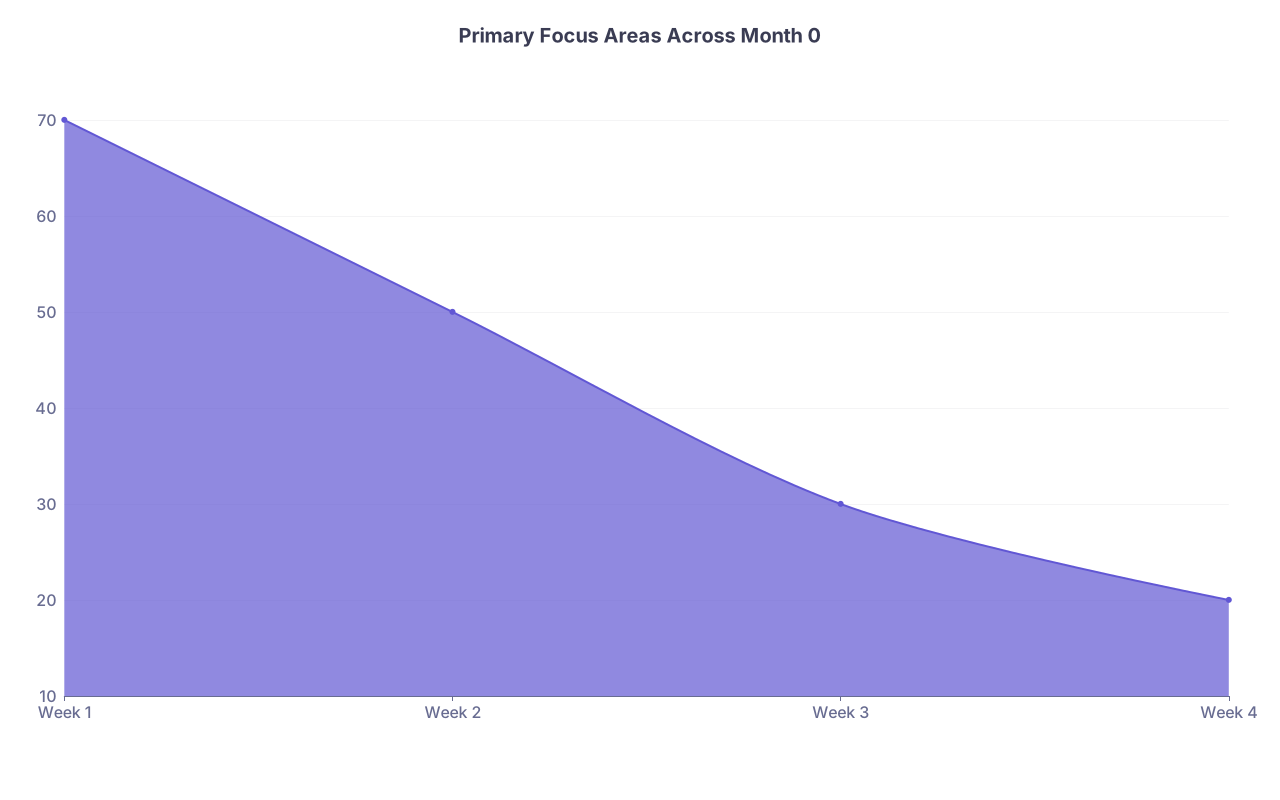
| Category | Value |
|---|---|
| Week 1 | 70 |
| Week 2 | 50 |
| Week 3 | 30 |
| Week 4 | 20 |
(Interpretation: High emotional/diagnostic work in Week 1, steadily shifting toward concrete planning and applications by Week 4. You are moving from reaction to strategy.)
FAQ (Exactly 4 Questions)
1. Should I reapply this coming cycle or wait an extra year?
Decide based on how much repair your application needs. If your main issues are strategy errors (too few programs, applied late, weak personal statement, mediocre letters), you can usually fix that and reapply this coming cycle with a strong gap-year role. If you have major red flags (multiple Step failures, professionalism issues) or you are planning a big specialty switch with zero background, you might need more than 12 months of work. Use the Week 2 feedback meetings to get a frank answer from people who actually sit on selection committees.
2. Is research always the best use of a gap year?
No. That is one of the biggest myths. Research is extremely valuable if you are applying to academic-heavy or competitive specialties and if you can get plugged into a productive lab or clinical research unit with mentors who publish and write letters. But for many IM, FM, psych, peds applicants, a year of strong clinical work with great evaluations and letters beats a pseudo-research job where you do data entry and never see a manuscript. Choose the role that fixes your main deficit, not what sounds impressive on paper.
3. How early in Month 0 should I contact program directors?
For gap-year roles (research, prelim spots, vacancies), start outreach in Week 4 once you have your story straight and documents cleaned up. For asking about “why I did not match,” lean more on your own school, mentors, and faculty who know you personally in Weeks 1–2. Cold-emailing dozens of PDs for feedback on why their program did not invite you is usually low yield and can come off as tone-deaf if done emotionally. Use Month 0 to build targeted, professional communication, not scattershot “please help me” messages.
4. What if I feel completely burned out and cannot imagine reapplying right away?
That is real, and you should not ignore it. In Month 0, acknowledge the burnout honestly with mentors and with yourself. The question becomes: can you realistically recover, re-engage, and put forward a strong, energetic application by the next cycle? If the answer is no, it may be smarter to build a two-year plan: first year focused on recovery plus a foundational role (clinical or research), second year on a fresh, strong application. The worst path is pretending you are “all in” while half-checked-out and submitting a lukewarm reapplication that wastes time, money, and another Match cycle.
Key points to walk away with:
- Month 0 is for diagnosis, not decoration. Understand exactly why you did not match before you “fix” anything.
- By the end of the first month you should have: clear reasons, a chosen direction, active applications for a strategic gap-year role, and a draft 12-month roadmap.


