

The worst mistake in a gap year is treating letters of recommendation like a form you “send later.” They are a year-long relationship project, not a last-minute upload problem.
You are in a gap year before residency. You want strong LoRs, not generic “hardworking and pleasant” fluff. That means you need a plan that starts 12 months before ERAS submission and runs right through Rank List season.
I will walk you through that year, month by month, with specific “at this point you should…” actions and scripts. No vague “network more” nonsense. This is about timing, pressure, and how to keep letter writers engaged without being annoying.
Big Picture: Your 12‑Month LoR Timeline
Before we zoom into each month, you need the skeleton.
| Phase | Approx Months | Primary Focus |
|---|---|---|
| Foundation | Aug–Oct | Identify roles & potential letter writers |
| Build | Nov–Jan | Deepen relationships, early asks, first drafts |
| Lock | Feb–Apr | Formal LoR requests, ERAS accounts, uploads |
| Fine-Tune | May–Jul | Gentle nudges, supplemental letters, final list |
| Maintain | Aug–Nov | Updates, interview support, no‑burn bridges |
Key anchor dates (for a typical ERAS cycle, adjust by year as needed):
- ERAS opens to applicants: mid‑June
- Programs can start downloading apps: mid‑September
- MSPE release (for med students; you’re a grad, but timing still matters): Oct 1
Letters should ideally be requested 4–6 months before September and uploaded by August.
Now let’s go month by month.
August–October (One Year Before Match): Set the Board
At this point you should: Build the roles that will justify your letters.
You do not start with “Hey, can you write a letter?” You start with: “Will I give this person a year’s worth of evidence that I am an excellent intern?”
Your situation right now:
- You have graduated or are finishing.
- You are in or lining up:
- A research year
- A chief year
- A clinical gap year job (hospitalist extender, scribe, etc.)
- Or some combination
August: Choose strategic roles and supervisors
At this point you should:
Identify 3–5 potential letter writer “lanes”:
- 1–2 clinical attendings in your target specialty
- 1 research PI or scholarly mentor
- 1 “character/work ethic” mentor (program director, chief, job supervisor)
Structure your work so you are not invisible:
- Take ownership of a project under a named PI, not just “the lab.”
- Ask to round consistently with the same attending rather than rotating ad hoc.
- If in a non‑clinical job (scribe, MA), seek a physician supervisor who knows you by name and trusts your judgment.
You are not collecting letters yet. You are designing your year so the letters will actually mean something.
September: Make yourself visible and useful
At this point you should:
- Establish regular touchpoints:
- Weekly or biweekly meetings with your PI.
- Recurring clinic/rounding days with the same attending.
- Start behaving like a future intern:
- Show up early, know your patients, anticipate tasks.
- Volunteer for unglamorous but critical work (data cleaning, coverage, call schedule help).
You want people saying, “We would be lucky to have them as an intern,” under their breath by October.
October: Signal your residency goals early
At this point you should:
- Tell key mentors explicitly:
- “I plan to apply to internal medicine this coming ERAS cycle.”
- “My gap year goal is to strengthen my application for EM.”
- Ask for feedback that sets up future LoRs:
- “If I continue at this level, do you feel comfortable supporting my application strongly when the time comes?”
- You are not asking for a letter yet. You are checking the trajectory.
Red flag: if someone hesitates, looks vague, or gives noncommittal feedback now, they are not your primary LoR. Keep them as backup at best.
November–January: Quietly Lock in Your Core Writers
These months separate the planners from the panickers.
November: Turn contact into mentorship
At this point you should:
Deepen your relationships with 2–3 primary potential letter writers:
- Schedule individual check‑ins: “Could we meet for 20 minutes to talk about my development this year?”
- Come with a short agenda: cases, project progress, skills you want to grow.
Start building your “letter packet” (you will not send it yet):
- Working CV (updated monthly)
- Draft personal statement themes (bullets, not full essay yet)
- Short paragraph on:
- Why this specialty
- Why this specific mentor’s perspective on you is unique
You’re quietly preparing so that when you ask, they have everything.
December: Soft commitment from top-choice writers
At this point you should:
- Have an honest talk with 1–2 key writers:
Example script, in person or by video:
“Dr. X, I am planning to apply to internal medicine this coming cycle. My gap year goal is to grow clinically and academically so I can be a strong intern. If over the next few months I continue to perform at this level, would you feel comfortable writing a strong letter of recommendation for me when ERAS opens?”
You want to hear:
- “Yes, absolutely.”
- Or even better: “Of course, I would be happy to write you a strong letter.”
If you get:
- “Let’s see how the year goes.”
- “I usually wait until closer to applications to decide.”
Then you file them under backup, not primary.
January: Formal pre‑ask and calibration
At this point you should:
- For your top 2–3 mentors, transition from “if” to “when” language:
“Assuming ERAS opens in June like usual, I will request letters around March–April so there is plenty of time. Is that timeline reasonable for you?”
Most attendings will say yes. You are clearing the runway now so you are not competing with fellowship letters and promotion packets in June.
- Ask for performance feedback with teeth:
- “If you were writing a letter today, what would you say are my strengths?”
- “What do I still need to show you to earn your strongest endorsement?”
Write their answers down. Those gaps become your next couple of months’ priorities.
February–April: Official Requests and ERAS Logistics
This is the most critical phase. Letters get written—or forgotten—here.

| Step | Description |
|---|---|
| Step 1 | Identify mentors |
| Step 2 | Soft ask & confirm willingness |
| Step 3 | Prepare packet: CV, PS draft |
| Step 4 | Formal request 4-6 months before ERAS |
| Step 5 | Add to ERAS LoR list |
| Step 6 | Gentle reminders 4-6 weeks later |
| Step 7 | Confirm upload before submitting |
February: Get your documents tight
At this point you should:
- Have ready for each potential letter writer:
- Updated CV (no typos, clean formatting)
- Draft or outline of your personal statement
- Bullet list: 4–6 specific things you did with them:
- “Led data collection for 120‑patient cohort”
- “Pre‑rounded independently and presented concisely on inpatient cards”
- Your target specialty (and subspecialty interest if relevant)
- Any program types you target (academic vs community, region, etc.)
You are not spamming them yet. You are making sure your materials do not embarrass you when you send them.
March: Formal asks begin (yes, this early)
At this point you should:
- Formally ask your top 2–3 writers. In person if possible; then follow with email.
In‑person ask:
“Dr. Y, applications will open in June and programs will start reviewing in September. I would be honored if you would write a strong letter of recommendation for my internal medicine residency application. Would you be willing to do that?”
If they agree, you follow up within 24 hours with a tight email:
Subject: Thank you + LoR materials for residency
Dear Dr. Y,
Thank you again for agreeing to write a strong letter of recommendation for my internal medicine residency applications this upcoming ERAS cycle.
As promised, I am attaching:
- My current CV
- A draft of my personal statement
- A brief summary of the work we have done together and skills I hope your letter can highlight
ERAS will open in June, and I will add your name in the LoR section so that you receive an official upload link. I am happy to provide any additional information that would be helpful.
Thank you again for your support,
[Name]
[AAMC ID if you have it already]
You are not asking them to upload yet because ERAS is not open. You are reserving their mental slot.
April: ERAS account and letter list strategy
At this point you should:
- Create or re‑activate your ERAS account as soon as the cycle opens (usually early‑mid June, but you plan prep in April).
- Decide your final LoR strategy:
- Most applicants will use 3–4 letters:
- 1–2 clinical in specialty
- 1 research / scholarly
- 1 “global” mentor (PD, chief, job supervisor)
- Very competitive specialties (derm, ortho, ENT) often lean toward more specialty‑specific clinical letters.
- Most applicants will use 3–4 letters:
Plan who gets used where:
- Example: You have:
- 2 strong internal medicine attendings
- 1 research PI
- 1 chief year PD
You might:
- Use all four for academic IM programs.
- Use 2 IM + PD for community programs that care less about research.
- Reserve the research letter for programs heavily focused on scholarship.
Write this plan down now. Do not invent it in September at 2 a.m.
May–July: Letters Written, Uploaded, and Quality‑Checked
This is where most gap‑year applicants blow it. They assume “I asked already, so I’m done.” No.
May: Gentle nudge before chaos hits
At this point you should:
- Send a short update + reminder email to each committed writer:
Subject: Residency application update + LoR timing
Dear Dr. Z,
I hope you are well. I wanted to share a brief update and confirm timing for my residency applications. ERAS for the upcoming cycle is expected to open to applicants in June, and programs can begin downloading applications in September.
As we discussed, I am very grateful that you agreed to write a strong letter of recommendation on my behalf. I will add your name in the ERAS system as soon as it opens so that you receive the official upload request.
Brief updates since we last spoke:
- [1–2 bullet points: new responsibility, abstract, leadership role]
Thank you again for your support,
[Name]
You are on their radar right before summer chaos and medical student eval flood.
June: ERAS opens – make it real
At this point you should:
The week ERAS opens:
- Enter each letter writer in the LoR section.
- Assign them to your specialty application (you can fine‑tune per program later).
- Decide whether to waive your right to view letters. You should waive. Programs trust waived letters more.
Immediately after entering them, send a clear, concise confirmation:
Dear Dr. Y,
I have now entered your information into the ERAS system for my internal medicine residency applications, and you should receive an email with instructions to upload your letter directly.
If it is helpful, I have reattached my updated CV and personal statement, as well as a one‑page summary of the work we have done together.
Thank you again for your time and support,
[Name]
July: Track like a project manager
At this point you should:
- Maintain a basic LoR tracking sheet:
| Writer | Type | Date Asked | ERAS Added | Uploaded? | Last Reminder |
|---|---|---|---|---|---|
| Dr. A | Clinical IM | Mar 5 | Jun 10 | Yes | Jul 2 |
| Dr. B | Research PI | Mar 12 | Jun 10 | Pending | Jul 15 |
| Dr. C | PD/Chief | Mar 20 | Jun 11 | Yes | — |
By late July:
- Aim to have at least 2 letters uploaded.
- If someone is significantly delayed, line up a backup:
- Another attending who has seen you regularly.
- A second research mentor if your PI is chronically behind.
Send one more polite, specific reminder to anyone outstanding:
Dear Dr. B,
I hope you are doing well. I wanted to gently check in about the residency letter of recommendation we discussed. ERAS shows that the letter has not yet been uploaded.
I plan to certify and submit my application in early September, and having your letter in place would be extremely helpful. Please let me know if there is any additional information I can provide to make this easier.
Thank you again for your support and mentorship,
[Name]
You are not apologizing for following up. You are managing your application like an adult.
August–November: Keep Relationships Alive Through Interview Season
By now, if you followed the timeline, your letters should be uploaded before most programs even start serious screening.
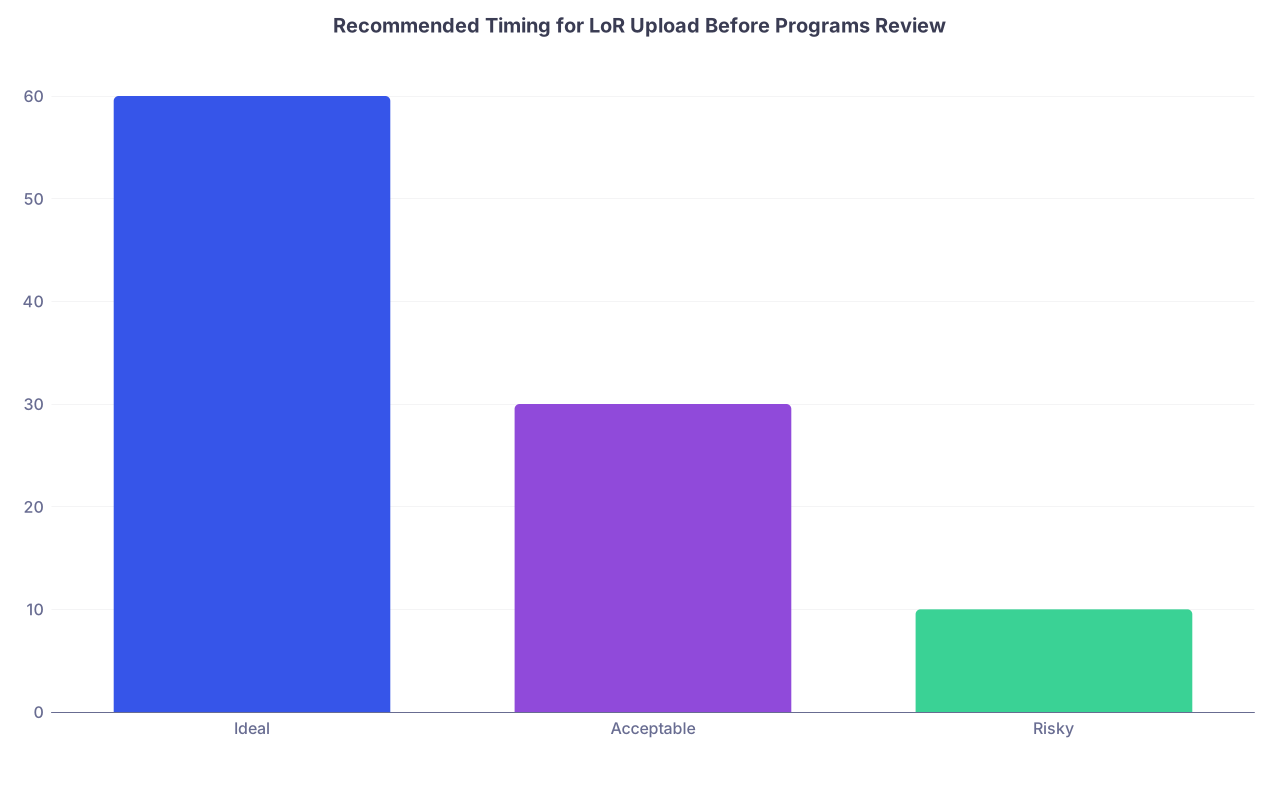
| Category | Value |
|---|---|
| Ideal | 60 |
| Acceptable | 30 |
| Risky | 10 |
(Representing days before mid‑September.)
August–September: Final checks and application submission
At this point you should:
Confirm in ERAS:
- All letters show as “Received.”
- Each program has 3–4 letters assigned (per their guidelines).
Do not overload with irrelevant letters:
- For IM, 3 strong IM letters beat 6 random ones including your volunteer supervisor from college.
Send a short thank‑you update just before submission:
Dear Dr. X,
I wanted to let you know that I have now certified and submitted my residency applications. Thank you again for your letter of recommendation and all of your mentorship this year.
I have applied primarily to [brief description: academic IM programs in the Northeast, etc.], and will keep you updated as interview invitations start to arrive.
I am very grateful for your support,
[Name]
You are reminding them you exist right before programs may call or email them about you.
October–November: Interviews and real‑time signal boosting
At this point you should:
- When you get interview invites at top‑choice programs:
- Briefly tell your main mentor(s):
“I received interviews at [Program A] and [Program B], which I am very excited about as they are among my top choices.”
Some mentors will quietly email their contacts. You do not ask outright unless you have that kind of relationship. But you give them the chance.
- Keep updates lean:
- A single email mid‑season: “I have received X interviews so far, very grateful.”
- Do not spam a running commentary.
What Changes If You Are Late?
Not everyone reads this 12 months out. If you are starting late:
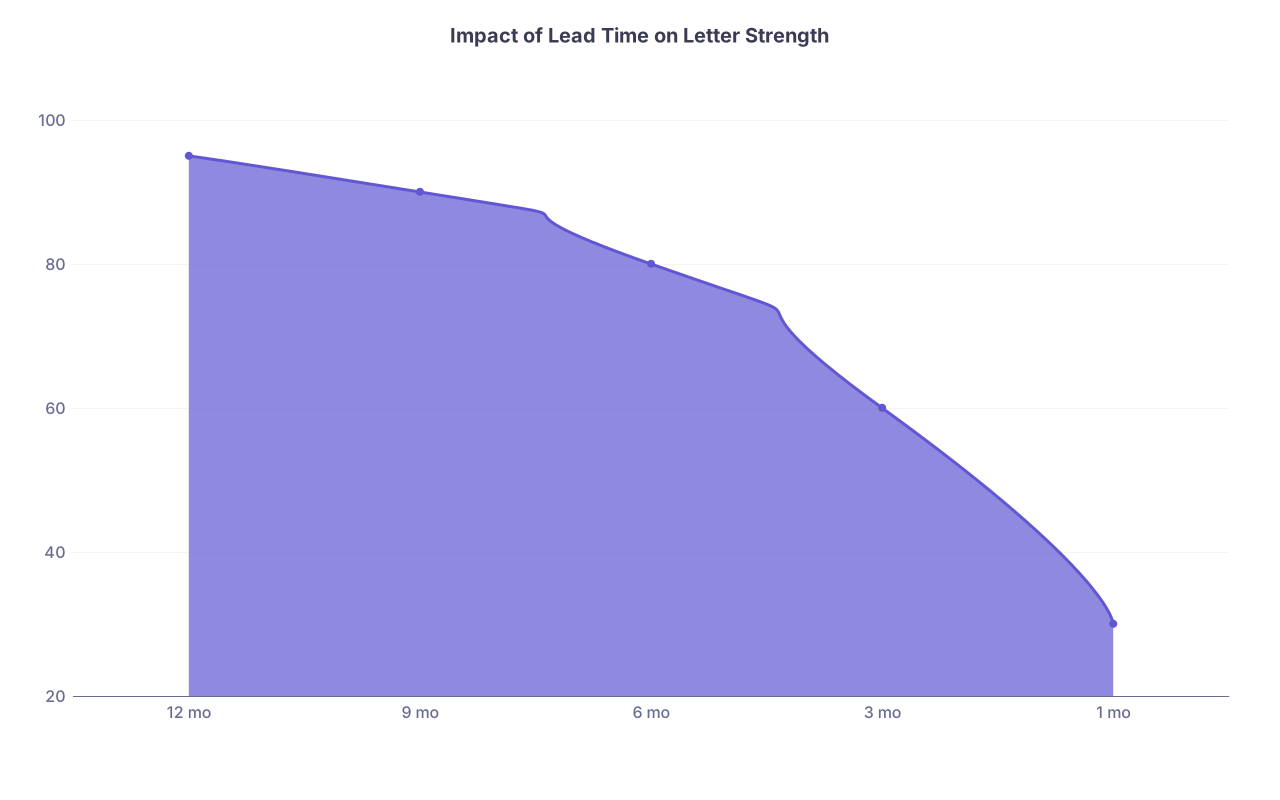
| Category | Value |
|---|---|
| 12 mo | 95 |
| 9 mo | 90 |
| 6 mo | 80 |
| 3 mo | 60 |
| 1 mo | 30 |
(Conceptual “strength/quality” score as lead time shrinks.)
- 6 months out (around March):
- You can still get good letters if you have existing relationships.
- Compress the October–January steps into 4–6 weeks.
- 3 months out (June):
- You are asking during ERAS opening.
- Be very direct about deadlines and provide flawless materials.
- 1 month out (August):
- You are in “salvage mode.”
- Focus on people who truly know you well right now.
- Accept that some programs will see weaker or fewer letters.
Final Two Weeks Before Submission: Absolute Checklist
At this point you should:
Verify in ERAS:
- All committed writers show “Received.”
- Each program has the correct 3–4 letters assigned.
- No placeholder or outdated letters from previous cycles are attached by mistake.
Have backup assignments ready:
- If one letter still missing, re‑balance:
- Use your 3 strongest letters across all programs rather than forcing a fourth weak letter.
- If one letter still missing, re‑balance:
Stop tinkering with the LoR plan the night before. That is when people make dumb assignment errors.
Two Things To Remember
- Strong LoRs are built in November–March, not July–September. The ask is a formality. The year‑long relationship is the work.
- You are managing a small project: mentors, deadlines, and information flow. Treat it that way—track, follow up, update—and your letters will stop being the weak link in your application.


