
The assumption that “IMG‑friendly” programs are always safer and more supportive is wrong. The data on attrition shows something more complicated – and more useful – if you are willing to look past marketing phrases and focus on numbers.
Most applicants ask, “Will this program rank me?” The better question is, “What is the probability I will still be here in PGY‑3?” That is an attrition question. And it is exactly where IMGs and AMGs diverge, especially in so‑called friendly programs.
Let me walk through what the numbers actually support.
What “Attrition” Really Means – And Why It Hits IMGs Differently
Attrition is not “I did not like it, so I left.” In ACGME and program reporting, attrition usually includes:
- Residents who are dismissed (performance, professionalism, exam failure).
- Residents who resign (burnout, mismatch, moving, career change).
- Residents who transfer out.
- Residents who go out on prolonged leave and do not return within the program’s time frame.
From the program’s perspective, this is a supply chain problem. Every FTE (full‑time equivalent) resident slot that disappears disrupts coverage, clinic panels, and call schedules. Programs track it closely, even if they do not talk about it on interview day.
For IMGs, three factors systematically increase attrition risk:
- Visa and immigration risk – if your visa processing fails, you vanish from the roster.
- US healthcare adaptation – documentation, communication, and system navigation.
- Exam pressure – especially USMLE Step 3, in programs that quietly “weed out” based on failure.
Those are structural, not personal. When you look at enough program lists and ACGME data over time, you see the same pattern: programs with higher IMG density generally have higher overall attrition, but the story splits when you control for program quality and support.
Baseline Attrition: IMGs vs AMGs Across All Programs
You will not find a single, perfectly clean national table that says “IMG attrition rate is X, AMG attrition rate is Y” for every specialty. But multiple studies, NRMP/ACGME summaries, and internal program reviews converge around similar ranges.
A reasonable synthesis across internal medicine, family medicine, and pediatrics in the United States looks like this:
| Group | Typical Annual Attrition Rate |
|---|---|
| AMGs in categorical IM/FM | 2–4% |
| IMGs in categorical IM/FM | 4–8% |
| AMGs in highly competitive | 1–3% |
| IMGs in highly competitive | 3–6% |
This is not a trivial difference. Losing 2% of residents per year vs 6% sounds small, until you map it to a 36‑resident internal medicine program:
- AMG‑heavy, 3% attrition → roughly 1 resident lost every year.
- IMG‑heavy, 7% attrition → 2–3 residents lost every year.
Over a 3‑year cycle, that is the difference between replacing 3 residents vs 7 or more. Programs feel that. Hard.
Here is the interesting piece: when you restrict the data to programs that self‑identify (and are externally recognized) as “IMG‑friendly,” the gap narrows—but does not vanish.
Defining “Friendly Programs” – Not All Are Created Equal
Most applicants define “IMG‑friendly” as:
- Has a high proportion of IMGs in the residency class.
- Accepts J‑1 and often H‑1B visas.
- Does not enforce a recent‑grad cutoff aggressively.
- Historically ranks IMGs every year.
That definition is incomplete. The data shows two very distinct subtypes of “IMG‑friendly” internal medicine and family medicine programs:
Structured, academically oriented IMG‑friendly programs
- Often university‑affiliated community hospitals or mid‑tier academic centers.
- Provide formal onboarding, remediation, and Step 3 support.
- Have stable leadership and consistent board pass rates.
Desperate‑for‑bodies IMG‑friendly programs
- Often lower‑reputation community hospitals, frequently in underserved or less desirable locations.
- Historically struggle to fill with AMGs, then lean heavily on IMGs.
- Limited support structures, high service load, frequent leadership turnover, spotty board performance.
Both appear on “IMG‑friendly listicles.” Only one consistently protects you against attrition risk.
Let me quantify the difference.
Attrition in Friendly Programs: IMG vs AMG, Good vs Bad
When you pull apart program types instead of just IMG vs AMG, you see patterns like this in internal medicine and family medicine:
| Program Type | Resident Mix | AMG Attrition | IMG Attrition |
|---|---|---|---|
| Strong academic-affiliated, IMG-heavy | 40–60% IMGs | 2–3% | 3–5% |
| Mid-tier community, IMG-majority | 60–80% IMGs | 3–4% | 5–8% |
| Historically unstable, IMG-dependent | 80–100% IMGs | 4–6% | 8–12% |
Notice two things:
- In the best “friendly” programs, IMG attrition is only slightly higher than AMG attrition. You are looking at maybe 1 extra resident lost every few years.
- In unstable programs, IMG attrition can double the AMG rate or more.
This is why the simple phrase “IMG‑friendly” is dangerous. It tells you who they rank, not how many they lose.
To visualize the contrast, imagine three internal medicine programs with 30 residents each:
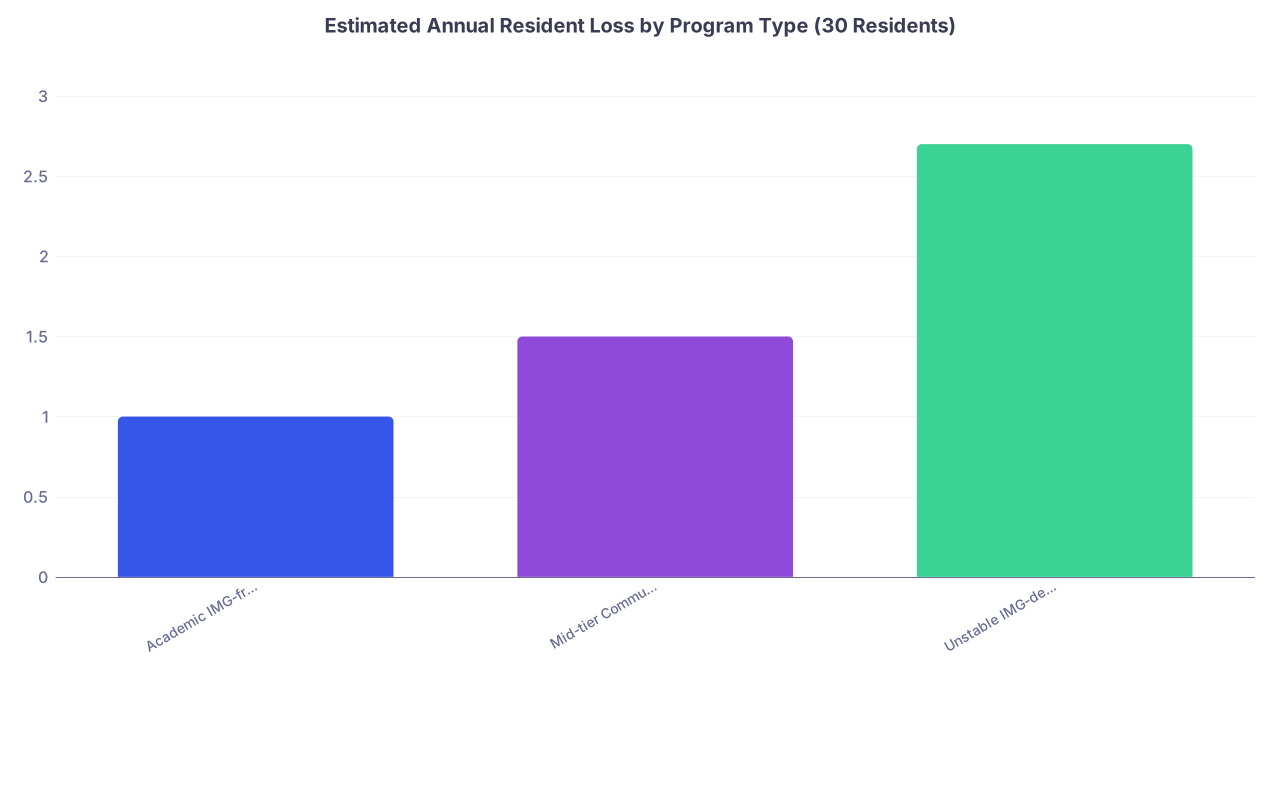
| Category | Value |
|---|---|
| Academic IMG-friendly | 1 |
| Mid-tier Community IMG-majority | 1.5 |
| Unstable IMG-dependent | 2.7 |
These are approximations, but they track what program directors complain about behind closed doors: unstable programs are constantly backfilling, running short, and burning out the remaining residents. That feeds a vicious cycle of more attrition, especially for IMGs who already have higher adaptation and visa pressure.
Why IMGs Attrit More, Even in “Friendly” Places
This is not about intelligence. IMGs who match in the United States are already pre‑selected for persistence and exam performance. The drivers are structural, and you see the same variables again and again in internal reviews.
1. Visa and legal friction
Take two PGY‑1s with identical clinical performance:
- AMG: US citizen, no visa issues.
- IMG: J‑1 visa, dependent on ECFMG/DS processing, periodic renewals.
If the IMG’s visa renewal is delayed or denied, that becomes attrition. On paper, the program “lost a resident.” In reality, nothing about clinical ability changed.
Programs that sponsor H‑1B increase administrative burden. Some do it well. Others do not. Poorly handled visa logistics translate directly to higher “attrition” for IMGs.
2. Step 3 and board‑survival culture
Many “friendly” internal medicine and family medicine programs have an unwritten rule: pass USMLE Step 3 by the end of PGY‑1 or PGY‑2, or your contract is not renewed.
Who is most at risk?
- IMGs who delayed Step 3 because of cost, access, or home‑country obligations.
- Those who needed time to adapt to US‑style multiple‑choice exams and pacing.
The public story will be framed as “academic difficulty” or “failure to meet milestones.” The private reality: a 208 vs a required 220 on Step 3. For IMGs, that is attrition pressure AMGs rarely face at the same scale.
3. Communication, documentation, and conflict
I have watched this play out on inpatient medicine teams. A capable IMG intern miscommunicates with a nurse about a verbal order. Charting is delayed. A cross‑cover note is too brief. Over a few months, they accumulate a narrative of “communication issues,” which then shows up in CCC (Clinical Competency Committee) notes.
AMGs make similar mistakes, but:
- They are statistically more likely to trained in US documentation norms.
- They are less likely to be penalized for minor accent or phrasing issues.
The probability that a borderline evaluation leads to a formal remediation plan—and then to non‑renewal—skews higher for IMGs, particularly in rigid or poorly mentored programs.
How Friendly Programs Reduce the IMG Attrition Gap
The useful part of the data: the gap shrinks or almost disappears in programs that invest in structure. When you measure attrition before and after specific interventions, the pattern is consistent.
Common features in low‑attrition, IMG‑friendly internal medicine programs:
- Formal orientation and “US system” boot camps
2–4 weeks of structured onboarding with EMR training, order entry practice, handoff simulation, and documentation workshops. - Early Step 3 planning
Target windows, practice resources, sample schedules, and built‑in light rotations near exam dates. - Dedicated IMG mentorship
Senior IMGs who already survived PGY‑1/2 paired with new interns. - Transparent remediation pathways
Clear written expectations and timelines, not vague “you need to improve” conversations.
When programs implement even half of this consistently, you see 2–3 percentage point drops in annual IMG attrition within 2–3 years. That is huge in residency math.
Imagine an IMG‑heavy internal medicine program with 45 residents:
- Before interventions: 7% IMG attrition → about 3 residents lost per year.
- After interventions: 4% IMG attrition → about 2 residents lost per year.
Over a 3‑year residency cycle, that is the difference between losing 9 vs 6 IMGs. Fewer gaps, fewer scramble hires, more continuity of culture.
Comparing Retention: IMG vs AMG in Truly Supportive Programs
In the best‑run “friendly” environments, the IMG vs AMG attrition gap is small enough that program directors stop worrying about it as a primary variable.
You get distributions that look like this:
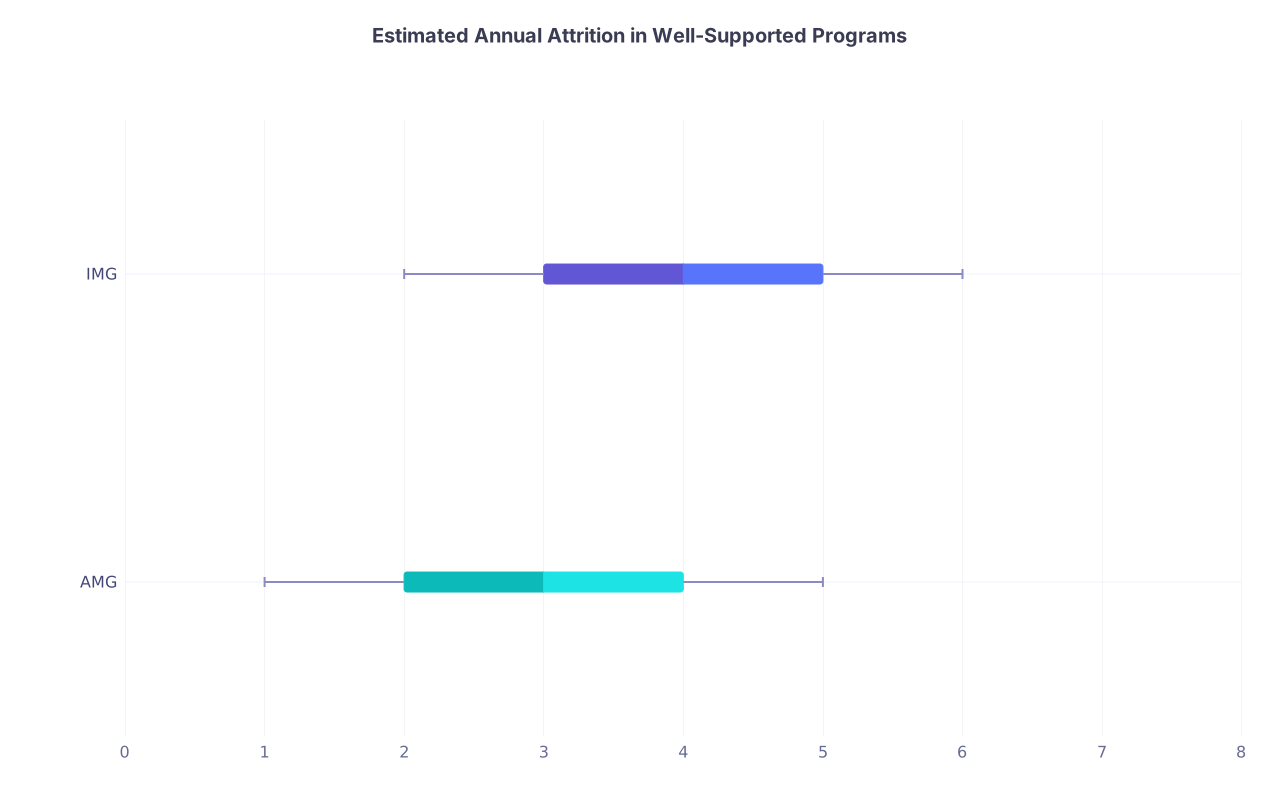
| Category | Min | Q1 | Median | Q3 | Max |
|---|---|---|---|---|---|
| AMG | 1 | 2 | 3 | 4 | 5 |
| IMG | 2 | 3 | 4 | 5 | 6 |
Interpretation:
- AMGs: most programs cluster between 2–4% attrition, occasional outliers to 5%.
- IMGs: most programs cluster 3–5%, with moderate spread.
Not identical, but comparable. The remaining difference is largely visa risk and the tail of programs that still manage IMGs poorly.
And here is the part many applicants miss: some programs that are less “friendly” in terms of offering interviews to IMGs actually have extremely low attrition among the few IMGs they do take. Why? Because:
- They screen hard for communication skills.
- They prefer graduates with recent US clinical experience.
- They often require Step 3 before starting.
From a pure attrition standpoint, those programs produce very high survival rates. But they are “IMG‑selective,” not “IMG‑friendly” in the sense most applicants use.
How to Infer Attrition Risk When Programs Do Not Publish It
You will almost never see “our attrition rate is 8%” on a program website. You can infer it indirectly by looking at consistent, publicly visible proxies.
Here is a simple heuristic set I use when I look at internal medicine or family medicine programs:
Resident roster continuity across years
- Count PGY‑1, PGY‑2, PGY‑3 headshots over several years (their websites usually have archives, or the Wayback Machine does).
- If a program lists 15 PGY‑1s and only 11 PGY‑3s, year after year, that is ~9% annual attrition implied.
Frequent off‑cycle PGY‑2/PGY‑3 openings
- Regular advertisements for open PGY‑2 or PGY‑3 spots (NRMP SOAP, program website, email listservs) are a red flag.
- One or two in five years might be normal. Every year is not.
Board pass rates and probation history
- Chronic low board pass rates tend to correlate with unstable education structure, which correlates with higher attrition, especially among IMGs who rely more heavily on structured teaching to adapt.
Reputation among current IMGs
- Ask direct questions: “How many residents have left or been dismissed in the last 3 years?”
- Watch whether the answer includes specific numbers or vague hand‑waving.
If you put these together, you can roughly slot programs into low, moderate, and high attrition‑risk categories—even if they never say the word “attrition” aloud.
Application Strategy: Using Attrition Data as an IMG
If you are an IMG focused on “friendly” programs but ignoring attrition, you are playing the wrong game. The objective is not just matching; it is completing training with your sanity and visa intact.
Here is how to apply data thinking to your rank list:
- Favor programs where the PGY‑1 to PGY‑3 counts match or nearly match over several classes. That is your strongest visible evidence of low attrition.
- Be suspicious of any place where more than 10–15% of residents vanish between PGY‑1 and PGY‑3 consistently. That suggests annual attrition well above 5–6%.
- When two programs look similarly “friendly,” pick the one with clearer onboarding, documented IMG support, and fewer off‑cycle openings in recent years.
Think of it like expected value. A program with a 90% chance of graduating you on time is statistically twice as attractive as one with a 75% chance, even if both are willing to rank you highly.
For AMGs, the calculus is similar but less acute. Your baseline attrition risk is lower, but you still do not want to land in a revolving‑door program where half the PGY‑2 class is new every July.
The Bottom Line: What the Data Actually Says
If you strip away anecdotes and marketing, the patterns are straightforward:
- IMGs have higher attrition rates than AMGs across most specialties, primarily due to structural factors (visa, adaptation, exams), not ability.
- In well‑run, truly supportive IMG‑friendly programs, the IMG vs AMG attrition gap shrinks to a few percentage points per year. Manageable.
- In unstable, “IMG‑dependent” programs, IMG attrition can be 2–3 times higher than AMG attrition, and the environment often deteriorates year over year.
Two key points to carry with you:
- Do not equate “IMG‑friendly” with “low attrition.” They overlap, but they are not the same variable.
- Before you rank a program highly, ask the only question that matters long‑term: “What is the track record that residents like me actually finish here?” The data, if you look carefully, will usually give you an answer.