
You are in a small call room, post‑interview, scrolling through your email. Subject line: “Preliminary Employment Contract – Please Review and Sign.” It is from a so‑called “IMG‑friendly” program that seemed welcoming on interview day. The coordinator told you, “We love IMGs here.” The residents nodded. The PD smiled a lot.
You click the PDF. 18 pages of legal text. And you are tired, on a student visa, halfway across the world, and very aware you do not have leverage.
This is exactly where people get trapped.
Let me walk you through what actually matters in those pages—and which “friendly” programs become a problem once you sign.
The Big Picture: Why Contracts Matter More for IMGs
Most AMGs have a safety net: family nearby, easier transfer options, no visa issues. If a contract turns out bad, some can walk away or lateral transfer.
IMGs rarely can.
You are often:
- On a visa that is tied to that employer
- Far from your support system
- Less familiar with U.S. labor law or standard residency terms
- More dependent on a clean record for future visas, fellowships, and jobs
So when an IMG‑heavy program hands you a contract with unusual clauses, they are often testing one thing: how desperate you are.
“Friendly” on a website or interview day does not mean the contract is friendly.
Let me break down the clauses IMGs need to read very carefully, and what good vs bad actually looks like.
1. Visa Sponsorship Language: The Non‑Negotiable Section
If you are an IMG on anything other than green card or U.S. citizenship, this is life or death. Do not skim it.
What you must find in writing
At minimum, you want clear, explicit statements on:
- Which visa types they sponsor (J‑1 vs H‑1B)
- Who covers costs (filing fees, attorney fees, premium processing)
- Timing commitments (when they file, by which date)
- Contingencies (what happens if visa is delayed or denied)
If a program director says in an email, “Oh yes, we sponsor H‑1B,” but the contract/offer letter only mentions “visa support” vaguely, that is a red flag. Verbal promises mean nothing if the contract and GME policies do not match.

J‑1 vs H‑1B – see it in black and white
Many IMG‑heavy internal medicine and family medicine programs “prefer” J‑1 only, even while hinting they “sometimes” do H‑1B. Your contract (or at least the official offer letter) should not be ambiguous.
Look for statements like:
- Good: “The Sponsoring Institution will sponsor a J‑1 clinical visa in coordination with ECFMG for the duration of training, contingent upon continued satisfactory performance.”
- Acceptable if true: “The Sponsoring Institution does not sponsor H‑1B visas for residency training. Only J‑1 visas will be supported.”
- Risky: “The Institution will assist with appropriate immigration documentation as needed.” (Too vague—could mean nothing.)
If you are specifically hoping for H‑1B and the contract documents do not name it, assume you will not get H‑1B.
Who pays and when
Some contracts bury this inside a generic “fees” section or GME handbook:
- Who pays USCIS filing fees?
- Who pays attorney fees?
- Is premium processing covered?
A common pattern in IMG‑heavy “friendly” community programs: they agree to H‑1B “if the resident covers all costs.” That could be several thousand dollars you do not have.
You want language closer to:
- “The Institution will cover reasonable attorney fees and USCIS filing fees associated with obtaining or extending the resident’s J‑1/H‑1B visa, excluding fees for dependents.”
If they explicitly state the resident is responsible for all employer‑side costs—that is not IMG‑friendly, regardless of the marketing.
Contingency language: if visa is delayed/denied
Pay attention to termination and start date clauses:
- Does the contract automatically void if you cannot start on time because USCIS is slow?
- Is there any flexibility to adjust start date?
- Does it label you “in breach” if the visa is denied? (It should not.)
A reasonable clause would say something like:
- “This Agreement is contingent upon the Resident obtaining appropriate visa status. Failure to obtain such status despite good‑faith efforts shall render this Agreement null and void without penalty to either party.”
If instead you see language about “breach,” “damages,” or “liability” tied to your inability to start due to immigration, that is dangerous.
2. Termination, Non‑Renewal, and “At‑Will” Language
You think residency is a fixed 1‑year renewable contract unless you seriously mess up. Many IMGs learn the hard way that some “friendly” programs keep the right to cut you loose with minimal process.
Watch for these phrases
Red flags in IMG‑heavy programs:
- “At‑will employment” without strong due process protections
- Termination “with or without cause” with short notice
- Vague “failure to meet expectations” as grounds for not renewing
Residency is not supposed to be standard at‑will employment. ACGME expects fair evaluation and remediation processes. If you sign a contract that allows them to drop you mid‑year with 30 days’ notice “for any reason,” you are volunteering for instability.
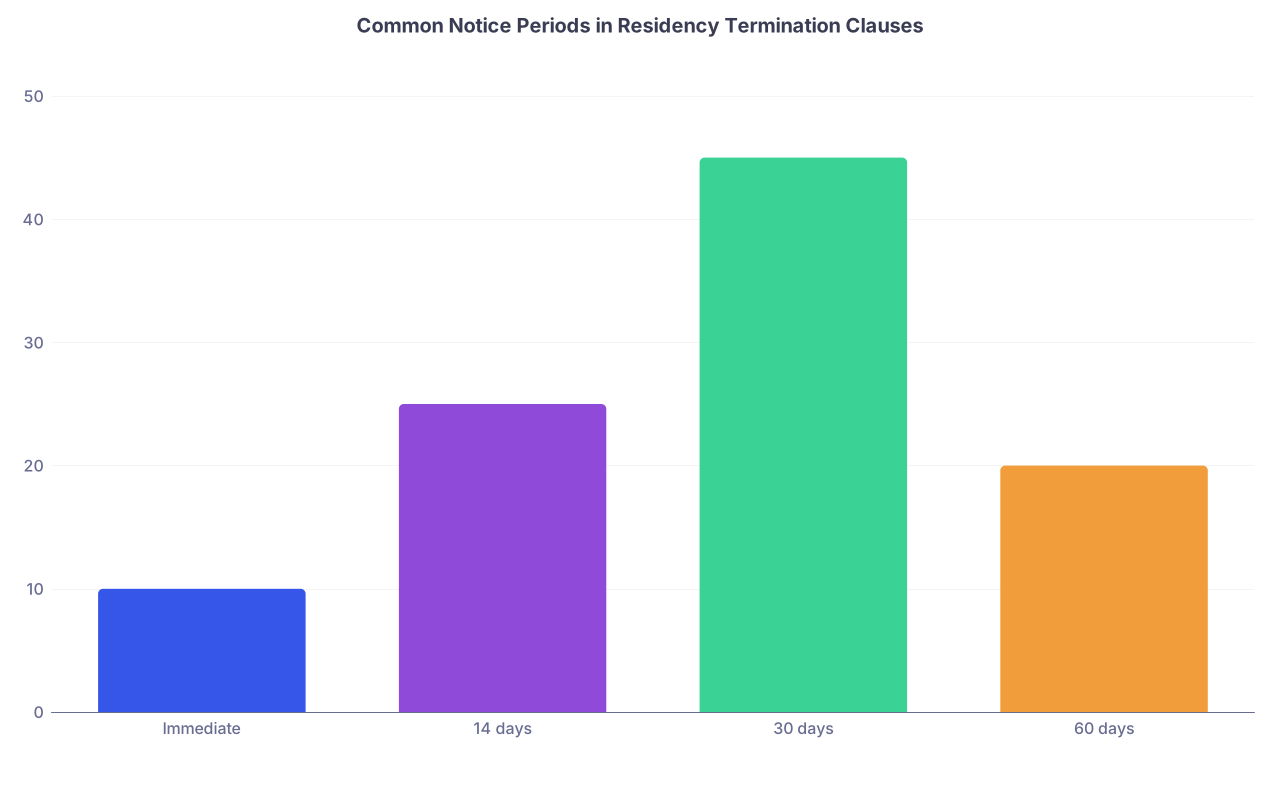
| Category | Value |
|---|---|
| Immediate | 10 |
| 14 days | 25 |
| 30 days | 45 |
| 60 days | 20 |
Due process: is it in the contract or just in a handbook?
There are usually two documents:
- The actual contract / appointment letter
- A referenced GME policy or Resident Handbook
You want both:
- A contract that says termination/non‑renewal will follow GME due process
- A GME policy that spells out steps: written notice, chance to respond, remediation, right to appeal
If your contract states:
- “Resident may be terminated at any time, with or without cause, at the sole discretion of the Program Director”
and then does not explicitly bind the PD to GME policies or describe an appeal process, you have almost no recourse.
Better wording includes:
- “Adverse actions, including non‑renewal, suspension, or termination, will be conducted in accordance with the Sponsoring Institution’s Graduate Medical Education Policies, including due process and appeal procedures.”
If they will not give you the GME policy or handbook before you sign, that is not a friendly program. That is a trap.
Non‑renewal versus termination
Two different beasts:
- Termination: mid‑year; more severe; often requires more documentation
- Non‑renewal: end‑of‑year decision not to offer next PGY level
Some programs exploit non‑renewal to avoid formal “termination,” especially with IMGs they think will not fight it.
Ask yourself:
- How much notice must they give for non‑renewal?
- Do you get a chance to review your evaluations and remediate?
- Is there an appeal pathway?
If the contract allows them to wait until late June to tell you “we will not renew,” then as an IMG you now have: no visa, no job, no time to recover.
3. Moonlighting: Income, Visa, and Exploitation
IMG‑heavy programs often dangle moonlighting as an advantage: “Lots of chances to moonlight and make extra money.” The contract tells you whether that is actually real.
Three things to check
- Are you allowed to moonlight at all?
- If yes, is it internal only or external too?
- As a visa holder, are you legally allowed to do the kind of moonlighting they’re suggesting?
Look for explicit language:
- Some contracts ban moonlighting altogether. That is not necessarily bad, but you should know before you count on extra income.
- Some say “moonlighting requires prior approval of the Program Director and DIO.” This is standard. The problem is when it looks allowed but is practically impossible.
Now the visa angle:
- J‑1: Your “employer” is effectively ECFMG. Many forms of external moonlighting are not allowed. Internal “extra shifts” may be permitted if they fit under training.
- H‑1B: Employer‑specific. If your program wants you to moonlight at another hospital, that site needs its own H‑1B or concurrent petition. Many do not bother.
If the contract says you can moonlight, but you are J‑1, understand that this may be more theoretical than real. Some programs look the other way and call it “extra call,” still under training. Others try to push you into work that may violate your visa limits.
Hidden exploitation: “extra shifts” without proper pay
Some IMG‑heavy places have a classic line: “We do not call it moonlighting; it is part of your duties.” Then they pay a flat low rate or nothing extra.
Your contract should clarify:
- Standard duties and expected call/shift schedule for each PGY level
- How “additional” shifts are compensated, if at all
- Whether “bonus” time is voluntary or can be mandated
If compensation language is absent, but residents are “expected” to cover uncovered shifts, you will feel it in your sleep and your bank account.
4. Work Hours, Call Schedule, and “Compliance” with ACGME
Study the sections that talk about:
- Duty hours
- In‑house call vs home call
- Maximum consecutive hours
- Days off
Why? Because some IMG‑dense programs treat ACGME rules as a suggestion, not a standard.

| Step | Description |
|---|---|
| Step 1 | Receive Contract |
| Step 2 | Check Visa Clauses |
| Step 3 | Review Termination Terms |
| Step 4 | Examine Moonlighting Rules |
| Step 5 | Verify Duty Hours and Benefits |
| Step 6 | Assess Noncompete and Buyouts |
| Step 7 | Discuss Concerns with Program |
Language to interpret carefully
Many contracts include generic ACGME compliance language:
- “The Program will comply with ACGME duty hour requirements.”
That sounds fine. But the enforcement is what matters.
What you want beyond the generic line:
- Reference to a mechanism for reporting duty hour violations without retaliation
- Clarification that duty hours include all clinical and educational work
- Acknowledgment of post‑call time off and maximum shift lengths
If residents are informally told “we just do what we need to for patient care; ACGME is flexible,” and the contract has no teeth for you to protect yourself, you are signing up for potential abuse.
IMG‑specific angle
IMGs often do not complain because:
- They fear visa or contract retaliation
- They feel replaceable in an IMG‑heavy program
- They are told “this is how U.S. training works; be grateful”
If the contract includes any language hinting that raising concerns can be seen as “disruptive” behavior without clear whistleblower or non‑retaliation protections, that is not a friendly culture. On paper or in reality.
5. Salary, Benefits, and Hidden Financial Clauses
You are not just looking for the base PGY‑1 number. You are looking at how tightly your financial future gets controlled by this one program.
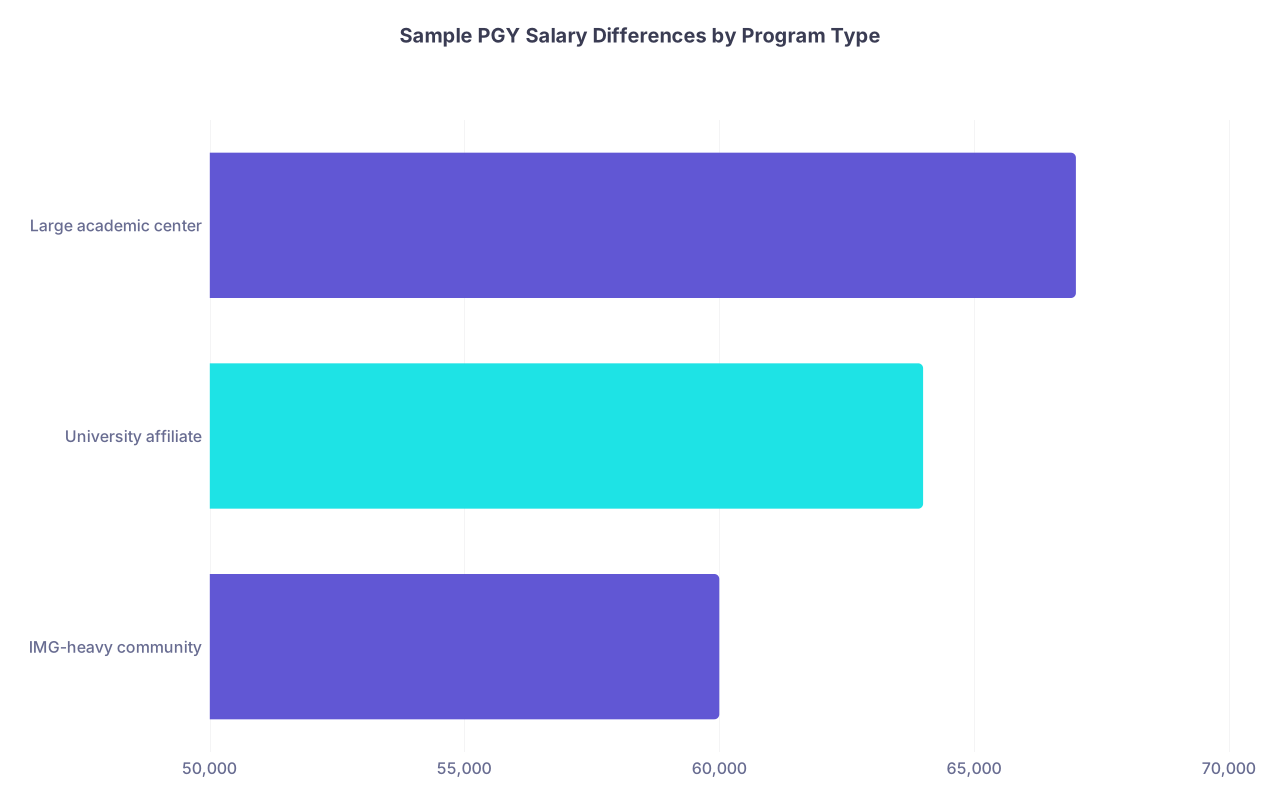
| Category | Value |
|---|---|
| IMG-heavy community | 60000 |
| University affiliate | 64000 |
| Large academic center | 67000 |
Salary and overtime reality check
Standard GME contracts list:
- Annual stipend by PGY level
- How and when paid (monthly, biweekly)
- Whether call pay or extra duty is separately compensated (usually not)
A red flag for IMG “friendly” mills:
- Salary significantly lower than regional averages without a compelling reason
- No cost‑of‑living adjustment in high‑cost cities
- Language that allows them to lower stipend mid‑year for “budgetary reasons”
You cannot renegotiate mid‑way. You are stuck.
Health insurance, disability, and life coverage
Check:
- When do benefits start? Day 1 or after a waiting period?
- Does health insurance cover dependents, and at what cost?
- Is there short‑term and long‑term disability (you will care if you get sick or injured)?
Some programs assume single residents with no families and offer minimal dependent coverage. For an IMG trying to support a spouse or children on one salary, those premiums matter.
Repayment obligations and “training costs”
This is the ugly part many IMG applicants miss.
Look for clauses that say:
- “If Resident voluntarily resigns or is terminated for cause, Resident shall reimburse the Institution for…”
- Visa fees
- Relocation costs
- Sign‑on bonus
- Orientation or onboarding costs
I have seen contracts from IMG‑heavy internal medicine programs in small towns that require $10,000+ “repayment” if the resident leaves in the first year, regardless of the reason, as long as it is not program‑initiated without cause.
You need to know:
- How much could you owe if you had to leave?
- How is “cause” defined (poor performance, professionalism issues, visa problems)?
If the contract says you must repay costs even if you are terminated for performance or “fit,” you are signing a high‑risk deal.
6. Non‑Compete, Geographic Restriction, and Post‑Training Clauses
Yes, some residency contracts sneak in non‑compete style language. Especially in IMG‑dense rural programs.
| Clause Type | Good/Standard Example | Concerning Example |
|---|---|---|
| Visa Sponsorship | Explicit J-1/H-1B terms | Vague "immigration support" only |
| Termination | Tied to GME due process | At-will, minimal notice |
| Repayment | Limited to clear sign-on bonus | Broad "training costs" repayment if you leave |
| Non-Compete | No restrictions post-residency | 1-2 year ban within large geographic radius |
| Moonlighting | Clear policy aligned with visa rules | Allowed on paper, but conflicts with visa status |
What might show up
Examples you may see:
- “Resident agrees not to practice medicine within 25 miles of the Institution for 1 year following completion or early termination of the program without written consent.”
- “Resident agrees to give the Institution right of first refusal for employment within the health system for [X] years following training.”
Residency non‑competes are legally questionable in some jurisdictions, but you do not want to be the one litigating this on a J‑1 waiver timeline.
Why this matters to IMGs:
- You may plan to do a J‑1 waiver job close to your training site. A geographic restriction can kill that plan.
- You might want to stay in the region for family or visa convenience, but the contract silently pushes you away.
Best case: no non‑compete at all.
If something appears, it should be narrow, time‑limited, and ideally tied to post‑residency employment contracts, not training.
7. Promotion and Evaluation: How You Actually Move from PGY‑1 to PGY‑3+
Many IMGs assume if they “work hard” and avoid obvious issues, they will progress. The contract and GME policies tell you if that is actually predictable.
What to look for
The contract often references:
- Criteria for promotion
- Role of Clinical Competency Committee (CCC)
- Use of milestones and evaluations
You want clarity like:
- “Promotion is based on the resident’s achievement of ACGME Milestones as determined by the Clinical Competency Committee, with documented evaluations and opportunities for remediation if deficiencies are identified.”
Be alert for vague or discretionary language:
- “Promotion is at the sole discretion of the Program Director.”
- “Resident may be required to repeat a year at the Institution’s discretion.”
Tie this back to due process: if they can hold you back or fail to promote you based on opaque criteria, and there is no appeal path, you are taking a serious career risk as an IMG.
8. Relocation, Start‑Date, and Pre‑Employment Conditions
Small, IMG‑heavy programs in non‑desirable locations often add “golden handcuff” style perks:
- Relocation allowance
- Housing stipend
- Sign‑on bonus
These are not free gifts. The contract will tell you what happens if you leave early.
Relocation and sign‑on strings
A common clause:
- “Resident agrees that if they terminate employment or are terminated for cause within 12 months of start date, they will repay relocation assistance and sign‑on bonus on a prorated basis.”
This is reasonable if transparent and proportional. It becomes exploitative when:
- The time horizon is long (repayment if you leave within 3 years).
- The amount is high relative to your stipend.
- “Cause” is defined broadly and controlled entirely by the program.
IMGs in trouble situations sometimes feel forced to stay in toxic environments because they cannot afford to repay $8,000 in relocation when they are barely covering rent.
Pre‑employment conditions: licensing, exams, and background checks
Carefully read sections on:
- Passing Step 3 by a certain date (especially if H‑1B is involved)
- Obtaining state license or training license
- Background checks and drug screening
If the contract says the appointment is contingent on all of the above and gives the program unilateral power to void the contract without any support or alternate plan, you need to be realistic about your risk.
For example:
- H‑1B‑seeking IMGs being required to pass Step 3 before a specific deadline, with the threat of contract cancellation if they do not.
You want to know those conditions early, not after moving your entire life.
9. Practical Strategy: How to Actually Review and Push Back (as an IMG)
You will not rewrite their whole contract. But you are not powerless.

Step 1: Get all documents, not just the PDF
Do not rely only on the one “Resident Agreement” PDF.
Ask directly (in writing):
- “Could you please share the current GME policies/Resident Handbook and any institutional policies referenced in the contract (e.g., due process, moonlighting, promotion)?”
If they say “You will get it at orientation,” that is a bad sign.
Step 2: Flag the high‑risk areas
Use a simple personal checklist:
- Visa: explicitly defined, costs covered or not, contingency language
- Termination/non‑renewal: notice, due process, appeals
- Financial traps: repayment clauses, non‑compete, unrealistic bonuses
- Moonlighting: allowed or not, aligned with your visa or not
- Promotion/due process: CCC, milestones, remediation
Highlight anything that gives one‑sided discretion to the institution without a referenced process.
Step 3: Ask targeted questions (not an emotional rant)
You can absolutely email the PD or GME office, even as an IMG, with calm, specific questions:
- “Could you clarify whether the Institution sponsors H‑1B visas for residency? I see only J‑1 mentioned in the contract.”
- “The contract mentions repayment of training costs if the resident leaves early. Could you specify what costs those are and the typical amounts?”
- “I did not see explicit due process language for termination. Can you point me to the GME policy that outlines appeal procedures?”
Their response tells you almost as much as the written language. Programs that are truly “friendly” do not get defensive about residents understanding what they are signing.
Step 4: Know when “friendly” is actually predatory
Patterns I have seen in truly problematic IMG “friendly” programs:
- Very high proportion of IMGs + rural or undesirable location
- Heavy service load, borderline or clear ACGME violations
- Contract with:
- Weak due process
- Strong repayment or penalty clauses
- Vague visa promises
- Non‑compete or geographic restrictions
If more than two of those show up, I would tell you directly: consider ranking them lower, even if they seemed nice. Nice does not protect your visa or your career.
10. Quick Visual: Clauses IMGs Must Read Twice
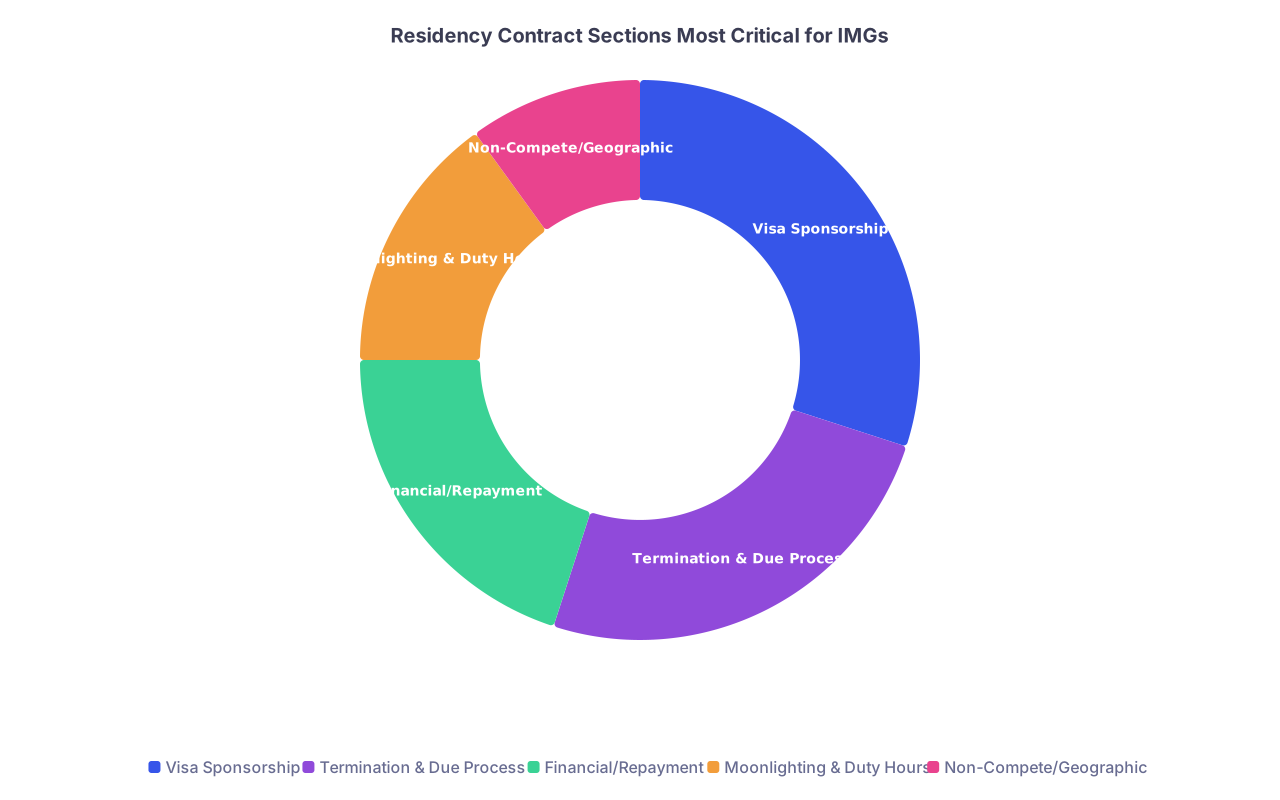
| Category | Value |
|---|---|
| Visa Sponsorship | 30 |
| Termination & Due Process | 25 |
| Financial/Repayment | 20 |
| Moonlighting & Duty Hours | 15 |
| Non-Compete/Geographic | 10 |

Key Takeaways
- Do not confuse “IMG‑friendly” with “contract‑friendly.” Read visa, termination, and repayment clauses line by line.
- Any contract that gives the program broad power to terminate or non‑renew you, combined with visa dependence and repayment penalties, is high‑risk for IMGs.
- Ask for policies in writing, clarify vague language, and be willing to walk away or rank lower a program whose paper reality does not match the friendly interview performance.