
The label “IMG-friendly” does not kill your shot at competitive fellowships. Your record does.
Let me be blunt: fellowship directors care far more about what you did in residency than whether your program was tagged on some Reddit list as “IMG-friendly.” But there are real traps here. Some IMG-heavy programs set you up beautifully for cards, GI, heme/onc, etc. Others quietly cap your ceiling.
Your job is to tell the difference—before you sign a contract.
Here’s the answer you’re looking for, broken down.
1. The core truth: fellowship directors don’t care about the “IMG-friendly” label
Fellowship selection is brutally simple under all the noise. The usual hierarchy:
- Your clinical performance (evaluations, letters, reputation).
- Your research and scholarly work.
- Your in-training/board scores.
- Your program’s reputation within that specialty, not overall.
- Interview performance and fit.
Notice what’s missing: “Are you from a program that takes a lot of IMGs?”
Directors are not filtering ERAS by “IMG-friendliness.” They’re asking:
- Do I know this program?
- Do I trust their letters?
- Has this PD ever sent me a strong fellow?
- Does this resident have a track record that proves they can handle a competitive fellowship?
I’ve watched fellowship rank list meetings where someone says:
“Program X? I do not care that it’s community. The last two fellows from there were rock solid.”
Game over. You’re judged by the track record, not the website branding.
Where “IMG-friendly” can hurt you is indirect:
- If the program has weak research infrastructure.
- If no one matches into strong fellowships.
- If letters are generic and ignored by fellowship PDs.
- If clinical exposure is limited.
So the right question is not “Does an IMG-friendly program hurt me?”
It’s “Does this particular program launch people like me into the fellowships I want?”
2. What actually matters for competitive fellowships from an IMG-friendly program
If you want competitive fellowships (cards, GI, heme/onc, critical care at big-name places), here’s what matters far more than the label on your residency.
Track record: the most underrated data point
If an IMG-heavy program consistently places people into good fellowships, you’re fine. If they don’t, you’re gambling.
| Factor | Good Sign | Red Flag |
|---|---|---|
| Fellowship match list | Regular matches in cards/GI/heme-onc/CCM | Vague, outdated, or not shared |
| Where they match | Mix of university and solid community fellowships | Only low-tier or local unknown programs |
| Who matches | IMGs consistently represented | Only AMGs getting the best spots |
| PD support | PD talks specifically about helping fellows | PD gives generic “we support all paths” answer |
Ask for a 5-year fellowship match list. Not a cherry-picked year. If they will not show it to you, that’s your answer.
Internal reputation: is this a “feeder” to anyone?
Some programs are unofficial feeders to certain fellowships. That relationship matters more than whether the residency is IMG-friendly.
During interview or pre-match calls, ask senior residents:
- “Do any of our attendings sit on fellowship selection committees at other institutions?”
- “Have past residents matched where you want to apply?”
- “Do we regularly send people to University X, Y, Z for fellowship?”
Those quiet pipelines are gold.
3. The 4 big pitfalls of some IMG-friendly programs (and how to spot them)
Not all IMG-heavy programs are the same. Some are strong, others are basically service factories that burn residents and produce weak applications.
Here are the specific ways IMG-friendly programs can actually hurt your fellowship chances—and how to recognize them in advance.
Pitfall 1: Service monster, zero bandwidth for scholarship
You know these programs: 80+ hour “unofficial” weeks, chaotic call, no protected time, documentation burden through the roof.
Result: you never get research finished, you barely squeeze by on ITE studying, and your fellowship PS reads like “I survived.”
- “Real talk: do any residents here realistically complete research projects?”
- “How many posters/oral presentations did last year’s fellowship applicants have?”
- “Is there protected time for scholarship? Or do people just do it exhausted at 10 p.m.?”
If they say “Oh, a couple people did a case report…” and that’s the highlight? That’s a problem if you’re aiming for cardiology at a university program.
Pitfall 2: Weak or absent research culture
IMG-friendly doesn’t mean anti-research. But some programs absolutely are.
Signs of a research-scarce environment:
- No structured scholarly curriculum.
- No regular research meetings or mentorship assignments.
- No one can name the research director.
- Residents publish only isolated case reports, if anything.
Healthy research culture looks different:
- There’s a research director you meet on interview day.
- Residents can readily name specific projects going on.
- You hear: “Yeah, we usually get 5–10 posters at [regional/national] meetings each year.”
If nobody talks about abstracts, IRB, or conferences unless you drag it out of them, expect to do everything on your own. Which is possible, but harder.
Pitfall 3: Letters that carry no weight
Fellowship directors read hundreds of letters. Some names stop them. Others get skimmed.
What hurts you is not that your program is IMG-heavy, but that:
- Your PD is unknown outside the region.
- Letters are generic: “hardworking, team player, pleasure to work with” and nothing else.
- No one writing for you has academic clout in that specialty.
Ask current fellows (or PGY-3s applying):
- “Who writes the strongest letters here for cards/GI/heme/onc?”
- “Do our attendings know people at other programs?”
- “Has our PD ever called programs to advocate for someone?”
If you hear, “We mostly match locally” and “we don’t really do phone calls,” that’s a clue: you’ll be relying entirely on your paper application and cold letters. Still doable, but again—harder.
Pitfall 4: No prior track record in your target specialty
If your dream is advanced heart failure, and the program has never matched anyone into cardiology—ever—you should at least pause.
Ask very specifically:
- “In the last 5 years, how many residents matched into:
- Cardiology?
- GI?
- Heme/Onc?
- Pulm/CCM or CCM?”
- “Were they IMGs?”
- “Where did they go?”
If the answer is “We’re more of a primary care–oriented program,” believe them. That doesn’t make the program bad. It just makes it misaligned with your goals.
4. How to use an IMG-friendly program as a launchpad (not a limitation)
You can come from a smaller or IMG-heavy program and match into excellent fellowships. I’ve seen:
- An IMG from a mid-tier community IM program match cardiology at a top-30 university.
- A heme/onc fellow at a major academic center from a so-called “IMG dump” program.
- Pulm/CCM fellows from places nobody on SDN ever talks about.
They all had the same playbook.
Step 1: Dominate clinically
Fellowships don’t want research robots who can’t run a ward team. Your first job:
- Crush your evaluations.
- Become the resident nurses and interns trust.
- Be the person attendings fight to have on their team.
This translates directly into:
- Strong, specific letters (“best resident I’ve worked with in 5 years,” “third-year level as a PGY-2”).
- PDs who actually advocate for you.
- A reputation that survives a mediocre brand name.
Step 2: Build real scholarly output
From an IMG-friendly or smaller program, you need to show effort and productivity.
Aim for:
- At least 1–2 meaningful projects in your target specialty:
- Retrospective chart review.
- QI project with clear outcomes.
- Case series with literature review.
- Posters at regional/national meetings (ACC, ACG, ASH, ATS, CHEST, etc.).
- One or two publications if possible (not mandatory, but helps a lot).
If your program has no research infrastructure, cold email:
- Subspecialists in your interest area at your hospital.
- Adjunct/affiliate faculty at academic centers they rotate with.
- Former graduates now in academic fellowships.
Tell them exactly what you want: “I’m an IM resident interested in [X fellowship]. I’d like to help with any ongoing project and eventually take a first- or second-author role if possible.”
Yes, you’ll get ignored a lot. But you only need one serious mentor to say yes.
Step 3: Crush your ITE and boards
Another stereotype: “IMG-friendly program, weak exam culture.”
Do not feed that.
Fellowship PDs still look at:
- ITE scores (trend matters).
- ABIM/board pass and performance if available in time.
- USMLE/COMLEX (less now with Step 1 P/F, but Step 2 can still matter).
You want a simple story: “Yes, IMG. Yes, community/IMG-heavy program. But numbers, performance, and productivity are excellent.”
Step 4: Build direct connections beyond your program
If your home program is small or locally known, extend your network:
- Do away electives at academic centers in your target specialty.
- Present at national meetings and actually talk to people afterward.
- Email fellowship coordinators and faculty with your abstract beforehand: “I’ll be presenting X at Y—would love to briefly meet.”
You want at least one letter from:
- A recognizable name in the specialty outside your home program
or - A well-published subspecialist at your hospital who’s respected regionally/nationally.
That letter plus your PD letter can neutralize the “small, IMG-heavy program” perception.
5. How to evaluate IMG-friendly programs before you rank them
Here’s a simple framework. Use it on every program you’re considering if you care about competitive fellowships.
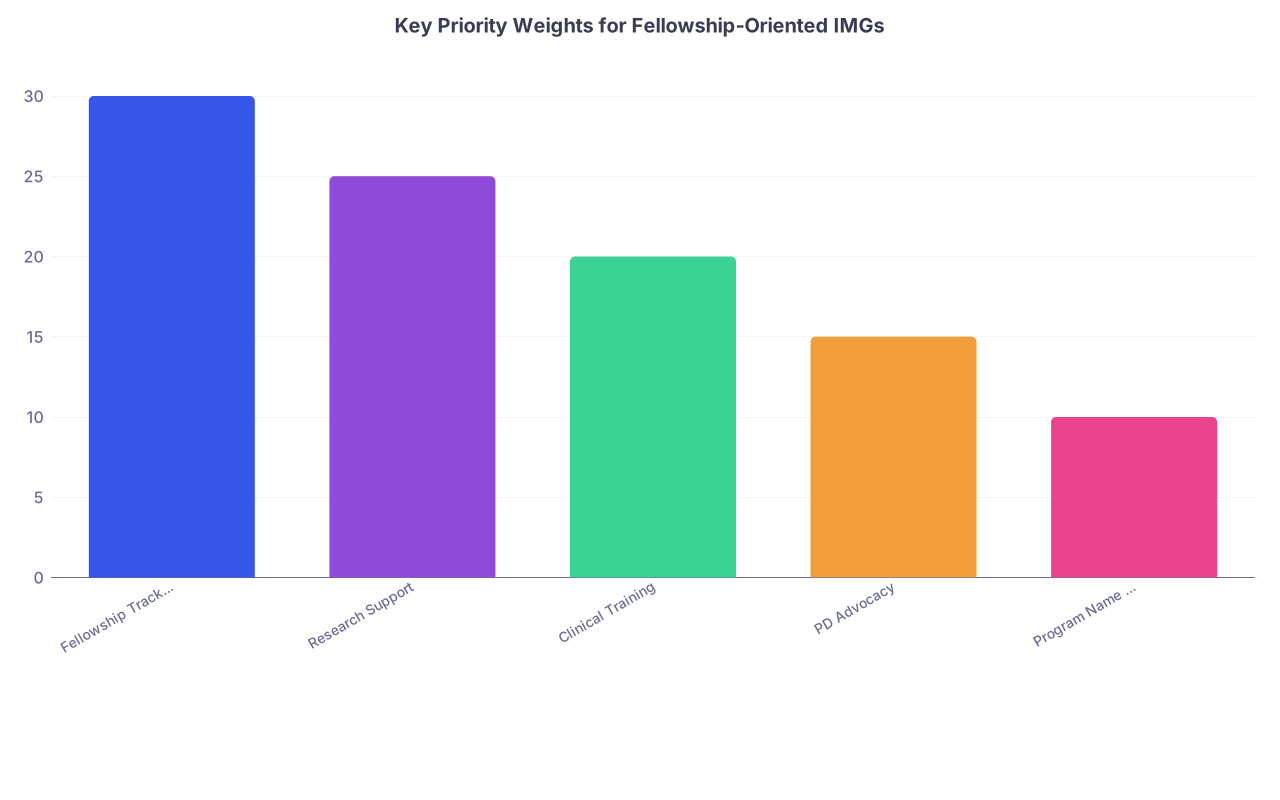
| Category | Value |
|---|---|
| Fellowship Track Record | 30 |
| Research Support | 25 |
| Clinical Training | 20 |
| PD Advocacy | 15 |
| Program Name Brand | 10 |
You should care about:
Fellowship track record (highest weight)
- 5-year list.
- Representation of IMGs in competitive fellowships.
- Honest answers from residents.
Research support
- Actual ongoing projects.
- A named research mentor or director.
- Residents with abstracts/posters/publications.
Clinical volume and acuity
- Enough complexity to impress in letters and prepare you for fellowship.
- But not so crushing that you can never open your laptop for anything else.
PD and faculty advocacy
- PD knows the fellowship process.
- Willing to make calls, send emails, advise on strategy.
- Subspecialists engaged with resident career goals.
Program brand
- Yes, it matters. But it’s overrated compared to the others.
- A mid-tier but productive program with strong letters beats a “name” place that burns you out with no mentorship.
If an IMG-friendly program scores well on 1–4, the fact that it’s IMG-heavy is not a problem. It may actually mean they’re used to helping IMGs match well.
6. So… do IMG-friendly programs hurt your chances?
Short answer: By themselves, no. Weak programs do.
An IMG-friendly residency program helps or hurts you depending on:
- Whether it has a real fellowship track record.
- Whether there’s space and structure for research.
- Whether your PD and subspecialists will go to bat for you.
- Whether you turn your situation into a strong, coherent application.
The worst mistake is assuming:
- “IMG-friendly = low tier = I can never do cards/GI/heme/onc.”
Plenty of fellows at good programs came from IMG-heavy residencies.
The second-worst mistake is assuming:
- “They take a lot of IMGs, so they must know how to get us fellowships.”
Not necessarily. Some just know how to fill a schedule.
Your responsibility is to interrogate programs—kindly but directly—and pick the ones that actually support your long-term goals, not just your immediate visa or match need.

| Step | Description |
|---|---|
| Step 1 | IMG considering program |
| Step 2 | Lower on rank list |
| Step 3 | Proceed only if willing to hustle solo |
| Step 4 | Risk of weak letters and advocacy |
| Step 5 | Good platform for competitive fellowship |
| Step 6 | Has strong fellowship match list? |
| Step 7 | Has research and mentorship? |
| Step 8 | PD and faculty advocate for fellows? |
FAQ (exactly 5 questions)
1. I matched an IMG-friendly community program. Is cardiology or GI still realistic for me?
Yes, if the program has at least some history of matching residents into those fellowships and you’re willing to work for it. You’ll need strong clinical performance, clear interest in the specialty early, at least a couple of solid scholarly outputs, and strong letters (ideally including one from an academic cardiologist or gastroenterologist, even via away rotations or research). If your program has zero track record in those fields, it becomes harder but not impossible—you just need to build your network outside the program aggressively.
2. Do fellowship programs rank AMGs from big-name residencies above IMGs from IMG-friendly programs by default?
Not automatically. Brand name gives them an initial familiarity advantage, but a well-prepared IMG from a lesser-known program with strong letters, tangible research, and excellent evaluations absolutely gets ranked highly. Where you lose is if your application is mediocre and your program is unknown. A strong file from a smaller IMG-heavy program can outrun a lukewarm application from a better-branded place.
3. How many research projects do I need from an IMG-friendly program to be competitive?
There’s no magic number, but as a rule of thumb for competitive fellowships: 1–2 substantial projects (chart reviews, QI with real outcomes, or multi-case series) and 2–4 abstracts/posters at regional/national meetings put you in a decent spot. A publication or two helps but is not strictly mandatory at every program. What matters is that your output clearly aligns with your target specialty and shows sustained engagement, not just one random case report in something unrelated.
4. If my program has poor fellowship outcomes, should I try to transfer programs?
Transferring is an option but not a cure-all. It’s disruptive, hard to pull off, and you may burn time and relationships. Before thinking transfer, exhaust what’s available: find any subspecialist mentor, look for research at affiliated hospitals, attend conferences, do away electives. If you’re early (PGY-1), the environment is clearly toxic or abusive, and there is zero path for growth or fellowship, then exploring a transfer can make sense. But do not assume a move to a different IMG-friendly program automatically fixes things—the new program must clearly be stronger in track record and support.
5. Will being an IMG always put me at a disadvantage for top fellowships, no matter the residency?
You start with a perception hurdle, yes. But it’s not a permanent cap. Many fellowship PDs have trained outstanding IMGs and know how strong they can be. If you deliver: high performance, excellent communication skills, clear specialty commitment, meaningful scholarship, and strong letters, the “IMG” label becomes background noise. What they see is: “Can this person do the job and elevate our program?” At that point, your residency’s IMG-friendliness is largely irrelevant—your actual performance is what counts.
Key takeaways:
- “IMG-friendly” by itself does not harm your fellowship chances; weak track record and poor support do.
- For competitive fellowships, prioritize programs with proven match history, research infrastructure, and PD/faculty advocacy—even if they are IMG-heavy or community-based.
- From any program, your best leverage is outstanding clinical work, targeted scholarship, and strong, specific letters from people fellowship directors trust.