
The Match does not care that you failed Step once. It only cares whether you give program directors a clear, low-risk reason to say yes anyway.
If you are an IMG with a Step 1 or Step 2 CK fail on your record, you are not finished. You are just not allowed to be sloppy anymore. The casual, “spray-and-pray” application strategy your classmates use will not work for you. You need to weaponize IMG‑friendly programs, data, and storytelling to rebuild your candidacy.
Here is exactly how.
1. Face the Damage – Then Quantify Your Real Chances
First, stop guessing how bad the fail “looks.” Program directors are not emotional about this. They think in risk buckets.
For IMGs, a USMLE fail usually means:
- Auto-screen rejection at many “brand-name” or academic-heavy programs
- Extra scrutiny at mid-tier community programs
- A chance (not a guarantee) at IMG-heavy, community-based, or prelim programs
- A significant penalty if:
- You failed Step 2 CK (worse than Step 1 in many programs’ eyes), or
- You failed the same exam more than once
You cannot change that. What you can change is everything else.
Hard reality check (do this now)
Write down:
- Your USMLE history
- Step 1: pass/fail, number of attempts, if scored then actual score
- Step 2 CK: score and attempts
- CS (if applicable) / OET / English issues
- Your profile:
- Year of graduation (YOG)
- Number of months of U.S. clinical experience (USCE) – real USCE, not observerships
- Any research or publications
- Any gaps in training or unexplained time off
- Your target specialties:
- Internal Medicine, Family Medicine, Pediatrics, Psychiatry, Neurology, etc.
You are trying to answer one question:
“Am I a realistic candidate for IMG-friendly, community-heavy programs if I apply strategically and over a wide enough range?”
If you have:
- Step 2 CK above ~230 on first pass after an earlier fail on Step 1
- < 5 years since graduation
- At least 2–3 months of solid USCE with letters
- No professionalism issues or serious red flags
Then yes, you absolutely still have a shot at many IMG‑friendly programs. I have seen applicants with a Step 1 fail and a 240+ Step 2 match Internal Medicine and Family Medicine in the United States. Every year. The ones who fail? They usually wasted their application on the wrong programs, too few programs, and generic documents.
2. Understand What “IMG‑Friendly” Actually Means (Not the Myth Version)
Most applicants abuse that phrase. “IMG-friendly” is not a warm, fuzzy concept. It is measurable.
A program is genuinely IMG-friendly if it satisfies at least 3 of these:
- Always has current IMGs in PGY1 and above
- Historically has >25–30% IMGs in the program
- Accepts or sponsors visas (J-1 and/or H-1B)
- Lists no U.S. graduation requirement (e.g., “U.S. med school only”)
- Has a known history of accepting applicants with attempts or gaps
Now narrow that further for your situation: IMG + prior Step fail.
You are looking for:
- Programs listing “multiple attempts considered” or not listing an attempt maximum
- Programs without strict Step 2 CK cutoffs (e.g., “we prefer 220+” is better than “we require 240+ on first attempt”)
- Community-based or community/university-affiliated programs, not big-name university hospitals that pretend to be “open-minded” but screen on attempts
Core specialties that remain realistic with a fail
If you are an IMG with a Step fail, these are usually the repairable routes:
- Internal Medicine (community and some university-affiliated community)
- Family Medicine
- Pediatrics (selected programs)
- Psychiatry (IMG-heavy community programs; more competitive each year)
- Neurology (still somewhat open to IMGs, but tightening)
These are much more difficult with a fail as an IMG:
- Radiology, Dermatology, Ophthalmology, Orthopedics, ENT, Neurosurgery
- EM at most places
- Anesthesiology and OB/GYN at many academic centers
You can still try for tougher specialties as a stretch, but do it after you build a safe core list. Survive first. Upgrade later.
3. Build a Ruthlessly Targeted Program List
Here is where most IMG applicants waste their entire cycle. They:
- Apply to 100+ random programs from the ERAS list
- Throw in a few “dream” university programs
- Ignore historical IMG data
- Do not read the fine print on attempt limits
You cannot do that.
Step 1: Use data, not vibes
You need three concrete sources:
NRMP Charting Outcomes / Program Director Survey
- Shows how attempts and IMG status affect match probability by specialty
FREIDA (AMA)
- Filter by:
- IMG percentage
- Visa sponsorship
- Program size
- Community vs academic
- Filter by:
Actual resident rosters + recent match lists (program websites)
- Scroll for:
- FMG/IMG distribution
- Schools that look like yours
- Visa notes in resident bios
- Scroll for:
Build a spreadsheet. Yes, a real one. With columns like:
| Column | Example Entry |
|---|---|
| Program Name | XYZ Community Hospital IM |
| State | NY |
| Specialty | Internal Medicine |
| IMG % (estimate) | 60 |
| Visa Sponsorship | J-1 |
| Step Attempt Policy | Allows multiple attempts |
| YOG Limit | Within 5 years |
| Min Step 2 CK (stated) | 220 preferred |
| USCE Required | Yes, 1 month |
This is dull work. Do it anyway. It is how you stop lighting your ERAS fee on fire.
Step 2: Classify your target programs
Put each program into one of three buckets:
- Green – Very IMG-friendly, many current IMGs, explicit or implied flexibility on attempts, visas okay, scores around your range.
- Yellow – Some IMGs, maybe a soft cutoff, less clear about attempts, but still plausible.
- Red – IMG-light or U.S. grad-heavy, strict cutoffs, or no sign of flexibility.
If you have a fail, your distribution per specialty should look roughly like this:
- 60–70% Green
- 25–35% Yellow
- 0–10% Red (only if you have other serious strengths: research, strong Step 2, US grads vouching for you)
Step 3: Decide how many programs to apply to (realistic ranges)
IMG with one fail and improved scores:
- Internal Medicine: 120–180 programs
- Family Medicine: 80–140 programs
- Pediatrics: 60–100 programs
- Psychiatry: 80–140 programs
- Neurology: 60–100 programs
These are not fantasies. This is what it often takes to overcome an attempt as an IMG in competitive cycles. If that volume is not financially possible, your job is to be even more selective with your program list and tighten your story (we will talk about that).
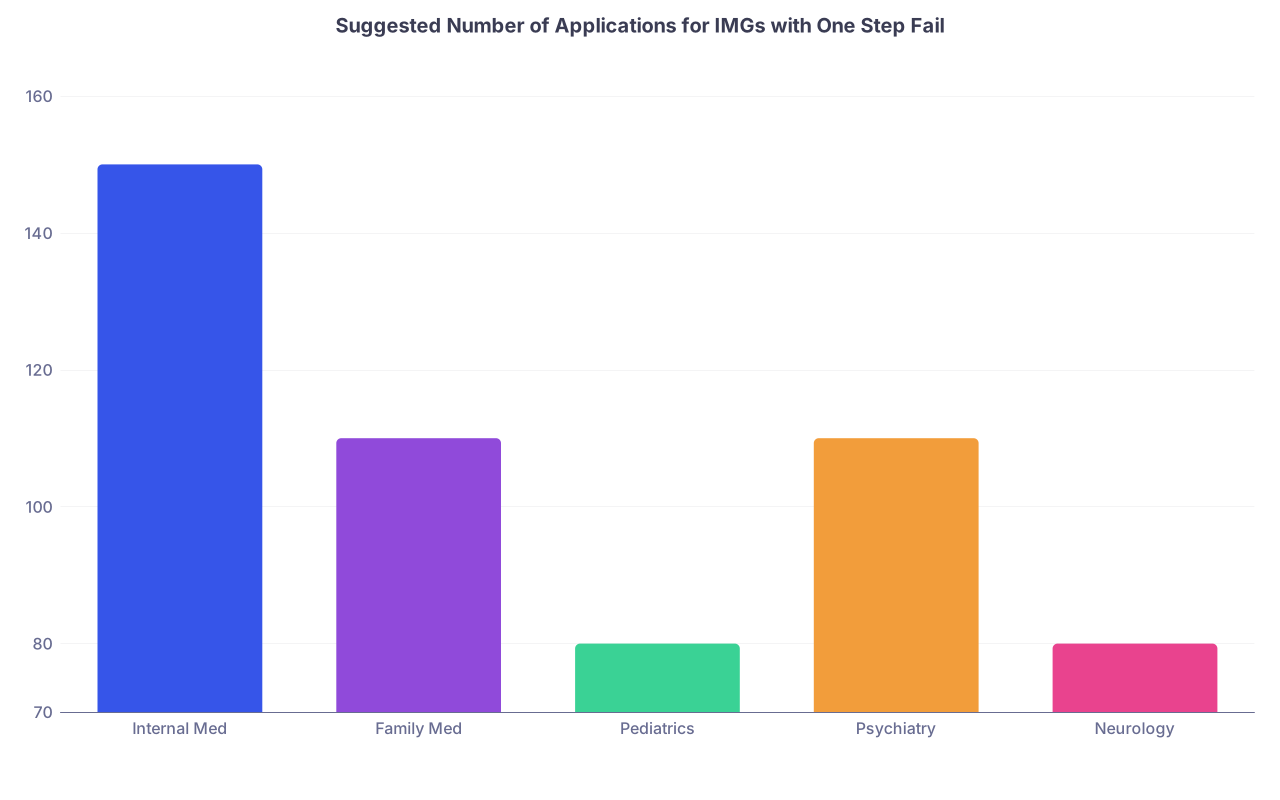
| Category | Value |
|---|---|
| Internal Med | 150 |
| Family Med | 110 |
| Pediatrics | 80 |
| Psychiatry | 110 |
| Neurology | 80 |
4. Turn Your Step Fail from “Red Flag” into “Resolved Problem”
Most applicants try to hide the fail. Program directors hate that. They see an unexplained failure as a continuing risk, not a past mistake.
Your job is to make the fail look like:
- A single, clearly explained event
- Followed by documented improvement
- With a plausible underlying cause that is unlikely to recur in residency
Step-by-step: How to explain the fail
You will address it in two places:
- Personal statement (briefly)
- MSPE/dean’s letter or ESLOE equivalent (if applicable) – you cannot control this as much, but you can sometimes request clarification
In your personal statement
Use a short, direct paragraph. Not a sob story. Example skeleton:
- State what happened.
- Give the real primary cause (within reason).
- Show what you changed.
- Prove it worked (with your later scores and performance).
Template you can adapt:
During my initial attempt at Step 1, I failed to pass. At that time, I underestimated the adjustment required to study effectively while working part-time and managing a move to a new country. After that result, I reorganized my schedule, enrolled in a structured prep course, and completed over 3,000 practice questions with detailed review. On my subsequent attempts at Step 1 and Step 2 CK, I passed on the first retake and improved my Step 2 CK score to 238. This experience forced me to build a more disciplined, data-driven approach to learning that I now apply consistently in clinical work.
Key rules:
- Do not blame the test. Or the system. Or the proctor.
- Do not describe yourself as a victim.
- Focus on what you learned and how you permanently changed your behavior.
Back it up with action
Words are cheap. Data is not. Make sure you have:
- Clearly better Step 2 CK on first attempt after the fail
- Strong clinical evaluations from U.S. rotations
- Ideally: one attending who can explicitly say in a letter that you are reliable, prepared, and academically solid
5. Use IMG-Friendly Programs Strategically, Not Desperately
You are not begging. You are offering solid value to programs whose mission and structure truly align with your background.
What IMG-friendly community programs actually value
Ask any PD at a busy community IM or FM program and they will tell you the truth:
They care more about:
- Reliability
- Work ethic
- Team fit
- Clinical maturity
- Communication skills (especially with diverse patients)
…than they do about whether you got 260 on Step 2.
So your entire application needs to scream:
“I will show up, do the work, not cause drama, and my Step 2 and clinical track record prove I am beyond the fail that happened years ago.”
How you show that:
Letters of recommendation from U.S. clinicians who actually know you
The worst mistake: 3–4 generic letters from your home country, none from U.S. rotations.
Minimum for a serious IMG+fail candidate:
- 2 letters from U.S. attending physicians in the specialty you are applying to
- 1 additional letter (U.S. or home country) that addresses reliability / resilience / work ethic
Ask them specifically:
“Can you comment on my ability to learn quickly, handle feedback, and my reliability on the team?”Program-specific signals in your personal statement
No, you do not need 150 separate personal statements. You need 2–3 versions:
- Community IM-focused version
- FM-focused version (if applying FM)
- Maybe a psych/neuro version if applicable
Then you add 1 customized paragraph for certain programs where you have a real connection or strong fit:
- You rotated there
- You worked with their graduates
- Their patient population matches your prior experience (e.g., underserved, refugee, rural)
That paragraph should mention concrete details:
- “Your clinic’s focus on diabetic education and group visits…”
- “Your program’s continuity clinic at XYZ Community Health Center…”
Not vague praise like “Your excellent teaching and research environment.”
ERAS application that matches their priorities
For IMG-friendly community programs, emphasize:
- Long-term clinical work or volunteering with real patient contact
- Leadership in practical, service-based roles (clinic coordinator, quality improvement, etc.)
- Language skills and experience with diverse or underserved populations
- Concrete evidence you can handle volume and call
6. Fix Your Timeline and Experience Gaps Before You Click “Submit”
If you already failed a Step, you cannot also look inactive, disconnected, or drifting.
If you are 0–2 years post-graduation
You need to:
- Lock in at least 2–3 months of U.S. clinical experience (hands-on if possible: externships, sub-internships, clerkships).
- Start these before application season if you can, or at least have them scheduled and listed in ERAS.
If you are 3–5+ years post-graduation
Programs will worry your clinical skills are rusty. You must show a continuous connection to medicine:
- Current clinical work (physician, general practitioner, hospitalist, or similar)
- Or a structured role in research + clinical observerships
- Or teaching roles with clinical content
If you have a multi-year gap, you must:
- Explain it clearly in ERAS and, if appropriate, in your personal statement:
- Family illness, mandatory military service, visa delays, financial reasons
- Show that you have been actively closing the gap now (U.S. rotations, refreshed coursework, etc.)

| Step | Description |
|---|---|
| Step 1 | Step Fail Identified |
| Step 2 | Retake and Improve Step 2 |
| Step 3 | Obtain US Clinical Experience |
| Step 4 | Target IMG Friendly Programs |
| Step 5 | Craft Focused Application |
| Step 6 | Secure Interviews |
| Step 7 | Match or Improve for Next Cycle |
7. Interview Season: Turn “Why Did You Fail?” Into “We Want This Resident”
You will be asked about the fail. Sometimes by people who do not sugarcoat it.
Your answer needs to be:
- Short
- Calm
- Cause–Correction–Proof structure
Example:
I failed Step 1 on my first attempt. At that time, I was adjusting to a new country and did not have a structured plan; I believed that my prior school habits would be enough. After that result, I treated preparation like a full-time job: I built a daily schedule, tracked my performance in question banks, and worked closely with a study group. I passed Step 1 on my next attempt and improved my Step 2 CK score to 236 on the first try, which reflects the more disciplined approach I now use in residency-level work as well.
Then stop talking. If they want more detail, they will ask.
During the rest of the interview, you must overdeliver on:
- Clinical reasoning (use specific cases when answering questions)
- Teamwork stories (conflict, difficult colleagues, night float, etc.)
- Reliability (times you took extra responsibility, prevented errors, stayed late)
- Maturity: speak like a junior colleague, not a desperate applicant
8. If You Do Not Match: How to Use One Cycle to Massively Upgrade
I have to say this directly: with a fail on your record, you may need more than one cycle. That does not mean you give up. It means the year between cycles becomes your most important training block.
If you go unmatched:
Do not reapply immediately with the same application. That is how people burn 3–4 cycles.
Conduct a post-match autopsy:
- Number of applications by specialty
- Number of interviews received
- Feedback from mentors / interviewers if possible
- Compare your stats to matched IMGs in community programs
Choose 2–3 of these high-yield upgrades for the next cycle:
- 3–6 months of fresh, hands-on U.S. clinical experience
- A U.S.-based research assistant position in your specialty that includes some clinical exposure
- A structured Step tutoring or teaching role to reinforce your academic narrative
- A quality improvement or clinical project that can become a poster or abstract
- Improved English communication (public speaking course, OSCE-style practice, targeted coaching)
Fix whatever was clearly weak this cycle:
- If you had almost no interviews: your program list or Step profile was misaligned.
- If you had interviews but no rank offers: your interview skills, explanation of the fail, or perceived fit were off. Get mock interviews with harsh feedback.
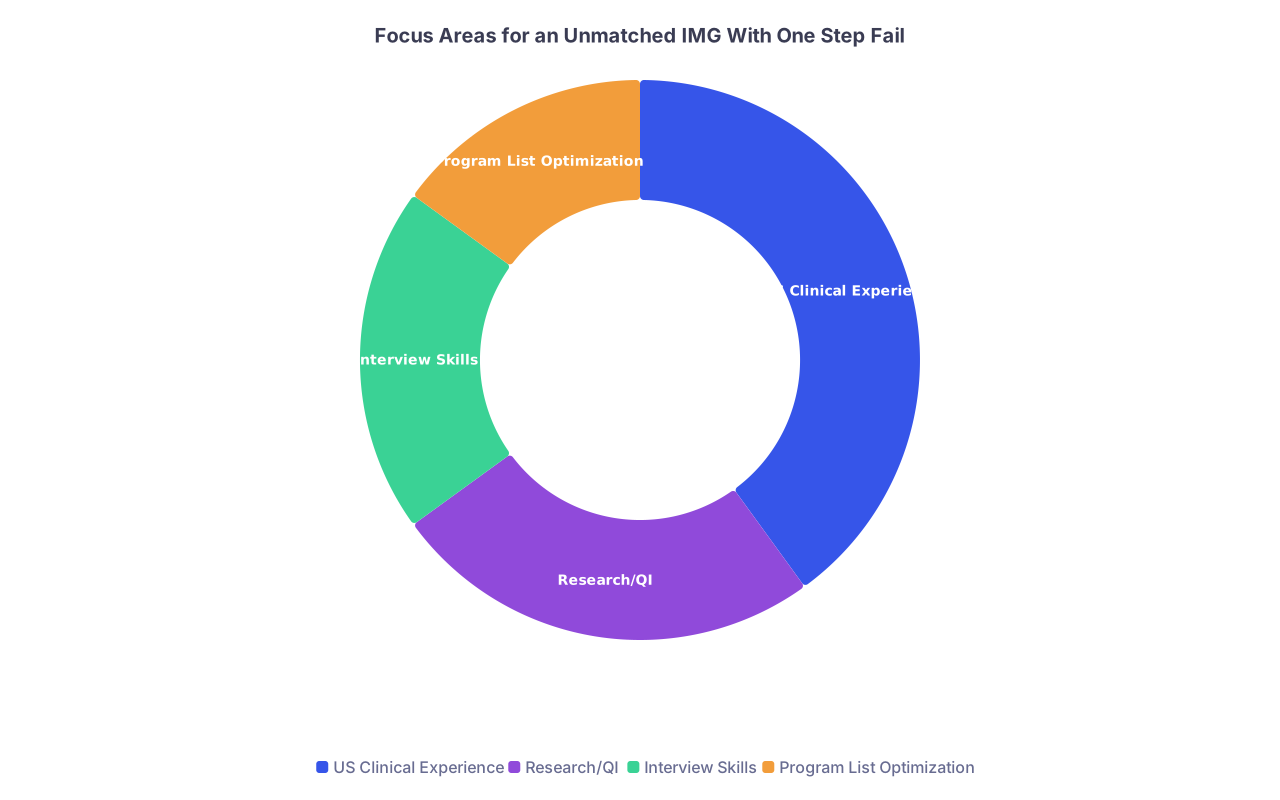
| Category | Value |
|---|---|
| US Clinical Experience | 40 |
| Research/QI | 25 |
| Interview Skills | 20 |
| Program List Optimization | 15 |
9. Example Pathways: How Real IMGs With Fails Have Rebuilt
No fairy tales. These are the types of paths I have seen work.
Case 1: Step 1 fail, strong Step 2, Internal Medicine match
- Foreign grad, YOG 2020
- Step 1: Fail, then Pass
- Step 2 CK: 241 on first try
- 4 months USCE (2 IM sub-internships, 2 inpatient electives)
- Applied to 170 IM programs (mostly community, some university-affiliated community)
- 11 interviews, matched at a mid-sized community IM program in the Midwest with ~60% IMGs
Why it worked:
- Clear upward trend in scores
- Strong IM letters from U.S. attendings who explicitly said, “I would gladly have this applicant as my resident”
- Program list heavily weighted toward IMG-heavy regions and hospitals
Case 2: Step 2 CK fail, pivot to Family Medicine
- Foreign grad, YOG 2017
- Step 1: Pass (scored, mid-220s)
- Step 2 CK: Fail, then 228
- 3 years of general practice in home country, then 3 months USCE (FM clinics)
- Switched target to Family Medicine, applied to 120 FM programs
- 7 interviews, matched to a community FM program in a rural area that values prior independent practice
Why it worked:
- Leaned into prior real-world practice
- Picked a specialty that values broad clinical background and underserved commitment
- Explained the fail as poor time management during a heavy clinical workload, then demonstrated improvement with structured studying

10. Concrete 30-Day Action Plan to Rebuild Using IMG-Friendly Programs
You are overwhelmed. So let me simplify.
Here is what you can do in the next 30 days to actually move the needle.
Week 1: Data and Damage Control
- Gather your:
- USMLE scores and attempts
- CV and transcript
- YOG and all gaps
- Decide your primary specialty and backup (if needed).
- Subscribe to or access:
- FREIDA
- NRMP data (free)
- Start a program spreadsheet and add at least 40 programs in your main specialty with IMG percentages, visa info, and attempt notes.
Week 2: Upgrade Your Narrative
- Draft your personal statement, including:
- One direct paragraph explaining the fail (as described above)
- Clear, specific reasons for choosing your specialty
- 2–3 concrete patient or clinical stories that show maturity and clinical thinking
- Identify 3–4 potential letter writers (preferably U.S. attendings) and ask them now.
- If you do not have enough USCE, start contacting hospitals, clinics, and externship providers daily to secure upcoming rotations.
Week 3: Program Targeting and Document Polish
- Expand your spreadsheet to:
- 100+ programs for FM or smaller specialties
- 150+ programs for IM, psych, etc., if budget permits
- Color-code them into Green/Yellow/Red.
- Create 2–3 versions of your personal statement for different specialty focuses.
- Start rough drafts of your ERAS experiences with specific, measurable details (patients/day, projects completed, responsibilities).

Week 4: Interview Prep and Gap Planning
- Do at least two mock interviews with someone who will be brutally honest.
- Practice your Step fail explanation until it sounds calm, concise, and consistent.
- If you suspect you may need another cycle:
- Identify research, USCE, or clinical jobs you can start or apply for now.
- Plan a 6–12 month improvement project (QI, teaching, or a research project) that you can discuss in interviews.

| Step | Description |
|---|---|
| Step 1 | Week 1 - Data and List |
| Step 2 | Week 2 - Narrative and Letters |
| Step 3 | Week 3 - Program Targeting |
| Step 4 | Week 4 - Interview Prep and Gap Plan |
| Step 5 | Submit Stronger Application |
11. Stop Apologizing. Start Strategizing.
A Step fail as an IMG is not a death sentence. It is a forced upgrade. You no longer have permission to be average in your planning or your execution.
If you are meticulous with:
- Program selection
- Honest explanation and clear upward trend
- Strong USCE and letters from IMG‑friendly environments
- Focused, mature interview performance
You can match. Not “maybe.” Not “if you get lucky.” You can become exactly the kind of resident IMG‑friendly community programs rely on every year.
Here is your next move:
Open a blank spreadsheet right now and list 10 Internal Medicine or Family Medicine programs you know are IMG-heavy. For each one, add columns for IMG %, visa policy, Step attempt policy, and YOG limits. Once you see that data in front of you, you will know where to aim—and where to stop wasting time.