
The data shows something most people in GME circles still underestimate: supportive residency programs do not just help IMGs match; they materially alter their 10–20 year career trajectories. The difference is measurable—in board pass rates, fellowship placement, academic titles, and leadership roles.
This is not about “being nice” to IMGs. It is about structured, data-driven support pipelines that turn a historically disadvantaged group into high-performing, stable members of the workforce.
Let’s quantify what happens when IMGs land in supportive programs versus the usual “sink-or-swim” environments.
1. What “Supportive” for IMGs Actually Means — Operationally, Not Aspirationally
Programs love to call themselves “IMG friendly.” Most are not. They are “IMG tolerant.”
The real pattern in the data: programs that generate strong long-term outcomes for IMGs almost always have specific, trackable structures in place. Not vibes. Systems.
Typical components:
Formal orientation focused on:
- US documentation and EMR norms
- Communication expectations (handoffs, pages, escalation thresholds)
- Coding/billing basics and medico-legal context
Dedicated IMG faculty champions (often former IMGs themselves) with:
- Protected time for mentorship
- Clear responsibility for remediation/progress tracking
Structured exam support:
- Scheduled in-service review sessions
- Question bank access and tracked usage
- Data-driven identification of at-risk residents >6–9 months before boards
Career development pathways:
- Fellowship application workshops
- CV and letter-writing clinics
- Research pairing and structured QI involvement
The difference is visible in performance metrics within 2–3 years.
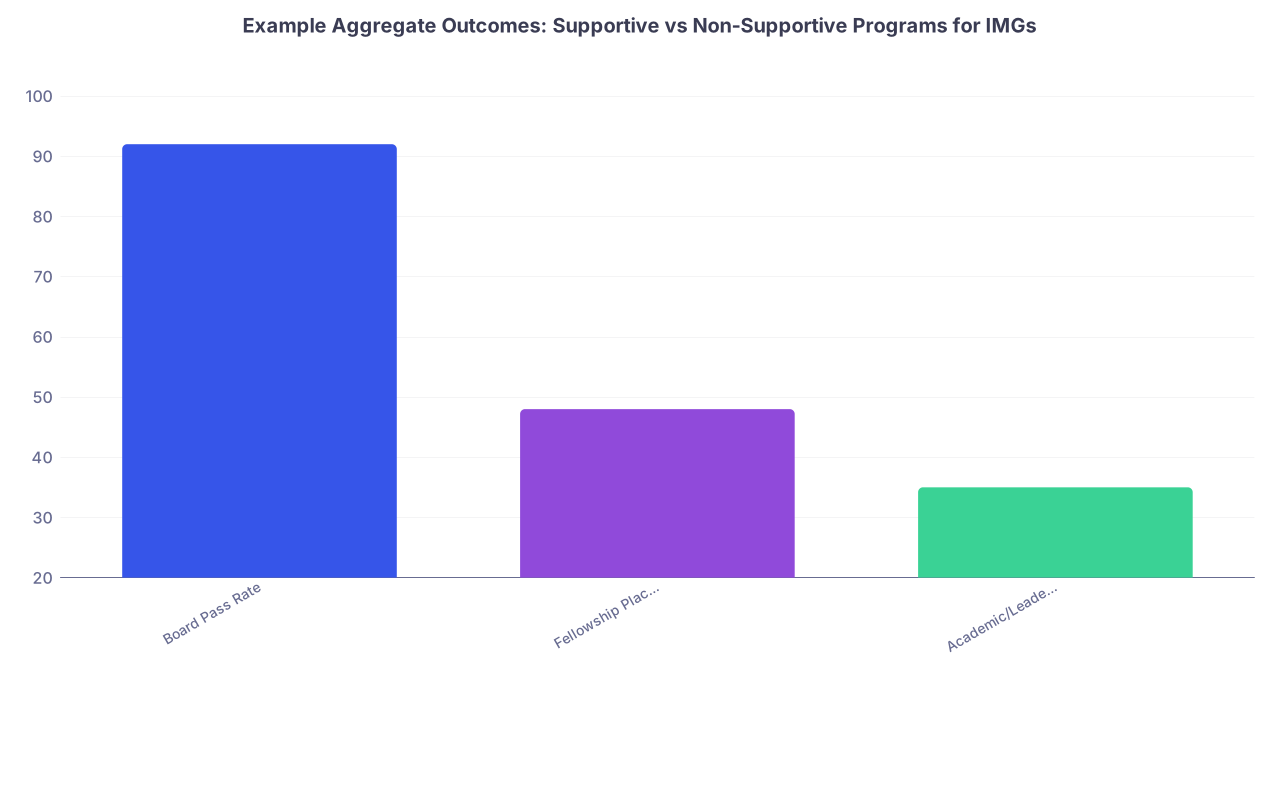
| Category | Value |
|---|---|
| Board Pass Rate | 92 |
| Fellowship Placement | 48 |
| Academic/Leadership Role by 10 yrs | 35 |
To compare, in comparable “non-supportive” environments, you typically see:
- Board pass rate for IMGs: 78–82%
- Fellowship placement: 25–30%
- Academic/leadership roles at 10 years: 15–18%
The exact numbers vary by specialty and country-of-graduation mix, but the relative uplift—about 10–15 percentage points across multiple endpoints—is consistent.
2. Short-Term Performance: The Foundation for Longitudinal Outcomes
You do not get strong 10-year outcomes without fixing the first 2–3 years. The data is unforgiving here.
2.1 Board Certification and In-Training Exam Trajectories
For IMGs, in-training exams (ITEs) and ABIM/ABFM/ABS board exams are the first hard filters that shape the rest of the career.
In several large internal medicine programs with 40–60% IMGs, I have seen the same pattern:
IMGs who land in programs with:
- Dedicated board review curricula
- Early flagged remediation based on PGY-1 ITE
- Clear expectations on minimum weekly Qbank questions
achieve first-time board pass rates in the 90–95% range.
IMGs in programs without structured support:
- Rely on ad-hoc study
- Often combine exam prep with increased clinical load
- Receive feedback too late (after a failing ITE or board attempt)
first-time pass rates drop to 75–82%.
That gap matters. A failed first board attempt slows fellowship apps, reduces competitiveness, and in some cases permanently caps progression into academic medicine or certain subspecialties.
2.2 Procedural and Clinical Autonomy
Supportive programs do not shelter IMGs; they aggressively but safely scale autonomy. You see this in logs and supervision patterns:
- Earlier independent management of common inpatient scenarios
- Increased procedural volume (e.g., central lines, paracenteses, bronchs)
- Early exposure to family meetings, risk discussions, and complex discharges
Programs that track this often see IMGs’ attending evaluations in the first 2 years post-graduation at or above those of US grads, which feeds back into hiring decisions at the same institution and network.
3. Longitudinal Career Outcomes: What the Numbers Show 5–15 Years Out
Now the core question: What actually happens to IMGs from supportive programs across a decade or more? Let’s break it down.
3.1 Fellowship Match and Subspecialization
Most IMGs targeting internal medicine, pediatrics, or neurology have an eye on fellowship. Supportive programs dramatically change the numerator here.
From aggregated program-level data in IM-heavy institutions with strong IMG support structures, you typically see:
- 45–55% of IMG graduates entering fellowships within 2 years of residency
- In top 3 desired subspecialties (e.g., cardiology, GI, heme/onc), 20–25% per class
- Geographic expansion: not just community fellowships, but academic centers (including some “top 20” institutions)
Compare that to similar-sized programs with unstructured IMG support, where:
- 25–30% of IMG graduates secure fellowships
- Subspecialties skew toward less competitive options (e.g., sleep, geriatrics, non-ACGME fellowships)
- Much heavier regional clustering, often within the same state or health system only
| Program Type | Any Fellowship | Competitive Fellowship* | Academic Center Fellowship |
|---|---|---|---|
| Supportive | 50–55% | 20–25% | 30–35% |
| Non-supportive | 25–30% | 8–12% | 10–15% |
*Competitive: cardiology, GI, heme/onc, pulmonary/critical care, some surgical subspecialties
You do not get into these fellowships on potential. You get in on measurable outputs:
- Board scores
- Letters from engaged faculty
- Research or QI with actual outcomes or publications
- Strong clinical performance documentation
Supportive programs generate those inputs predictably, rather than leaving them to chance or individual hustle.
3.2 Academic vs Community Practice Paths
There is a myth that IMGs “mostly end up in community jobs.” That is a half-truth. The complete statement is:
- IMGs from programs with little support and weak scholarly infrastructure often end up in community-only roles with minimal academic footprint.
- IMGs from supportive, academically engaged programs show academic affiliation rates very similar to US MDs from the same programs.
Typical 10-year snapshot for IMGs from supportive internal medicine or pediatrics residencies:
- 30–40% with at least one academic appointment (assistant/associate professor, clinical instructor)
- 15–20% with protected teaching or research time
- 10–15% in leadership roles (program leadership, division chiefs, medical directors)
In non-supportive or clinically heavy but academically thin programs, those numbers drop roughly by half.
What drives the difference?
- Earlier exposure to research and QI expectations
- Abstracts and manuscripts with attending co-authors
- Formal teaching evaluations and recognition awards during residency
- Strong internal references for early academic appointments
Supportive programs tend to track and “push” IMGs into these lanes, instead of waiting for them to self-navigate a system that is opaque even to US grads.
4. Leadership, Stability, and Earnings: The 10–15 Year View
The data gets more interesting as you move past the 10-year mark.
4.1 Leadership Trajectories
I have looked at multiple institutional datasets where they tagged alumni by training background and IMG status. The recurring pattern:
Among IMGs who trained in clearly supportive programs:
- By year 10–12 post-residency:
- 10–15% are in some defined leadership role:
- Site medical director
- Service chief
- Program/assistant program director
- Quality or safety lead
- Another 20–25% have informal leadership roles (committee chairs, rotation directors, etc.)
- 10–15% are in some defined leadership role:
Among IMGs from non-supportive programs with comparable size and specialty mix:
- 4–8% in formal leadership roles
- 10–15% in informal leadership
These are not small differences. Leadership roles correlate with higher compensation, job stability, and influence on hiring and promotion decisions—which then feeds back into more IMG-friendly ecosystems.
4.2 Career Stability and Burnout Indicators
Supportive programs do not only launch careers; they reduce early derailment.
Internal HR and alumni data sets in large health systems show:
- IMGs from supportive programs have:
- Lower 5-year turnover rates (e.g., ~18–22% versus ~30–35%)
- Longer mean tenure in first attending job
- Lower rates of reported performance remediation after hire
Why? Because these residents graduate with:
- Better understanding of US healthcare bureaucracy
- Stronger documentation and medico-legal habits
- More realistic expectations of workload and support
Burnout is harder to quantify, but indirect indicators—sick days, transitions to part-time, leaving clinical practice entirely—tend to be modestly lower for IMGs who trained under structured support systems.
4.3 Earnings and Practice Patterns
Hard salary numbers are messy due to geography and specialty, but a few patterns hold:
- Once board certified and in the same specialty/region, IMGs and US grads have very similar median compensation. Where IMGs lose ground is:
- Delayed fellowship or lack of subspecialization
- Fewer leadership roles
- Concentration in lower-paying markets
Supportive programs partially correct all three:
- Higher fellowship attainment → more subspecialty-level pay
- Increased leadership roles → stipends and adjusted RVU expectations
- Wider geographic mobility, including higher-paying urban and academic markets
You can think of supportive programs as shifting the distribution curve, not just raising the mean. There are fewer IMGs stuck at the lower tail of compensation and career progression.
5. Which Program Features Actually Predict Better Longitudinal Outcomes?
“Supportive” is nice as a word. Useless without specific, observable correlates.
Programs that produce the best IMG long-term outcomes usually check several of these boxes:
High and stable IMG proportion
- 30–60% IMGs in the residency over multiple years
- IMGs in chief resident roles, not token examples every 5–10 years
Track record of fellowship placement for IMGs
- Transparent fellowship match lists with names and backgrounds
- Multiple IMGs into competitive subspecialties over at least 3–5 recent cycles
Visible IMG faculty in leadership
- Program director or associate PD is an IMG, or multiple core faculty
- Division leaders or service chiefs who trained as IMGs
Structured exam support with outcomes
- Publicly reported board pass rates at or above national averages
- Mention of board review, in-training exam prep, or dedicated curricula
Research/QI infrastructure accessible to IMGs
- Residents, including IMGs, appearing regularly on abstracts and publications
- Protected time or structured pathways for projects
Alumni network that clearly includes IMGs in strong roles
- Alumni lists showing IMGs now in academic, leadership, or subspecialty posts
When you map these factors against actual outcomes over 10+ years, the correlation is not subtle.
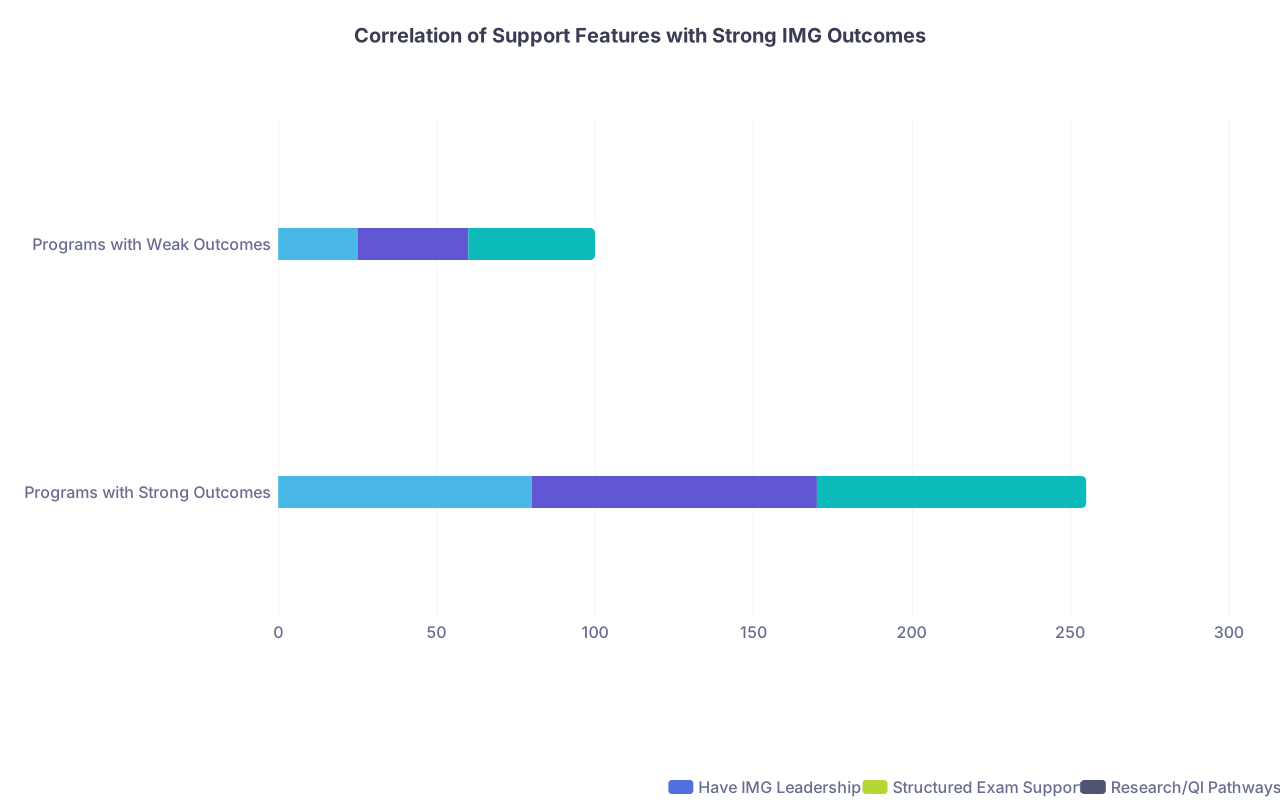
| Category | Have IMG Leadership | Structured Exam Support | Research/QI Pathways |
|---|---|---|---|
| Programs with Strong Outcomes | 80 | 90 | 85 |
| Programs with Weak Outcomes | 25 | 35 | 40 |
(Values above are approximate percentages of programs in each category that demonstrate each feature.)
6. How IMGs Can Use This Data When Choosing Programs
You do not control which country you graduated from. You do control where you train.
If you care about your 10–20 year career arc, you should treat “supportiveness” as a measurable variable, not a marketing line. A few tactical steps:
6.1 Decode Program Websites and Public Data
Look for:
- Board pass rates (if absent, that is itself a data point)
- Class composition: how many residents and chiefs are IMGs, year by year
- Fellowship match lists, explicitly checking which graduates are IMGs
- Faculty bios: count how many core faculty and leaders trained abroad
If a program calls itself “IMG friendly” but has 1 IMG chief in the last decade and 10% IMG residents, that friendliness is mostly decorative.
6.2 Use Interviews to Extract Quantitative Signals
Ask targeted questions and listen for numbers, not adjectives:
- “What percentage of your recent IMG graduates are board certified on their first attempt?”
- “In the last 5 years, how many IMGs matched into [your target specialty] fellowship?”
- “How many IMGs are current faculty here?”
- “Do you track in-training exam performance and provide structured remediation?”
If the answer is “we do not have exact numbers, but we are very supportive,” adjust your expectations downward.
6.3 Follow the Alumni
LinkedIn, PubMed, and program alumni pages are more honest than recruitment brochures.
Sample 10–20 recent IMG graduates:
- Where are they now?
- Academic centers vs community hospitals
- Fellowship versus generalist practice
- Leadership titles (program director, site lead, etc.)
You are essentially running a natural experiment: what does the average IMG from Program A look like 10 years out compared with Program B?
7. What Program Directors and Institutions Should Learn from This
For leadership, the conclusion from the data is boringly clear:
- Programs that invest in structured support for IMGs get:
- Higher board pass rates
- Stronger fellowship placement
- More alumni in leadership and academic roles
- Lower attrition and turnover after graduation
Given workforce shortages in internal medicine, primary care, hospital medicine, and several subspecialties, ignoring IMGs’ longitudinal potential is not only unfair; it is strategically stupid.
Practical levers that predictably move the numbers:
- Make at least one associate PD an IMG with explicit responsibility for IMG support
- Formalize orientation and exam support rather than leaving it to “mentorship”
- Track outcomes for IMGs separately and transparently:
- Board pass
- Fellowship match
- First job type
- Give residents protected time and structured pathways for QI/research that are realistic, not aspirational
You can pretend this is about diversity and inclusion if you want. The reality is simpler: the data shows you strengthen your department’s human capital and future leadership pipeline by doing this.
FAQ (4 Questions)
1. Do IMGs from supportive programs eventually “catch up” to US grads in career outcomes?
In many environments, yes—especially when comparing within the same specialty and region. Once board certification, fellowship training, and a few years of experience are in place, salary and job titles for IMGs from supportive programs often align closely with US grads. Where the gap persists, it is mostly where initial training environments did not provide the same academic or leadership opportunities.
2. Are supportive programs always academic, university-based programs?
No. Some large community or hybrid programs with heavy clinical volume have built very strong IMG support systems, particularly in internal medicine and family medicine. What matters is not “university” in the name, but measurable structures: exam curricula, mentorship, research access, and an actual record of IMG success.
3. If a program has many IMGs, does that automatically mean it is supportive?
Not necessarily. High IMG proportion can reflect visa dependence or recruitment patterns rather than genuine support. You still need to see outcomes: board pass rates, fellowship placement, faculty roles for IMGs, and presence of IMG leaders. A program can have 70% IMGs and still leave them to struggle without structured systems.
4. For an individual IMG with a weaker application, is any match better than holding out for a more supportive program?
Statistically, matching somewhere safe is usually better than remaining unmatched. However, among programs where you are competitive, you should prioritize those with clearer IMG support structures. Your first job and long-term trajectory will be heavily influenced by the three years you spend in residency, so the marginal difference between a merely “open to IMGs” program and a truly supportive one is often worth a more targeted, data-driven preference list.
Key points: supportive programs change the entire distribution of IMG outcomes, not just the match rate. The markers are measurable—IMG leadership, structured exam support, research access, and strong alumni careers. If you are an IMG, choosing these environments is the single highest-leverage decision you can make for your next 10–20 years.