

It’s July 1st. Your pager just started buzzing like it has a personal vendetta, you’re getting “Hey chief, quick question” texts from people who never used to know your number, and your name is suddenly on group emails you did not know existed.
You’re chief now.
The next 30 days will either set you up as the person people trust—or as the person everyone quietly routes around. The difference isn’t your grand leadership vision. It’s the specific meetings you schedule, the emails you send, and the decisions you lock in week by week.
Let’s walk it in order.
Days 1–3: Stabilize and Get Eyes on Everything
At this point you should not be “leading.” You should be listening, mapping, and quietly pulling power toward you.
Day 1: Get your map of power and pain
Non‑negotiable meetings in the first 24 hours:
Program Director (PD) – 30–60 minutes
- Purpose: What they expect from you this year.
- Ask directly:
- “Top three problems last year you want me to fix.”
- “What are you worried will blow up this year?”
- “How do you want to hear bad news—text, email, or in person?”
- Walk out with:
- Clear understanding of your authority (schedule changes? discipline? wellness days?).
- Agreement on how often you’ll meet (weekly is ideal at the start).
Other Chiefs – 60 minutes
- If multiple chiefs (IM day/night, surgery, subspecialty):
- Decide:
- Who owns what: scheduling, didactics, wellness, recruitment, QI, communications.
- Decision rules: what needs unanimous agreement vs “one chief decides, others informed.”
- A single communication channel: one chief email, chief GroupMe/WhatsApp/Slack.
- Outcome: No ambiguity about who handles what. Residents hate “ask the other chief.”
Program Coordinator – 30–45 minutes
- They know how everything actually works.
- Ask:
- “What did last year’s chiefs do that helped you the most?”
- “Which recurring deadlines do I absolutely not want to miss?”
- “Who gets angry if certain emails are late?”
By the end of Day 1, you should have:
- Standing weekly meeting time with PD.
- A draft division of responsibilities among chiefs.
- Key program dates on your calendar (CCC, intern orientation pieces, block changes).
Now you send your first chief email.
Email #1: “Hi, I’m your chief this year” (Day 1–2)
Keep it short. Residents do not want an essay.
Core pieces:
- Who you are (1–2 sentences).
- How to reach you (and when).
- What they can expect in the first month.
Example structure:
- Subject: “From Your New Chief – What to Expect This Month”
- Body:
- 2 lines of intro.
- 3–5 bullet points:
- How sick call will run.
- When the first chief‑led meeting will be.
- How schedule questions should be sent (format and deadline).
- Close with: “If something doesn’t seem safe or fair, email or text me directly.”
Send it. Do not overthink it.
Days 4–7: Take Control of the Schedule and Communication Channels
At this point you should be eliminating chaos. That starts with schedule and information flow.
Meeting: Scheduling and Coverage (Day 4–5)
Sit down with:
- Program coordinator
- Prior chief (if available)
- Any chief whose portfolio includes scheduling
Agenda:
- Review:
- Sick call pool rules.
- Golden weekends / requested days off.
- How last year’s coverage disputes were handled.
- Decide:
- Who has final say on conflicts.
- Response time expectations for schedule emails (e.g., within 48 hours).
- How “no-show” or late call will be escalated.
Lock in a coverage algorithm and write it down. No improvising at 2 a.m.
| Priority | Who Gets Called First |
|---|---|
| 1 | Same rotation, same site |
| 2 | Same PGY, same site |
| 3 | Same PGY, other site |
| 4 | Adjacent PGY, same site |
| 5 | Pre-arranged backup pool |
Post that somewhere residents can see it. Transparency kills drama.
Communication Infrastructure (Day 4–6)
At this point you should consolidate channels.
Decide:
- Official channels:
- 1 residency‑wide email list.
- 1 messaging platform for urgent updates (WhatsApp, GroupMe, Slack).
- 1 academic/home base (Teams, Slack, or email) for non‑urgent stuff.
- Rules:
- “If it affects patient care today → group chat and email.”
- “If it’s educational, policy, or reminders → email only.”
- “No individual schedule changes approved by text. Email only.”
Then send Email #2: Communication ground rules.
Hit:
- Which channels you’ll use for:
- Schedules
- Urgent floor issues
- Wellness/feedback
- Timing:
- “Weekly chief update email on Fridays.”
- “Urgent clinical changes as they happen.”
- Expectation:
- “If you’re on service, you’re expected to check email at least once per day.”
This makes the rest of the year survivable.
Week 2 (Days 8–14): Face Time With Each Group
By now, people have started forming an opinion about you. You’re either “organized and responsive” or “MIA and overwhelmed.”
Week 2 is where you get in front of each stakeholder group.
Day 8–9: Meet the Seniors and Interns Separately
You need two different conversations.
Seniors (PGY2+ or PGY3+, depending on program)
Goal: Align on expectations and where they need support.
Meeting agenda (30–45 minutes):
- “What drove you nuts last year about schedules or communication?”
- “Where do you feel unsafe or unsupported on nights?”
- “What do you want me to fight for with the PD?”
Outcomes:
- Top 3 pain points seniors want fixed.
- Informal leaders identified (the ones others listen to).
- One senior on each service who can be your point person.
Interns
Very different tone. Less therapy, more scaffolding.
Brief intro meeting (20–30 minutes):
- What chiefs actually do for them.
- How to reach you without feeling like they’re “bothering” you.
- Basic rules:
- When to escalate concerns.
- What to do if an attending is unsafe or unprofessional.
- That you’d rather hear about problems early.
Leave 5–10 minutes for anonymous questions (let them write questions on paper or a Google Form and answer live). You’ll learn a lot.
Day 10–11: Faculty and Hospital Stakeholders
You cannot ignore faculty. They can either make your year easy or brutal.
Meet individually or in small groups with:
- Site directors (if you have multiple hospitals).
- Key service attendings (ICU, ED, night float, busy ward services).
- Nursing leadership if you rotate through a main unit.
Ask directly:
- “Top resident issues you see on your service?”
- “How do you prefer we handle performance concerns that you identify?”
- “What’s one change from the trainee side that would make your life easier?”
And then you make a Faculty-Facing Email template:
- Subject: “Resident performance concern – [Rotation/Month]”
- 3 bullets:
- Brief description.
- Steps you’ve already taken.
- What you’re asking from the PD or faculty.
Use it. Faculty respect concise narratives.
Week 2–3: Start the Cadence of Chief Emails
By the middle of Week 2 you should lock in your recurring communication rhythm.
Weekly Chief Update Email (Anchor on One Day)
Pick a day. Stick to it. Friday afternoon is common.
Standard sections:
- “Next Week Highlights”
- Key didactics, M&M, grand rounds, exams.
- “Schedule / Coverage Notes”
- Any temporary changes, anticipated gaps.
- “Policy / Operations”
- New expectations, EHR changes, process updates.
- “Wellness & Wins”
- Small shoutouts, thank-you notes, match/interview updates later in the year.
Keep it scannable:
- No giant paragraphs.
- Use bold for clinic cancellations, call changes, deadlines.
You’re training everyone: “If I read this weekly email, I will not be surprised during the week.”
Week 3 (Days 15–21): Make Your First Real Decisions
By now, the honeymoon is over. Something will have gone wrong:
- A schedule error.
- A resident melting down mid‑block.
- A coverage refusal.
- A senior treating an intern poorly.
This is where your decisions start to define you.
Critical Decision Domain #1: Schedule Conflicts
At this point you should have a default stance: fair process > making everyone happy.
Steps when a schedule dispute hits your inbox:
Pull the facts:
- Old emails with requests.
- Coverage rules you agreed on.
- Who’s already had what (weeks off, golden weekends, holidays).
Decide:
- Are you following policy or making an exception?
- If exception, can you explain it without sounding arbitrary?
Respond in writing:
- Acknowledge the conflict.
- Briefly state the rule or standard.
- Give the decision.
- Offer future options (“We can prioritize you for X in the next block.”)
Never let schedule conflict threads linger more than 48 hours. Silence creates anger.
Critical Decision Domain #2: Sick Call and “Wellness Days”
You’ll quickly see patterns:
- The same resident “sick” every other Friday.
- The intern who never calls out but is clearly burning out.
- The post‑night team calling you to say, “This is unsafe.”
Your stance this early should be:
- Err on the side of patient safety.
- Track patterns, don’t react to one‑offs.
Create a simple sick-call log (Excel/Sheets):
- Date
- Name
- Rotation
- Reason (brief)
- Coverage provided by
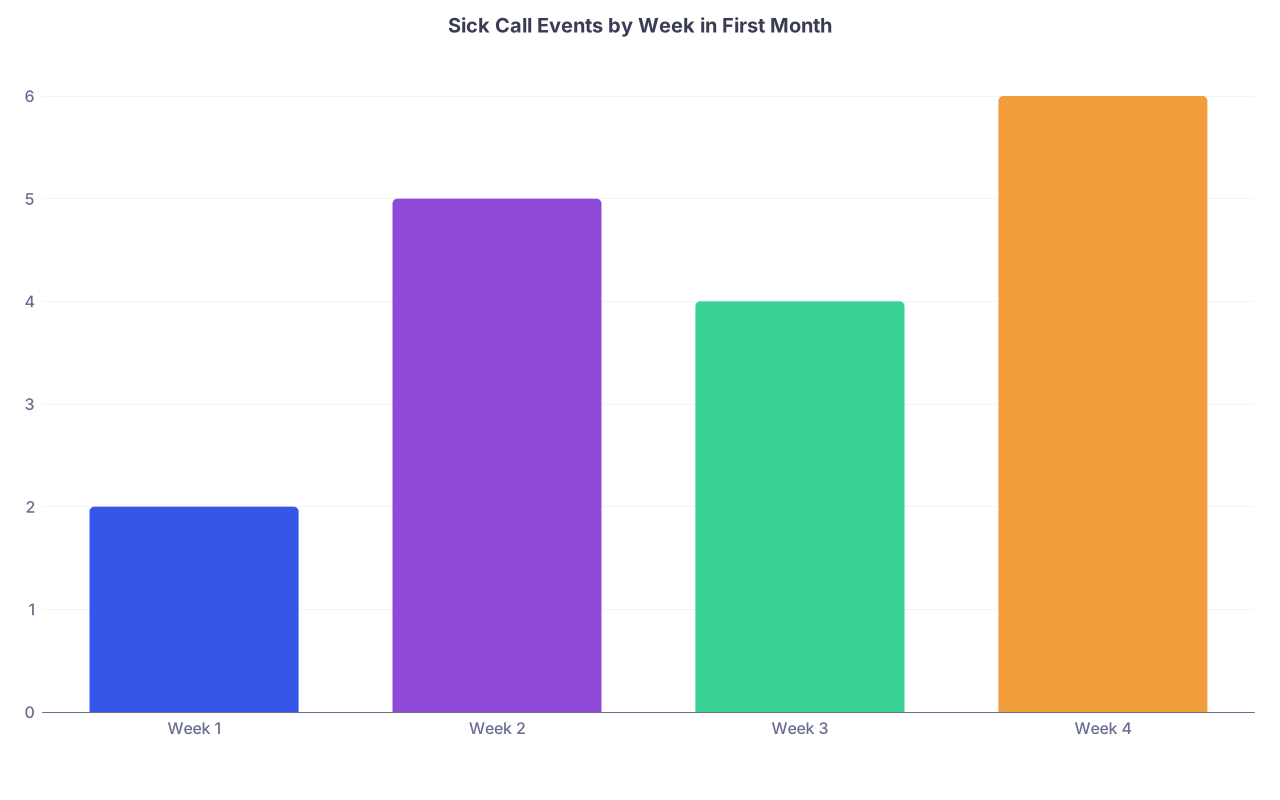
| Category | Value |
|---|---|
| Week 1 | 2 |
| Week 2 | 5 |
| Week 3 | 4 |
| Week 4 | 6 |
Review this weekly with the other chiefs or the PD (depending on culture). If you see a pattern, you address it early, not in January.
Critical Decision Domain #3: Unprofessional Behavior
By Week 3 you’ll hear about:
- A resident yelling at nursing.
- Someone routinely leaving early.
- A senior dumping work on interns.
Your move:
- Get at least two perspectives (never act on one complaint only).
- Decide if this is:
- Coaching level (you handle it).
- Pattern/serious (you involve PD quickly).
When you handle it yourself:
- Short, direct conversation.
- “Here’s what I heard. Here’s the impact. Here’s what needs to change.”
- Document for yourself in a private file. Date, issue, what you said.
You are not HR, but you are not a bystander either.
Week 4 (Days 22–30): Systematize and Prepare for the Next 3 Months
At this point you should stop living in pure reaction mode. The first 3 weeks showed you where the fires usually start. Week 4 is about building systems so you’re not re‑inventing the wheel at 2 a.m.
Build Your Chief Dashboards
You don’t need fancy software. You need 3 simple trackers:
Schedule & Coverage Tracker
- Tabs for:
- Vacations/requests.
- Sick call log.
- Backup pool usage.
- Color code heavy‑hitters (people called in repeatedly).
- Tabs for:
Resident Issues Tracker (Confidential)
- Columns:
- Name
- Issue type (performance, professionalism, wellness, conflict, other)
- Date first noted
- Actions taken
- PD informed? (Y/N)
- This prevents “we all knew, but no one had the full picture.”
- Columns:
Projects & Deadlines Tracker
- CCC dates
- Evaluations deadlines
- Orientation sessions
- Recruitment events
- M&M and didactics you’re responsible for
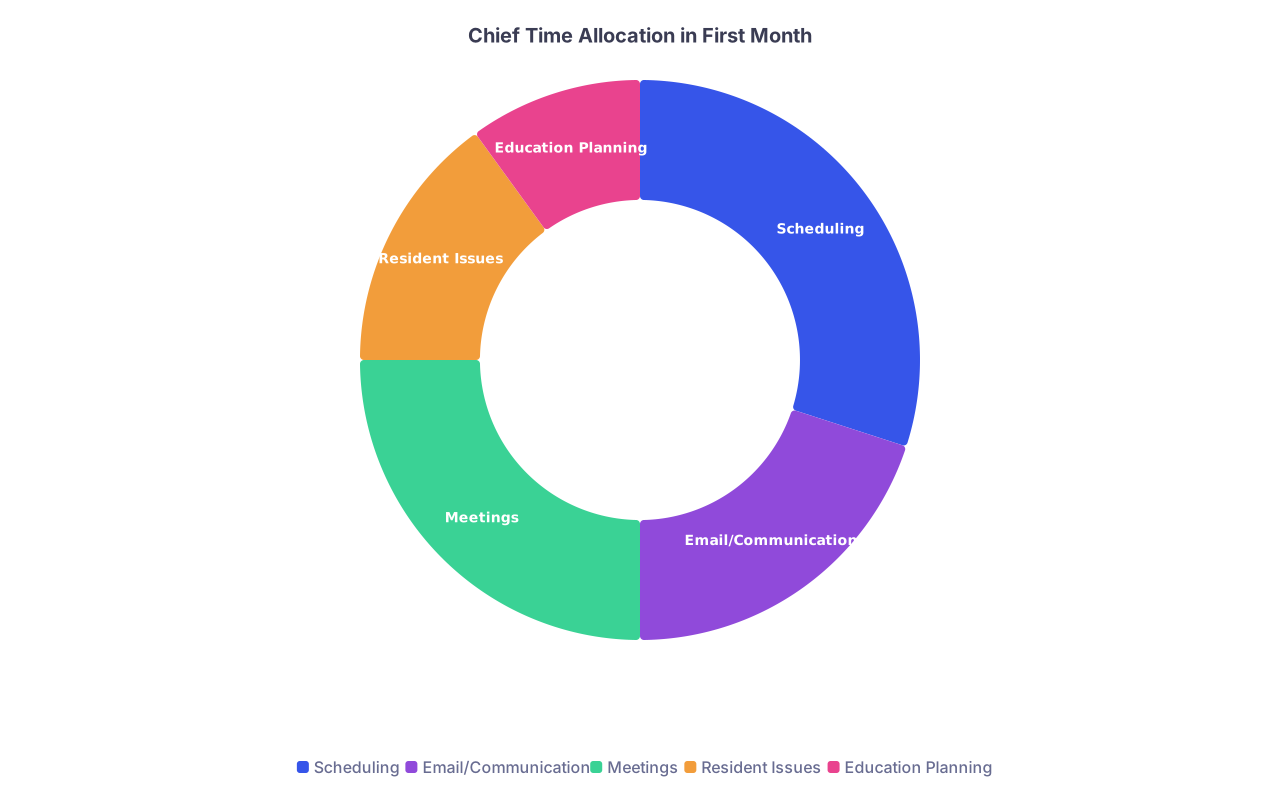
| Category | Value |
|---|---|
| Scheduling | 30 |
| Email/Communication | 20 |
| Meetings | 25 |
| Resident Issues | 15 |
| Education Planning | 10 |
These aren’t busywork. When the PD asks, “How often are people calling out?” you will have an actual answer, not a vibe.
Solidify Recurring Meetings
By Day 30, your calendar should have:
- Weekly:
- Chiefs + PD check‑in (30–60 minutes).
- Chiefs internal huddle (15–30 minutes).
- Monthly:
- Resident forum / town hall (even 30 minutes at noon).
- Meeting with program coordinator for big‑picture logistics.
- Quarterly (start planning now):
- Chief‑led feedback session with each PGY class.
- Review of scheduling equity (holiday distribution, nights, weekends).
Block this now before the year eats your calendar alive.
Email Templates You Should Have Saved by Now
You should not be writing these from scratch each time.
Schedule Change Response
- “Thanks for reaching out. Here’s the current policy…”
- “In this case, we can/cannot accommodate because…”
- “Future requests should be submitted by [date] so we can consider them fairly.”
Sick Call Coverage Summary
- Sent to affected team/attendings:
- “Short note to update you: [Resident] is out sick today. Coverage: [Person] will cover [X hours/role]. Please reach out if this is unsafe.”
Faculty Concern Acknowledgment
- “Thank you for letting me know about [issue]. I’ve spoken with [resident] and we are [coaching/action]. I’ll keep you updated if further steps are needed.”
Resident Support / Check‑in
- “I heard about [situation]. Wanted to check in and see how you’re doing. If you’re open to it, let’s find 10–15 minutes to talk this week.”
Save them as drafts or text snippets. It will save you hours.
What Success Looks Like at Day 30
By the end of your first month as chief, here’s what should be true:
- Everyone knows:
- How to reach you.
- When to expect updates from you.
- How schedule and sick call decisions are made.
- You know:
- The PD’s real priorities.
- The residents’ real pain points.
- The attendings and nurses who can quietly make or break you.
- There is:
- A weekly chief email.
- A single source of truth for schedules.
- A basic system to track resident issues and sick call.
You’re not supposed to have changed the culture in 30 days. You’re supposed to have stopped the bleeding, mapped the terrain, and shown people you’re competent and fair.
One Concrete Step to Take Today
Open your calendar right now and block three recurring events for the next 3 months:
- Weekly chiefs–PD meeting.
- Weekly internal chief huddle.
- Weekly residency‑wide chief update email writing block.
Those three anchors will force the rest of your first 30 days to take shape around them.


