

The mid-year slump does not mean you are a bad leader. It means you are a normal resident in a broken system.
You are exhausted, your “chief year vision” notes are buried somewhere in Notion, and your leadership goals from July feel like they belonged to a different person. This is exactly the point in the year where most residents drift. Or reset. The difference is not motivation. It is structure and timing.
I am going to walk you month-by-month, then week-by-week, then day-by-day through a mid-year leadership reset. Think of this as a structured reboot that fits into residency reality: post-call, cross-cover chaos, 28‑hour shifts, and all.
Big Picture: The 6-Month Reset Arc
At this point in the academic year (typically December–February), you should stop pretending “I’ll get to leadership stuff when things calm down.” They will not. You need a timeline.
Here is the six-month arc we are building:
| Phase | Timeframe | Primary Focus |
|---|---|---|
| 1. Audit | 1–2 weeks | Honest review & data gathering |
| 2. Redefine | Weeks 3–4 | Clarify 2–3 leadership priorities |
| 3. Implement | Months 2–3 | Small, consistent behavioral changes |
| 4. Expand | Months 4–5 | Larger projects and influence |
| 5. Consolidate | Month 6 | Document impact & set next-year vision |
You are going to move through:
- A two-week reality check
- A four-week reset sprint
- A three-month execution block
- A final month of consolidation and planning
Not inspirational. Operational.
Phase 1 (Weeks 0–2): The Brutally Honest Mid-Year Audit
At this point, you should stop adding new leadership tasks and start measuring what has actually happened.
Week 0–1: Quick Leadership Inventory
Take one call-free evening (60–90 minutes). Door closed, phone away.
Answer three categories:
Roles you occupy
- Formal: chief resident, QI lead, wellness rep, committee member, curriculum rep, teaching resident.
- Informal: “the scheduler person,” “the person interns text when confused,” “the only one who knows the EMR templates.”
Leadership goals you had in July
- Find old notes/emails/Slack if you can. If not, reconstruct:
- What did you think you would improve on the team?
- What did you want your interns/medical students to say about you by year end?
- What projects did you vaguely promise to “work on”?
- Find old notes/emails/Slack if you can. If not, reconstruct:
Reality: what actually happened
- Where are you now on:
- Teaching (bedside, chalk talks, feedback)
- Team culture (psychological safety, efficiency, communication)
- Systems/QI (handovers, order sets, pathways, checklists)
- Professional reputation (reliable? calm? overwhelmed? unavailable?)
- Where are you now on:
You are not writing an essay. You are building a map. Bullet points are enough.
Week 1–2: Data from Other People (Fast and Targeted)
At this point you should stop guessing what kind of leader you are and ask.
Pick 3–5 people maximum:
- 1 attending who has seen you run a team
- 1–2 co-residents
- 1 intern or student
- Optional: program coordinator or nurse you work with often
Send a short message. Something like:
“I am doing a mid-year reset on my leadership goals. Could I ask you 2 quick things?
- One leadership behavior of mine that helps the team.
- One thing I should change or do differently in the next 3–6 months.”
Give them permission to be blunt. Do not argue. Do not justify. Say thank you, write it down.
Summarize into three buckets on one page:
- Strengths (that you want to double down on)
- Liabilities (behaviors that are actively hurting your leadership)
- Blind spots (things others see that you never considered)
That single page is the foundation for everything that follows.
Phase 2 (Weeks 3–4): Redefining Leadership Goals That Actually Fit Residency
Now you have data. At this point, you should stop carrying 10 vague leadership goals and choose 2–3 concrete ones.
Week 3: Converting Wishful Thinking into Measurable Targets
Pick one primary leadership lane for the next 3–6 months:
- Team culture (psychological safety, respect, burnout buffering)
- Teaching (students and interns actually learning on your team)
- Operations/QI (rounding efficiency, handoff quality, fewer errors)
- Professionalism & reliability (you as the “rock” on the team)
- Upward leadership (managing attendings, chiefs, or admin more effectively)
You can touch others, but one lane is your main arena.
Then define 2–3 goals in that lane using this formula:
“By [end date], I will be the resident known for [specific leadership behavior], demonstrated by [2–3 measurable indicators].”
Examples:
Team culture:
- “By June 30, I will be the resident known for reliable, calm leadership on busy ward months, demonstrated by:
- Every intern on my team getting at least one specific piece of feedback weekly.
- My teams starting rounds within 5 minutes of planned time on 90% of days.
- At least one unsolicited comment to the PD or chief about positive team experience.”
- “By June 30, I will be the resident known for reliable, calm leadership on busy ward months, demonstrated by:
Teaching:
- “By June, I will be known as a strong bedside teacher, demonstrated by:
- Running a 10-minute micro-teaching session on 4 of 5 working days.
- Asking students to rate my teaching at the end of each rotation and averaging ≥4/5.”
- “By June, I will be known as a strong bedside teacher, demonstrated by:
Keep it ruthless. Vague goals die in residency.
Week 4: Break Down into Weekly Leadership Behaviors
Now you convert goals into specific weekly actions.
Draft a Weekly Leadership Checklist (simple, not pretty):
- Daily:
- Ask at least one open-ended learning question on rounds.
- Name one intern or student success out loud in front of the attending.
- Weekly:
- Give each intern one targeted piece of growth feedback (written or verbal).
- Ask the team one question about what is not working in our system this week.
- Fix or escalate one small process annoyance (pager workflow, template, checklist).
- Monthly:
- Lead or co-lead a brief teaching conference, huddle, or QI update.
- Send a one-paragraph update to a chief or PD about your leadership project.
You are designing something you can execute on a brutal post-call week. If it looks pretty but fails on nights, it is useless.
Phase 3 (Months 2–3): The Execution Block – Week-by-Week Guide
Now we shift into action. This is where most residents bail because they try to “be better” in general instead of changing specific weeks and days. You will not make that mistake.
Month 2, Week 1: Soft Launch on a “Normal” Week
At this point, you should test drive your checklist on the easiest week you can find in the block.
Focus on:
- Doing the daily items 3–4 days that week.
- Tracking nothing fancy—just:
- A note section in your phone.
- Or one row per day in a simple spreadsheet.
- Observing friction:
- Where did you forget?
- When did you feel too rushed?
- Which items already help?
You are not optimizing yet. You are just getting reps.
Month 2, Week 2: Stress-Test on a Hard Week (Call, Nights, or ICU)
Now you deliberately test on a bad week. Nights, ICU, or those classic “3 admits after 4 pm” days.
Your goal this week is not perfection. It is survival-level consistency:
- Pick one or two leadership behaviors and refuse to drop them:
- Example: “No matter how bad it gets, I will still:
- Give one intern-specific feedback by end of the week.
- Ask one ‘How can I make your day easier tomorrow?’ question to the team.”
- Example: “No matter how bad it gets, I will still:
Afterward, jot a 5-minute debrief:
- What leadership behaviors survive peak stress?
- Which goals are unrealistic for this rotation and need adjusting?
Month 2, Week 3–4: Establishing a Weekly Leadership Rhythm
By now the novelty is gone. This is the danger period. At this point you should cement a simple weekly ritual.
Pick a fixed time—Sunday evening or early Monday—for a 15-minute leadership reset:
Review last week:
- What did I actually do?
- Any feedback from attendings / interns / students?
- One leadership win. One leadership miss.
Choose one theme for the coming week:
- “Feedback week”
- “Efficiency on rounds week”
- “Delegate properly week”
- “Teaching at the bedside week”
Choose one micro-experiment:
- Example: “For 5 days, I will start rounds by quickly agreeing on:
- Stop time
- Teaching goal
- One thing we will not do (to protect sanity).”
- Example: “For 5 days, I will start rounds by quickly agreeing on:
This rhythm is what converts a mid-year reset from a motivational blip into a sustained change.
Visual: Commitment vs. Capacity Over the Year
Here is what usually happens if you do not reset: your leadership commitments stay high, your capacity drops, and you burn out or withdraw.
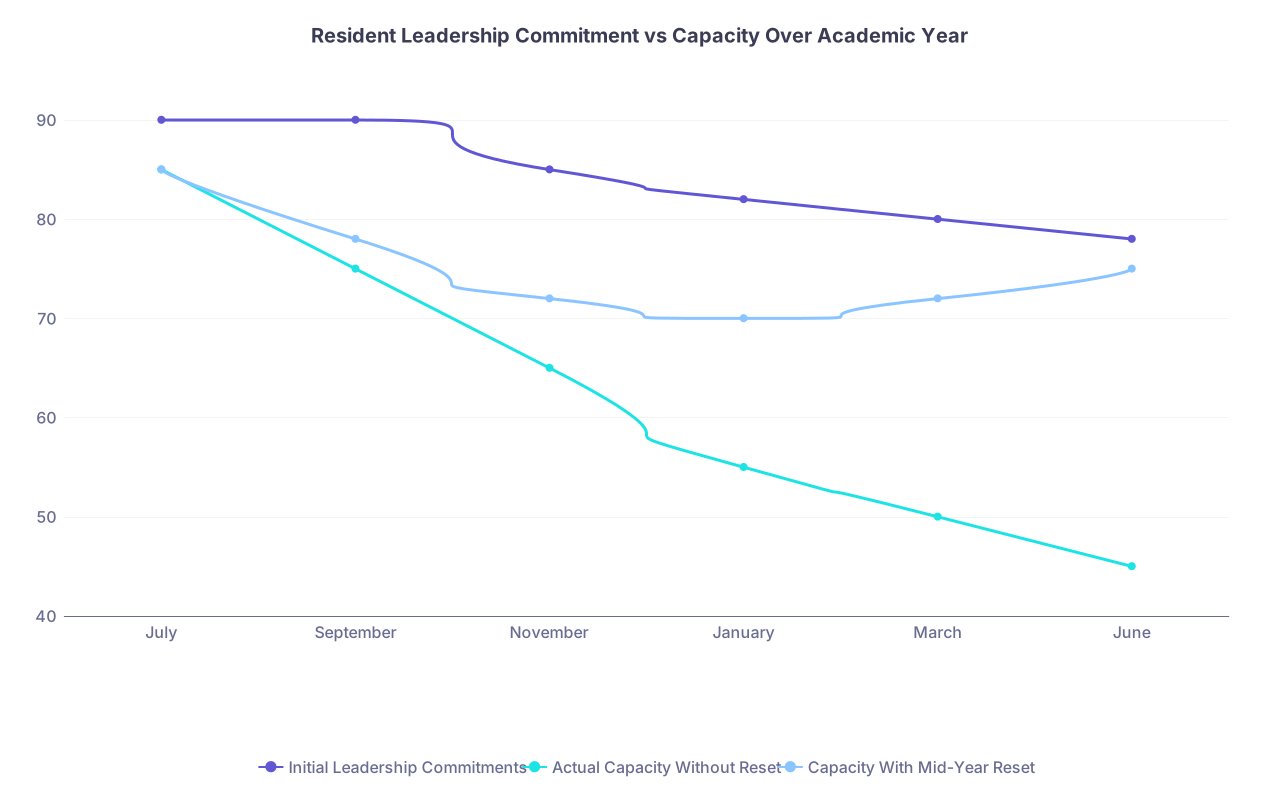
| Category | Initial Leadership Commitments | Actual Capacity Without Reset | Capacity With Mid-Year Reset |
|---|---|---|---|
| July | 90 | 85 | 85 |
| September | 90 | 75 | 78 |
| November | 85 | 65 | 72 |
| January | 82 | 55 | 70 |
| March | 80 | 50 | 72 |
| June | 78 | 45 | 75 |
Your reset is about bringing commitments back into alignment with real capacity—then gradually rebuilding.
Phase 4 (Months 4–5): Expanding Influence Without Imploding
Once your weekly rhythm is stable for 4–6 weeks, you can scale. At this point you should think about where your leadership can reach beyond your own team.
Month 4: Choose One “Small but Real” Leadership Project
Pick one project that:
- Can be completed or clearly advanced in 6–8 weeks.
- Directly affects daily life for residents, interns, or students.
- Is simple enough that you can move it forward 20–30 minutes per week.
Good examples:
- Create or refine:
- An admission template that everyone uses.
- An efficient discharge checklist that cuts chaos on Fridays.
- A handoff script that reduces “Did anyone order…?” pages.
- Launch:
- A weekly 15-minute “chalk talk” series before or after sign-out.
- A “failure debrief” mini-conference for residents to share mistakes safely.
- A shared folder of one-page teaching handouts.
Bad examples:
- “Fix burnout.”
- “Revamp the entire curriculum.”
- “Redesign the EMR.” (No, you will not.)
Break the project into weekly subtasks:
- Week 1: Ask 5 residents what the real pain point is.
- Week 2: Draft version 0.1 of the tool/process.
- Week 3: Pilot with one team or one call night.
- Week 4: Iterate based on feedback.
- Week 5: Present to chiefs or PD.
- Week 6–8: Implement and stabilize.

Month 5: Start Leading Up and Across
By this point, your leadership should not only be “me and my interns.” You should be influencing:
- Across: co-residents on other teams, cross-cover, night float.
- Up: chiefs, program leadership, committee heads.
Concrete actions this month:
- Attend one committee or leadership meeting you used to skip.
- Send a concise email to chiefs or PD about your project:
- Problem → Intervention → Early data → Ask (support, spread, feedback).
- Offer to:
- Lead one orientation session for new interns.
- Host a brief session on what you have learned about team efficiency or feedback.
This is where people start to see you as “a leader in the program,” rather than “just another PGY-2/3 trying to be helpful.”
Phase 5 (Month 6): Consolidate, Capture, and Aim Forward
If you skip this phase, your growth evaporates. At this point, you should harvest the value of what you have done.
Week 1–2 of Month 6: Measure and Document Impact
Pull together:
Concrete outcomes:
- Number of micro-teaching sessions you led.
- Changes in team start/stop times.
- Any reduction in common errors or pages after your intervention.
- Feedback quotes from interns/students/attendings.
Short reflections (4–6 lines each):
- What leadership behaviors became automatic?
- Where did you still struggle?
- What surprised you about how people responded?
Turn this into:
- A one-page “Leadership Year in Review” document.
- Or a 3–5 slide deck you could use for:
- A resident meeting.
- A future job interview.
- A fellowship application.

Week 3–4 of Month 6: Set Next-Cycle Leadership Targets
Now you zoom out and design your next arc.
Ask yourself:
- Do I double down on the same lane (teaching, QI, culture)?
- Or do I keep what is automatic and shift primary focus?
Draft next-year leadership goals using the same structure:
- “By [date], I will be known for [X], demonstrated by [Y outcomes].”
Then build a lighter-weight version of your weekly checklist:
- Because you are now starting from a higher baseline.
- You should not be repeating the exact same grind; you should be iterating.
Daily and Weekly Micro-Timeline: What This Looks Like On the Ground
Residents always ask, “What does this look like on an actual day?” Fair question.
A Realistic Leadership Day Template
On a busy ward day:
- Before rounds (5–7 minutes):
- Identify one intern and one student you will intentionally support/teach.
- Pick one micro-teaching point connected to a real patient.
- During rounds:
- Ask one “what do you think is going on?” question.
- Explicitly back an intern in front of the attending at least once.
- After rounds (5 minutes):
- Ask the team: “One thing I can do differently tomorrow to make your day easier?”
- End of day (2–3 minutes):
- Jot 2 bullets: leadership win / leadership miss.
That is it. Leadership in residency is not a separate time block. It is how you run the day you already have.

| Step | Description |
|---|---|
| Step 1 | Start of Day |
| Step 2 | Pick 1 intern and 1 student focus |
| Step 3 | Set 1 teaching point |
| Step 4 | Ask thinking question on rounds |
| Step 5 | Support team member in front of attending |
| Step 6 | Ask team end of day question |
| Step 7 | Note win and miss |
| Step 8 | Adjust behavior next day |
Common Traps in the Mid-Year Slump (And When To Address Them)
You are not special in your struggles. I have watched the same patterns every year.
| Trap | When to Address | Fix Action |
|---|---|---|
| Overcommitting to 5+ projects | Phase 2 | Cut to 1–2 goals |
| Ghosting your original goals | Phase 1 | Honest audit + external feedback |
| Only leading when attendings watch | Phase 3 | Daily micro-behaviors with interns |
| Waiting for a formal role | Phase 4 | Launch small project without title |
| Never writing anything down | Entire 6 months | Weekly 15-min review ritual |
You fix different problems at different phases. Trying to “be more disciplined” is not a plan. Aligning specific fixes with specific weeks is.
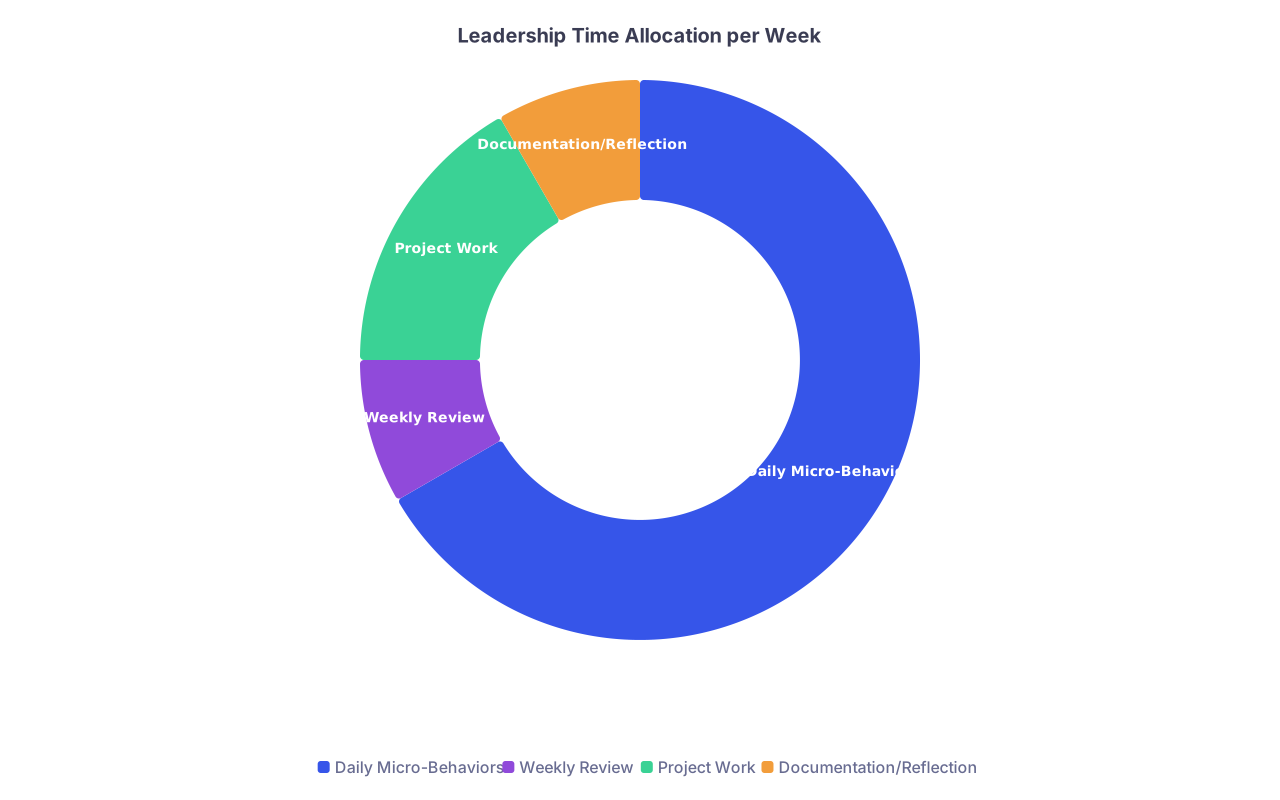
| Category | Value |
|---|---|
| Daily Micro-Behaviors | 120 |
| Weekly Review | 15 |
| Project Work | 30 |
| Documentation/Reflection | 15 |
(Those numbers are minutes. Across a whole week. This is not a second job. It is a smarter way to do the one you already have.)
Your First 24 Hours: What You Should Do Right Now
Do not “think about this.” Do exactly three things in the next day:
- Schedule a 60-minute block in the next week labeled “Leadership Audit.”
- Draft and send one message to a trusted attending or co-resident asking:
- “What is one leadership behavior of mine that helps the team, and one I should change in the next 3–6 months?”
- Write one line at the top of a page (paper or digital):
- “By June 30, I want to be known as the resident who ________.”
Start there. Then open your calendar and place a 15-minute slot next Sunday labeled “Leadership Weekly Reset.” That tiny recurring event is how the mid-year slump stops being your story, and a mid-year reset becomes your pattern.


