

You’re on week three of a busy wards month. The senior is swamped, the attending is double-booked in clinic, and your co-resident is juggling three new admits. You see things falling through the cracks: discharge instructions half-done, no one has called the family, the plan for that borderline septic patient is… vague.
You want to step up. You also don’t want to be that resident — the one who narrates every helpful thing they do, CCs the world on every email, and gets quietly eye-rolled by nurses and co-residents.
Here’s the line you’re trying to walk: show initiative, be a leader, but do not look like a show-off.
Let me give you the framework that actually works in residency, not the fluffy “be proactive” nonsense that ignores power dynamics and team culture.
The Core Rule: Initiative = Ownership, Not Spotlight
If you remember one thing, make it this:
Real initiative is about taking ownership of problems. Show-off behavior is about taking ownership of credit.
That distinction drives everything.
You look like a leader when you:
- Quietly solve high-value problems
- Loop in the right people
- Make others’ lives easier
- Share credit instead of hoarding it
You look like a show-off when you:
- Talk more about your actions than the problem
- Perform “helpfulness” where others can see, but ignore messy work
- Publicize your contributions in ways that feel like a sales pitch
So your filter becomes:
“Does this help the patient / team first, or does this help my image first?”
If the honest answer is “my image,” you are drifting into show-off territory.
A Simple Decision Framework Before You “Take Initiative”
Before you jump in, run yourself through four quick questions. This keeps you from overstepping, annoying nurses, or undermining your senior.

| Step | Description |
|---|---|
| Step 1 | See a problem or gap |
| Step 2 | Call senior or attending now |
| Step 3 | Handle it and document |
| Step 4 | Offer plan to senior or nurse |
| Step 5 | Flag clearly to right person |
| Step 6 | Is it patient safe to wait? |
| Step 7 | Is it clearly in my lane? |
| Step 8 | Can I propose help instead of deciding alone? |
Is this a safety issue or time-sensitive?
If yes, you do not “show initiative” by acting solo. You show judgment by escalating fast.Is this clearly in my lane?
Example: you’re the night float; potassium is 2.9. Ordering replacement? In your lane. Changing goals-of-care alone at 3 a.m.? Not in your lane.Can I propose instead of decree?
“Hey, I noticed X; I’m thinking about doing Y. Any concerns?” This sounds like collaboration, not grandstanding.Do I know who owns this?
PCP, consult team, charge nurse, case manager. You get credit for knowing how the system works, not just for clicking buttons.
If you use this filter, you’ll almost always land on the “strong initiative, not showy” side.
Concrete Ways to Show Initiative That Don’t Read as Show-Off
Let’s get specific. Here’s what appropriate initiative actually looks like in residency.
1. Quiet Operational Fixes
These are the unglamorous, high-impact moves that everyone remembers, even if nobody claps for them.
Examples:
- You notice discharge summaries are chronically delayed. You build a simple template, share it in the team chat:
“I made a quick template for CHF discharges since we’re drowning. Use/modify if helpful.” - The sign-out is chaotic. You clean up your portion, organize it by acuity, and at the end of the week say to your senior:
“I tried a new sign-out structure to make nights safer. Let me know if there’s a better way.”
You’re not saying “Look how organized I am.” You’re saying, “Here’s something that might make our lives less terrible.”
That lands very differently.
2. Anticipating Needs (Without Making It About You)
You don’t wait to be asked for everything. You think one or two steps ahead — but you don’t announce every step.
Good:
- Before rounds, you pre-chart the sickest patients, pull up yesterday’s cultures, and have vitals up.
When asked, you already know: “Blood culture now growing GNRs, sensitivities pending, patient has been febrile overnight to 38.5, BP stable.” - Before a family meeting, you skim the last consultant note so you don’t contradict them.
Bad:
- Saying on rounds: “So I took the initiative to pre-chart all these patients and look at all the overnight trends for the team.” Everyone gets what you’re doing. And they’ll resent it.
Let your preparation show through your performance, not your narration.
3. Doing Follow-Through That Others Forget
Most residents are good at “make plan.” Fewer are good at “see plan to completion.”
You show initiative by owning the second part.
Examples:
- You hear the attending say, “We should probably get PT/OT involved,” three days in a row. You just put in the consult, then tell the team:
“I went ahead and placed PT/OT since this keeps coming up; I ordered standard eval, let me know if you want anything specific.” - You discharge someone with complex meds. Later that day, you call the SNF or PCP to confirm med reconciliation went through. You send a brief handoff note.
Again, you’re not giving a speech about your thoroughness. You’re closing loops that keep patients out of the ED.
4. Proposing, Not Pushing, Clinical Plans
Initiative in clinical reasoning is subtle: you want to think, not grandstand.
The move that works:
- Do the thinking.
- Present it as “here’s what I’m considering,” not “here’s what we should do.”
For example:
- On rounds: “Given the rising creatinine and low urine output, I’m wondering about pre-renal vs intrinsic. I was thinking of checking a urinalysis and FENa and holding the ACE. Does that make sense, or am I missing something?”
This shows:
- You’re thinking ahead
- You respect the senior/attending
- You’re open to correction
What doesn’t work:
- “So I think this is clearly ATN from yesterday’s contrast, and we should do X, Y, Z.”
As an intern or early resident, that sounds arrogant even if you’re right.
5. Supporting the Team When It’s Thankless
Residents who show real initiative don’t just jump into the spotlight tasks. They do the glue work the team feels but doesn’t always see.
Things like:
- Watching the board at 4:30 p.m. and saying, “I’ll grab this new admit so you can finish notes.”
- Asking the nurse: “What’s making your shift hardest on our patients today? Anything I can reasonably help with?”
- Volunteering to stay the extra 15 minutes to help with that crashing patient instead of sprinting out at sign-out.
You don’t need to announce, “I stayed late.” People notice. They remember who disappears and who shows up.
Communication: How to Make Initiative Look Collaborative, Not Performative
The same action can read as humble or show-off depending on how you talk about it.
Here’s the basic script structure that works:
- Acknowledge the team’s role or ownership
- State what you noticed
- Offer what you did or propose to do
- Invite correction
Example with a nurse:
- “I know you’re watching her closely. I noticed her pressures are drifting down over the past couple hours. I was thinking of repeating a lactate and grabbing a quick exam now. Any other changes you’ve seen that I should know about?”
Example with senior:
- “You’ve got a ton going on with the new admits. I saw that Mr. X still needs his discharge med list cleaned up. I can go through it now and then run the final version by you before we send it. Sound good?”
Notice what you’re not doing:
- You’re not framing yourself as the hero.
- You’re not implying others dropped the ball.
- You’re not “selling” your value.
You’re positioning yourself as a responsible, collaborative adult.
Where People Cross the Line Into Show-Off Territory
Let me be blunt. There are patterns that consistently make residents look like show-offs, even if their intentions are decent.
| Situation | Healthy Initiative | Show-Off Version |
|---|---|---|
| Pre-charting | Quietly prepared, answers ready | Announces “I pre-charted everyone” |
| Quality improvement | Brings data and small pilot idea | Talks about “my QI project” constantly |
| Helping nurses | Asks what’s helpful, does it | Performs help only when attending is around |
| Email communication | Brief, to relevant people | CCs senior/attending unnecessarily |
| Teaching juniors | Offers help, checks needs | Lectures unsolicited, corrects in front of others |
The common thread:
Show-offs broadcast their contributions. Leaders let their work speak, and let others talk about them.
Initiative in Long-Term Projects (QI, Committees, Education)
Residency “leadership” often shows up as projects: quality improvement, education, committees. This is where people overbrand themselves.
Here’s how to do it right:
Pick Problems That Actually Matter
Starting a “resilience noon conference series” that no one asked for? Probably show-off territory.
Fixing a documented issue (like delays in time-to-antibiotics for sepsis)? That’s substantive.
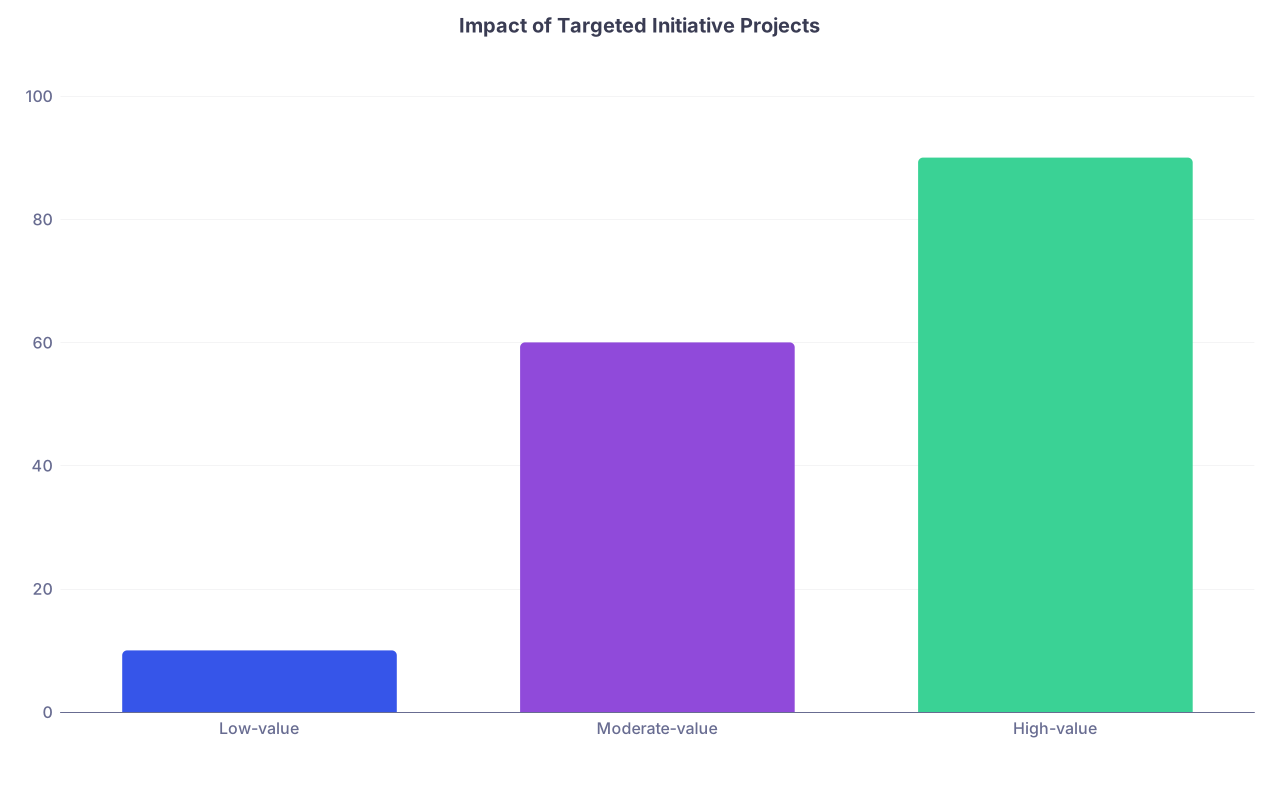
| Category | Value |
|---|---|
| Low-value | 10 |
| Moderate-value | 60 |
| High-value | 90 |
High-value projects:
- Address real patient outcomes (readmissions, safety events, time to treatment)
- Reduce frustration for staff (pager burden, workflow issues)
- Make something actually easier for residents or nurses
Low-value projects:
- Exist mainly because they look good on a CV
- Have lots of talking, few measurable changes
Share Credit Aggressively
You avoid “show-off” status in projects by:
- Putting nurses, pharmacists, case managers as co-authors or co-presenters
- Saying things like, “This was really driven by our charge nurses noticing X pattern”
- Highlighting others when presenting to leadership
If every sentence includes “I led,” “my project,” “I created,” people tune out.
Calibrating to Culture: Know Your Program’s Norms
This part nobody tells you: what reads as “strong initiative” in one program can look like “aggressive” in another.
You need to calibrate.

Watch for:
- Do seniors typically invite interns to suggest plans? Or do they prefer interns to execute more than design?
- Do attendings love emails with detailed follow-up? Or do they prefer brief verbal updates?
- Are nurses used to residents jumping in on tasks? Or is there a clear division they’re protective of?
If you’re not sure, you can literally ask:
- “How much do you want me to suggest plans vs just execute what we discuss?”
- “If I notice a systems issue, what’s the best way to bring it up so it’s helpful?”
That itself is initiative — but it’s humble initiative.
Quick Phrases That Help You Show Initiative Safely
Steal these. They work.
To propose action:
- “I was thinking of doing X. Any concerns with that?”
- “Would it be helpful if I…?”
- “If you’re okay with it, I can take the first pass at…”
To avoid sounding like you’re policing others:
- “I’m sure this is already on your radar, but I noticed…”
- “Maybe I’m overthinking this, but I wondered if…”
To give others credit:
- “The nurse pointed out that…”
- “Pharmacy caught that the dose was off…”
- “This idea came from something you mentioned yesterday…”
Those little phrases soften your edges while still making it obvious you’re engaged and proactive.
Handling the Fear of Being Seen as a Show-Off
Last piece. Some residents swing so hard away from looking like a show-off that they become invisible. That’s not better.
If you:
- Consistently follow through
- Think about patient safety first
- Share credit
- Avoid narrating your heroics
…you’re not a show-off. You’re just competent.
You’re allowed to:
- Be proud of doing good work
- Mention projects during evaluations
- Advocate for yourself when applying for fellowships or jobs
Self-advocacy in the right context is not showing off. It is necessary.

FAQ: Initiative vs Show-Off in Residency
1. My co-resident thinks I’m trying too hard. Should I back off?
Maybe. Or maybe they’re projecting. Ask yourself:
- Are you solving real problems or creating work to look busy?
- Are you constantly talking about what you’ve done? If your seniors and nurses appreciate you and you’re not undermining anyone, you’re probably fine. But if multiple peers hint at the same thing, dial down the narration, not the effort.
2. How do I show initiative on a service where the senior is very controlling?
Keep it micro. Focus on:
- Perfecting your own patient care: notes done early, anticipatory orders, family communication
- Quietly handling logistics: discharge planning, follow-up appointments When you propose ideas, frame them as questions: “Would it help if I…?” If they still shut you down, stop fighting. Document, learn, and live to see a better rotation.
3. Can I email attendings about ideas without seeming political?
Yes, but do it rarely and thoughtfully. One solid, well-observed email about a meaningful systems issue is fine:
- Keep it short
- Focus on the problem, not your brilliance
- Offer to help, do not demand ownership
If you’re emailing every week with “innovations,” you’ve crossed into self-promotion.
4. How do I show leadership as an intern with no authority?
Own your tasks completely. That’s your lane.
- Know your patients better than anyone
- Close every loop you’re given
- Be the intern others trust to get things done
Leadership at your level is reliability plus curiosity, not barking orders.
5. What if my program rewards the loud, showy people more?
That happens. You still don’t need to become them. Two moves:
- Make sure your faculty mentors actually see your work — send them a concise end-of-rotation summary of your projects and contributions.
- Speak up strategically at conferences or meetings, not constantly. High signal, low noise. Long term, people remember who delivered, not who talked the most.
6. How do I bring up a recurring problem on the service without sounding like I’m complaining?
Frame it as a pattern plus impact plus proposal:
“Over the last few weeks, I’ve noticed X keeps happening, and it’s leading to Y (delays, safety risks, frustration). I had a small idea we could test, like Z. Would that be worth trying, or is there another way you’d approach it?”
You’re not whining. You’re diagnosing a systems problem and offering a pilot solution.
Key points:
- Initiative is about ownership of problems, not ownership of credit.
- Anticipate needs, follow through, and communicate in a way that sounds collaborative, not performative.
- Let your work speak, share credit freely, and use self-advocacy in the right contexts — that’s leadership, not showing off.


