

The harsh truth: most “leadership” on resident CVs is fluff that program directors skim and forget.
If you want leadership to actually help you—for fellowship, academic jobs, or promotion—you need to be ruthless about what belongs on your CV and what does not. Title-chasing and laundry lists do not impress anyone who reads applications for a living.
Here’s the filter: if your “leadership” did not change something, own something, or move people, it probably does not belong. Let’s walk through what should make the cut, what’s borderline, and what you should just leave off.
1. The 3-Part Test: What Counts as Real Leadership on a Residency CV
Use this simple three-part test. If the activity doesn’t hit at least one of these strongly, think twice.
Real leadership usually involves:
Decision-making power
You weren’t just present—you chose priorities, made calls, set direction.Responsibility for outcomes
If it went badly, someone would reasonably look at you for answers.Influence on others or systems
You changed behavior, improved a process, or led a group toward a defined goal.
If your “leadership” was: “Helped with…” “Participated in…” “Attended meetings for…”—that’s weak. That belongs under “Volunteer Experience” or “Professional Activities,” not leadership.
Strong verbs: led, chaired, created, implemented, organized, directed, founded, coordinated, supervised, negotiated.
When in doubt, ask: would a busy PD or fellowship director care that you did this?
If the honest answer is no, cut it.
2. Leadership Activities That Definitely Belong on Your Residency CV
These are the heavy-hitters. If you’ve done them with real responsibility, they should be on your CV—and not buried.
Chief resident roles
If you’re chief, that’s leadership. But you still need to show substance.
Good to list:
- Administrative Chief Resident
- Education Chief Resident
- Wellness Chief Resident
- Quality/Safety Chief Resident
Bad: “Informal chief” or “people came to me for advice.” That’s not a role.
For chiefs, specify:
- Size of the program (e.g., “Chief Resident, Internal Medicine, 42 residents”)
- Key domains: scheduling, education, recruitment, wellness, quality improvement
- Measurable outputs when possible (e.g., “Redesigned jeopardy system, reduced uncovered shifts from 7 per month to 1–2 per month”)
Formal committee roles with teeth
Being “on a committee” is not automatically leadership. Leadership is:
- Chair
- Co-chair
- Resident representative with a real vote
- Task force leader
Legitimate examples:
- Resident representative, GME Committee
- Co-chair, Residency Program Evaluation Committee
- Chair, Resident Wellness Committee
- Member, Hospital Sepsis Steering Committee with assigned workstreams
If your role was: “Sat there and listened, said hello at the start,” that’s fine, but it’s not leadership.
Leading QI or patient safety projects
Quality improvement is one of the easiest ways to demonstrate leadership during residency—if you actually led, not just collected data.
Belongs on CV when:
- You initiated or took over project leadership
- You coordinated people (nurses, IT, pharmacy, other residents)
- You drove implementation, not just “analyzed results”
Example that belongs:
“Project Lead, Sepsis Early Recognition Initiative
– Led multidisciplinary team of 6 to implement EHR alert, increased appropriate bundle completion from 62% to 81% over 9 months.”
Example that does not belong under leadership:
“Team member, Sepsis QI project, helped collect data and present poster.”
Still valid experience—just not a leadership bullet.
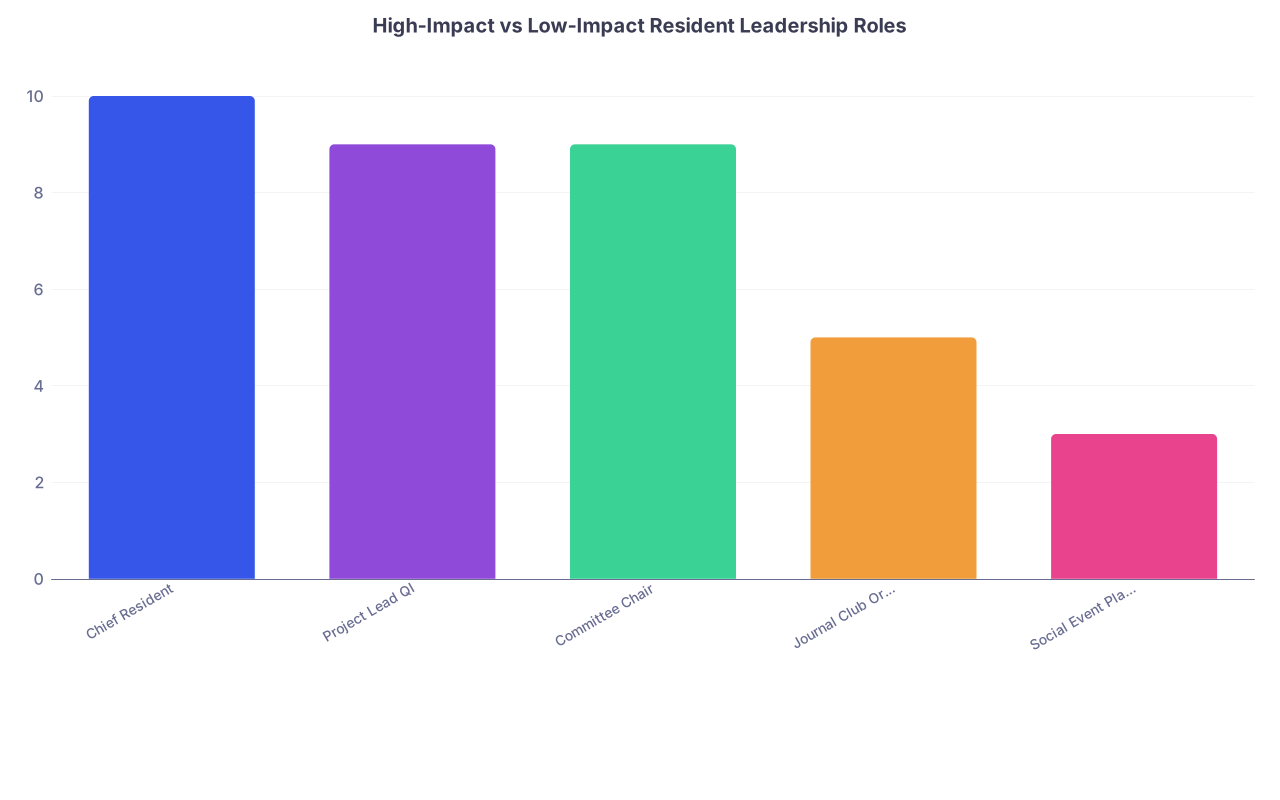
| Category | Value |
|---|---|
| Chief Resident | 10 |
| Project Lead QI | 9 |
| Committee Chair | 9 |
| Journal Club Organizer | 5 |
| Social Event Planner | 3 |
(Scale: 1 = minimal leadership signal, 10 = strong leadership signal to program/fellowship directors)
Program-building and curriculum design
Nearly every PD I know cares about this.
Examples that absolutely belong:
- Created a new simulation curriculum for codes or procedures
- Developed a structured onboarding or bootcamp for interns
- Designed a longitudinal point-of-care ultrasound curriculum
- Built and ran a new elective (e.g., “Healthcare for the Homeless”)
What makes it leadership:
- You didn’t just give a lecture—you built a structure or program
- You coordinated faculty, residents, or resources
- The curriculum continued beyond a one-off session
Leading education for peers or juniors
Teaching is common in residency. Leadership in teaching is different.
Strong examples:
- Resident Director, Morning Report (scheduled, set format, ensured consistency)
- Coordinator, MS3 Medicine Clerkship Didactics
- Peer teaching program founder or coordinator
- Simulation leader with structured, recurring sessions
Weak:
- “Gave 3 noon conferences”
- “Taught physical exam to med students occasionally”
Those may belong under Teaching Experience, but not leadership.
3. Gray-Zone Activities: When They Count as Leadership and When They Don’t
Some CV entries can be either excellent leadership or complete fluff depending on how you frame and what you actually did.
Resident wellness / social committees
Running a residency happy hour is not leadership. But:
- Creating a funded wellness initiative with measurable participation
- Establishing a peer support program after codes or bad outcomes
- Negotiating with GME for wellness budget or protected time
That’s legitimate leadership.
Test it: if your role could be replaced by a group text (“Guys, tacos Friday?”), it’s not leadership.
Recruitment and interview season
Good:
- Resident recruitment coordinator (scheduled resident interviewers, organized pre-interview dinners/tours, coordinated feedback)
- Led development of virtual interview format or applicant Q&A sessions
- Created structured resident-led social or info sessions that impacted applicant experience
Weak:
- “Participated in residency interview dinners”
- “Spoke with applicants during interview day”
Those are expected of almost all residents—don’t try to sell them as leadership.
Journal clubs / conference organizing
Leadership:
- Re-designed journal club format to include critical appraisal tools and faculty moderators
- Organized a recurring, structured, interdepartmental M&M series
- Chair of an education series with responsibility for scheduling, topic selection, and evaluation
Not leadership:
- “Presented at journal club”
- “Frequently attend M&M”
Again: you must own the structure or direction, not a single session.

4. What You Should Almost Never List as Leadership
This is where resident CVs get inflated and silly. Avoid it.
Generic participation
Drop these from your leadership section:
- “Member, Residency Social Committee” with no defined role
- “Volunteer, Community Health Fair” (unless you directed or coordinated it)
- “Participant, hospital diversity workshop”
You can still list them somewhere else. Just not as leadership.
One-off “lead” moments
Examples:
- Led one code blue because the senior was busy
- Ran one teaching session as a favor
- Covered sign-out one day when chief was out
That’s called being a good resident, not a leader. Leadership is repeated, structured responsibility.
Inflated titles
If your “title” was something nobody at your institution actually used, be careful.
Questionable:
- “Informal leader among co-residents”
- “Shadow chief resident”
- “Resident champion of professionalism” (unless that’s a formal, named role)
If your PD would look at the title and say, “What is that?”—you’re overselling.
5. How to Write Leadership Entries So They Actually Impress
Most residents either undersell (“Chief Resident”) or oversell (“Visionary healthcare leader”) their leadership.
Use this simple structure:
Role / Organization / Dates
1–2 bullets: scope + impact
Example:
Chief Resident, Internal Medicine Residency, XYZ Medical Center (2024–2025)
- Led administrative scheduling and coverage for 42 residents; reduced uncovered shifts by 60% through redesigned jeopardy system
- Co-led recruitment for 2,100 applications and 120 interviewees; implemented standardized resident debrief process adopted by program
Notice:
- Numbers (residents, applications, reduced by X)
- Verbs that indicate leadership (led, co-led, implemented)
- Clear spheres: administration, recruitment, education, QI
If you cannot think of a second bullet that shows impact, the “leadership” may not be strong enough to highlight.
| Activity Type | Where It Belongs |
|---|---|
| Chief Resident (admin/education) | Leadership section |
| QI Project Lead with implementation | Leadership or QI section |
| Committee Member, no defined duties | Professional activities |
| Organizer, recurring teaching series | Leadership or Teaching |
| One-time journal club presenter | Teaching experience |
| Social event planner, casual | Maybe omit or Activities |
6. Where to Put Leadership on Your CV (So It Gets Noticed)
If leadership is one of your selling points—for fellowship, chief year, or academic jobs—don’t bury it.
A simple order that works well:
- Education and Training
- Certifications / Licensure
- Leadership Positions
- Teaching and Mentorship
- Quality Improvement and Patient Safety
- Research and Publications
- Professional Activities / Committees
- Volunteer and Community Service
If your leadership is modest, you can combine: “Leadership & Professional Activities”
Do not scatter leadership roles in random sections. Group them so a reviewer can quickly see: “This resident consistently takes responsibility.”
Also: keep it chronological within the section, most recent first.
7. How Leadership Plays With Fellowships and Careers
You’re not listing leadership to feel good about yourself. You’re listing it to get something: a fellowship spot, a junior faculty role, a hospital committee seat.
Here’s how program and fellowship directors think.
They care about:
- Will you show up and do work outside clinical duties?
- Can you manage projects and people with minimal hand-holding?
- Do you understand systems and not just individual patients?
- Have you done things that look like the next step’s expectations?
For example:
- Cardiology or ICU fellowship: QI project leadership, code committee roles, curriculum design in critical care topics.
- Academic hospitalist job: chief resident role, education program leadership, committee work with tangible outcomes.
- Health systems or quality roles: hospital QI committee leadership, system redesign work, data-driven initiatives.
Leadership activities that live in your email and not on your CV don’t help you. Be deliberate.

| Step | Description |
|---|---|
| Step 1 | Activity |
| Step 2 | Include under Leadership |
| Step 3 | Move to Activities |
| Step 4 | Omit or leave informal |
| Step 5 | Formal role or title? |
| Step 6 | Owned decisions or outcomes? |
| Step 7 | Led people or systems repeatedly? |
| Step 8 | One time or minor task? |
8. Quick Rewrite Examples: From Fluff to Solid
Let’s fix a few common lines I’ve seen on resident CVs.
Fluff:
“Member, Wellness Committee”
Better if true:
“Co-lead, Resident Wellness Committee – Implemented quarterly peer support debriefs after adverse events; 60% average attendance across PGY levels”
Fluff:
“Participated in interview days for residency recruitment”
Better:
“Resident Recruitment Coordinator – Organized resident participation for 15 interview days, created standardized virtual Q&A format adopted by program”
Fluff:
“Led journal club presentations”
Better (if you actually structured it):
“Journal Club Coordinator – Redesigned monthly format, incorporated structured appraisal tools; increased resident presenters from 6 to 18 per year”
If you can’t rewrite it into something that shows scope and impact without lying, it probably doesn’t belong in the leadership section.
FAQ: Leadership on a Residency CV
1. Do I need a formal title for something to count as leadership?
No, but it helps. What you need is clear responsibility and repeated, structured involvement. If you functionally led a project or program—even without a fancy title—you can list it as “Project Lead,” “Coordinator,” or similar. Just don’t invent titles nobody at your institution would recognize.
2. Can presenting at conferences or giving lectures count as leadership?
On its own, usually not. Single lectures are teaching, not leadership. It becomes leadership when you create or coordinate a recurring series, curriculum, or program, and are responsible for its planning, execution, and improvement over time.
3. I have mostly small roles—should I skip a leadership section altogether?
If all you have are “member” roles and one-off tasks, yes, combine under “Professional Activities” and build real leadership before the next application cycle. A weak leadership section just highlights that you do not actually lead much.
4. How many leadership activities should I list as a resident?
Quality beats quantity. Three to six solid, clearly described leadership roles is plenty. Ten vague “member” or “helped with” bullets makes you look unfocused and padding. Aim for the roles where you can show scope, responsibility, and impact.
5. Where should I put leadership from medical school (e.g., student org president)?
If you’re an early PGY-1 and lack residency leadership, you can still include strong med school leadership—clearly labeled by dates. By PGY-3, residency-level leadership should dominate. Med school roles become less relevant over time, especially for fellowship.
6. Does being a “senior on call” or team leader count as leadership?
No. That’s part of your expected clinical role. Everyone in your PGY level does some version of that. You don’t list “ran the inpatient team on call” as leadership any more than you list “wrote progress notes” as research.
7. How detailed should my leadership bullets be—do I need metrics?
Use metrics when you have them, but don’t fabricate. If you can quantify participation, coverage, or outcomes, do it—numbers pop on a CV. If you can’t, at least describe scope (“multidisciplinary team of 7,” “residency of 36 trainees,” “monthly sessions over 1 year”). The reader should immediately see why this role mattered.
Key points:
Focus on leadership roles where you owned decisions, outcomes, or people—not just where you were in the room. Group them clearly on your CV, write concise bullets highlighting scope and impact, and cut the fluff. If your leadership actually changed something in your program or hospital, you’re on the right track.


