

The idea that “more leadership is always better” during residency is wrong – and it is burning people out.
Here’s the honest answer: most residents can sustainably hold 1 major leadership role or 2–3 minor roles at a time. More than that, and you’re usually borrowing energy, sleep, and sanity from your future self.
Let me break down what that actually means and how to decide your personal limit without wrecking your training or your health.
The Real Question: What Type of Leadership, Not Just How Many
You can’t talk about “how many” roles without defining the weight of each role. A chief resident year is not the same as being the “wellness committee rep” in name only.
Here’s a practical way to think about it:
- Major leadership roles = you’re responsible for outcomes, people, and ongoing work.
Think:
- Chief resident
- Program-wide quality improvement (QI) project lead
- House staff council officer
- Leading a big curriculum project (new M&M format, new rotation design)
- Minor leadership roles = you show up, contribute, maybe own a slice, but you’re not the glue.
Think:
- Residency wellness/DEI/social committee member
- Resident liaison for one rotation
- Journal club organizer
- Small research/QI subproject lead within a bigger team
As a rule of thumb:
- Major role ≈ 3–6 hours/week on average (more during crunch times)
- Minor role ≈ 0.5–2 hours/week
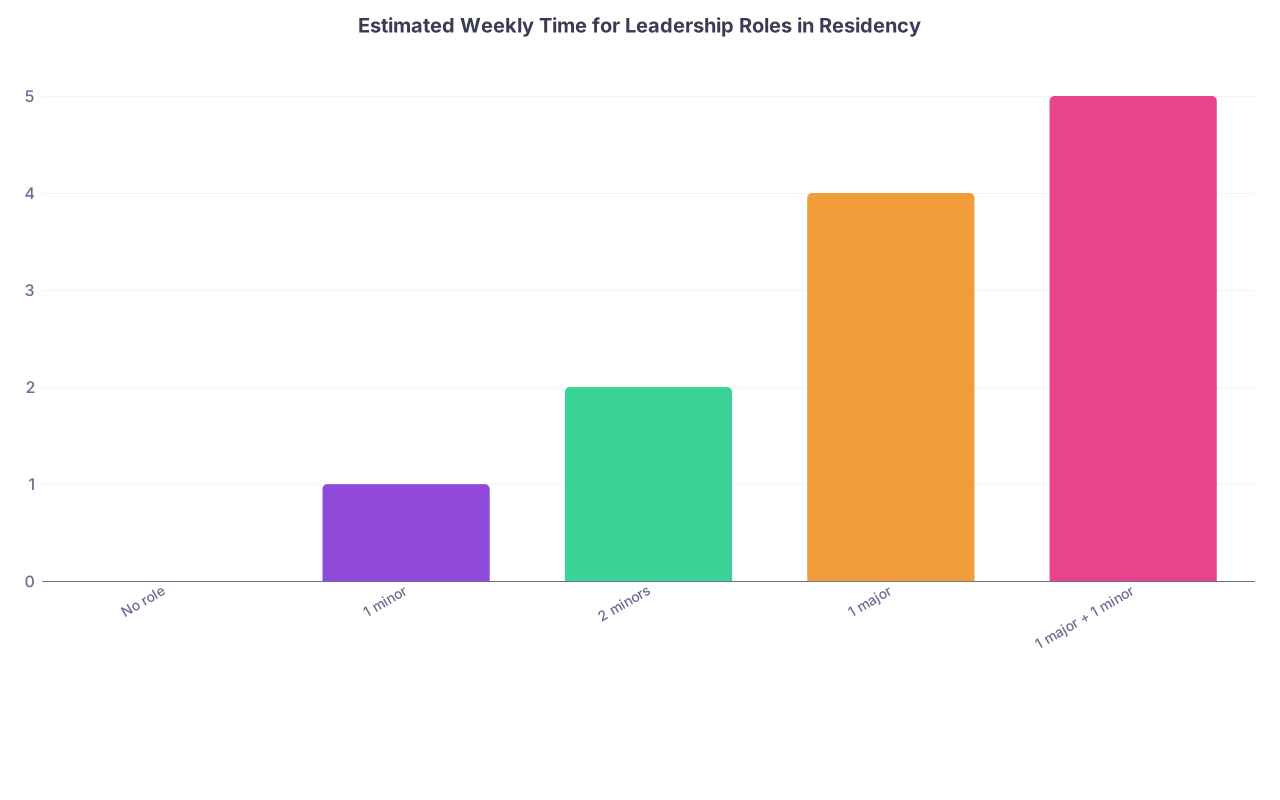
| Category | Value |
|---|---|
| No role | 0 |
| 1 minor | 1 |
| 2 minors | 2 |
| 1 major | 4 |
| 1 major + 1 minor | 5 |
That doesn’t sound like much until you remember this is stacked on top of:
- 60–80 hour weeks
- Nights, 28-hour calls, ICU blocks
- Studying for in-training exams/Boards
- Life (relationships, kids, rent, laundry)
This is why “How many can I take?” is the wrong first question. The better question is:
“How much consistent responsibility can I carry on my worst rotation and still be safe and decent to patients and myself?”
For most residents, that answer translates into:
- Safe upper limit:
- 1 major OR
- 2–3 minor roles
- Combine only if one of them is very lightweight and seasonal.
A Simple Framework: The 4-Lane Capacity Check
Before you say yes to another role, do a quick 4-lane check. If 2 or more are already near capacity, you’re done. Say no.
The four lanes:
- Clinical bandwidth
- Sleep/mental health
- Study/learning
- Life outside the hospital
1. Clinical Bandwidth
Ask yourself:
- What’s my average weekly hour load over the next 3–6 months?
- Do I have any of these coming:
- ICU months
- Night float
- Heavy call rotations
- Step 3 or board prep window
Concrete rules that I’ve seen work:
- If your program has multiple “black hole” months (ICU, wards + heavy call, night float), you should avoid starting new leadership roles during those months.
- If >50% of your next 6 months are heavy rotations, cap yourself at 1 minor role.
2. Sleep and Mental Health
Ignore this and you will regret it.
If any of these are true:
- You’re averaging <6 hours of sleep/night on service months
- You’re already using your rare post-call days to “catch up” on leadership stuff
- You’re having consistent anxiety, dread, or irritability around work
Then your honest leadership capacity right now is zero new roles. You can continue something small you already have if it feeds you, but you don’t add more.
3. Study and Learning
Residency is still training. Programs expect you to progress. Boards matter.
Ask:
- Did my last in-training exam go how I wanted?
- Am I consistently behind on reading for common cases?
- Do I feel like “I don’t have time to learn, only to survive”?
If your scores are borderline or you feel like you’re always behind:
- Take on no major roles, and
- At most 1 minor role that doesn’t demand weekly meetings.
4. Life Outside the Hospital
This one gets ignored until something breaks.
Real situations I’ve watched:
- Residents with new babies trying to be chief + QI lead. They were white-knuckling it by month 3.
- Long-distance relationships dying while someone “just helped” with three different committees.
Ask:
- Do I have major life events coming up (baby, move, wedding, illness in family)?
- Am I already letting basic life stuff slip: bills late, house disgusting, no exercise for months?
If your life lane is already maxed, leadership doesn’t fix it. It makes it worse.
A Practical Rule: Choose One “Anchor” Role per Year
Your safest strategy: each PGY year, pick one anchor leadership role that really matters to you, and then add small, low-stress things if you truly have room.
Examples:
PGY-1
- Anchor: none, or very small (e.g., wellness rep, class rep)
- Optional add-ons: ad hoc teaching sessions, help with interview days
PGY-2
- Anchor: QI project lead, or house staff council rep, or small curriculum project
- Optional: one committee membership that meets monthly
PGY-3
- Anchor: chief resident (if selected) OR major leadership role (chief of QI, DEI, scheduling)
- Optional: very limited. Maybe one passion project that is genuinely fun.
Fellowship or senior years
- Same pattern: one anchor, everything else is bonus and strictly capped.
| PGY Year | Anchor Role Example | Reasonable Add-Ons |
|---|---|---|
| PGY-1 | Wellness rep | Interview day helper |
| PGY-2 | QI project lead | 1 monthly committee |
| PGY-3 | Chief resident | 0–1 tiny passion project |
| PGY-4+ | Fellowship curriculum rep | Occasional teaching |
Warning Signs You’ve Taken On Too Much
You don’t need a burnout questionnaire. The signs are obvious when you stop sugarcoating.
You’ve likely exceeded your sustainable number of roles if:
- You’re answering leadership emails on every post-call day.
- You’re sneaking leadership work into:
- Pre-rounding time
- Handoffs
- While cross-covering at night
- You start resenting the very people you’re “leading.”
- Your co-residents joke, “Do you ever go home?” and it stings because it’s true.
- Small tasks feel huge. Writing a simple email takes you days.
- You find yourself quietly hoping a meeting gets canceled so you can just lie down.
If two or more of these are happening, you’re in the red zone. Time to drop or scale back something.
How to Say No (Without Burning Bridges)
You’re afraid that if you say no, you’ll look lazy or less committed. That’s not how adults who run programs think.
Here’s a script you can adapt:
“I’m really interested in this, but I’m currently [chief / QI lead / on a major project] and I don’t want to commit to something I can’t do well. My plate is full through [month].
If you’re still looking for help after that, or if there’s a smaller way I can contribute, I’d be open to that.”
Or more blunt, which I’ve heard residents use very effectively:
“I’ve hit my safe capacity for extra roles this year. I don’t want my clinical work or current commitments to suffer, so I need to pass on anything new.”
People who respect boundaries will actually trust you more after that. They know you won’t overpromise and underdeliver.
If You Already Took On Too Much: Triage, Don’t Hero It
If you’re reading this thinking, “I’m already overcommitted,” here’s the move. Do a three-bucket triage:
Must keep
- Anything tied to your job (chief, formal role with real impact)
- Anything midstream where abandoning would cause major harm or chaos
Can step back partially
- Ask to:
- Move from lead to co-lead
- Shift to advisory/consultant role
- Reduce meeting presence (only attend key ones)
- Ask to:
Can exit
- Roles where:
- There’s plenty of coverage
- Your name is on it but you’re not critical
- You joined out of obligation or FOMO
- Roles where:
Then have short, direct conversations with the relevant leaders:
“I took on more roles than I can safely sustain. To protect my clinical work and avoid burning out, I need to step back from [X] starting [date]. I’m happy to help with a brief handoff and make sure whoever takes over has what they need.”
You’re not a martyr. You’re a trainee with finite bandwidth.
What Programs and PDs Actually Care About
Here’s what I’ve heard repeatedly in resident selection and fellowship interviews:
- They’d rather see one sustained, meaningful leadership role than a long list of titles with no substance.
- Chiefs or PDs will often comment positively on:
- “She led our QI council for two years and actually changed our handoff process.”
- “He redesigned our M&M and presented at a national meeting.”
- No one is impressed by a CV that reads like: “member, member, member, member” with no clear story or impact.
So in concrete terms, for career impact you need:
- 1–2 real leadership stories you can talk about in detail:
- What was broken
- What you did
- What changed
- What you learned
You do not need:
- Ten committee memberships
- Every possible “resident rep” slot
- To be on every wellness or DEI initiative your program starts
Pick a lane that matches where you’re heading (academics, QI, education, admin, advocacy) and go deep, not wide.
A Quick Personal Capacity Check You Can Use Today
Use this 5-question gut check. If you answer “yes” to 3+ of these, you’re already at or above capacity:
- In the past month, have you done leadership work when you should have been sleeping?
- Have you skipped studying or reading for patient care to do something for a leadership role?
- Are you behind on basic life tasks (bills, laundry, calling family) consistently?
- Do you feel dread when you see another leadership-related email or meeting invite?
- Have you recently dropped the ball (late responses, missed tasks) on something patient-care or safety related?
If that stung, your number of leadership roles is not the problem. Their total weight is. You either drop one or shrink them.
Visual: A Healthier Leadership Path Through Residency
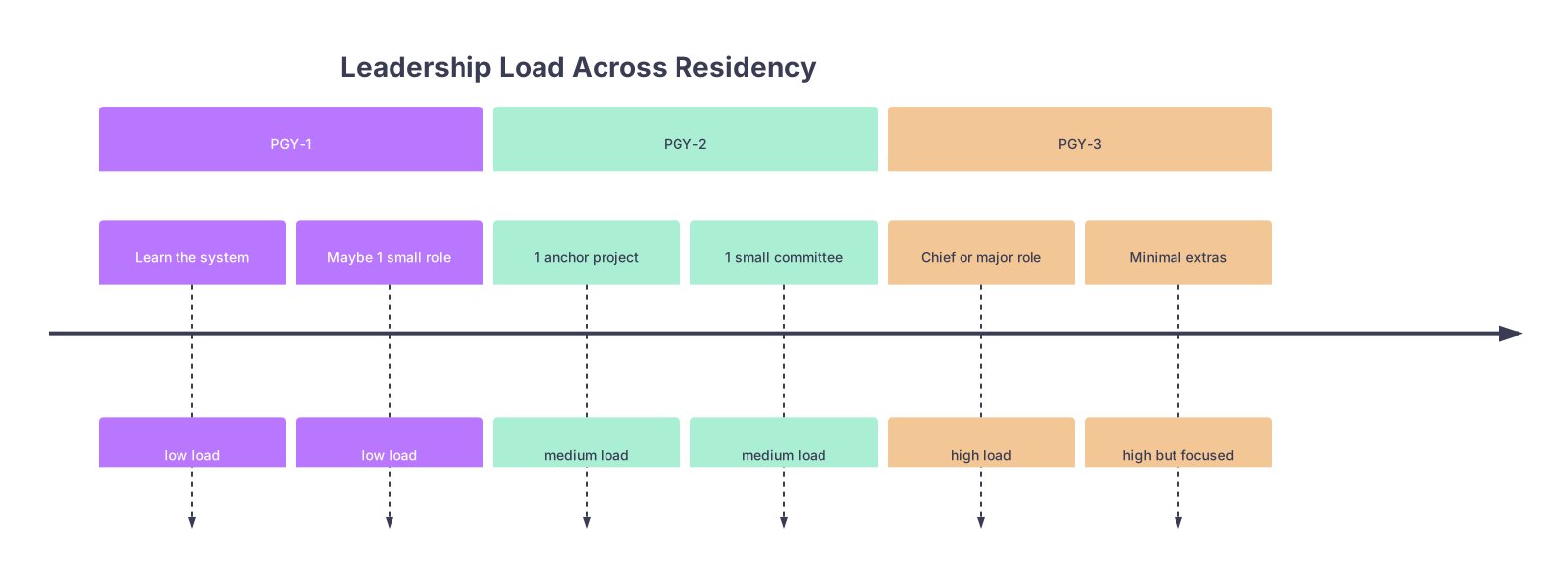
| Period | Event |
|---|---|
| PGY-1 - Learn the system | low load |
| PGY-1 - Maybe 1 small role | low load |
| PGY-2 - 1 anchor project | medium load |
| PGY-2 - 1 small committee | medium load |
| PGY-3 - Chief or major role | high load |
| PGY-3 - Minimal extras | high but focused |
This is closer to what a sane, sustainable path looks like. Big push when you’re more senior and efficient, lighter when you’re just trying to survive call.
FAQs
1. Is it a bad idea to be chief resident and also lead a big QI or research project?
For most people, yes. Chief alone is effectively a second job. Combining it with a large high-stakes project is how people end up exhausted, resentful, or doing both poorly.
If you’re chief:
- Keep any other role tightly scoped and low maintenance.
- Anything that needs weekly heavy lifting or lots of coordination should wait.
2. How many leadership roles do competitive fellowships “expect”?
They don’t expect a number. They expect a coherent story. One or two strong, sustained roles with real impact beats six small, superficial ones. For something like cards, GI, heme/onc, EM, or surgical subspecialties, your clinical performance, letters, and (for some) research matter more than sheer leadership count.
3. Should interns (PGY-1) take on leadership roles at all?
Lightly, if you want to—and only after you’ve proven to yourself you can handle the clinical load. A single small role is plenty: wellness rep, class rep, small QI contributor. Your main job as an intern is to become safe and solid clinically. That’s not negotiable.
4. How do I explain stepping back from a role in future interviews?
You tell the truth like an adult:
“I initially took on several roles, then recognized I was at risk of overcommitting and impacting my clinical work. I had a direct conversation with my mentor and stepped back from X to prioritize Y. I learned how to set realistic limits and protect the quality of what I do commit to.”
That answer sounds mature, self-aware, and safe. Interviewers like that.
5. What if I genuinely enjoy leadership work and it gives me energy?
Great. You might be able to tolerate the higher end of the range—1 major + 1 minor—without suffering. But your objective markers still apply: sleep, exam performance, clinical feedback, and your personal life. Enjoyment doesn’t protect you from burnout if the load is chronically too high.
Bottom line:
- Most residents can sustainably carry 1 major leadership role or 2–3 minor ones at a time; more than that is usually debt you’ll pay back in burnout or poor performance.
- Use your worst rotation, not your best, as the benchmark for what you can safely handle.
- Depth beats volume. One or two serious leadership stories that you did well and survived intact are worth more than a dozen thin titles and a fried nervous system.


