

You’re halfway through residency. You just watched your chief residents run morning report, juggle the schedule, smooth over an attending blow-up, and still somehow be human at 6 pm. Someone turns to you and says, “You’d be a great chief.”
Now you’re stuck with the question: Should you actually aim for chief resident, or is that a terrible idea for you?
Here’s the answer you’re looking for: being chief is fantastic for the right person in the right context, and a giant time‑sucking headache for the wrong person or wrong program.
You need a clear framework, not vibes.
Step 1: Understand What “Chief Resident” Really Means at Your Program
Forget the glossy brochure version. You need the gritty local truth.
At its core, chief resident usually means some mix of:
- Schedule and admin work
- Teaching and curriculum roles
- Serving as the buffer between residents and leadership
- Being “the face” of the residency
But the ratio of those things is what matters.
Ask these questions specifically (to current and recent chiefs, not just the PD):
- How many protected hours per week are actually free of clinical work?
- Who really owns the schedule? You or a coordinator?
- How often are chiefs dealing with conflict, complaints, or crises?
- Are chiefs mostly doing scut admin work or meaningful leadership projects?
- Do chiefs get real say in policy and culture, or just execute orders?
If they say things like “Honestly, I’m on email all night” or “I had to move 14 golden weekends last month because of coverage gaps,” that’s data. Not noise.
You’re trying to figure out if this is a leadership job or a gap‑coverage job dressed up as leadership.

Step 2: Get Honest About Your Real Motivations
This is where people lie to themselves and end up miserable.
Here are good reasons to aim for chief:
- You genuinely like teaching and mentoring, and you already do it.
- You want more say in how the program runs and have ideas you’re dying to test.
- You’re considering an academic or leadership‑heavy career and want reps.
- You’re energized (not drained) by being the “go‑to” person.
- You want more structured feedback on your leadership style.
Here are red‑flag reasons that usually blow up:
- “It’ll look good on my CV.” (It will. But not enough to justify a bad year.)
- “Everyone says I should.” (Everyone also goes home at 5 while you fix the schedule.)
- “I feel obligated; they’ve done so much for me.” (This is a job, not a favor.)
- “I don’t know what else to do next year.” (That’s avoidance, not strategy.)
- “I need it to get any job.” (Almost never true outside a few niches.)
Be blunt with yourself. If you stripped away the prestige and the title and it was just “Resident Administrator Year,” would you still want it?
If the answer is no, pay attention.
Step 3: Match Chief Resident Against Your Career Goals
Here’s where we get practical. Different career paths get different levels of benefit.
| Career Direction | Chief Year Value | Why It Helps (or Doesn’t) |
|---|---|---|
| Academic clinician-educator | High | Teaching, curriculum, leadership, visibility |
| Subspecialty fellowship (competitive) | Moderate | Slight plus, helps if tied to leadership/education |
| Community hospitalist/EM/primary care | Moderate-Low | Nice but not required; mainly for skills & networking |
| Private practice procedural specialties | Low | Rarely a deciding factor, may delay income for little return |
| Physician-administration/leadership | Very High | Early leadership testbed, projects, exposure to systems |
If you’re aiming for:
- Clinician-educator jobs: Chief often helps a lot. Gives you teaching experience, evals, curricular innovation.
- Program leadership / admin roles: It’s almost like an informal mini‑fellowship in leadership. Highly useful.
- Competitive fellowship: It won’t erase a weak application, but paired with strong letters and scholarship, it can be a plus.
- Pure private practice with no teaching: Chief is mostly about personal growth, not employability.
If your career goal is “I want out ASAP and I never want to touch scheduling politics again,” then doing a chief year just to delay real life is usually a bad move.
Step 4: Assess Your Tolerance for Conflict and Emotional Labor
This is the piece nobody really explains. Being chief is emotional labor.
You will:
- Hear about residents in crisis before anyone else.
- Sit in meetings about remediation, professionalism, and burnout.
- Get texts at 10 pm about schedule changes, unfair evaluations, and angry nurses.
- Sometimes have to say “no” to your friends. Repeatedly.
If conflict makes you physically nauseous, chief will be rough.
If you can handle:
- Two co-residents both convinced they’re right
- An attending who’s furious about “the quality of residents”
- A PD asking, “What’s really going on with this person?”
- Saying, “I hear you, but I can’t make that change,”
…then you might do well.
And no, being “nice” is not the same as being good at this. You need boundaries. You need to be able to listen, validate, and still not cave when the answer is no.
Step 5: Reality-Check the Time, Money, and Burnout Equation
Let’s talk cost.
Time: Chief year adds another year before full attending pay. That’s not nothing.
Money:
You’re likely still at resident salary or slightly above. Meanwhile, your co‑residents become attendings or fellows.
Burnout:
You’re doing:
- Admin work
- Teaching
- Often some clinical service
- Plus constant low‑level “on call” for program issues
If you’re already crispy by PGY-2 or PGY-3, chief can either:
- Give you a different type of work that feels more sustainable, or
- Completely drain you and sour you on leadership for a decade
I’ve watched both happen.
Quick exercise:
If you’re IM, EM, or similar, estimate:
- Attending starting salary where you want to practice
- Resident salary as chief
The raw difference over a year is usually tens of thousands of dollars. For some people, the leadership experience is absolutely worth that opportunity cost. For others, especially with loans, family responsibilities, or burnout, it’s not.
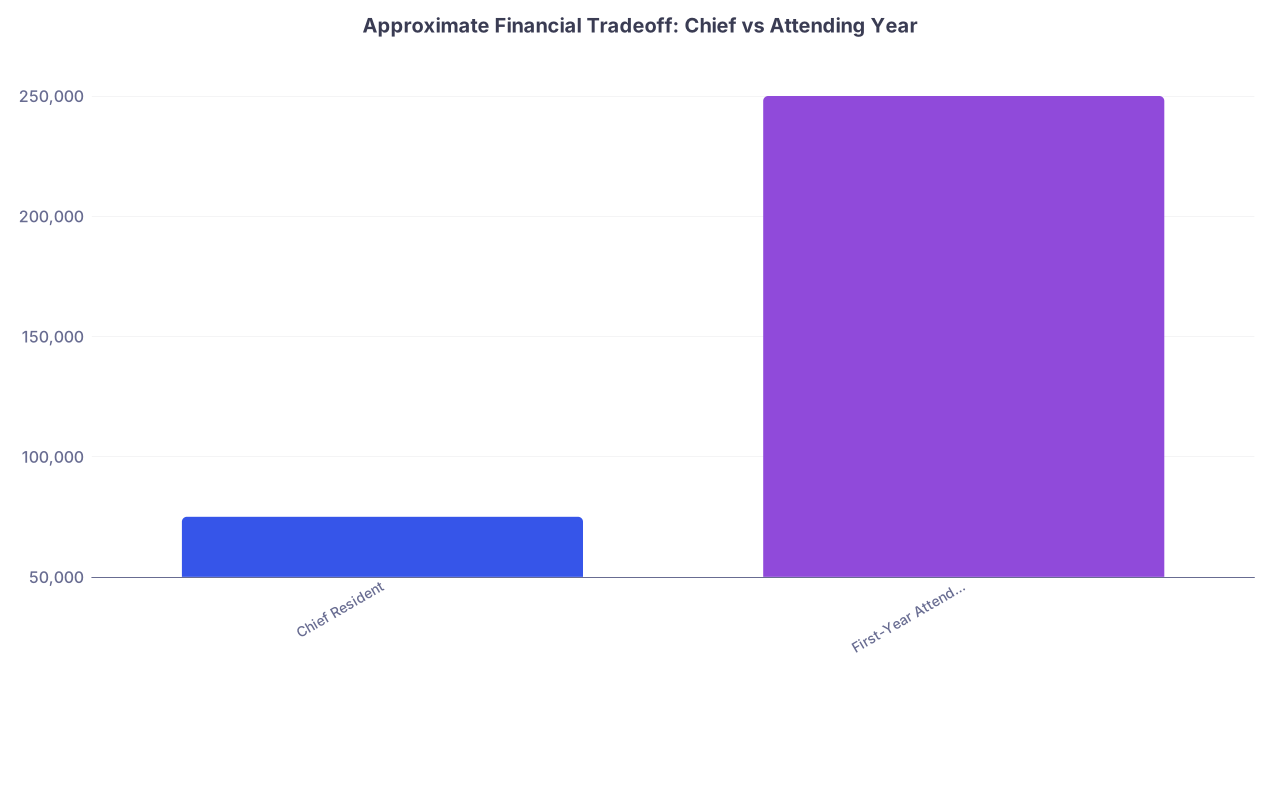
| Category | Value |
|---|---|
| Chief Resident | 75000 |
| First-Year Attending | 250000 |
Numbers here are rough, but the magnitude is real.
Step 6: Evaluate Your Program’s Culture and Support for Chiefs
Same job title. Completely different realities depending on program culture.
You want to know:
- Do chiefs get formal mentorship (from PD, APDs, department)?
- Are there clear expectations or is it “figure it out”?
- Do chiefs attend leadership committees where decisions are actually made?
- When chiefs push back on unsafe or unfair policies, are they heard or sidelined?
Green flags:
- Chiefs say things like “We actually changed X policy last year and it stuck.”
- Faculty describe chiefs as “partners” or “colleagues,” not “the people who do scheduling.”
- Previous chiefs are still in touch and positive about the experience.
Red flags:
- High chief turnover or people declining the role.
- Chiefs visibly burned out or bitter by midyear.
- PD says “It’s what you make of it” but can’t give you a concrete description of support or outcomes.
If your program culture doesn’t back its chiefs, you’re signing up to be a shock absorber, not a leader.
Step 7: Use This Simple 4-Box Framework
Let’s compress all this into a simple decision grid.
Look at two axes:
- Career benefit (for your specific goals): High vs Low
- Personal fit + program support: High vs Low
You get four scenarios:
High benefit / High fit
- You want academic or leadership roles
- You like teaching and conflict doesn’t paralyze you
- Program supports chiefs and gives them real influence
→ Strong yes. Aim for chief. Build the year around deliberate leadership and teaching goals.
High benefit / Low fit
- Chief would help your career but you’re already burned out, conflict-avoidant, or your program treats chiefs poorly
→ Only consider if you can mitigate: negotiate role scope, demand mentorship, or work on boundaries. Otherwise, be careful. The cost might outweigh the boost.
- Chief would help your career but you’re already burned out, conflict-avoidant, or your program treats chiefs poorly
Low benefit / High fit
- You’d probably enjoy it and are good at it, but your career path doesn’t need it
→ This is a values decision. If you care about leaving the program better, mentoring juniors, and you can afford the extra year, go for it. Just don’t pretend you “need” it for private practice.
- You’d probably enjoy it and are good at it, but your career path doesn’t need it
Low benefit / Low fit
- Your career doesn’t need it, and the job would drain you
→ Hard no. You can still be a great leader and teacher without the chief title.
- Your career doesn’t need it, and the job would drain you
Step 8: If You Decide to Aim for Chief, Be Strategic
If after all that, you’re leaning “yes,” don’t just hope you get picked and figure it out later. That’s how people waste the year.
Do this:
- Define 2–3 concrete goals for your chief year
- Example: redesign the night float handoff system; build a resident teaching curriculum; start a wellness initiative that’s not fluff.
- Ask for specific leadership development
- Courses, workshops, or at least formal mentorship meetings.
- Clarify your non‑negotiables
- How much clinical time is acceptable?
- How many nights/weekends are you willing to cover?
- What tasks are off the table unless someone else resigns?
And before you accept, talk to at least two previous chiefs alone, with the door closed, and say:
“If you could go back, would you do it again?”
Push until you get a real answer, not the politically correct one.

| Step | Description |
|---|---|
| Step 1 | Clarify Career Goals |
| Step 2 | Do not pursue chief |
| Step 3 | Assess personal fit |
| Step 4 | Evaluate program culture |
| Step 5 | High risk - only if benefits huge |
| Step 6 | Pursue chief strategically |
| Step 7 | Chief helps those goals? |
| Step 8 | Enjoy teaching and leadership? |
| Step 9 | Program supports chiefs? |
Step 9: If You Decide Not to Aim for Chief, Still Grow as a Leader
Saying no to chief doesn’t mean you’re not a leader. It just means you’re not signing up for that specific role.
You can still:
- Run educational sessions, morning report, or QI projects
- Mentor interns and students deliberately
- Lead committees or initiatives that actually interest you
- Build the exact same skill set—communication, conflict management, systems thinking—without the schedule headaches
I’ve seen residents skip chief and go straight into leadership tracks, medical director roles, and clinician-educator positions because they built a portfolio of leadership, not a title.
FAQ: Chief Resident – 7 Questions Answered
1. Does being chief resident significantly improve fellowship chances?
Sometimes, but it’s not magic. For competitive fellowships, what really matters is the whole package: strong letters, solid evaluations, academic work, and reputation. Chief can help by signaling leadership, reliability, and teaching ability. It can also get you face time with powerful faculty. But nobody is matching a weak applicant just because “they were chief.”
2. Is it better to do chief before or after fellowship?
Depends on the specialty and program. In IM, many do chief after residency, some as part of fellowship, some post‑fellowship (e.g., subspecialty chiefs). Doing it right after residency keeps your generalist skills fresher and puts you closer to core residency operations. Doing it after fellowship can be better if your leadership goals are in that subspecialty. Ask recent grads in your field what’s most common and why.
3. How bad is the workload really as chief?
It ranges from “busy but manageable” to “this is two jobs.” At decent programs, chiefs work hard but have protected time and support. At dysfunctional programs, chiefs are the patch for every coverage gap, every disgruntled attending, and every administrative fire. That’s why talking to current/previous chiefs is mandatory. You want examples like “I usually leave by X” and “I have Y hours/week that are predictable.”
4. Does saying no to chief hurt my relationship with the program or PD?
If your PD is reasonable, no. You’re allowed to choose what’s best for your life and career. The way you say no matters more than the no itself. Be appreciative, be clear, and, if true, offer to contribute in specific other ways (teaching sessions, QI projects, mentoring). If a program punishes people for not accepting extra unpaid labor, that’s a program problem, not a you problem.
5. What if I want leadership roles but hate scheduling and admin tasks?
That’s most people, honestly. Chief is a mixed bag: part leadership lab, part logistics job. If scheduling and admin are a hard no, you might be better off leading focused projects instead—QI, curriculum, research, committees—where you practice leading without owning the entire machine. You can still learn the politics and systems piece without individually moving 30 call shifts every month.
6. How early do I need to signal interest in being chief?
Usually by mid PGY-2 in a three‑year program, sometimes earlier in very structured places. If you’re even mildly interested, start acting like a leader now: be reliable, teach juniors, handle conflict like an adult, and take initiative on projects. Then tell your PD or APD quietly, “I might be interested in chief; can you give me feedback on what I’d need to show?” That both signals interest and gets you useful data.
7. What’s one sign I’m not ready to be chief, even if I want it?
If you’re already barely holding it together emotionally and your response to any new problem is irritation or avoidance, adding a chief role will likely crush you. Chiefs don’t need to be perfect, but they do need some capacity to absorb stress without exploding or ghosting. Wanting the title isn’t enough. You need at least a little extra bandwidth to handle everyone else’s problems on top of your own.
Here’s your next step:
Open a blank page and write two lists—“Why I want to be chief” and “Why I don’t.” Then send that list to one trusted mentor (faculty or senior resident) and ask them: “Given what you know about me and our program, does this add up to a yes or a no?” Their reaction will tell you a lot.


