

What separates the resident everyone tolerates from the resident everyone will follow into a code at 3 a.m.—and how do you actually move from one to the other in a matter of months, not years?
Let me be clear: people do not suddenly “become” leaders during chief year. The residents who stand out by PGY-2 or PGY-3 are making specific, repeatable moves—month after month—that compound. You can copy those moves.
Here’s how that growth actually happens in real residency life.
The Core Shift: From “Me and My Notes” to “Us and Our Outcomes”
Early on, you’re obsessed with survival: getting your notes done, not missing labs, not sounding clueless on rounds. That’s normal. But leadership growth starts the moment you mentally switch from:
“Did I finish everything?”
to
“Did my team move the patient’s care forward today?”
Residents who improve fast do three things consistently:
- They define the goal of each day or shift for the team, not just themselves.
- They communicate those goals clearly and briefly.
- They close the loop and check whether it actually happened.
Example from a PGY-1 in medicine:
- 6:45 a.m.: Writes on the team list: “By noon: D/C 2B, clarify goals of care 4C, CT angio results for 3A, PT evals ordered for 5A/5B.”
- 7:15 a.m.: Quick 90-second huddle with med student + intern: “Our main push this morning is discharge on 2B and getting clarity on 4C’s code status. I’ll handle talking to the family; can you watch for the CT angio and page me when it’s back?”
That takes under 3 minutes. It changes everything. That’s leadership in residency language.
What Actually Improves Month to Month
Residents do not become better leaders by reading leadership books at midnight. They improve because certain skills get tighter with repetition and intentional tweaks.
Here are the big ones.
1. Your “Command Presence” in Chaos
Leadership in medicine is most visible when things go wrong: rapid response, airway emergency, crashing patient. Month to month, this is what improves if you push it:
- How fast you claim or assign roles: “You’re on chest compressions, you’re pushing meds, you’re documenting, I’ll run the code.”
- How clear your voice is under pressure. Short sentences. “Stop compressions for rhythm check.” Not “Uh can we maybe pause for a second.”
- How well you summarize and reset the room every 1–2 minutes.
You don’t start out good at this. You get better by doing one thing after each event: a micro-debrief.
After a code, literally 60 seconds with whoever’s around:
“What worked? What was messy? One thing we’ll do differently next time?”
You’ll hear things like:
- “We couldn’t hear you over the monitors.”
- “We didn’t know who was documenting.”
- “We lost track of how many epi doses.”
That feedback shapes the next event. Repeat that cycle for three months and your leadership under pressure will look completely different.
2. Your Ability to Direct, Not Just Do
Early residents think leadership means “I’ll do everything faster.” That’s how you burn out and still look disorganized.
Leaders shift from doer to director.
Effective residents month to month get better at:
- Assigning tasks clearly: “You call the family and update them. I’ll call nephrology.”
- Matching tasks to people’s skill level: giving a student a simple note, giving an intern the complicated transfer.
- Saying “No, I’ll take that” when something is too complex or sensitive to delegate.
A simple “leadership rep” you can do daily:
On rounds, before leaving a room, pause and say:
“Okay, owners:
– I’ll call cardiology and update the family.
– You’ll reorder the diuretics and place the PT/OT consult.
– You’ll put in the echo order and update the sign-out.
Let’s have all that done by 11.”
Then actually check back. That’s you training yourself to think like a leader every single patient.
3. Reading the Room (and Not Ignoring It)
The best residents get noticeably better at reading people and adjusting.
Month 1: you miss that the intern is drowning.
Month 4: you see the intern hasn’t eaten and is getting snappy, and you change the plan.
The skill you’re building:
- Noticing energy: Who’s withdrawn? Who’s overwhelmed? Who’s underused?
- Calling it out in a non-dramatic way: “You look wiped. After we finish this patient, go eat for 10 minutes. I’ll cover pages.”
- Adjusting how you give feedback to each person.
This doesn’t take extra time. It’s literally one extra sentence in your day, but it’s leadership gold and your team remembers how you made the work feel.
4. Owning Decisions (Even When You’re Not 100% Sure)
Strong residents move from “I’ll ask the attending every single thing” to “Here’s my plan, here’s my backup, I’ll run it by them.”
This skill improves when you:
- Always show up to attending with a plan A, B, and “if they say no”.
- Verbally commit: “My plan is to switch from heparin drip to DOAC because X. If that’s not acceptable, my second choice is Y.”
- Take responsibility when something doesn’t work: “I chose that strategy; it didn’t land with the family. Next time, I’ll involve social work earlier.”
People follow residents who clearly own the plan. Even if that plan occasionally needs to be changed.
Why Some Residents Leap Ahead: They Run a Monthly Experiment
The residents who make big jumps don’t just “gain experience.” Everyone accumulates hours. They’re running deliberate experiments with how they lead.
Think of each month as a mini-project:
- This month: “I’m going to improve how I start the day with my team.”
- Next month: “I’m going to get good at running family meetings.”
- Following month: “I’m going to practice giving direct feedback that doesn’t feel like an attack.”
Then they gather data. Tiny, informal, but real.
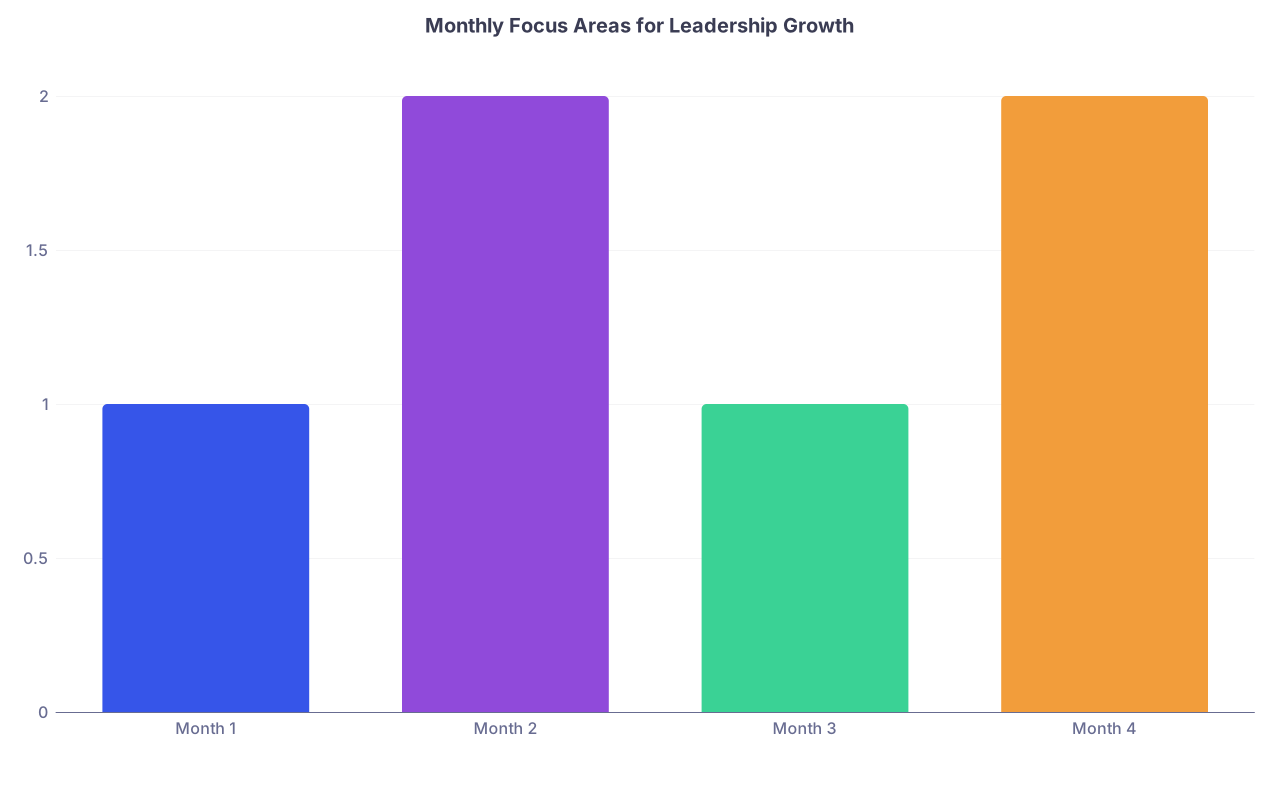
| Category | Value |
|---|---|
| Month 1 | 1 |
| Month 2 | 2 |
| Month 3 | 1 |
| Month 4 | 2 |
Example cycle:
Month 1 focus: Start-of-day structure
- Action: 2-minute huddle every morning, written plan on the list
- Metric: Does the intern still feel “lost” by noon? Ask them twice a week.
Month 2 focus: Running family meetings
- Action: Volunteer to lead at least 1 meeting per week
- Metric: After each one, ask the attending or nurse, “Did that feel organized? What was missing?”
Do that for 6–12 months and you won’t recognize yourself.
Concrete Things Great Leaders Do on Different Rotations
Leadership looks different on ICU vs clinic vs nights, but the growth pattern is the same: clarity, ownership, and care for the team.
On ICU
You improve by:
- Running structured check-ins: “Overnight events, vent changes, pressor changes, procedure plans. Same order every day.”
- Delegating procedure prep so you’re not personally running around for ultrasound gel and consent forms.
- Being the person who says out loud: “We’re going to step back for 30 seconds—what are we missing?”
A PGY-2 I worked with transformed their leadership in one ICU month by forcing themselves to summarize at the end of rounds: “Three key patients to watch this afternoon: 8A for pressor wean, 10B for CT results, 11C for extubation readiness. Intern A owns 8A, intern B owns 10B, I’ll handle 11C.”
That took 45 seconds. It changed how the entire team moved.
On Wards
Wards leadership is about flow and morale.
Residents who get better each month:
- Start the morning with a plan for discharges and high-yield patients.
- Protect the intern from silly tasks when they’re drowning (“I’ll write that note, you go see the new admit”).
- Make themselves predictable: they round in the same order, follow a similar structure, don’t disappear without saying where they’re going.
Predictability is leadership. Chaos from the senior equals chaos for everyone.
On Nights
Nights is where your “ownership” muscles get huge—if you let them.
You grow by:
- Running sign-out well: “Sickest patients we’re watching, likely overnight events, clear ‘don’t call unless’ parameters.”
- Stating your threshold for escalation: nurses feel safer and trust you more when they know.
- After a mess (delayed response, near miss), doing a solo debrief: “What should I have noticed earlier? Who should I have looped in?”
You’ll see some seniors shrug off close calls as “just nights things.” The ones who grow don’t. They quietly fix their own processes.
The Uncomfortable Part: Feedback and Conflict
If you avoid conflict, your leadership stalls. Period.
Leaders get noticeably better month to month because they:
- Ask for real feedback, not vague praise.
- Tolerate discomfort when giving feedback.
- Stop blaming “the system” for everything and start fixing what they can.

A simple script that accelerates growth:
Once a week, tell your attending or senior:
“I’m trying to get better at leading the team. What is one thing I’m doing that’s helping, and one thing I’m doing that is holding the team back?”
You will hear things you do not want to hear:
- “You disappear into the computer and we lose track of you.”
- “You sound uncertain even when you’re right; no one knows what the plan is.”
- “You take everything on yourself and then miss deadlines.”
Write those down. Build next month’s “experiment” around them.
On the flip side, when someone on your team is underperforming, leadership means you address it:
“Hey, I’ve noticed sign-outs from you are missing contingency plans and it’s creating problems overnight. Tomorrow, I want you to structure it like: ‘If X happens, do Y.’ I’ll listen to your first one and we’ll refine it.”
Is that comfortable? No. Does it dramatically grow your leadership muscles over a few months? Yes.
How Systems-Level Thinking Starts to Show Up
Another big jump in leadership is when you stop accepting every broken workflow as “just how it is.”
Residents who grow fast start to:
- Keep a running list: “Things that repeatedly waste our time or hurt patient care.”
- Fix small ones themselves (standardized sign-out template, shared phrases in discharge instructions).
- Escalate bigger ones with a proposed solution (“Our consult paging is a mess; can we pilot a single shared list for 1 month?”).
| Problem | Resident Action |
|---|---|
| Messy sign-out | Created standard template |
| Delayed STAT labs | Standard phrase added to orders |
| Lost consult pages | Shared team contact list |
| Inconsistent discharge teaching | One-page checklist per service |
| Repeated paging for same question | FAQ reply saved in text expander |
You don’t need a QI grant. You need an index card and the willingness to fix one thing per month.
How to Structure Your Own Month-to-Month Leadership Growth
You can be intentional about this instead of hoping “experience” does it for you.
Here’s a simple process:

| Step | Description |
|---|---|
| Step 1 | Pick 1 leadership focus |
| Step 2 | Define 1-2 daily actions |
| Step 3 | Ask for specific feedback weekly |
| Step 4 | Adjust approach mid month |
| Step 5 | End of month 10 min reflection |
| Step 6 | Choose next month focus |
Step-by-step:
Pick one focus for the month
Examples:- Running rapid responses with clear communication
- Giving your intern structure at the start of the day
- Leading one family meeting per week
Define 1–2 actions you will do daily or weekly
Keep them tiny and concrete:- “I will hold a 2-minute huddle every morning.”
- “After each family meeting, I will ask the attending: ‘What’s one thing I could do better next time?’”
Ask for feedback at least once a week
To attending, senior, intern, or nurse. Same question every time. Track answers.Reflect for 10 minutes at the end of the month
Not a novel. Just:- What changed?
- What still feels weak?
- What will I focus on next month?
Most residents never do this. If you do, you will quietly lap people.
What Improvement Actually Feels Like
You won’t feel like a “leader.” You’ll notice things like:
- Pages feel less chaotic because your team knows the plan.
- Nurses start calling you first because you’re predictable and decisive.
- Your interns start saying, “I feel safe working with you.”
- Attendings let you run more of rounds and step back.

That’s what month-to-month leadership growth looks like. It’s not sexy. It’s small, repeated, slightly uncomfortable actions.
One Thing You Can Do Today
Before your next shift, grab a scrap of paper or open your notes app and write:
“Leadership focus for this month: _________”
Under it, write two concrete behaviors you’ll do every day or every shift that support that focus.
Example:
“Leadership focus for this month: clearer daily plan for my team.
Behaviors:
- 2-minute morning huddle with priorities written on the list.
- End-of-day 1-minute check-in: what worked, what was rough, 1 thing we’ll change tomorrow.”
That’s it. Bring that with you tomorrow. Do it once. Then again the next day.
You’ll be surprised how quickly people start treating you like the leader you’re deliberately becoming.


